Japan is home to countless folktales, but not all of them end with a heartwarming “happily ever after.” Sometimes, these stories serve as dark moral warnings passed down through generations, depicting the terrifying consequences of human karma and uncontrollable emotions. Today, we introduce “Hitomoshi Yama” (The Mountain Where Fire is Lit), a traditional folktale from the Lake Suwa region in Nagano Prefecture. It is a tragic story brought about by a love that was simply too intense.
1. The Story of “Hitomoshi Yama”
Long ago, in a village on the eastern shore of Lake Suwa in Shinano Province (modern-day Nagano Prefecture), there lived an incredibly passionate young woman named Onami. Onami was deeply in love with a young man, and the two had promised their futures to each other.
However, one day, due to unavoidable circumstances, the young man had to move to a village on the opposite side of the lake. Devastated by the prospect of being separated from her beloved, Onami fell into deep despair. To comfort her, the young man made a promise: “Every night, I will light a fire on the mountain by the lake. When you see that fire, know that my heart is with you.”
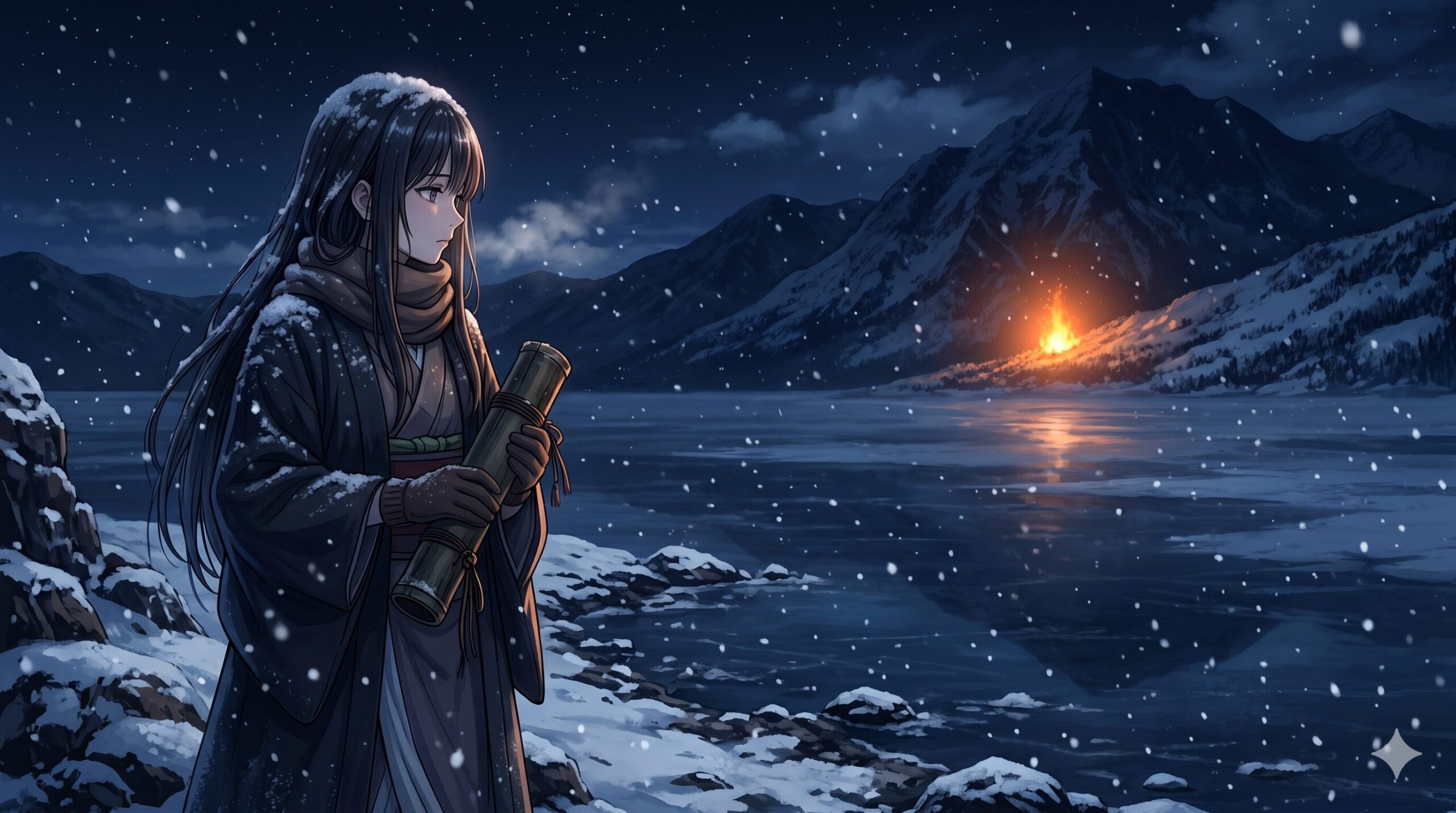
From the very first night he moved, the young man kept his promise and lit the fire. Onami watched the flames from the opposite shore, but her burning love and the overwhelming urge to see him became impossible to suppress. Using the fire as her guide in the dark night, she began to run toward him.
She sprinted along the perimeter of the lake, carrying a bamboo tube filled with cold sake for him to drink. Miraculously, by the time she reached him, steam was rising from the bamboo tube. The cold sake had become piping hot, just like “Atsukan” (heated Japanese sake). Onami smiled and told him, “My heart was burning so fiercely with the desire to see you quickly, that the heat of my passion warmed this sake.”
But her obsession did not stop there. Realizing that swimming across the lake in a straight line would be much faster than running around it, Onami began plunging into the freezing waters of Lake Suwa in the dead of winter, guided only by the young man’s fire. One night, she emerged from the freezing water holding a live fish she had caught with her bare hands while swimming in the dark.
At first, the young man was deeply moved by her devotion. But gradually, a cold chill crept down his spine. Seeing her emerge from the pitch-black, freezing lake in the middle of winter, clutching a live fish, made her look less like a human woman and more like a terrifying, supernatural monster possessed by obsession. Eventually, his awe turned into pure terror. He became frightened of Onami’s very existence and decided he had to escape her.
One night, amidst a heavy snowstorm, Onami plunged into the pitch-black lake as usual, trusting that the young man would eventually light the fire to guide her. But that night, the fire was never lit. Having lost her only beacon, Onami wandered blindly in the freezing waters of Lake Suwa and was never seen again.
A short time later, a rumor drifted back to Onami’s village on the wind. The young man on the opposite shore had been struck down by a mysterious, severe fever. Consumed by the unnatural heat, he had died.
2. Analysis: The Transformation from Pure Love to Psychological Horror
“Hitomoshi Yama” begins as a romantic tale of long-distance love but rapidly devolves into a gripping psychological horror. The true terror of this story lies in the fact that there are no ghosts or demons at the beginning; it is humanly pure affection, pushed to its absolute extreme, that transforms a person into an anomaly.
From the young man’s perspective, the fear is deeply realistic. A woman swimming across a freezing lake in winter, carrying sake heated entirely by her own body temperature and emotional passion, defies the laws of physics. It is completely understandable that he viewed her as “something other than human” and rejected her out of survival instinct. However, his decision to abandon her (by not lighting the fire) resulted in his own death by a mysterious high fever. This poetic justice strongly implies that Onami’s “burning passion” transformed into a deadly curse that literally burned him to death from the inside out.
3. Cultural Connection: The Heat of Passion and the Roots of “Yandere”
In traditional Japanese ghost stories (Kaidan) and folklore, the “intense passion of a woman” frequently warps the laws of nature and triggers physical phenomena. A famous example found in Kabuki and Noh theater is the legend of “Anchin and Kiyohime.” Betrayed by the monk she loved, Kiyohime’s sheer grief and rage transform her into a massive fire-breathing serpent, ultimately incinerating the man alive. Onami’s ability to heat cold sake through her intense emotions in “Hitomoshi Yama” is the exact same culturally specific trope: the visualization of raw, destructive passion.
In modern Japanese anime and manga culture, there is a popular character archetype known as “Yandere” (a portmanteau of ‘yanderu’ meaning sick, and ‘deredere’ meaning lovestruck). A Yandere is someone whose intense romantic love leads them to mental instability and extreme, often terrifying actions. Onami’s behavior can easily be seen as the historical blueprint for the Yandere archetype. Her madness, attempting to prove her love through grueling self-sacrifice (swimming in a frozen lake), is a trope that has survived through the centuries and continues to thrive in modern pop culture.
Furthermore, the setting of Lake Suwa is geographically significant. In deep winter, the lake completely freezes over, and the shifting ice creates massive, jagged ridges known as “Omiwatari” (The God’s Crossing). According to local Shinto myth, this phenomenon is the trail left by a male god walking across the ice to visit a goddess on the opposite shore. “Hitomoshi Yama” serves as a dark, mortal contrast to this grand, divine romance, painting a grim picture of human tragedy against the harsh backdrop of Suwa’s winter.
4. How Would You Face Such Obsession?
Where exactly is the line between deep love and terrifying obsession? The young man in “Hitomoshi Yama” grew terrified of Onami’s overwhelming affection and made the cruel decision to extinguish her guiding light. As a result, she sank to the bottom of a freezing lake, and he perished from a mysterious fever.
If you were in the young man’s shoes, what would you have done? Could you open your arms to accept a lover who swims across a frozen, pitch-black lake just to see you? Or would you, like him, feel a deep primal fear and run away? How should we react when love becomes too heavy to bear? This ancient Japanese folktale continues to ask us sharp, uncomfortable questions even today. We would love to hear your thoughts.
Related Links:
- Reference: Manga Nippon Mukashibanashi Database – Hitomoshi Yama (Japanese)
- Read more articles in our Japanese Folktale Series
日本昔話「火ともし山」:情念が引き起こす愛と恐怖の物語
日本には数多くの昔話が存在しますが、そのすべてが心温まるハッピーエンドを迎えるわけではありません。時に人間の深い業や、制御しきれない感情が生み出す恐ろしい結果を、後世への教訓として残す物語があります。今回ご紹介する「火ともし山(ひともしやま)」は、長野県の諏訪湖周辺に伝わる、あまりにも強すぎる愛が招いた悲劇の物語です。
① 昔話「火ともし山」のストーリー
むかしむかし、信濃国(現在の長野県)にある諏訪湖の東側の村に、「おなみ」という大変情熱的な娘が住んでいました。おなみには、将来を誓い合った一人の若者がおり、二人は深く愛し合っていました。
ところがある日、若者はやむを得ない事情により、諏訪湖を挟んだ対岸の村へ引っ越さなければならなくなりました。愛する人と離れ離れになることに、おなみは深く絶望し、悲しみに暮れます。そんな彼女を慰めるため、若者は一つの約束を交わしました。「毎晩、湖のほとりにある山に火をともそう。その火を見て、お互いの心を通わせよう」と。
若者は新しい村に移り住んだその日の夜から、約束通り山に火をともし始めました。対岸からその火を見つめていたおなみでしたが、次第に燃え上がるような恋心と「会いたい」という衝動を抑えきれなくなります。彼女は火を目印にして、夜の暗闇の中、若者の元へと走り出しました。
おなみは道中、若者に飲ませるために酒を入れた竹の筒を抱えて、湖のほとりを全力で駆け抜けました。若者の元へたどり着いたとき、不思議なことが起きていました。竹の筒に入っていた冷たい酒から湯気が立ち上り、まるで熱燗のように温まっていたのです。おなみは「あなたに早く会いたいと胸を焦がす思いが、このお酒を温めたのです」と微笑みました。
しかし、彼女の執着はそれだけでは留まりませんでした。湖を迂回して走るよりも、直線距離で向かった方が早いと考えたおなみは、凍えるような真冬の夜であっても、若者がともす火を頼りに、冷たい湖を泳いで渡るようになったのです。ある夜など、湖から上がったおなみの手には、泳いでいる最中に捕まえた生きた魚が握られていました。
若者は、最初は彼女の深い愛情に感動していたものの、次第にその異常な執念に対して背筋が凍るような恐怖を抱くようになります。真冬の湖を泳ぎ切り、生きた魚を握りしめて暗闇から現れる彼女の姿は、もはや人間の女性というよりも、何かに取り憑かれた恐ろしい魔物のようでした。ついに若者は、おなみの存在そのものが恐ろしくなり、彼女から逃れることを決意します。
雪が激しく降りしきるある夜。少しでも早く若者に会いたいおなみは、いつものように「途中で火がともされるだろう」と信じて、真っ暗な湖へと飛び込みました。しかしその晩、若者が山に火をともすことは決してありませんでした。目印を失ったおなみは、凍てつく冬の諏訪湖の中を彷徨い、そのまま二度と姿を現すことはありませんでした。
その後、風の便りでおなみの村に一つの噂が届きます。対岸に引っ越したあの若者が、原因不明の高熱にうなされ、謎の熱病で命を落としたというのです。
② 昔話の考察:純愛から心理ホラーへの変貌
「火ともし山」は、前半は遠距離恋愛のロマンチックな純愛物語として始まりますが、後半にかけて一気にサイコロジカル・ホラーへと姿を変えます。この物語の最大の魅力であり恐ろしさは、「怪物や幽霊が最初から存在するのではなく、人間の純粋な愛情が極限まで達した結果、怪異へと変貌してしまう」という点にあります。
若者の視点に立てば、この恐怖は非常に現実的です。愛する女性が、自分のために真冬の湖を泳いで渡ってくる。手には生きた魚を握りしめ、抱えた酒は自身の体温と情念だけで熱燗に変わっている。これは物理法則を無視した執念の現れであり、若者が彼女を「人間ではない何か」として恐怖し、拒絶したのも無理はありません。しかし、その恐怖から彼女を見殺しにした(火をともさなかった)結果、若者自身も高熱で死ぬという結末は、おなみの「胸を焦がすほどの情念」が呪いとなって彼を焼き尽くしたことを示唆しています。
③ 日本文化との関連:情念の熱と「ヤンデレ」の系譜
日本の伝統的な怪談や昔話において、「強すぎる女性の情念」はしばしば自然界の法則を歪め、物理的な現象を引き起こします。歌舞伎や能でも有名な「安珍・清姫伝説」では、愛する僧侶に裏切られた清姫が、怒りと悲しみのあまり巨大な蛇(龍)に姿を変え、口から火を吹いて男を焼き殺します。「火ともし山」におけるおなみの「酒を温めるほどの体熱」も、これと全く同じ日本特有の「情念の可視化」です。
現代の日本のアニメやマンガの文化には、愛するがゆえに精神を病み、過激な行動に走るキャラクターを指す「ヤンデレ」という言葉があります。おなみの行動は、まさにこの「ヤンデレ」の元祖とも言えるものです。自己犠牲を伴う過酷な行動(冬の湖を泳ぐ)で愛情を証明しようとする狂気は、時代を超えて現代のポップカルチャーにも脈々と受け継がれています。
また、舞台となる諏訪湖は、冬になると湖面が完全に凍結し、氷が山脈のようにせり上がる「御神渡り(おみわたり)」という自然現象が起こることで有名です。これは諏訪大社の男神が対岸の女神の元へ通った跡だと伝説では語られています。「火ともし山」は、この神々の壮大な逢瀬の伝説とは対照的な、人間の男女のドロドロとした悲劇として、諏訪の厳しい冬の自然を背景に見事に描かれています。
④ あなたなら、この執着にどう向き合いますか?
愛と執着の境界線は、一体どこにあるのでしょうか。「火ともし山」の若者は、おなみの強すぎる愛に恐怖し、最後は火をともさないという冷酷な決断を下しました。その結果、彼女は冷たい湖の底に沈み、彼自身も謎の熱病で命を落としました。
もし、あなたがこの若者の立場だったら、どうしていたでしょうか?真冬の湖を泳いでまで自分に会いに来る恋人を、両手を広げて受け入れることができますか?それとも、若者と同じように恐怖を抱き、逃げ出してしまいますか?愛が重すぎる時、人はどう振る舞うべきなのか。この日本の古い昔話は、現代に生きる私たちにも鋭い問いを投げかけています。ぜひ、あなたの考えを教えてください。
関連リンク:
コメント