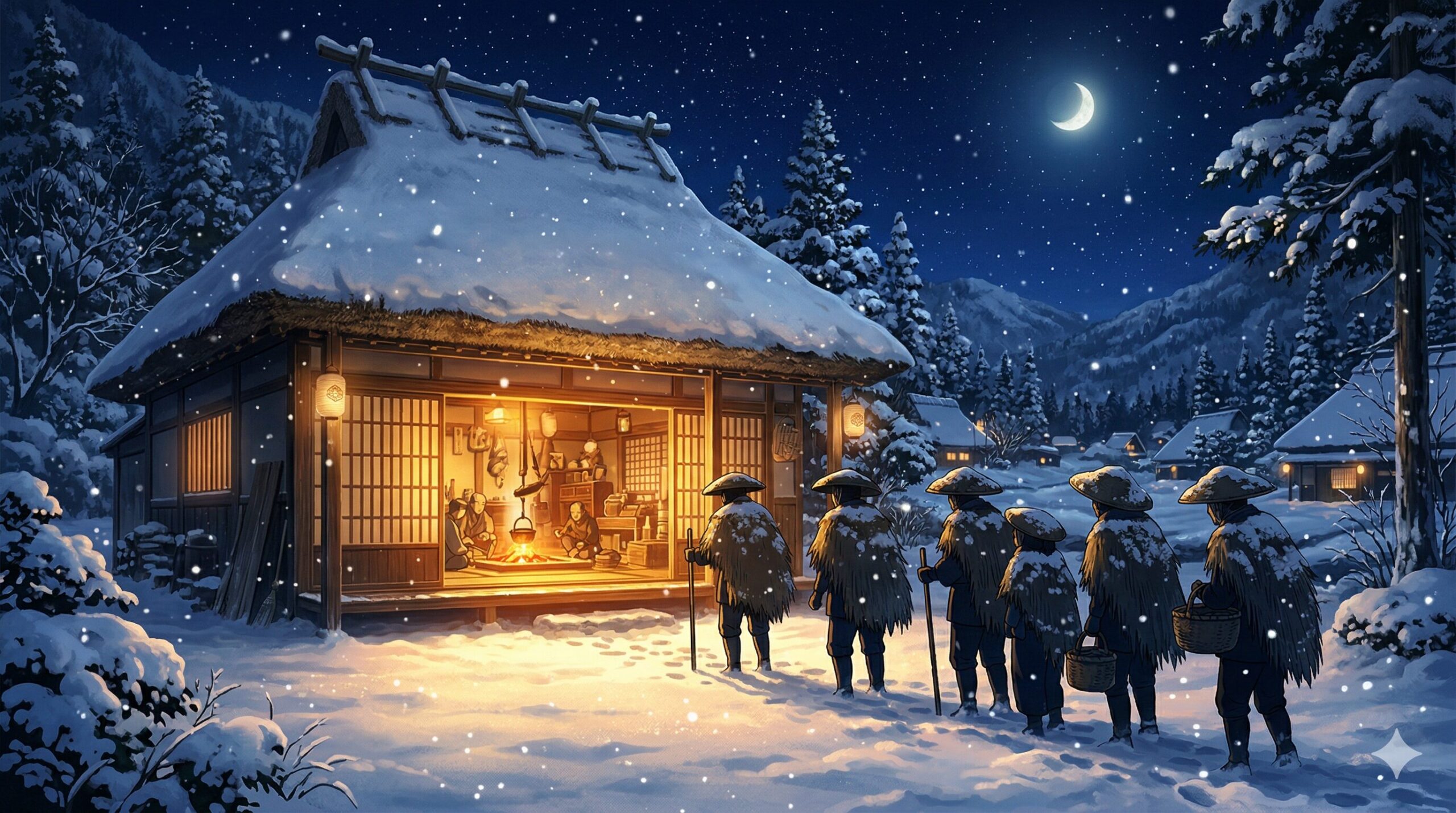
On a cold, snowy New Year’s Eve in Japan, unseen and mysterious guests might be wandering through towns and villages. Since ancient times, Japan has had a custom of welcoming gods and spirits who visit on the final day of the year. The Japanese folktale we are introducing today, “Ootoshi no Kyaku” (The New Year’s Eve Guests), is a heartwarming yet profound story that takes place on just such a night, piercing the very essence of human nature.
The Story of “Ootoshi no Kyaku”
Once upon a time, an old woman lived alone by a small stream on the outskirts of a village. She made her living by cultivating a tiny rice paddy in front of her house. Unfortunately, the weather that year was unkind, and she managed to harvest only a meager two measures of rice.
As winter deepened and “Ootoshi” (New Year’s Eve) arrived, the old woman decided to visit her landlord to pay her year-end respects. She packed one measure of her precious rice into a bag and walked downstream to the landlord’s grand mansion.
Upon arriving, she saw the magnificent parlor piled high with luxurious year-end gifts from other tenant farmers. The old woman bowed deeply, expressed her gratitude, and offered her small bag of rice. However, the greedy and arrogant landlord sneered at her meager offering. “What is this? Just a handful of rice grains? Toss this to the chickens as feed!” he scoffed, and to her dismay, he scattered her precious rice in the garden. With a heavy heart, the old woman trudged back to her dilapidated shack through the falling snow.
As night fell, the snow turned into a fierce blizzard. Just as the old woman was preparing to welcome the New Year quietly alone, there was a knock at the door. When she opened it, she found seven travelers in shabby, snow-covered clothes standing there. “We apologize for the sudden intrusion. We are stranded in this terrible snowstorm. Could you please spare us a night’s lodging?” they pleaded.
Without a single look of annoyance, the old woman kindly welcomed them in. “If you don’t mind this humble place, please come inside.” She built a warm fire in the hearth and cooked her last remaining measure of rice to feed them. The old woman herself went without eating, gave the travelers her warm room, and lay down to sleep in the drafty, freezing storage shed.
Dawn broke, bringing New Year’s Day. When the old woman entered the main house to start her morning chores, she was astonished to find the room bathed in a dazzling light. She opened the sliding paper doors to find that the travelers from the night before were gone. In their place stood seven magnificent statues of the “Shichi-fuku-jin” (The Seven Lucky Gods), all made of pure, glowing gold. The shabby travelers had actually been the gods of fortune. From then on, the old woman’s fields yielded abundant crops, and she lived happily as a very wealthy woman.
However, there was another side to this New Year’s Eve story. For many years, seven “Binbou-gami” (Gods of Poverty) had been secretly living in the old woman’s shack. When the Seven Lucky Gods arrived that night, the house became deeply uncomfortable for them. The Gods of Poverty quietly slipped out, boarded a battered boat, and rowed downstream. Their destination? The grand mansion of that greedy landlord. Needless to say, what happened to the landlord’s estate afterward requires no explanation.
Folktale Analysis: The Folly of Judging by Appearances
This tale carries a depth far beyond a simple moral story of “rewards for the good and punishment for the wicked.” The most striking aspect is that the gods chose to appear in the most wretched and miserable forms.
Surrounded by material wealth, the landlord had become insensitive to the pain of others and had forgotten the heart of gratitude. The old woman, on the other hand, never lost her altruistic spirit—her willingness to help others in need—even when she was on the verge of starvation herself. The gods borrowed the appearance of the most vulnerable to test the true value of human hearts. This story strongly reminds us today of the folly of judging people by their appearance or social status, and that a compassionate heart is the greatest wealth of all.
Connection to Japanese Culture: Toshigami and Omotenashi
The backdrop of “Ootoshi no Kyaku” heavily reflects traditional Japanese beliefs and culture. In Japan, there is an ancient belief that from New Year’s Eve to New Year’s Day, deities known as “Toshigami-sama” (New Year Gods) descend from high mountains to visit every household, bringing bountiful harvests and happiness for the coming year. Customs such as setting up Kadomatsu (pine decorations), displaying Kagami Mochi (round rice cakes), and doing a thorough year-end cleaning are all preparations to welcome Toshigami-sama into a purified space.
Furthermore, the “Shichi-fuku-jin” (Seven Lucky Gods) featured in the story represent a unique Japanese blend of deities originating from India, China, and Japan. The depiction of them swapping places with the Gods of Poverty encompasses the Buddhist teaching that one’s destiny can change dramatically based on one’s own actions (Karma).
Above all, the old woman’s actions represent the ultimate form of “Omotenashi” (Japanese hospitality). It is the spirit of welcoming guests by offering everything one has, without expecting anything in return. This remains one of the most cherished and beautiful virtues in modern Japanese society.
If you wish to explore more profound meanings behind Japanese folktales, please check out other articles in our Japanese Folktale Series.
For more information about the original source of this story, you can verify it at the Japanese Folktale Database.
What Would You Do?
How did this story make you feel? Imagine if you were in the old woman’s shoes—with barely enough food left for yourself, shivering strangers knock on your door seeking shelter from a deadly winter storm. Would you be able to offer them your warm bed and your last meal? Please share your thoughts, and let us know if there are similar teachings in your own culture!
大晦日の夜に訪れた不思議な客たち:「大年の客」から学ぶ日本の心
日本の大晦日、冷たい雪が舞い散る夜には、目に見えない不思議な客人たちが町や村を歩き回っているかもしれません。日本には古くから、一年の最後の日に訪れる神様や精霊をもてなす風習があります。今回ご紹介する日本の昔話「大年の客(おおとしのきゃく)」は、まさにそんな大晦日の夜に起きた、心温まると同時に人間の本質を突く不思議な物語です。
「大年の客」の物語
むかしむかし、ある村のはずれの小川のほとりに、一人のお婆さんが住んでいました。お婆さんは家の前の小さな田んぼを一人で耕して暮らしていましたが、その年は天候に恵まれず、たった二升ばかりの米しか収穫できませんでした。
やがて冬が深まり、その年の最後の日である「大年(大晦日)」がやってきました。お婆さんは、田んぼを借りている地主のところへ年末の挨拶に行くことにしました。なけなしの米の中から一升を袋に詰め、川下の地主の大きなお屋敷へと向かいます。
地主の屋敷に着くと、立派な座敷には小作人たちから届けられた歳暮の品々が山のように積まれていました。お婆さんは深く頭を下げて地主にお礼を述べ、持ってきた一升の米を差し出しました。しかし、強欲で傲慢な地主は、その少なさを鼻で笑いました。「なんじゃ、たったこれっぽっちの米粒か。こんなもの、鶏の餌にでもしてしまえ」と言い放ち、あろうことかお婆さんの米を庭に撒いてしまったのです。悲しい気持ちを胸に抱え、お婆さんは雪の降る中をとぼとぼと自分のあばら家へ帰っていきました。
夜になり、雪は激しい吹雪に変わりました。お婆さんが一人で静かに新年を迎えようとしていた時、家の戸を叩く音がしました。戸を開けると、そこには雪にまみれたみすぼらしい身なりの七人の旅人が立っていました。「突然申し訳ない。ひどい雪で難儀しておる。どうか一晩、宿を貸してはくださらんか」と旅人たちは頼みます。
お婆さんは嫌な顔一つせず、「こんなむさ苦しい所でよければ、どうぞお入りくだされ」と快く彼らを迎え入れました。そして、いろりに火を焚いて彼らを温め、残っていた一升の米で温かいご飯を炊いて振る舞いました。お婆さん自身は食べるものを我慢し、旅人たちに暖かい部屋を譲ると、自分は隙間風の吹く冷たい物置小屋で横になりました。
こうして夜が明け、元日の朝を迎えました。お婆さんが朝の支度をしようと家の中に入ると、不思議なことに部屋の中がまばゆい光に包まれています。驚いて障子を開けると、そこには昨夜の旅人たちの姿はなく、代わりに純金でできた立派な「七福神」の像が七体、光り輝いて並んでいたのです。みすぼらしい旅人の正体は、福をもたらす七福神だったのです。それ以来、お婆さんの畑は豊作続きとなり、瞬く間に大金持ちになって幸せに暮らしました。
ところで、この大晦日の夜にはもう一つの物語がありました。実はお婆さんのあばら家には、長年「七人の貧乏神」が住み着いていたのです。しかし、大晦日の夜に七福神がやってきたため、家の中が居心地悪くなってしまいました。貧乏神たちはこっそりと家を抜け出し、ボロ船に乗って川を下っていきました。彼らが目指したのは、あの強欲な地主の大きなお屋敷でした。その後、地主の家がどうなったかは、言うまでもありません。
昔話の深い考察:外見で人を判断することの愚かさ
この物語は、単なる「善人への報酬と悪人への罰」を描いた勧善懲悪のストーリー以上の深みを持っています。最も注目すべき点は、「神様が最もみすぼらしい姿で現れた」という事実です。
地主は物質的な豊かさに囲まれながらも、他者の痛みに鈍感になり、感謝の心を忘れていました。一方でお婆さんは、自分自身が明日食べるものに困るような極限状態にあっても、困っている他者を助ける「利他の心」を失っていませんでした。神様は、人間の真の価値を試すために、あえて最も助けを必要とする弱者の姿を借りて現れたのです。この物語は、外見や社会的地位で人を判断することの愚かさと、思いやりの心こそが最大の財産であることを現代の私たちに強く訴えかけています。
日本文化との関連性:歳神様とおもてなしの心
この「大年の客」の背景には、日本の伝統的な信仰と文化が色濃く反映されています。日本には古くから、大晦日の夜から元日にかけて「歳神様(としがみさま)」と呼ばれる神様が、各家庭に新年の豊作や幸福をもたらすために高い山から降りてくるという信仰があります。門松を立てたり、鏡餅を飾ったり、大掃除をするのも、すべてこの歳神様を清らかな状態でお迎えするための準備なのです。
また、物語に登場する「七福神」は、恵比寿、大黒天、毘沙門天、弁財天、布袋尊、福禄寿、寿老人という、インド、中国、日本の神々が混ざり合って生まれた日本独自の信仰の形です。彼らが貧乏神と入れ替わるという描写は、運命は自分自身の行い(カルマ)によって劇的に変わるという仏教的な教えも内包しています。
そして何より、お婆さんの行動は、日本の「おもてなし」の精神の究極の形と言えます。見返りを求めず、自分の持てるすべてを尽くして客人を迎える心。それは現代の日本社会においても、最も美しい美徳の一つとして大切にされています。
もっと日本の昔話を読み解きたい方は、ぜひ当ブログのJapanese Folktale Seriesのカテゴリーから他の記事もご覧ください。
また、今回参考にした物語の原典に関する情報は、日本の昔話データベースにて確認することができます。
あなたなら、どうしますか?
この物語を読んで、あなたはどのように感じましたか? もしあなたがこのお婆さんと同じように、自分が食べるものさえ残りわずかな状況で、見知らぬみすぼらしい旅人が寒さに震えて助けを求めてきたとしたら……。あなたは自分の部屋と最後の食事を彼らに差し出すことができるでしょうか? ぜひ、あなたの考えや文化における似たような教えがあれば教えてください。

コメント