A Mysterious and Tragic Weaving Tale from the Mountains of Hiroshima
Long, long ago, in a deep and rugged mountain pass called Mitagadao in the Aki District of Hiroshima Prefecture, there stood a single, old, dilapidated house. An old woman lived there all alone, spending her days quietly weaving cloth on her loom. Clack, clack, thud. The rhythmic sound of her weaving echoed through the mountain pass, harmonizing with the winds of the changing seasons.
One scorching summer day, a traveling Buddhist monk passed by. Sweating profusely and visibly exhausted, he called out to the old woman. “Excuse me, but I am parched and feel as though I might collapse. Could I trouble you for a single cup of water?”
Without a hint of annoyance, the old woman kindly replied, “You must be terribly tired. Please wait right here.” She took the trouble to walk down to the cold mountain stream behind her house, drew crystal-clear, refreshing water, and handed it to the monk. After quenching his thirst, the monk was deeply moved by the old woman’s selfless kindness and hospitality.
To show his gratitude, the monk picked up the old woman’s kuda (a small hollow bamboo spool used to hold weaving thread). He began to softly chant a mysterious spell over it. When he finished, he looked directly into the old woman’s eyes and said, “Thank you for the delicious water, grandmother. From now on, thread will continuously flow from this spool without end. It will never run out. …However, you must make me one promise. You must never doubt this magic, and you must never look inside the spool to see how it works.”
With those parting words, the monk walked away into the intense summer heat, disappearing down the mountain path.
Half-doubting, the old woman resumed her weaving. To her absolute astonishment, the monk’s words were true. No matter how much she wove, no matter how much thread she pulled, the spool remained full. High-quality, beautiful thread flowed endlessly. Rumors of this magical, inexhaustible thread soon reached the ears of the village headman (Shoya), a man of great wealth and power.
“Use that endless thread to weave a magnificent kimono for me by the New Year,” the headman ordered. The old woman accepted the commission. Through the passing of autumn and the arrival of a bitter winter, she worked tirelessly at her loom every single day.
Finally, New Year’s Eve arrived. The headman’s kimono was almost completely finished. Letting out a long sigh of relief, a sudden thought crossed the old woman’s mind. “Still, how on earth does this spool keep producing thread? What kind of mechanism is hidden inside…?”
It was just a tiny spark of curiosity. Forgetting her solemn promise to the monk, the old woman peered into the hole of the spool and poked inside with a thin stick. But there was no special mechanism. It was just an empty piece of bamboo.
“What? It’s just a normal spool,” she thought. But the moment she tried to resume weaving, the blood drained from her face. The magical thread, which had been flowing endlessly just moments before, stopped completely. No matter how hard she pulled, not a single inch of thread came out.
“Oh no! At this rate, the headman’s kimono won’t be ready for New Year’s Day!”
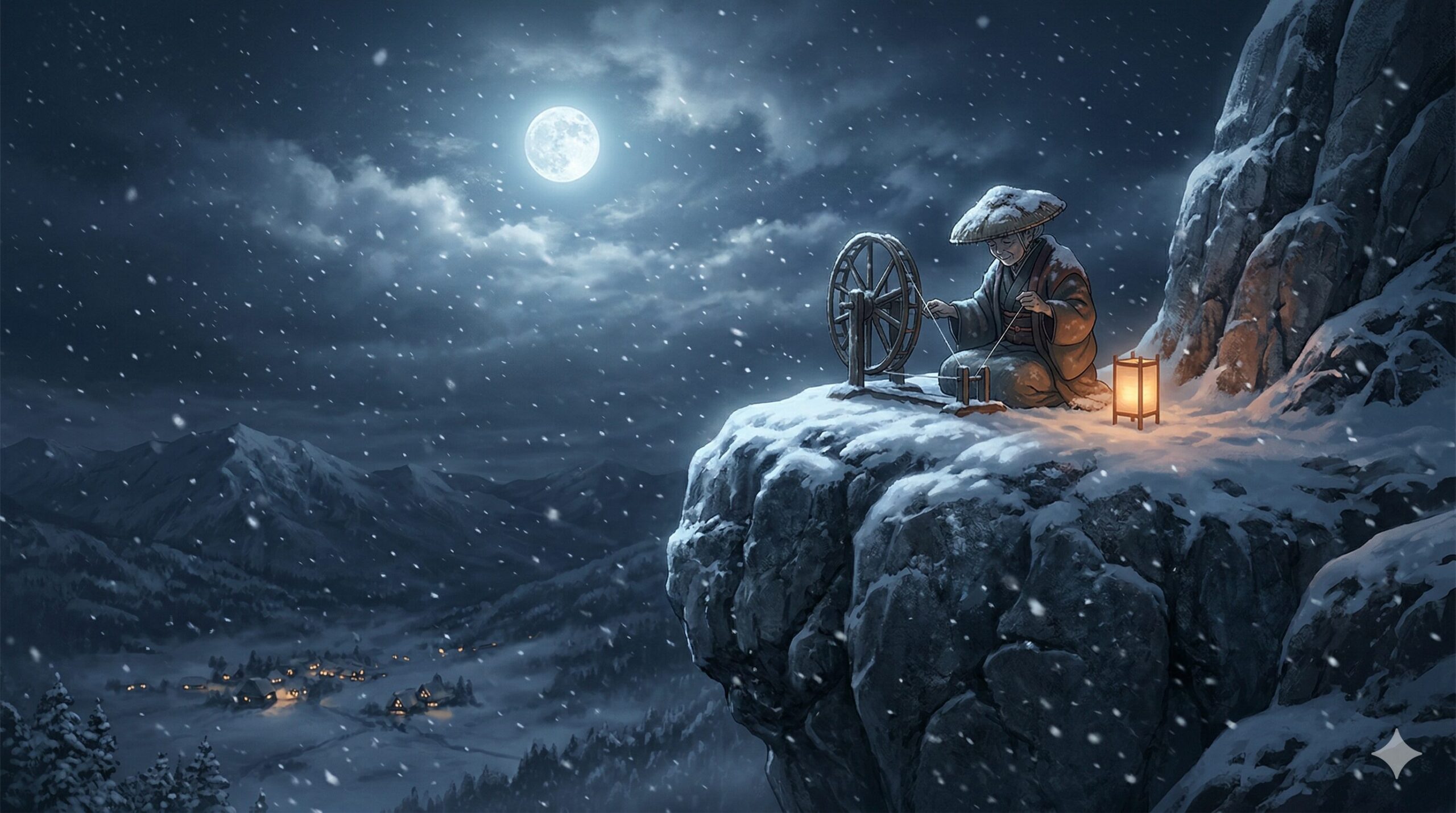
Thrown into a sheer panic, the old woman realized she had to spin the thread herself. Grabbing her wakukuri (a traditional thread-winding tool), she rushed out of her house. Outside, a fierce blizzard was raging. In the freezing, dark, snow-filled night, the desperate old woman sat upon a giant boulder and began to spin thread like a madwoman. Clatter, clatter, clatter.
Eventually, the night ended, and the morning of New Year’s Day dawned. The headman arrived at the old woman’s house to collect his kimono, but the house was empty. Confused, he searched outside and found a tragic scene. There, on top of the snow-covered boulder, sat the old woman. She had frozen to death in the bitter cold, her hands still tightly gripping the wakukuri.
Ever since that tragic night, every New Year’s Eve, the sad, echoing sound of a thread-winder—”kararin, kararin”—can be heard coming from that empty boulder. The villagers came to fear and respect the rock, naming it “Wakukuri Iwa” (The Thread-Winding Rock). Over time, young women of the village who wished to improve their weaving skills began to visit the rock, spinning thread upon it to comfort the old woman’s spirit and seek her blessing.
Analysis: Human Frailty and the Weight of a Promise
This story is not merely a tragedy or a ghost story; it is a piercing examination of the “frailty” hidden deep within human psychology. The old woman was not a greedy or evil person. She was a compassionate soul who willingly fetched cold water for a stranger. So why did she break her promise?
The answer lies in “the relaxation of tension after a long struggle” and “pure curiosity.” She had carried the heavy burden of the headman’s order right up to the deadline of New Year’s Eve. The moment she saw the finish line, her tension snapped. Humans are most vulnerable the moment they are released from extreme stress. It was in this gap that the curiosity of “Why?” slipped in. Much like the Greek myth of Pandora’s Box, this tragedy was brought about by an irresistible human desire to know.
Furthermore, the story illustrates the terrifying consequences of “loss of trust.” The magical thread existed solely because of the “trust” (the absence of doubt) between the monk and the old woman. The moment she tried to uncover the secret, the magic vanished. This serves as a powerful metaphor for human relationships today: if you constantly doubt others and try to forcefully uncover what is in their hearts, the beautiful bond (the thread) you have built can easily snap.
Connection to Japanese Culture: “The Taboo of Looking” and “Marebito”
The tale of “Wakukuri Iwa” hides two crucial elements of ancient Japanese culture and belief.
The first is the “Taboo of Looking” (Miruna no Taboo). In Japanese folktales and mythology, there is a recurring motif where tragedy strikes because a character breaks a promise “never to look.” We see this in “The Crane’s Return of a Favor” (looking into the weaving room), “Urashima Taro” (opening the forbidden box), and even in the Kojiki, Japan’s founding myth, where the god Izanagi looks upon his deceased wife Izanami in the underworld. This reflects a deep-rooted Japanese belief that hidden things possess sacred power, and forcefully exposing them is a sin that destroys natural order.
The second is the “Marebito (Sacred Guest) Belief”. In ancient Japan, it was believed that unknown travelers coming from afar or from the spirit world (marebito) were incarnations of gods or spirits who brought good fortune and wealth. The monk who appeared on that summer day was exactly this—a marebito. Because the old woman treated him with immense hospitality, she received the blessing of the magic thread. The roots of Omotenashi (traditional Japanese hospitality) can be traced back to this sense of awe and respect for sacred visitors.
What Would You Do? An Eternal Question
Imagine it is New Year’s Eve. You feel a wave of relief as your massive workload is finally nearing its end. Right in front of you is a magical tool that has helped you succeed, but it comes with one strict condition: “You must never look inside.”
If you were in this old woman’s shoes, could you suppress your curiosity and maintain absolute faith until the very end? Or would you succumb to the temptation, thinking, “Just a little peek won’t hurt”? A thread that is cut can never be perfectly restored. This folktale challenges us today to reflect on the delicate balance between trust and curiosity. What would you do? Please share your thoughts.
Reference Links
- Manga Nippon Mukashibanashi Database – Wakukuri Iwa (Japanese)
- Explore More: Japanese Folktale Series
わくくり岩 (Wakukuri Iwa):決して覗いてはいけなかった魔法の糸
広島の山奥で紡がれた、不思議で悲しい機織りの物語
むかしむかし、広島県の安芸郡にある三田峠(みたがだお)という険しい山道に、一軒の小さな古い家がありました。そこには、一人暮らしのお婆さんが住んでおり、毎日毎日、機(はた)を織って静かに暮らしていました。カタン、トン、カタン、トン。峠には、お婆さんの織る機織りの音が、季節の風とともに響き渡っていました。
ある厳しい暑さの夏の日。太陽が照りつける中、一人の旅のお坊さんが通りかかりました。お坊さんは汗だくで、疲労困憊の様子でした。「すみません、喉が渇いて倒れそうです。どうか、お水を一杯いただけないでしょうか」とお坊さんはお婆さんに尋ねました。
お婆さんは嫌な顔一つせず、「それはお疲れでしょう。少し待っていてくだされ」と言い、家の裏手にある冷たい谷川までわざわざ降りていき、澄み切った美味しい水を汲んで手渡しました。乾ききった喉を潤したお坊さんは、お婆さんの見返りを求めない優しさと親切な心に深く感動しました。
お坊さんはお礼を言うと、お婆さんが機織りの糸を巻いて入れておく「管(くだ)」という小さな道具を手に取りました。そして、何やらごにょごにょと不思議な呪文を唱え始めたのです。呪文を唱え終えると、お坊さんはお婆さんの目を見つめ、こう言いました。「お婆さん、美味しいお水をありがとう。これからは、この管からいつまでも尽きることなく糸が出続けます。決して糸が切れることはありません。……ただし、一つだけ約束してください。決してこの管の中がどうなっているのか、疑って覗いてはいけませんよ」
そう言い残すと、お坊さんは再び夏の強い日差しの中へと歩き去っていきました。
お婆さんが半信半疑で機織りを再開すると、お坊さんの言葉は本当でした。いくら織っても、いくら糸を引き出しても、管の中の糸は全く減る気配がありません。上質で美しい糸が無限に湧き出てくるのです。この魔法のような糸の噂は、やがて村の権力者である庄屋(しょうや)の耳にも届きました。
「その決して尽きることのない不思議な糸で、今年の正月までに私の立派な着物を織ってくれないか」庄屋はそうお婆さんに依頼しました。お婆さんは依頼を引き受け、秋が過ぎ、厳しい冬が訪れても、毎日休むことなく機を織り続けました。
そして、ついに大晦日の日を迎えました。庄屋の着物は、あとほんの少しで完璧に織り上がるところまで来ていました。ホッと一息ついたお婆さんの心に、ふと、ある考えがよぎりました。「それにしても、この管はどうしてこんなに糸が出続けるのだろう? 中には一体どんな仕掛けがあるのかしら……」
ほんの少しの好奇心でした。お婆さんはお坊さんとの約束を忘れ、管の穴を覗き込み、細い棒で中をつついてしまいました。しかし、中には何も特別な仕掛けはありませんでした。ただの空っぽの管だったのです。
「なんだ、ただの管じゃないか」そう思って機織りを再開しようとした瞬間、お婆さんの血の気が引きました。先ほどまで無限に湧き出ていた糸が、ピタリと止まってしまったのです。何度引き出そうとしても、二度と糸は出てきません。
「どうしよう、このままではお正月に庄屋様の着物が間に合わない!」
激しいパニックに陥ったお婆さんは、自分で糸を作らなければと、糸をつむぐための「わくくり(糸車のような道具)」を抱え、家の外へ飛び出しました。外は吹雪。凍えるような雪の降る暗闇の中で、お婆さんは大きな岩の上に座り込み、狂ったようにカラカラ、カラカラと糸をつむぎ始めました。
やがて夜が明け、新しい年、元旦の朝がやってきました。着物を受け取るために庄屋がお婆さんの家を訪れると、家の中には誰もいません。不思議に思って外を探すと、雪に覆われた大きな岩の上に、わくくりを固く握りしめたまま、カチコチに凍え死んでいるお婆さんの姿がありました。
それ以来、毎年大晦日の夜になると、誰もいないはずのその大岩から「カラリン、カラリン」と、悲しげなわくくりの音が響き渡るようになりました。村人たちはその岩を「わくくり岩」と呼んで恐れ、同時に敬いました。やがて、機織りの上達を願う村の娘たちが、お婆さんの魂を慰め、その技術にあやかろうと、この岩の上で糸をつむぐようになったと伝えられています。
「わくくり岩」の深い考察:人間の弱さと約束の重み
この物語は、単なる悲劇や怪談ではありません。人間の心理の奥底にある「弱さ」を鋭く突いた物語です。お婆さんは決して強欲な悪人ではありませんでした。見ず知らずの旅人に冷たい水を汲んであげる、思いやりを持った人物です。では、なぜ彼女は約束を破ってしまったのでしょうか。
それは「安心の後の気の緩み」と「純粋な好奇心」です。庄屋からの重圧ある仕事を大晦日という期限ギリギリまでこなし、ゴールが見えた瞬間に、緊張の糸が切れてしまったのです。人間は、極度の緊張から解放された瞬間、最も無防備になります。その隙間に入り込んだのが「なぜ?」という好奇心でした。ギリシャ神話の「パンドラの箱」にも通じる、人間の抗えない探求心が引き起こした悲劇と言えます。
また、この物語は「信頼の喪失」の恐ろしさも描いています。魔法の糸は、お坊さんとお婆さんの間の「信頼(疑わないこと)」によって成り立っていました。中身を暴こうとした瞬間、その魔法は消え失せました。これは現代の人間関係にも当てはまります。相手を疑い、無理に心の中を暴こうとすれば、それまで築き上げてきた美しい関係(糸)は簡単に途切れてしまうという教訓が含まれています。
日本文化との関連:「見るなのタブー」と「まれびと信仰」
「わくくり岩」には、日本古来の重要な文化と信仰が二つ隠されています。
一つ目は**「見るなのタブー(禁止モチーフ)」**です。日本の昔話や神話には、「決して見てはいけない」という約束を破ることで悲劇が起こるパターンが数多く存在します。「鶴の恩返し(機織り部屋を覗く)」「浦島太郎(玉手箱を開ける)」、さらに日本の建国神話である古事記においても、イザナギが黄泉の国で妻のイザナミの姿を見てしまうというエピソードがあります。日本文化において、「隠されているものには神聖な力が宿っており、それを暴くことは秩序を壊す罪である」という考え方が深く根付いていることがわかります。
二つ目は**「まれびと(客人)信仰」**です。古来の日本では、異界や遠方からやってくる見知らぬ旅人(まれびと)は、神仏の化身であり、幸運や富をもたらす存在だと信じられていました。夏の日に現れたお坊さんは、まさに「まれびと」です。お婆さんが彼を手厚くもてなしたことで、魔法の糸という恩恵(恩送り)を受けました。日本のおもてなし文化のルーツは、このような神聖な訪問者への畏敬の念から来ていると言えます。
あなたならどうしますか? 永遠の問いかけ
大晦日の夜、あと少しで仕事が終わるという安堵の瞬間。目の前には、不思議な力で自分を助けてくれた魔法の道具があります。ただ、「絶対に覗いてはいけない」という制約付きで。
もしあなたがこのお婆さんの立場だったら、最後まで一切の疑いを持たず、好奇心を抑え込むことができたでしょうか? それとも、「ちょっとだけなら」と誘惑に負けて覗いてしまったでしょうか? 一度途切れてしまった糸は、二度と元には戻りません。この物語は、現代に生きる私たちにも、信頼と好奇心のバランスについて深く問いかけています。ぜひ、あなたの考えを聞かせてください。
コメント