The Chilling and Sorrowful Tale of Michibiki Jizo
Long ago, in a quiet fishing village in Kesennuma, Miyagi Prefecture, there lived a mother and her young son, Hamakichi. One evening, after a long day of fishing, the mother took her son by the hand and hurried home, carrying their catch. It was already growing dark, and the only sound was the gentle crashing of the waves.
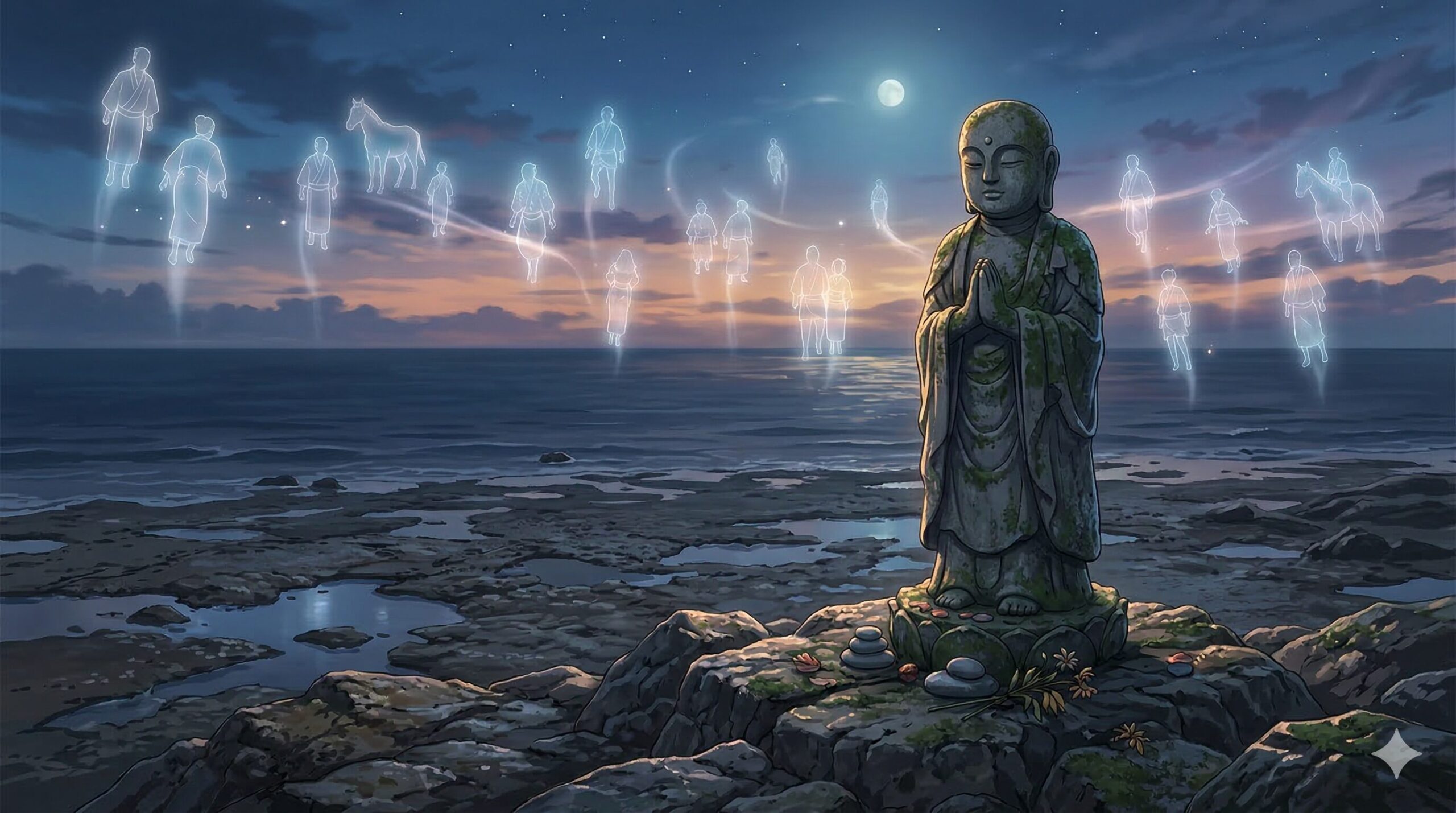
Along the way, Hamakichi grew exhausted and almost fell asleep while walking, so the mother stopped to wake him. As she looked up, she saw an ancient stone statue known as the “Michibiki Jizo” (The Guiding Jizo) standing quietly on a massive rock. This village had a terrifying legend: “Those destined to die the next day will always come to pray to this Michibiki Jizo the night before.”
Just as she recalled this legend, an unbelievable sight unfolded before her eyes. An elderly, sickly woman from the village appeared, her feet floating lightly above the ground. She deeply bowed to the Jizo statue and then ascended into the sky, vanishing into thin air. Speechless with shock, the mother watched as other villagers appeared one by one. A young man likely to meet an accident, a young woman holding a baby—all expressionless, they prayed to the Jizo and disappeared into the sky. Even the horses that supported the village’s farming lined up and ascended into the heavens.
“A catastrophic disaster will strike this village tomorrow.” Trembling with absolute terror, the mother grabbed Hamakichi and rushed back home as fast as she could. She tearfully recounted the bizarre event to her husband. However, he dismissed it entirely, laughing loudly and saying, “You must have been tricked by a fox or a raccoon dog.”
The next day brought the lowest spring tide of the month. However, the tide receded to an abnormal extent. The ocean floor was exposed far into the distance, and even as high tide approached, the water showed no signs of returning. The villagers rejoiced at this rare phenomenon, and many people, including Hamakichi’s family, went down to the beach to joyfully gather seaweed and shellfish.
But the mother could not erase the eerie scene of the previous night from her mind. Just as her anxiety reached its peak, a deafening roar echoing from the horizon shattered the peace. A massive tsunami, so huge it blocked out the sky, was rushing toward the village at a terrifying speed.
“Run!” Screaming at the top of her lungs, the mother forcefully pulled her husband and Hamakichi, desperately running up a nearby hill. The beach instantly turned into a living hell. In the blink of an eye, the giant wave swallowed the entire village without mercy, crashing right beneath their feet with tremendous force. The houses, the fields, and the villagers on the beach all vanished beneath the black waves.
The great tsunami claimed the lives of 61 villagers and 6 horses. The mother realized that the scene she had witnessed the night before was the souls of those fated to die, visiting the Jizo for a final greeting before departing to the afterlife. From then on, the “Michibiki Jizo” was deeply revered by the villagers as a sacred entity that guides the dead to paradise, and the offerings of incense and flowers never ceased.
Profound Analysis of the Folktale “Michibiki Jizo”
This story is not merely a ghost story. It contains a highly practical “warning” regarding natural disasters. People of the past connected the scientific fact that an abnormally receding tide is a precursor to a tsunami with the supernatural phenomenon of “souls greeting the Jizo.” This provided an excellent educational tool to ingrain the terror of disasters and the absolute necessity of evacuation into the minds of everyone, including children and those who could not read.
The most crucial element of this story is the husband’s “normalcy bias.” His attitude of laughing off the warning perfectly depicts the psychology of people in modern society who underestimate the danger of disasters and fail to evacuate in time. In stark contrast, the mother’s swift decision, driven by her anxiety, ultimately saved her entire family. This short tale carries a stern warning: if you sense something abnormal, you must take immediate action to protect your life, regardless of whether others laugh at you.
Connection to Japanese Culture and the Memory of Natural Disasters
Japan is one of the most disaster-prone countries in the world, and the coastal areas of the Tohoku region have historically suffered massive tsunamis time and time again. The tale of “Michibiki Jizo” is a unique Japanese cultural device designed to prevent the memories of tragic disasters from fading away.
Furthermore, it is deeply connected to the unique role of “Ojizo-sama” (Jizo Bodhisattva) in Japan. In Japanese Buddhism, Jizo Bodhisattva is a deeply compassionate figure who travels through the Six Realms (including hell) to save suffering souls. The Jizo statues standing quietly by the roadside act as navigators, bridging the boundary between the living and the dead, and correctly guiding lost souls. The conclusion of the story, where the Jizo gently guides the souls of the villagers who suddenly lost their lives to the tsunami, reveals Japan’s unique spiritual care culture aimed at healing the profound grief of the surviving families.
To explore more fascinating stories, check out other articles in the Japanese Folktale Series. You can also verify the original source information of this story at the Manga Nippon Mukashibanashi Database (Michibiki Jizo).
How Did This Story Resonate With You?
What did you feel after reading the story of Michibiki Jizo? If you were in the mother’s position and witnessed such an extraordinary supernatural event, would you be able to trust your instincts, convince your family, and evacuate to high ground? Or would you laugh it off as “impossible” like the husband and remain in your everyday routine?
Human power is completely helpless against the sheer force of nature. However, by listening to the warnings left by our ancestors in the form of “stories,” we can save lives in the future. Are there folktales that convey the threat of nature in your country or region? Please share this story with your family and friends, and discuss “what you would do” in the face of a natural disaster.
【日本の昔話】みちびき地蔵:津波の恐怖と命を救う先人たちの警告
みちびき地蔵の恐ろしくも悲しい物語
昔、宮城県の気仙沼にとある静かな漁村があった。ある日の夕暮れ時、漁を終えた母親は、幼い息子である浜吉の手を引き、獲った魚を抱えて家路を急いでいた。辺りはすでに薄暗く、波の音だけが静かに響き渡っていた。
道中、浜吉が疲れ果てて歩きながら眠りかけてしまったため、母親は足を止めて彼を起こした。ふと顔を上げると、目の前の巨大な岩の上に「みちびき地蔵」と呼ばれる古い地蔵菩薩の石像がひっそりと佇んでいた。この村には古くから恐ろしい言い伝えがある。「翌日に死ぬ運命にある者は、前日の夜に必ずこのみちびき地蔵へお参りに来る」というものだ。
母親がその言い伝えを思い出したまさにその時、信じられない光景が目の前に広がった。村に住む病気がちなお婆さんが、足元をふわりふわりと宙に浮かせながら地蔵の前に現れたのだ。お婆さんは深く地蔵を拝み、そのまま空高くへと昇って消えていった。驚きで声も出ない母親の前に、次々と村人たちが現れる。事故に遭いそうな若い男、赤ん坊を抱いた若い女。誰もが一様に無表情で地蔵に手を合わせ、空へと消えていく。人間だけではない。村の農作業を支える馬たちまでもが、列をなして空へ昇っていった。
「明日、この村で途方もない大災難が起きる」。母親は震え上がるような恐怖を覚え、浜吉を抱きかかえて大急ぎで自宅へ逃げ帰った。帰宅後、母親は夫に泣きながら事の顛末を話した。しかし、夫は「キツネかタヌキに化かされたのだろう」と全く取り合わず、大きな声で笑い飛ばすだけであった。
翌日は、一か月のうちで最も潮が引く大潮の日であった。しかし、その日の潮の引き方は尋常ではなかった。はるか沖合まで海底が露出し、満潮の時間が近づいても一向に潮が満ちてくる気配がない。村人たちはこの珍しい現象を喜び、浜吉の家族も含む多くの人々が浜辺へ下りて海藻や貝を拾って楽しんでいた。
だが、母親の胸中には昨晩の異様な光景がこびりついて離れない。不安が頂点に達したその時、海の彼方から地鳴りのような轟音が響いてきた。空を覆い隠すほどの巨大な津波が、村に向かって猛スピードで押し寄せてきたのだ。
「逃げて!」母親の絶叫とともに、浜は阿鼻叫喚の地獄と化した。母親は浜吉と夫の手を強く引き、無我夢中で小高い丘の上へと駆け上がった。間一髪、大波は村全体を無残に飲み込み、彼らの足元で凄まじい水しぶきを上げて砕け散った。家屋も、田畑も、そして浜辺にいた村人たちも、すべてが黒い波の底へと消え去った。
この大津波により、村では61人の命が失われ、6頭の馬が波に呑まれた。母親が前夜に見た光景は、亡くなる運命にあった者たちの魂が、死後の世界へ旅立つ前に地蔵へ挨拶に向かう姿であった。その後も、「みちびき地蔵」は死者を極楽浄土へ導くありがたい存在として村人たちの厚い信仰を集め、決して線香の煙と献花が絶えることはなかった。
昔話「みちびき地蔵」の深い考察
この物語は、単なる幽霊話や怪談ではない。自然災害に対する極めて現実的な「警告」のメッセージが込められている。異常な引き潮は津波の前兆であるという科学的事実を、昔の人々は「地蔵への魂の挨拶」という超常的な現象に結びつけて語り継いだ。文字を読めない人々や子供たちにも、災害の恐怖と避難の重要性を魂に刻み込ませるための、優れた教育的側面を持っている。
物語の中で最も注目すべきは、夫の「正常性バイアス」である。「キツネに化かされた」と笑い飛ばす夫の姿は、現代社会においても災害の危険を過小評価し、逃げ遅れる人々の心理を完全に描写している。一方で、不安を感じていた母親の迅速な判断が、結果として家族全員の命を救った。異常を感じたら、他人が笑おうともただちに命を守る行動をとるべきであるという強い戒めが、この短い物語には込められている。
日本文化と自然災害の記憶への繋がり
日本は世界有数の自然災害大国であり、特に東北地方の沿岸部は歴史上幾度となく巨大津波の被害を受けてきた。「みちびき地蔵」の物語は、悲惨な災害の記憶を風化させないための、日本特有の文化的装置である。
また、日本における「お地蔵様(地蔵菩薩)」の独自の立ち位置も深く関わっている。仏教において、地蔵菩薩は地獄を含む六道(すべての生命が輪廻転生する6つの世界)を巡り、苦しむ人々を救済する極めて慈悲深い存在である。村の道端にひっそりと佇むお地蔵様は、生者と死者の境界線を結び、迷える魂を正しく導くナビゲーターとしての役割を担っている。津波で突然命を奪われた村人たちの魂が迷わないよう、お地蔵様が優しく導いてくれたという結末には、残された遺族の深い悲しみを癒すための日本独自の精神的ケアの文化が垣間見える。
この物語に関連するさらに詳しい日本の昔話の世界については、こちらのJapanese Folktale Seriesのカテゴリーから他の記事も読んでみてほしい。また、本物語の出典に基づく情報はまんが日本昔ばなしデータベース(みちびき地蔵)で確認することができる。
あなたの心にどう響きましたか?
この「みちびき地蔵」の物語を読んで、あなたは何を感じただろうか。もしあなたが母親の立場だったら、あのような非日常的な光景を目撃したとき、自分の直感を信じて家族を説得し、高台へ避難させることができるだろうか。それとも、夫のように「ありえない」と笑い飛ばし、日常の風景に留まってしまうだろうか。
自然の脅威の前に、人間の力は無力である。しかし、先人たちが遺した「物語」という形の警告に耳を傾けることで、私たちは未来の命を救うことができる。あなたの国や地域にも、自然の脅威を伝える昔話が存在するだろうか。ぜひ、家族や友人とこの物語を共有し、自然災害に対して「あなたならどうするか」を話し合ってみてほしい。
コメント