March 13 is “Shinsengumi Day,” a date of immense significance in Japanese history. On this day in 1863 (Bunkyu 3), the “Mibu Roushigumi,” a group formed to maintain public order in Kyoto, was officially placed under the command of Matsudaira Katamori, the lord of the Aizu domain and Military Commissioner of Kyoto. This Mibu Roushigumi was the prototype of what would later become the most famous group of swordsmen in Japanese history: the “Shinsengumi.”
Today, we will unravel the history of the Shinsengumi—samurai who resisted the tides of the times with just a single sword in the rapidly modernizing Bakumatsu period—and explore why they continue to be so deeply loved in modern Japanese culture.
Who Were the Shinsengumi? The Turbulent Bakumatsu and Their Birth
In the mid-19th century, the arrival of the American “Black Ships” brought an end to over 200 years of Japan’s national isolation. Japan was plunged into fierce internal conflict. The nation was split between the “Sonno Joi” faction, which combined the desire to expel foreigners with reverence for the Emperor, and the “Sabaku” faction, which supported the ruling Tokugawa Shogunate.
Kyoto, the political center of Japan, became a lawless zone where radical masterless samurai (ronin) gathered from all over the country, and assassinations and arson became daily occurrences. To protect the peace of this chaotic city, a police force was established, centered around figures like Kondo Isami, Hijikata Toshizo, and Okita Soji. This was the Shinsengumi.
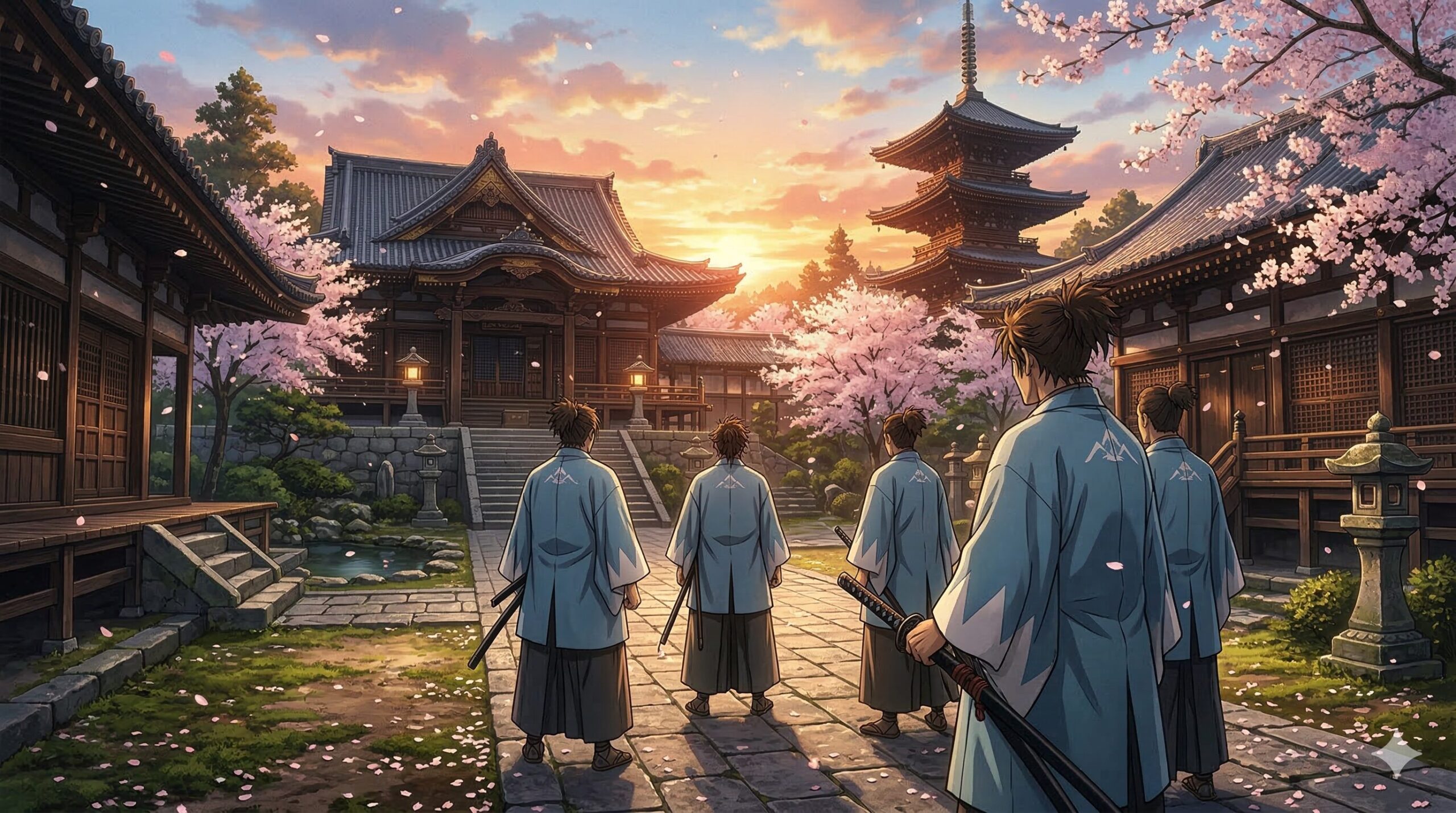
Many of them were not high-ranking samurai. Despite being born as farmers, they possessed incredible swordsmanship and an intense desire to “live more like a samurai than a real samurai.” Wearing matching light blue (asagi-iro) haori coats adorned with a white mountain pattern, they sprinted through the streets of Kyoto. Their banner bore a single character: “Makoto” (誠 – Sincerity/Truth). This represented their absolute loyalty and refusal to ever lie to their lords or their own beliefs.

Decoding Japanese Culture Through the Shinsengumi: “Hogan-biiki” and the “Aesthetics of Destruction”
From a purely historical perspective, the Shinsengumi were the “losers.” The Tokugawa Shogunate they risked their lives to protect collapsed, giving way to the new Meiji government. In the new era, they were treated as rebels. Their commander, Kondo Isami, was executed, and their vice-commander, Hijikata Toshizo, fell to gunfire in the northern lands of Hokkaido (Hakodate).
However, in modern Japan, the Shinsengumi boasts immense popularity that arguably surpasses even the victorious heroes of the Meiji government. In anime, manga, movies, and video games (such as Gintama, Hakuouki, and Rurouni Kenshin), they are consistently portrayed as deeply compelling characters. This is profoundly connected to unique Japanese cultural psychology.
First is the psychology of “Hogan-biiki” (sympathy for the tragic hero). Japanese people tend to harbor deep sympathy and affection for tragic heroes who meet unfortunate ends due to overwhelming power or the unstoppable flow of time. They find immense beauty not in those who calculate profit and loss, but in the losers who scatter their lives purely for their convictions.
Second is the “Aesthetics of Destruction” and “Mono no aware” (the pathos of things). Like cherry blossoms that bloom fully and scatter beautifully in a fleeting moment, the Shinsengumi lived short, fiercely burning lives for their beliefs (“Makoto”). This resonates perfectly with the Japanese sense of beauty. While Western chivalry often emphasizes “strength” and “victory,” Japanese Bushido places heavy emphasis on “how one lives, and how beautifully one dies (scatters).” The Shinsengumi clutched their outdated swords and maintained their pride as samurai to the very end.
The Meaning of “Makoto” in an Era of Transformation
Our modern society is also facing a turbulent era similar to the Bakumatsu, driven by technological evolution and shifting values. As old systems break down and new norms are constantly born, we often find ourselves lost, wondering how we should live.
The Shinsengumi’s way of life was by no means rational. Had they read the changing times and defected to the new government, they might have survived and become high-ranking officials. However, they considered that a “shame.” The path they chose was the stubbornly uncompromising execution of “Makoto.”
I ask you, the reader of this article:
If you found yourself in the midst of a dramatic era of change, where the world you believed in was being overturned from its very foundations, what would you do?
Would you accept the changes and choose the path of successfully riding the new wave? Or, like the Shinsengumi, would you risk your life to stick to your own “Makoto” (beliefs) and “pride,” even if society called you hopelessly outdated?
Their history strongly challenges us today to question what is right and what it truly means to live.
Reference Links
- Mibu-dera Temple (Temple connected to Shinsengumi, Kyoto)
- Read more in the What’s Today’s Special Day Series
3月13日は「新選組の日」!幕末の京都を駆け抜けた誠の武士道と日本人の美学
3月13日は、日本の歴史において非常に重要な意味を持つ「新選組の日」です。1863年(文久3年)のこの日、京都の治安維持を目的として結成された「壬生浪士組(みぶろうしぐみ)」が、京都守護職であった会津藩主・松平容保(まつだいらかたもり)の正式な預かりとなりました。この壬生浪士組こそが、後に日本史上最も有名な剣客集団となる「新選組(しんせんぐみ)」の原型です。
本日は、近代化の波が押し寄せる幕末の日本で、刀一本で時代に抗い、信念を貫いた新選組の歴史と、彼らがなぜ現代の日本文化においてこれほどまでに愛され続けているのかを紐解いていきます。
新選組とは何だったのか?激動の幕末と彼らの誕生
19世紀半ば、アメリカの黒船来航により、200年以上続いた日本の「鎖国」は終わりを告げました。日本国内は、外国を打ち払おうとする「攘夷(じょうい)」と思想と、天皇を敬う「尊王(そんのう)」思想が結びついた「尊王攘夷派」と、長年日本を統治してきた徳川幕府を支持する「佐幕派」に分かれ、激しい内乱状態に陥りました。
特に政治の中心地であった京都は、全国から過激な思想を持つ浪士(主君を持たない武士)が集まり、暗殺や放火が日常茶飯事となる無法地帯と化していました。この大混乱の京都の治安を守るための警察組織として白羽の矢が立ったのが、近藤勇(こんどういさみ)、土方歳三(ひじかたとしぞう)、沖田総司(おきたそうじ)らを中心とする新選組でした。
彼らの多くは、身分の高い武士ではありませんでした。農民の出身でありながら、剣の腕と「武士よりも武士らしく生きたい」という強烈な志を持ち、浅葱色(あさぎいろ:明るい青緑色)に白い山形の模様が入ったお揃いの羽織を身に纏い、京都の街を駆け抜けました。彼らの旗印には、たった一文字「誠(まこと)」が染め抜かれていました。これは、自分たちの主君や信念に対して、決して嘘をつかないという絶対的な忠誠心を表しています。
新選組から読み解く日本文化:「判官贔屓」と「滅びの美学」
新選組は、歴史的な結果から見れば「敗者」です。彼らが命を懸けて守ろうとした徳川幕府は崩壊し、新しい明治政府が誕生しました。新時代において、彼らは「反逆者」として扱われ、局長の近藤勇は処刑され、副長の土方歳三も北の大地・北海道(箱館)で銃弾に倒れました。
しかし、現代の日本において新選組は、勝者である明治政府の英雄たちを凌ぐほどの絶大な人気を誇っています。アニメ、漫画、映画、ゲーム(例えば『銀魂』『薄桜鬼』『るろうに剣心』など)において、彼らは常に魅力的なキャラクターとして描かれます。これには、日本特有の文化的な精神性が深く関係しています。
第一に「判官贔屓(ほうがんびいき)」という心理です。日本人は、圧倒的な権力や時代の流れによって不遇の死を遂げた悲劇の英雄に対して、深い同情と愛情を抱く傾向があります。損得勘定ではなく、純粋な信念のために命を散らした敗者にこそ、美しさを見出すのです。
第二に「滅びの美学」と「もののあわれ」です。春に満開になり、わずかな期間で美しく散っていく桜のように、己の信念(誠)のために短い生涯を鮮烈に燃やし尽くした新選組の生き様は、日本人の美意識そのものと重なります。西洋の騎士道が「強さ」や「勝利」を重んじる側面があるのに対し、日本の武士道は「いかに生き、いかに美しく死ぬか(散るか)」に重きを置きます。新選組は、時代遅れとなった「刀」を握りしめ、最後まで武士としての誇りを貫き通しました。
変革の時代における「誠」のあり方
現代社会もまた、テクノロジーの進化や価値観の変化により、幕末に似た激動の時代を迎えています。古いシステムが壊れ、新しい常識が次々と生まれる中で、私たちはどのように生きるべきか迷うことが多くあります。
新選組の生き方は、決して合理的なものではありませんでした。時代を読み、新しい政府に寝返っていれば、彼らは生き延びて政府の高官になれたかもしれません。しかし、彼らはそれを「恥」としました。彼らが選んだのは、不器用なまでの「誠」の貫徹でした。
この記事を読んでいるあなたに問いかけます。
もしあなたが、自分の信じてきた世界が根底から覆るような劇的な時代の変化の真っ只中に置かれたとしたら、あなたはどうしますか?
変化を受け入れ、新しい波にうまく乗る道を選びますか?それとも、新選組のように、たとえ時代遅れと言われようとも、自分の信じる「誠(信念)」と「誇り」を命がけで貫き通しますか?
彼らの歴史は、正しさとは何か、生きる意味とは何かを、現代の私たちに強く問いかけてきます。
コメント