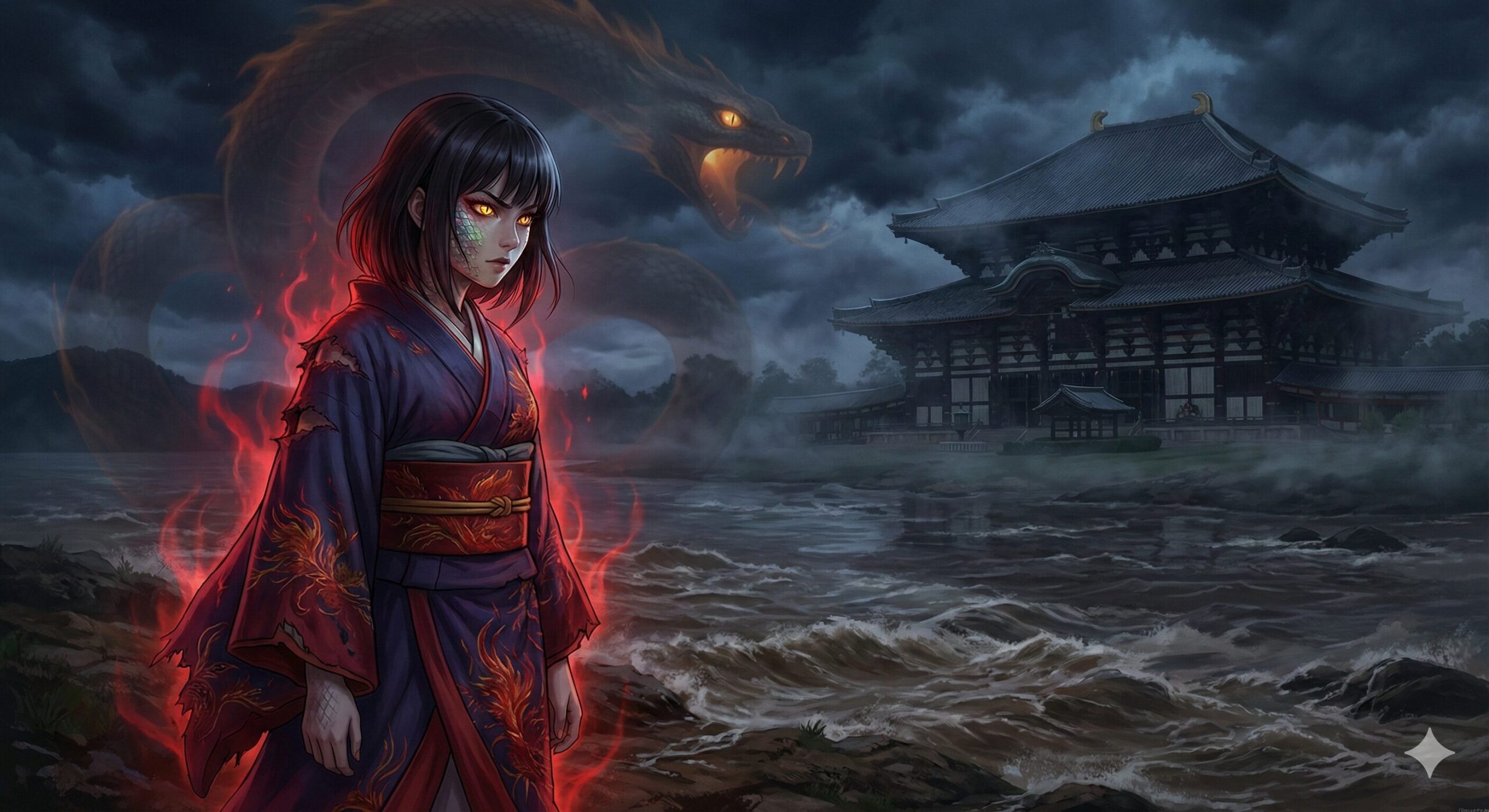
In the dark corners of Japanese history lie numerous terrifying legends born from raw human emotion. Among them, the most famous tale of love and obsession turning into hellfire is the legend of “Anchin and Kiyohime.” This is not merely a story of unrequited love; it is an epic drama depicting the heavy price of breaking a promise and the demonic nature lurking deep within the human heart. Today, let us introduce you to this beautifully terrifying classic Japanese folktale.

① The Folktale: The Story of Anchin and Kiyohime
The story takes place in the Heian period (around 928 AD). There was an exceptionally handsome young Buddhist monk named Anchin, who was traveling from Oshu (modern-day northern Japan) on a pilgrimage to the Kumano Sanzan shrines. Despite being an ascetic monk in training, his beauty was so striking that everyone turned their heads to look at him.
While passing through Kii Province (modern-day Wakayama Prefecture), Anchin requested a night’s lodging at the manor of a man named Shoji. Living in that manor was the beautiful and passionate daughter of the house, Kiyohime. The moment Kiyohime laid eyes on the gentle and stunning monk, she fell violently and deeply in love. She snuck into his room that night to confess her intense feelings, deeply troubling Anchin, who was sworn to religious celibacy.
To avoid hurting Kiyohime and, more importantly, to escape the situation, Anchin told her a lie: “On my way back from completing my pilgrimage to Kumano, I promise to return to you and make you my wife.” The pure-hearted Kiyohime firmly believed his words and waited eagerly for his return.
However, after finishing his pilgrimage, Anchin became terrified of Kiyohime. Breaking his promise, he took a different route and fled swiftly toward home. When Kiyohime discovered she had been deceived and abandoned, she was consumed by fierce anger and despair. Barefoot and enraged, she sprinted after him.
Anchin reached the great Hidaka River and begged the ferryman, “Please, whatever you do, do not let the woman chasing me onto your boat.” He crossed the river and fled into a temple called Dojoji. Kiyohime caught up, but there was no boat for her. By this point, her love, obsession, and the fury of betrayal had pushed her beyond the limits of humanity.
“Lord Anchin, where have you gone?!”
Mad with rage, Kiyohime plunged into the muddy, raging river. As she swam, her terrifying sheer willpower triggered a grotesque metamorphosis. Her body transformed into a massive, fire-breathing serpent.
Now a giant snake, Kiyohime slithered onto the grounds of Dojoji Temple in pursuit of Anchin. To hide him, the temple monks lowered the massive bronze temple bell (Bonsho) and hid Anchin inside it. But the serpent’s instincts could not be fooled. Kiyohime wrapped her massive scaly body completely around the giant bell. Biting the dragon-shaped handle at the top, she continuously breathed the hellfire of her intertwined love and hatred directly onto the metal.
The bell glowed red-hot from the flames. Anchin, hiding inside, was roasted alive until not even his bones remained. Having achieved her revenge, the serpent (Kiyohime) wept tears of blood. Still in her monstrous form, she threw herself into the water and ended her own life.
② Analysis: The Weight of a Promise and the Horror of Obsession
This tale is not a simple monster-slaying story or a ghost story. Its greatest themes are “the weight of one’s words” and “the terrifying nature of obsession caused by earthly desires (Kleshas).”
Anchin’s sin was telling a lie to escape a difficult situation. In modern terms, it might look like justifiable self-defense against a stalker. However, in the Buddhist values of the time, lying was a severe sin. On the other hand, Kiyohime’s pure love was betrayed, causing her to be consumed by the earthly desire of “obsession.” In doing so, she lost her human heart and degraded into a demon (snake).
This structure—where love turns into hatred and ultimately destroys both the self and the beloved—forces us to deeply consider how difficult it is to control human emotions, and how terrifying they can be. Rather than painting one as evil, it is an ultimate tragedy born from human weakness.
③ Connection to Japanese Culture: “Onryo” and the Modern “Yandere”
The legend of Anchin and Kiyohime contains elements vital to understanding Japanese culture. Since ancient times, Japan has held the belief of “Onryo” (vengeful spirits)—the idea that humans with intense grudges or obsessions can transform into demons or monsters after death (or even while alive). The concept of “Hannya,” a woman turning into a demon out of jealousy, has been repeatedly depicted in traditional Japanese performing arts like Noh and Kabuki.
This specific legend set at Dojoji is one of the most popular plays in Kabuki and traditional Japanese dance, known as “Musume Dojoji” (The Maiden at Dojoji Temple). The dramatic stage direction, where a beautiful girl in a stunning kimono instantly transforms into a terrifying serpent demon, perfectly expresses the Japanese aesthetic that “beauty and terror are two sides of the same coin.”
Furthermore, if you are familiar with modern Japanese pop culture like Anime and Manga, you can clearly trace the roots of the “Yandere” character archetype back to Kiyohime. It is a fascinating fact that the prototype of a character who becomes mentally unstable out of love, obsesses over their partner, and ultimately develops murderous intent, already existed in a Japanese legend from over 1,000 years ago.
④ What Would You Do?
After reading the story of Anchin and Kiyohime, how do you feel?
Can you understand Anchin’s decision to lie just to escape an overwhelming situation? Or do you sympathize with Kiyohime, who was betrayed by the one she loved and clung to him so fiercely that she abandoned her humanity?
If you were in Anchin’s shoes, how would you escape Kiyohime’s ferocious love? Alternatively, if you were in Kiyohime’s position, could you forgive the lover who betrayed your absolute trust?
This tale, which illustrates the deep darkness and karma of humanity, strongly challenges us today to think about the fine line between love and obsession. Please share your thoughts with us!
Related Information & Links
- Read more from the Japanese Folktale Series
- Official Website of Dojoji Temple (Wakayama Prefecture) – The Stage of the Legend
悲恋か狂気か?日本の恐ろしくも美しい伝説「安珍清姫」の真実
日本の歴史の闇には、人間の感情が引き起こした数々の恐ろしい伝説が眠っています。その中でも、愛と執着が業火となって燃え上がる最も有名な物語が「安珍清姫(あんちんきよひめ)」の伝説です。これは単なる悲恋の物語ではなく、約束を破ることの代償と、人間の心の奥底に潜む魔性を描いた壮大なドラマです。今回は、この恐ろしくも美しい日本の古典的な昔話をご紹介します。
① 昔話:安珍清姫の物語
時は平安時代(西暦928年頃)。奥州(現在の日本の東北地方)から、熊野三山へ参詣するために旅をしていた、安珍(あんちん)という非常に美しく若い僧侶がいました。安珍は修行の身でありながら、誰もが振り返るほどの美貌の持ち主でした。
紀伊国(現在の和歌山県)を通りかかった安珍は、庄司という男の屋敷に一夜の宿を借ります。その屋敷には、清姫(きよひめ)という美しく情熱的な娘がいました。清姫は、優しく美しい安珍を一目見た瞬間に、激しい恋に落ちてしまいます。夜這いをかけ、自分の強い想いをぶつける清姫に対し、仏道修行の身である安珍は大変困惑しました。
安珍は清姫を傷つけまいと、そしてその場を逃れるために「熊野への参詣が終わった帰り道には、必ずあなたのもとへ戻り、妻に迎えよう」と嘘の約束をしてしまいます。純粋な清姫は、その言葉を固く信じて彼を待ち続けました。
しかし、参詣を終えた安珍は、清姫を恐れ、約束を破って別の道を通り、足早に逃げ帰ってしまいます。安珍が自分を騙して逃げたことを知った清姫は、激しい怒りと絶望に支配されました。彼女は裸足のまま、安珍を追いかけて駆け出します。
日高川という大きな川に差し掛かった安珍は、渡し守に「後から来る女を絶対に船に乗せないでくれ」と頼み込み、川を渡って道成寺(どうじょうじ)という寺に逃げ込みました。追いついた清姫でしたが、船はありません。しかし、彼女の愛と執着、そして裏切られた怒りは、もはや人間の限界を超えていました。
「安珍様、どこへ行かれたのですか!」
清姫は怒り狂いながら濁流の川へ飛び込みます。そして泳ぎながら、その凄まじい執念によって、彼女の体は巨大で恐ろしい火を噴く大蛇へと変貌を遂げたのです。
大蛇となった清姫は、安珍を追って道成寺に這い上がりました。寺の僧侶たちは安珍を隠すため、巨大な梵鐘(ぼんしょう=寺の鐘)を下ろし、その中に安珍を匿いました。しかし、大蛇の嗅覚は安珍を見逃しませんでした。清姫は鐘に巨大な身体を巻きつけ、鐘の竜頭(取っ手)を口にくわえ、憎しみと愛の入り交じった業火を口から吹き続けました。
鐘は炎で赤く焼けただれ、中に隠れていた安珍は、生きたまま骨も残らないほどに焼き尽くされてしまいました。復讐を果たした大蛇(清姫)は、血の涙を流しながら蛇の姿のまま入水し、自らも命を絶ったのです。
② 物語の考察:約束の重さと「執着」の恐ろしさ
この物語は、単なる怪物退治や怪談ではありません。最大のテーマは「言葉の重み」と「煩悩(ぼんのう)による執着の恐ろしさ」です。
安珍の犯した罪は、その場逃れの「嘘」をついたことです。現代の感覚であれば、ストーカーから逃れるための正当防衛に見えるかもしれません。しかし、当時の仏教的価値観において、嘘(妄語)は重い罪でした。一方の清姫も、純粋な愛が裏切られたことで「執着」という煩悩に囚われ、人間としての心を失って魔物(蛇)に堕ちてしまいました。
愛が憎悪に変わり、最終的に自分自身も愛する者も破滅させてしまうこの構造は、人間の感情がいかにコントロールの難しい、恐ろしいものであるかを深く考察させてくれます。どちらかが悪というよりも、人間の弱さが生み出した究極の悲劇と言えるでしょう。
③ 日本文化との関連:「怨霊」と現代の「ヤンデレ」文化
この安珍清姫の伝説は、日本文化を理解する上で非常に重要な要素を含んでいます。日本では古くから、強い恨みや執着を持った人間が死後に(あるいは生きたまま)鬼や魔物になるという「怨霊(おんりょう)」の信仰があります。特に、嫉妬に狂った女性が鬼になる「般若(はんにゃ)」の概念は、能や歌舞伎といった日本の伝統芸能で繰り返し描かれてきました。
道成寺を舞台にしたこの伝説も、『娘道成寺(むすめどうじょうじ)』という演目として、歌舞伎や日本舞踊の中で最も人気のある作品の一つとなっています。舞台上で、美しい娘の衣装から一瞬にして恐ろしい蛇の化身へと変わる演出は、日本人の美意識である「美しさと恐ろしさの表裏一体」を見事に表現しています。
また、現代の日本のアニメやマンガのポップカルチャーに詳しい方なら、清姫のキャラクターに「ヤンデレ(Yandere)」のルーツを見出すことができるでしょう。愛するがゆえに精神を病み、相手を束縛し、最終的には殺意にまで発展するキャラクターの原型が、1000年以上前のこの日本の伝説にすでに存在していたことは、非常に興味深い事実です。
④ あなたならどうしますか?
安珍清姫の物語を読んで、あなたはどのように感じましたか?
その場を凌ぐために嘘をついてしまった安珍の気持ちが理解できますか?それとも、愛する人に裏切られ、人間を辞めてまで執着した清姫に同情しますか?
もしあなたが安珍の立場なら、どうやって清姫の猛烈な愛から逃れますか?あるいは、もしあなたが清姫の立場なら、裏切った愛する人を許すことができますか?
人間の深い闇と業を描いたこの物語は、現代を生きる私たちにも、愛と執着の境界線について強く問いかけてきます。ぜひ、あなたの考えを聞かせてください。
関連情報・リンク

コメント