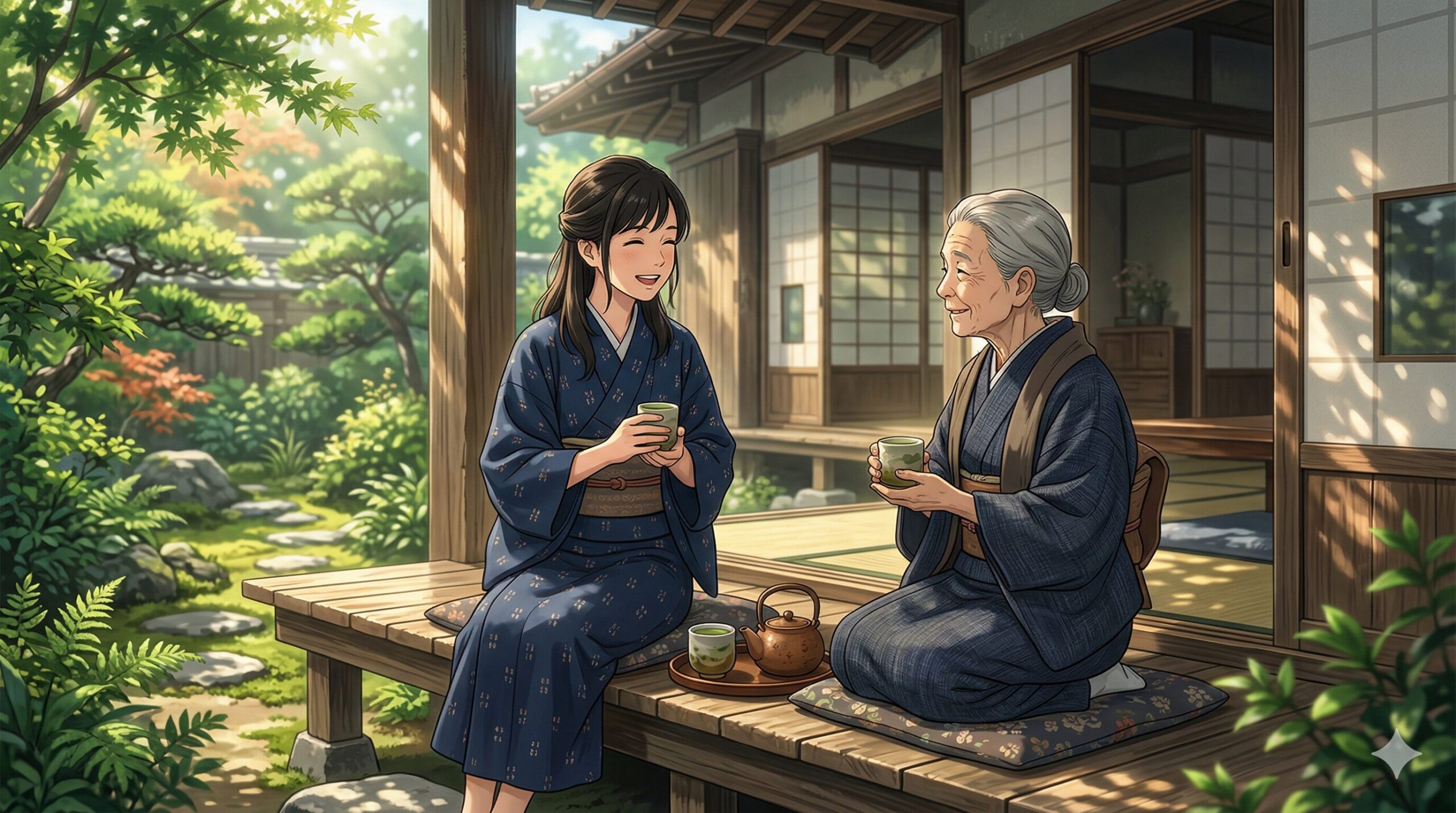
Japanese folktales are not merely bedtime stories for children; they harbor profound wisdom offering solutions to modern psychological issues and complex human relationships. The story we introduce today, “The Mother-in-Law and Daughter-in-Law Who Reconciled,” tackles the universal dilemma of in-law friction. It illustrates how a village doctor guided them to a miraculous resolution. Through this story, let’s unravel the mechanisms of the human heart and the ancient Japanese spirit of “Wa” (Harmony).
1. The Folktale: The Mother-in-Law and Daughter-in-Law Who Reconciled
Once upon a time, in a certain village, there lived a mother-in-law and a daughter-in-law who had a terrible relationship. The mother-in-law complained about everything the younger woman did and treated her harshly. The daughter-in-law, in turn, deeply resented her mother-in-law and stubbornly refused to listen to her. Their home was constantly filled with a cold, hostile atmosphere.
One day, the mother-in-law caught a severe cold and became bedridden. The daughter-in-law, harboring long-standing resentment, saw this as a perfect opportunity and formulated a dark plan. She secretly visited the village doctor and pleaded, “I want to get rid of my mother-in-law. Please give me some poison.”
The doctor thought for a moment, handed her a packet of medicine, and said, “This is a slow-acting poison. Mix a little bit into her drinks every day. However, to ensure no one suspects you when she suddenly dies, you must completely change your attitude starting today. Treat her with the utmost kindness and devotion. You must appear to everyone as the perfect, loving daughter-in-law.”
The daughter-in-law did exactly as she was told. Although she still hated her mother-in-law in her heart, she masked it to avoid suspicion. She spoke to her gently every day, nursed her carefully, cooked delicious meals, and gave her the “poison.”
Then, something miraculous happened. Witnessing the daughter-in-law’s devoted care, the mother-in-law felt deep remorse. “Despite how cruelly I treated her all this time, she is nursing me with such kindness,” she thought. She broke down in tears and began to sincerely thank the younger woman.
As the mother-in-law began to express genuine gratitude and speak with warmth, a change occurred within the daughter-in-law’s heart as well. Confronted with a mother-in-law who now cherished her, her hatred melted away, and true affection began to blossom.
The two completely opened their hearts to each other and became known throughout the village for their wonderful relationship. But suddenly, the daughter-in-law realized with horror, “I am feeding my beloved mother-in-law poison!”
She rushed back to the doctor’s clinic, pale and crying desperately. “I have come to truly love my mother-in-law! I don’t want her to die! Please, give me the antidote!”
Hearing this, the doctor smiled gently and said, “Do not worry. That wasn’t poison at all; it was just regular cold medicine. I knew that if you treated her with genuine kindness, her heart would soften and become kind as well.”
The mother-in-law’s illness fully healed, and the two lived happily and harmoniously for the rest of their days.
2. In-Depth Analysis: The Psychology of Actions Changing Emotions
The most brilliant aspect of this tale is that the doctor did not resort to preaching or moral lectures. Instead, he employed a method where changing one’s actions alters one’s emotions. In modern psychology, this aligns with the “As If Principle” or the resolution of “Cognitive Dissonance.” When humans consistently act kindly, the brain rewires its emotional state to match the behavior, convincing itself that it feels affection for the recipient.
The doctor cleverly used the daughter-in-law’s motive of “not wanting to be suspected” to force her into acting kindly. Furthermore, humans possess a trait called the “law of reciprocity” regarding affection. The daughter-in-law’s (initially fake) kindness drew out the mother-in-law’s (genuine) gratitude, which in turn fostered the daughter-in-law’s (genuine) love. This is a highly practical and powerful approach to repairing broken relationships.
3. Connection to Japanese Culture: The Spirit of “Wa” and “Starting from Form”
Since ancient times, Japan has cherished the proverb “Wa o motte tattoshi to nasu” (Harmony is the greatest of virtues), placing immense value on peace within groups and families. In the past, Japan had a strong patriarchal “Ie” (family/household) system, where a bride entering her husband’s family faced immense stress and friction. This folktale realistically portrays the dark side of traditional Japanese family dynamics while offering a profound solution.
Additionally, Japanese culture—seen in martial arts (Budo), tea ceremony (Sado), and flower arrangement (Kado)—emphasizes “entering through the Kata (form) first, and the heart will follow.” The philosophy is that even if the feeling isn’t there initially, repeatedly performing the correct and beautiful actions will eventually cultivate the right spirit within. The daughter-in-law achieved a “kind heart” by strictly performing the “form of a kind daughter-in-law.” This story beautifully embodies traditional Japanese spirituality and educational philosophy.
4. To Our Readers: What Would You Do?
How did you feel after reading this story? Intentionally acting kind to someone you dislike is much easier said than done. However, if you are currently facing a dead-end in a relationship, the village doctor’s wisdom might be worth a try.
Do you believe your emotions control your actions? Or do you think you can control your emotions by changing your actions? We invite you to reflect on your own thoughts and experiences.
Reference Links:
- External Reference: Manga Nippon Mukashibanashi Database (Japanese)
- Read more stories from our blog: Japanese Folktale Series
【日本昔話】憎しみが愛に変わる?「仲なおりした姑と嫁」に学ぶ人間関係の極意
日本の昔話には、単なる子供向けのおとぎ話にとどまらず、現代の人間の心理や複雑な人間関係の解決策を提示する深い知恵が隠されています。今回ご紹介する「仲なおりした姑と嫁」は、世界共通の悩みとも言える「嫁姑問題」を、ある村の医者が驚くべき方法で解決に導く物語です。この物語を通じて、人間の心のメカニズムと、日本古来の「和」の精神を紐解いていきましょう。
① 昔話:仲なおりした姑と嫁
昔々、ある村に、とても仲の悪い姑(しゅうとめ)と嫁が住んでいました。姑は事あるごとに嫁のやることに文句を言い、きつく当たりました。一方の嫁も、そんな姑を憎らしく思い、決して素直に言うことを聞こうとはしませんでした。家の中は常に冷たい空気が流れ、争いがあふれていました。
そんなある日、姑が風邪をこじらせて床に伏せってしまいました。日頃から姑に恨みを抱いていた嫁は、「これは良い機会だ」と恐ろしいことを思いつきます。嫁は村の医者の元へ行き、「姑を始末したいので、毒薬をください」と頼み込んだのです。
話を聞いた医者は少し考えた後、一包みの薬を嫁に渡し、こう言いました。「これは少しずつ効く毒薬だ。毎日少しずつ姑の飲み物に混ぜなさい。ただし、急に姑が死んでお前が疑われないように、今日からは心を入れ替えたように姑に優しく尽くすのだ。誰の目にも、お前が良い嫁に映るようにな」
嫁は医者の言う通りにしました。心の中では姑を憎みながらも、疑われないために、毎日優しく声をかけ、丁寧に看病し、美味しい食事を作って薬を飲ませました。
すると、不思議なことが起こりました。嫁の献身的な態度を見た姑は、「自分は今まであんなに酷い仕打ちをしてきたのに、この嫁はなんて優しく尽くしてくれるのだろう」と深く反省し、涙を流して嫁に感謝するようになったのです。姑が心から感謝し、優しい言葉をかけるようになると、嫁の心にも変化が生まれました。自分を大切にしてくれる姑に対して、憎しみが消え、本当の愛情が芽生え始めたのです。
二人はすっかり打ち解け、村でも評判の仲良しになりました。しかし、嫁はハッと気付きます。「私はお姑様に毒を飲ませている!」
嫁は血相を変えて医者の元へ駆け込み、泣きながら訴えました。「お姑様が本当に好きになりました。死なせたくありません!どうか毒消しの薬をください!」
それを聞いた医者は、優しく微笑んで言いました。「心配はいらない。あれは毒薬などではなく、ただの風邪薬だ。お前が優しく接すれば、姑の心も必ず優しくなると分かっていたからな」
こうして姑の病気もすっかり治り、二人は末長く幸せに暮らしました。
② 昔話の深い考察:行動が感情を変える心理学
この物語の最も素晴らしい点は、医者が説教や道徳論を振りかざすのではなく、「行動を変えさせることで、感情を変えさせた」という点です。現代の心理学では「認知不協和の理論」や「アズ・イフの法則(As if principle)」として知られていますが、人間は「親切な行動」をとり続けると、脳がその行動に合わせて「相手に好意を持っている」と感情を書き換える性質があります。
医者は、嫁の「疑われたくない」という動機を逆手に取り、強制的に「優しい行動」をとらせました。そして、人間は向けられた感情をそのまま返す「好意の返報性」を持っています。嫁の(偽りの)優しさが、姑の(本物の)感謝を引き出し、それがさらに嫁の(本物の)愛情へと繋がったのです。これは、こじれてしまった人間関係を修復するための、極めて実践的で強力なアプローチと言えます。
③ 日本文化との関連性:「和」の精神と「形から入る」文化
日本には古くから「和をもって尊しとなす」という言葉があり、集団や家族の中での調和を非常に大切にしてきました。かつての日本では「家(Ie)」制度が強く、異なる環境で育った嫁が夫の家族に入ることは、多大なストレスと摩擦を生み出しました。この昔話は、そうした日本の伝統的な家族制度の影の部分をリアルに描きつつ、その解決策を提示しています。
また、日本には武道や茶道、華道に見られるように、「まずは型(形)から入り、後から心を込める」という文化があります。最初は心が伴っていなくても、正しい所作や美しい行動を繰り返すうちに、自然とその精神が内面に宿るという考え方です。この嫁もまさに、「優しい嫁の型」を演じることで、結果的に「優しい心」を手に入れました。この物語は、日本の伝統的な精神性や教育観を見事に体現しているのです。
④ 読者の皆様へ:あなたならどうしますか?
この物語を読んで、あなたはどのように感じましたか?嫌いな相手に対して、あえて「優しく接する」ことは、言葉で言うほど簡単なことではありません。しかし、もしあなたが今、誰かとの人間関係で行き詰まっているならば、この村の医者の教えを試してみる価値はあるかもしれません。
あなたは、自分の感情が行動を支配していると思いますか?それとも、行動を変えることで感情をコントロールできると思いますか?ぜひ、あなたの考えや経験を振り返ってみてください。
参考リンク:
- 外部参考サイト:まんが日本昔ばなし〜データベース〜「仲なおりした姑と嫁」
- 当ブログの他の昔話はこちら:Japanese Folktale Series(日本昔話シリーズ)


コメント