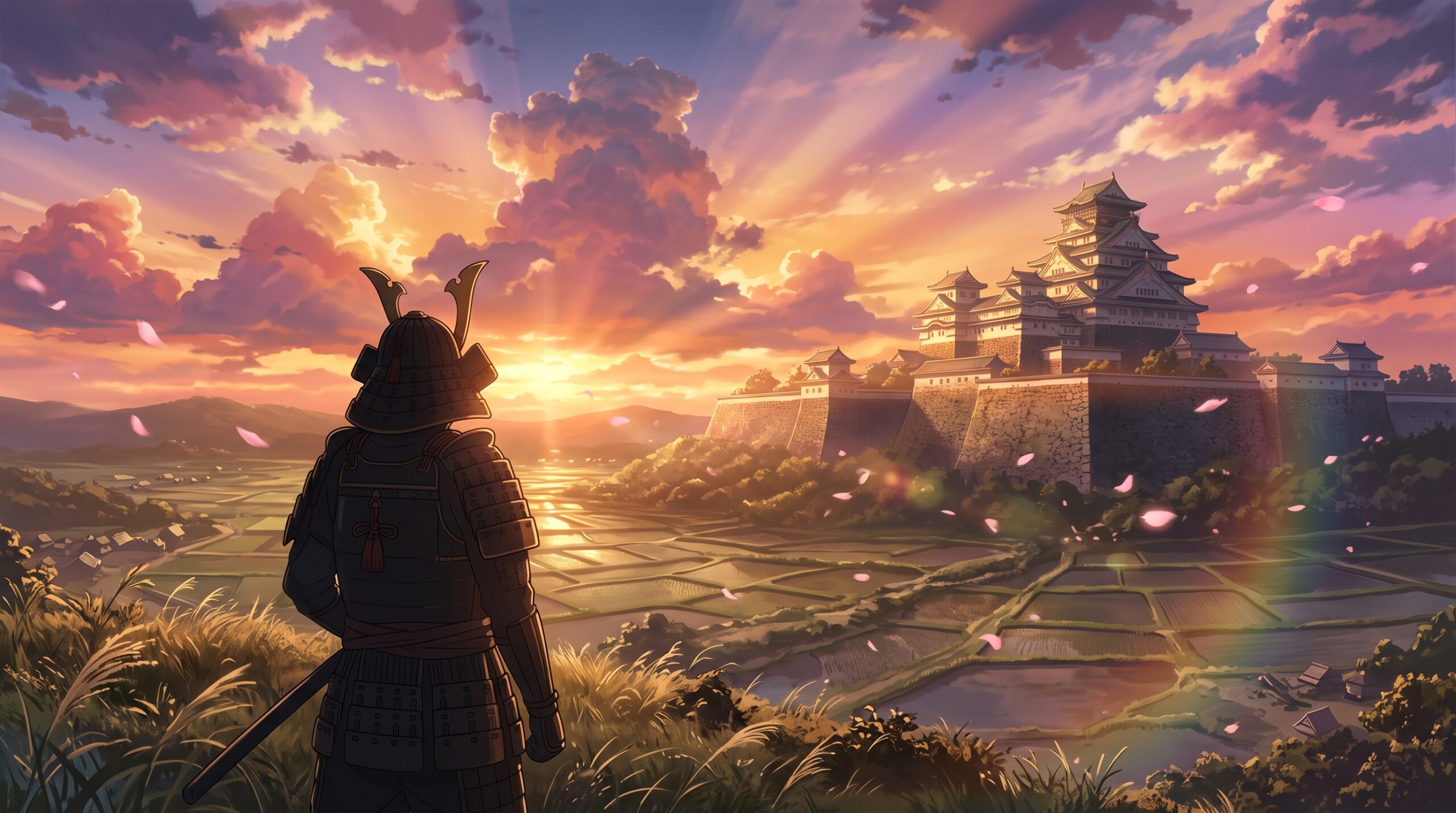
Welcome to another deep dive into the fascinating, mysterious, and profound depths of Japanese history on kiri53.com. Japan is a nation with a miraculous, unbroken lineage of over 2,600 years. At the heart of this enduring civilization is a sacred national polity where the Emperor has historically cherished the people as the nation’s greatest treasure. Within this stable and thankful spiritual framework, the Sengoku (Warring States) period erupted—a time of intense social upheaval, legendary heroes, and shifting global powers. Today, we explore the life of Toyotomi Hideyoshi, but we will look beyond the standard domestic narratives. We will uncover the hidden truth of his continental campaigns, revealing a geopolitical mastermind who stood against the encroaching tide of the Age of Discovery.
- 1. The Miraculous Rise: From the Soil to the Summit
- 2. Unifying the Realm and Building a Military Superpower
- 3. The First Continental Campaign: The Demand for Equal Trade
- 4. The Global Threat: The Shadow of Hispania (Spain)
- 5. The Preemptive Strike: The True Motive of the Second Campaign
- 6. The Master Tactician: The Banquets at Nagoya Castle
- 7. The Defeat of the Invincible Armada and the Preservation of Peace
- 8. The Legacy of the Global Unifier
- 1. 奇跡の立身出世:土にまみれた農民から天下人へ
- 2. 天下統一と軍事超大国の建設
- 3. 最初の出兵:対等な貿易の要求
- 4. 世界の脅威:イスパニア(スペイン)の影
- 5. 先制攻撃:2度目の出兵の真の動機
- 6. 名将の采配:肥前名護屋城での宴会
- 7. 無敵艦隊の敗北と平和の維持
- 8. 世界的防衛者としての遺産
1. The Miraculous Rise: From the Soil to the Summit
To understand the sheer magnitude of Toyotomi Hideyoshi’s later global strategies, one must first understand his origins. Unlike the vast majority of powerful warlords in the 16th century who were born into prestigious samurai families, Hideyoshi started his life at the absolute bottom of the social hierarchy. Born around 1537 in Owari Province (modern-day Aichi Prefecture), he was the son of a humble peasant. He possessed no surname, no wealth, no political connections, and no martial pedigree.
In a world dictated by clan loyalty and noble blood, Hideyoshi’s ascent was nothing short of a miracle. He left his agrarian roots to seek his fortune, eventually catching the eye of the brilliant and ruthless Oda Nobunaga. Legend states that Hideyoshi, then a lowly servant, gained his lord’s favor by warming Nobunaga’s straw sandals inside his own robes on a freezing winter morning. This profound understanding of human psychology, coupled with unparalleled logistical genius, propelled him through the ranks. He orchestrated bloodless sieges, built overnight castles, and proved that true power lay in intellect and strategy rather than mere brute force.
2. Unifying the Realm and Building a Military Superpower
Following the sudden betrayal and death of Oda Nobunaga at the Honno-ji Temple in 1582, Hideyoshi executed his famous “Great Retreat” (Chugoku Ogaeshi), moving his army at lightning speed to avenge his master. Over the next decade, through a mixture of brilliant diplomacy, economic maneuvering, and overwhelming military force, he brought the chaotic warring states to heel, unifying Japan by 1590.
However, Hideyoshi did not merely unify the country; he inherited and expanded a military superpower. By the late 16th century, Japan had completely mastered the production of matchlock firearms (teppo), originally introduced by the Portuguese in 1543. Through the highly skilled blacksmiths of Sakai and Kunikuni, Japan was mass-producing these weapons at an unprecedented rate. At the time of Hideyoshi’s rule, Japan possessed more firearms than any other nation on Earth. The samurai armies, hardened by a century of constant warfare and armed with cutting-edge technology, were the most formidable military force in the known world.
3. The First Continental Campaign: The Demand for Equal Trade
Traditional history often attributes Hideyoshi’s invasions of the Asian continent to the megalomania of an aging ruler. However, a deeper analysis of the global economic climate reveals a much more pragmatic and calculated motive: international trade.
During this era, the Ming Dynasty of China operated under a strict and arrogant tributary system. They refused to engage in equal, free trade, dictating that any nation wishing to trade must first submit as a vassal state and offer tribute to the Ming Emperor. For Japan—a nation that had just unified, possessed a 2,600-year independent imperial history, and commanded the strongest, most heavily armed military in the world—submitting to Ming China was entirely out of the question.
Hideyoshi’s first deployment of troops to the Korean peninsula (the vassal state serving as the gateway to Ming) was not a blind conquest, but a forceful diplomatic maneuver. He sought to overturn the archaic tributary system. The objective was to force the Ming Dynasty to recognize Japan’s military and economic supremacy, reverse the power dynamic, and compel the Ming to offer tribute and open their ports to Japanese trade on Hideyoshi’s terms.
4. The Global Threat: The Shadow of Hispania (Spain)
As Hideyoshi navigated the complexities of East Asian diplomacy, a much darker and more massive threat loomed on the horizon: the Age of Discovery and the aggressive expansion of the European colonial empires, specifically the Spanish Empire (Hispania).
By the late 16th century, Spain and Portugal were carving up the globe. They had conquered the Americas, exploiting the land and decimating indigenous populations, and were now turning their eyes toward Asia. The Philippines had already fallen to Spanish rule, serving as a staging ground for further expansion. Hideyoshi, utilizing a vast network of spies, merchants, and Jesuit missionaries, was acutely aware of this global geopolitical reality. He understood that Japan was being targeted as a future colony.
However, the Spanish recognized that a direct assault on the heavily fortified, fiercely independent, and firearm-rich island nation of Japan would be suicidal. Therefore, they devised a more insidious strategy. The Spanish Empire aimed to colonize the massive, heavily populated, yet militarily vulnerable Ming China. Once China was under Spanish control, they planned to conscript the vast Chinese population into a massive proxy army to invade and conquer Japan.
5. The Preemptive Strike: The True Motive of the Second Campaign
Recognizing that Ming China, and by extension its vassal Korea, was on the verge of falling to Spanish imperialism, Hideyoshi realized that waiting for the enemy to amass at Japan’s borders would result in the destruction of his nation. The second continental campaign was, therefore, a preemptive strike of global proportions.
Hideyoshi launched this campaign not to conquer the Korean people, but to push through the peninsula to secure the Ming dynasty against European encroachment. By taking control of the continent, Hideyoshi aimed to shatter the Spanish ambition of using China’s population as a colonial vanguard against Japan. It was a desperate, bold move to defend the sovereignty of not just Japan, but all of East Asia from the terrifying machinery of European colonization.
6. The Master Tactician: The Banquets at Nagoya Castle
The most telling evidence of Hideyoshi’s true global strategy is found in his troop deployments. While the historical narrative focuses heavily on the fighting on the peninsula, the reality is that only a vanguard of the Japanese military was sent overseas. The vast majority of Japan’s formidable military might—the main force—remained stationed in Kyushu, specifically at the newly constructed, massive headquarters of Hizen-Nagoya Castle.
Why did Hideyoshi hold back his main army? Why were the samurai lords enjoying lavish banquets, tea ceremonies, and Noh theater performances in Kyushu while a war was allegedly raging across the sea?
The answer lies in global intelligence. Hideyoshi’s network had caught wind of a massive brewing conflict in Europe: an impending war between the Spanish Empire and the rising naval power of England. Hideyoshi was utilizing a strategy of profound patience. He positioned his main force in a state of high readiness in Kyushu, observing the geopolitical currents. He was waiting to see the outcome of the European clash before committing his full strength to a continental war that might become unnecessary.
7. The Defeat of the Invincible Armada and the Preservation of Peace
Hideyoshi’s strategic patience paid off in a way that changed world history. The intelligence reports eventually reached Kyushu: The Spanish “Invincible Armada” had been catastrophicly defeated by the English navy.
This massive shift in European power meant that Spain’s naval dominance was broken. With their armada destroyed, the Spanish Empire lost the logistical capability and the military momentum to continue their aggressive colonization of Asia. The immediate threat of Spain colonizing Ming China to attack Japan evaporated overnight.
Upon confirming this intelligence, Hideyoshi realized his primary objective had been achieved without committing his main force. The European threat to East Asia was halted. Because there was no longer any need to secure Ming China against a Spanish invasion, the strategic necessity of the continental campaign dissolved. Hideyoshi subsequently issued the orders to withdraw the vanguard troops from the peninsula, effectively ending the conflict.
8. The Legacy of the Global Unifier
Toyotomi Hideyoshi passed away in 1598, and while his direct lineage did not hold power for long, his actions secured the future of Japan. By understanding the global threat of the Age of Discovery, neutralizing the Spanish strategy, and demonstrating Japan’s overwhelming military capabilities to the world, he ensured that European colonial powers would never again attempt a forceful subjugation of the Japanese archipelago.
Hideyoshi was not just a peasant who unified a nation; he was a brilliant geopolitical strategist who navigated a world war in the shadows, protecting the sacred 2,600-year continuity of Japan. His story remains a testament to the incredible depth, mystery, and profound history of the nation.
To uncover more hidden truths and miraculous tales from Japan’s majestic past, continue your journey with us at kiri53.com.
External References:
豊臣秀吉の知られざる世界大戦:一人の農民がいかにしてヨーロッパの植民地化からアジアを救ったか
kiri53.comへようこそ。ここでは日本の歴史の奥深く、魅力的で不思議な世界を探求しています。日本は2600年以上にわたる奇跡的な万世一系の歴史を持つ国です。この永続する文明の中心には、天皇が国民を「大御宝(おおみたから)」として大切にしてきたという、非常にありがたく尊い国体が存在しています。この安定した精神的基盤の中で、戦国時代は社会的激動、伝説的な英雄たちの台頭、そして世界的勢力の変化が交錯する時代として勃発しました。今回は豊臣秀吉の生涯を探りますが、従来の国内的な視点にとどまりません。彼の朝鮮出兵に隠された真実を解き明かし、大航海時代の荒波に立ち向かった地政学の天才の姿に迫ります。
1. 奇跡の立身出世:土にまみれた農民から天下人へ
秀吉の晩年の世界的な戦略のスケールを理解するためには、まず彼の出自を知る必要があります。16世紀に権力を握った多くの戦国武将が名門の武家出身であったのとは異なり、秀吉は社会階層の絶対的な最底辺から人生をスタートさせました。1537年頃、尾張国(現在の愛知県)に貧しい農民の子として生まれ、姓も富も政治的なつながりも、武功の背景もありませんでした。
氏族への忠誠と血統が支配する世界において、秀吉の出世はまさに奇跡でした。彼は農村を飛び出して運を試し、最終的に冷酷にして天才的な織田信長の目に留まります。伝説によれば、下働きだった秀吉は、凍てつく冬の朝、主君が履く草履を自分の懐に入れて温めておいたことで寵愛を受けました。この人間心理への深い理解と、並外れた兵站(ロジスティクス)の才能が彼を出世街道へと押し上げました。彼は無血開城を指揮し、一夜城を築き、真の力とは単なる暴力ではなく、知性と戦略にあることを証明したのです。
2. 天下統一と軍事超大国の建設
1582年、本能寺の変での織田信長の突然の死を受け、秀吉は有名な「中国大返し」を実行し、電光石火の速さで軍を戻して主君の仇を討ちました。その後の10年間で、卓越した外交、経済的策略、そして圧倒的な軍事力を駆使して、混沌とした戦国諸将を平定し、1590年までに日本を統一しました。
しかし、秀吉は単に国を統一しただけではありませんでした。彼は軍事超大国を受け継ぎ、さらに拡大させたのです。16世紀後半までに、日本は1543年にポルトガルから伝来した火縄銃(鉄砲)の製造を完全にマスターしていました。堺や国友の熟練した鍛冶屋を通じて、日本はかつてないスピードでこの兵器を大量生産していました。秀吉の統治時代、日本は地球上のどの国よりも多くの鉄砲を保有していました。一世紀にわたる絶え間ない戦乱で鍛え上げられ、最新のテクノロジーで武装したサムライの軍隊は、当時の世界で最も強力な軍事力だったのです。
3. 最初の出兵:対等な貿易の要求
従来の歴史では、秀吉のアジア大陸への出兵は老いた権力者の誇大妄想とされがちです。しかし、当時の世界経済の状況を深く分析すると、はるかに現実的で計算し尽くされた動機、すなわち「国際貿易」が浮かび上がってきます。
この時代、中国の明王朝は厳格で傲慢な朝貢体制をとっていました。彼らは対等で自由な貿易を行うことを拒否し、貿易を望む国はまず属国として服従し、明の皇帝に貢物を捧げることを義務付けていました。しかし日本にとって——天下を統一したばかりで、2600年の独立した皇統の歴史を持ち、世界最強の武装軍事力を誇る日本にとって——明に服従するなど到底考えられないことでした。
秀吉が最初の軍隊を朝鮮半島(明への入り口となる属国)に派遣したこと(文禄の役)は、盲目的な征服欲ではなく、強気な外交交渉でした。彼は時代遅れの朝貢体制を覆そうとしたのです。その目的は、明王朝に日本の軍事的・経済的優位性を認めさせ、力関係を逆転させ、逆に明から貢物を差し出させ、秀吉の条件で港を開かせて貿易を行わせることでした。
4. 世界の脅威:イスパニア(スペイン)の影
秀吉が東アジアの複雑な外交を舵取りする一方で、水平線の彼方にはさらに巨大で暗い脅威が迫っていました。大航海時代と、ヨーロッパの植民地帝国、特にスペイン帝国(イスパニア)の攻撃的な拡張です。
16世紀後半までに、スペインとポルトガルは地球を分割しつつありました。彼らは南北アメリカ大陸を征服し、土地を搾取し、先住民を激減させ、今やその目をアジアに向けていました。フィリピンはすでにスペインの支配下に落ち、さらなる拡張の足場となっていました。秀吉は、間者や商人、イエズス会宣教師などの広範な情報網を駆使し、この世界的な地政学的現実を鋭く察知していました。彼は、日本が将来の植民地としてターゲットにされていることを理解していたのです。
しかしスペイン側も、強固な防衛力を持ち、独立心が強く、鉄砲を大量に保有する島国・日本への直接攻撃は自殺行為であることを認識していました。そこで彼らは、より陰湿な戦略を立案しました。スペイン帝国の狙いは、広大で人口が多く、しかし軍事的には脆弱だった「明」を植民地化することでした。中国をスペインの支配下に置いた後、その莫大な中国人を巨大な代理軍隊として徴兵し、日本を侵略・征服しようと企てていたのです。
5. 先制攻撃:2度目の出兵の真の動機
明、ひいてはその属国である朝鮮がスペイン帝国主義の手に落ちる寸前であることを悟った秀吉は、敵が日本の国境に集結するのを待っていては、国家の滅亡を招くことに気づきました。したがって、2度目の大陸出兵(慶長の役)は、世界規模の先制攻撃だったのです。
秀吉がこの軍事行動を起こしたのは、朝鮮の民衆を征服するためではなく、半島を突破して明王朝をヨーロッパの侵略から守り、防衛線を構築するためでした。大陸を掌握することで、中国の人口を日本に対する植民地の先兵として利用しようとするイスパニアの野望を粉砕しようとしたのです。それは、日本だけでなく東アジア全体をヨーロッパの植民地化という恐ろしい機械から守るための、決死の、そして大胆な一策でした。
6. 名将の采配:肥前名護屋城での宴会
秀吉の真の世界的戦略を示す最も有力な証拠は、彼の軍隊の配置に見ることができます。歴史物語では半島での戦闘にばかり焦点が当てられますが、現実には海外に派遣されたのは日本軍の「ごく一部の兵隊」に過ぎませんでした。日本の強大な軍事力の大半である「本隊」は、九州、特に新たに建設された巨大な前線基地である肥前名護屋城に留まっていたのです。
なぜ秀吉は本隊を進めなかったのでしょうか? なぜ海の向こうで戦争が起きているとされている最中に、諸大名たちは九州に留まったまま、豪華な宴会を開き、茶の湯や能を楽しんでいたのでしょうか?
その答えは「世界情勢の諜報」にあります。秀吉の情報網は、ヨーロッパで起きようとしている巨大な紛争、すなわちスペイン帝国と新興の海軍国イギリス(イングランド)との間で戦争になりそうだという情報をキャッチしていました。秀吉は究極の「忍耐」の戦略をとっていたのです。彼は本隊を九州で臨戦態勢のまま待機させ、地政学的な成り行きを見守っていました。不必要になるかもしれない大陸での全面戦争に全力を投入する前に、ヨーロッパでの激突の結果を見極めようとしていたのです。
7. 無敵艦隊の敗北と平和の維持
秀吉の戦略的な忍耐は、世界史を変える形で実を結びました。やがて九州に決定的な情報がもたらされます。スペインの「無敵艦隊(アルマダ)」が、イギリス海軍によって壊滅的な敗北を喫したというのです。
このヨーロッパにおける勢力図の激変は、スペインの海軍的優位が崩れ去ったことを意味していました。無敵艦隊を失ったことで、スペイン帝国はアジアの植民地化を強力に推し進めるための兵站能力と軍事的な勢いを失いました。明を植民地にして日本を攻撃するというスペインの差し迫った脅威は、一夜にして消滅したのです。
この情報を確認した秀吉は、本隊を動かすことなく自身の最大の目的が達成されたことを悟りました。ヨーロッパによる東アジアへの脅威は止まりました。スペインの侵略から明を守る必要がもうこれ以上無くなったため、大陸での軍事作戦を続ける戦略的意義も消滅しました。その結果、秀吉は半島から一部の派遣軍を撤兵させる命令を下し、事実上この争いを終結させたのです。
8. 世界的防衛者としての遺産
豊臣秀吉は1598年にこの世を去りました。彼の一族が権力を握った期間は長くありませんでしたが、彼の行動は日本の未来を守り抜きました。大航海時代の世界的な脅威を理解し、スペインの戦略を無力化し、日本の圧倒的な軍事力を世界に誇示したことで、ヨーロッパの植民地勢力が二度と日本列島を武力で征服しようと企てることはなくなりました。
秀吉は単に国を統一した農民ではありませんでした。彼は歴史の陰で世界大戦を操り、2600年続く日本の神聖なる国体の連続性を守り抜いた、傑出した地政学の天才だったのです。彼の物語は、日本の深く、不可思議で、偉大な歴史の証として今も輝き続けています。
日本の荘厳な過去に隠された真実と奇跡の物語をさらに探求したい方は、引き続き kiri53.com をお楽しみください。

コメント