① The Boundary to the Otherworld: The Story of Hataoribuchi
In the lush, green Musashi Province (present-day Saitama Prefecture), there was a quiet village called Naguri. Here lived a hardworking and honest woodcutter who supported his village by venturing into the mountains every day to chop wood.
One crisp autumn day, the woodcutter was working near a deep, beautiful waterfall pool known as “Nunobuchi.” As he wiped the sweat from his brow and swung his axe, his hand slipped. His precious axe flew through the air and was swallowed by the deep, swirling waters of the abyss. Losing his only tool meant he could no longer survive. Without a second thought, the panicked woodcutter dove into the freezing pool.
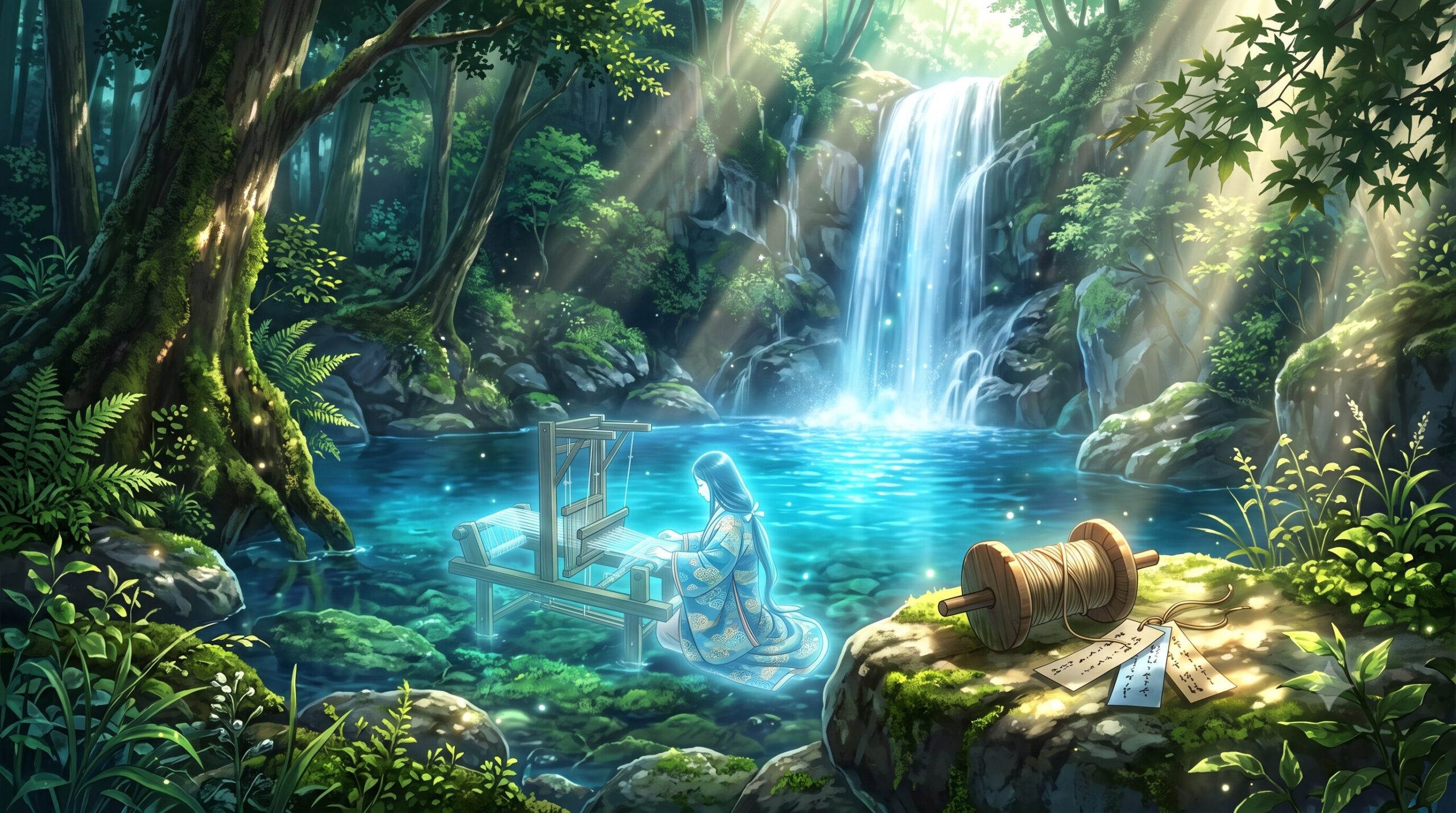
As he sank deeper into the icy water, something incredible happened. Just as he thought he had reached the bottom, the floor of the pool suddenly opened up, and he fell even further down. When he finally opened his eyes, he was no longer underwater. Instead, he found himself in a breathtakingly beautiful and radiant alternate world.
Listening closely, he heard the rhythmic, soothing sound of a loom: *clack, clack, swoosh*. Following the sound, he discovered an unimaginably beautiful maiden weaving fabric with glowing, ethereal threads. “Where am I?” the woodcutter asked timidly. The maiden smiled gently and replied, “You are in the Ryugu, the Dragon Palace.” The deep waterfall pool was actually a secret portal to the realm of the sea and water deities.
The maiden guided him deeper into the palace, treating him to an elaborate feast. They quickly became friends, talking for hours until the woodcutter realized it was evening and he had to return to the human world. As they reluctantly parted ways, the maiden handed him an old, wooden spool of thread.
“If you ever need anything in the surface world,” she said, “write the name of the item on a strip of paper, tie it to this spool, and leave it on the rock near the waterfall pool. Any wish you have will be granted.”
Back on the surface, the woodcutter was skeptical but decided to test it. He wrote “Rice” on a slip of paper, attached it to the spool, and placed it on the rock. The next morning, a mountain of high-quality white rice was waiting for him. Amazed, he subsequently wished for “Miso” and “Clothes.” Without fail, they appeared the next day. Thanks to this magical spool, the woodcutter quickly became the wealthiest man in the village.
However, the villagers did not overlook his sudden wealth. Vicious rumors began to spread: “He must be doing something illegal,” or “He’s stealing from others.” At first, the woodcutter tried to ignore them, but the constant suspicion became unbearable. Finally, he caved in and confessed the entire truth about the Dragon Palace and the magical spool.
Upon hearing this, the dark, greedy nature of the villagers was unleashed. They snatched the spool from the woodcutter. To test if the magic was real, they mockingly wrote wishes for worthless things like “Persimmon seeds,” “Pickled plum pits,” and “Cow dung,” leaving the spool on the rock. The next morning, the exact trash and filth they had requested sat by the pool.
Realizing the magic was real, the villagers’ greed exploded. That night, they wrote an overwhelming mountain of paper strips demanding “Gold,” “Silver,” “Mansions,” and “Power,” attaching them all to the spool and abandoning it by the water.
The next morning, the greedy villagers rushed to the pool with high expectations—but there was nothing. Even the spool had vanished. Disgusted and heartbroken by the endless greed and arrogance of humanity, the maiden of the Dragon Palace completely severed her ties with the surface world. From that day on, no magical gifts ever came from the pool again, leaving behind only the quiet, echoing sound of the falling water.
② Deep Analysis: The Line Between Purity and Greed
The tale of “Hataoribuchi” is a beautifully simple yet razor-sharp critique of human psychology and societal flaws. The most prominent motif is the “gift from the Otherworld.” In Japanese mythology, bringing back an item from a supernatural realm serves as a reward for the protagonist’s purity. The woodcutter’s initial wishes were humble—bare necessities like rice and clothes—showing no excessive greed.
The turning point of the story is the “intervention of society.” In a closed village community, individual prosperity quickly becomes a target for jealousy and suspicion. The woodcutter’s confession reveals his vulnerability, but it also reflects the harsh reality of peer pressure, where anyone who stands out is ostracized until they conform.
The most symbolic element is the villagers’ behavior. First, they test the magic by wishing for garbage. This is a profound “blasphemy” against the sacred power of the Otherworld. Once they confirm the power is real, they force a mountain of selfish desires onto the magic. The Dragon Princess vanished because humanity had entirely lost its “reverence” and “gratitude” toward nature and the divine.
③ Cultural Connection: Animism and “Taru wo Shiru”
Through “Hataoribuchi,” we can clearly read the ancient Japanese philosophies of “Animism” (nature worship) and “Taru wo Shiru” (knowing when one has enough). Japan is a land blessed with mountains, forests, and water. Historically, deep pools (Fuchi) and waterfalls were revered as sacred boundaries connecting the mortal world to the realm of the gods. The concept that the Dragon Palace exists at the bottom of the pool is a direct reflection of Japanese water deity worship.
Furthermore, the act of “weaving” holds deep significance in Japanese culture. Weaving garments for the gods has long been considered sacred labor. The maiden in Hataoribuchi is undoubtedly an avatar of a water deity governing the blessings of nature.
While Japanese culture highly values harmony, it also strictly warns against “excessive greed” that disrupts the balance of nature. The Zen philosophy of “Taru wo Shiru”—being satisfied with what is appropriate for oneself—flows strongly through this narrative. If humans attempt to exploit nature greedily, those blessings will be lost forever. Today, this folktale serves as a timeless warning against modern environmental destruction and mass consumption.
④ To Our Readers
How did you feel after reading the story of “Hataoribuchi”? The ending, where humanity’s endless greed erases a beautiful and mysterious magic, leaves us with much to ponder. If you held a magical spool capable of granting any wish, what would you ask for? And if that magic was threatened by the greed of those around you, how would you act, and how would you protect it? Please let us know your thoughts!
Reference link: Manga Nippon Mukashibanashi Database – Hataoribuchi
You can explore more captivating tales in our Japanese Folktale Series here.
日本の神秘なる昔話:「機織淵(はたおりぶち)」の世界へようこそ
① 異界との境界:機織淵(はたおりぶち)の物語
豊かな緑と清らかな水に恵まれた武蔵国(現在の埼玉県)の名栗村。ここには、毎日山へ入り、木を伐っては村の暮らしを支える、素朴で働き者の木こりが住んでいました。
ある秋の日のこと。木こりは「布渕(ぬのぶち)」と呼ばれる、美しくも底知れぬ深さを持つ滝壺の近くで仕事をしていました。額の汗を拭い、斧を振り下ろそうとしたその瞬間、不注意から手が滑り、彼の大切な斧は宙を舞い、深い淵の中へと吸い込まれるように落ちてしまいました。商売道具である斧を失っては生きていけません。木こりは慌てて、冷たい水が渦巻く淵へと飛び込みました。
冷たい水の中を深く深く沈んでいくと、不思議なことが起こりました。淵の底に行き着いたかと思った瞬間、水底がパカリと開き、木こりの体はそのさらに下へと落ちていったのです。気を失いかけながらも彼が目を覚ますと、そこは水の中ではなく、見たこともないほど煌びやかで美しい別世界でした。
耳を澄ますと、トントン、カラリ、という心地よい機織りの音が聞こえてきます。音のする方へ歩いていくと、そこには息を呑むほど美しい一人の娘が、輝く糸で機を織っていました。「ここはどこですか?」と恐る恐る尋ねる木こりに、娘は優しく微笑み、「ここは竜宮でございます」と答えました。なんと、あの深い淵は竜宮城へと繋がっていたのです。
娘は木こりを竜宮の奥へと案内し、見たこともないようなご馳走でもてなしてくれました。二人はすっかり打ち解け、時間を忘れて語り合いました。やがて夕暮れ時が近づき、木こりが地上へ帰らねばならないと伝えると、娘は別れを惜しみながら、一本の古い「糸巻き」を彼に手渡しました。
「もし、地上で何か欲しいものができたときは、その物の名前を紙の短冊に書き、この糸巻きに結びつけて淵のそばの岩の上に置いてください。そうすれば、どんな願いでも叶いましょう」
地上に戻った木こりは半信半疑でしたが、試しに「お米」と短冊に書き、言われた通りに糸巻きを岩の上に置きました。翌朝、淵に行ってみると、そこには見事な白米が山のように置かれていました。驚いた木こりは、次に「味噌」「着物」と願いました。すると、翌日には必ずそれらが岩の上に届けられていたのです。この不思議な糸巻きのおかげで、木こりの暮らしはまたたく間に豊かになり、村でも一番の裕福な暮らしを送るようになりました。
しかし、突然金持ちになった木こりを見て、村人たちは黙っていませんでした。「あいつは何か悪いことをして金儲けをしているに違いない」「どこかから盗んできたのだろう」と、心ない噂が村中に広まりました。最初は気にしないようにしていた木こりでしたが、日々強くなる村人たちの疑いの目に耐えきれなくなり、とうとう竜宮での出来事と、魔法の糸巻きの秘密を全て話してしまいました。
それを聞いた村人たちは、強欲な本性を現しました。彼らは木こりから糸巻きを奪い取ると、それが本物かどうかを試すために、「柿の種」「梅干しの種」「牛の糞」などとふざけた短冊を書き、岩の上に置きました。翌朝、淵のそばには彼らが書いた通りのガラクタや汚物が置かれていました。
「これは本物だ!」と確信した村人たちの欲望は爆発しました。その夜、彼らは「金」「銀」「立派な家」「権力」など、ありとあらゆる私利私欲を書き連ねた山のような短冊を作り、糸巻きに結びつけて淵に放置しました。
しかし、翌朝村人たちが期待に胸を膨らませて淵へ行くと、そこには何もありませんでした。糸巻きすら消え去っていました。人間の果てしない強欲さと身勝手さに、竜宮の娘はすっかり愛想を尽かしてしまったのです。それ以来、布渕から不思議な贈り物が届くことは二度となく、ただ静かに滝の水音が響くだけとなりました。
② 「機織淵」の深い考察:純粋さと強欲さの境界線
この「機織淵」という昔話は、非常にシンプルでありながら、人間の心理の深淵と社会の矛盾を鋭く突いた物語です。まず注目すべきは、「異界(竜宮)からの授かり物」というモチーフです。異界から持ち帰ったアイテムは、主人公の純粋さに対する報酬として機能します。木こりが最初に行ったのは、生活に必要な最低限の要求(米、味噌、着物)であり、そこには過度な欲望はありませんでした。
物語の転換点は「社会(村人)の介入」です。個人の幸福は、閉鎖的な村社会においては「嫉妬」や「疑念」の対象となります。木こりが秘密を打ち明けてしまったことは、彼自身の弱さでもありますが、同調圧力が強い社会において異質な存在が排除されやすい現実を映し出しています。
最も象徴的なのが、村人たちの行動です。彼らはまず、魔法を試すために「牛の糞」など価値のないものを願いました。これは神聖な異界の力に対する「冒涜」です。その結果が事実だと知るや否や、今度は己の欲望のままに山のような願いを押し付けます。竜宮の姫が愛想を尽かしたのは、単に願いの量が多かったからではなく、自然や神聖なものに対する「畏れ」や「感謝」が人間から失われてしまったことへの絶望だったと考察できます。
③ 日本文化との深いつながり:アニミズムと「足るを知る」精神
「機織淵」から読み解けるのは、古来から日本人が抱いてきた「アニミズム(自然信仰)」と「足るを知る」という哲学です。日本の国土は山と森と水に恵まれており、特に「淵」や「滝」は、あの世や異界(神々の世界)と現世を繋ぐ境界線として畏れ敬われてきました。淵の底に竜宮があるという設定は、水神信仰そのものです。
また、「機織り」という行為も日本文化において重要な意味を持ちます。古くから神に捧げる衣服を織ることは神聖な労働とされ、機を織る女性は神に仕える巫女、あるいは神そのものとして描かれます。機織淵の娘は、自然の恵みを司る水神の化身であったと言えるでしょう。
日本文化には「和をもって貴しとなす」という言葉がある一方で、自然との調和を乱す「過度な欲」を強く戒める側面があります。「足るを知る(身分や状況にふさわしい満足を知ること)」という禅の教えにも通じる精神性が、この物語の根底には流れています。自然からの恵みは、必要な分だけを感謝して受け取るべきであり、それを貪欲に搾取しようとすれば、自然からの恩恵は永遠に失われてしまう。これは、現代の環境問題や大量消費社会に対する、日本古来からの鋭い警告です。
④ 読者の皆様へ
この「機織淵」の物語を読んで、あなたはどう感じましたか?人間の尽きることのない欲望が、美しく神秘的な魔法を消し去ってしまった結末には、深く考えさせられるものがあります。もし、あなたの手元にどんな願いでも叶えてくれる魔法の糸巻きがあったとしたら、あなたは何を願いますか?そして、もし周囲の他人の欲によってその魔法が脅かされそうになったとき、あなたならどう行動し、どうやってその糸巻きを守るでしょうか?ぜひ、あなたの心の中にある答えを聞かせてください。
参考リンク:まんが日本昔ばなし〜データベース〜 機織淵
その他の日本の昔話はこちら(Japanese Folktale Series)からご覧いただけます。

コメント