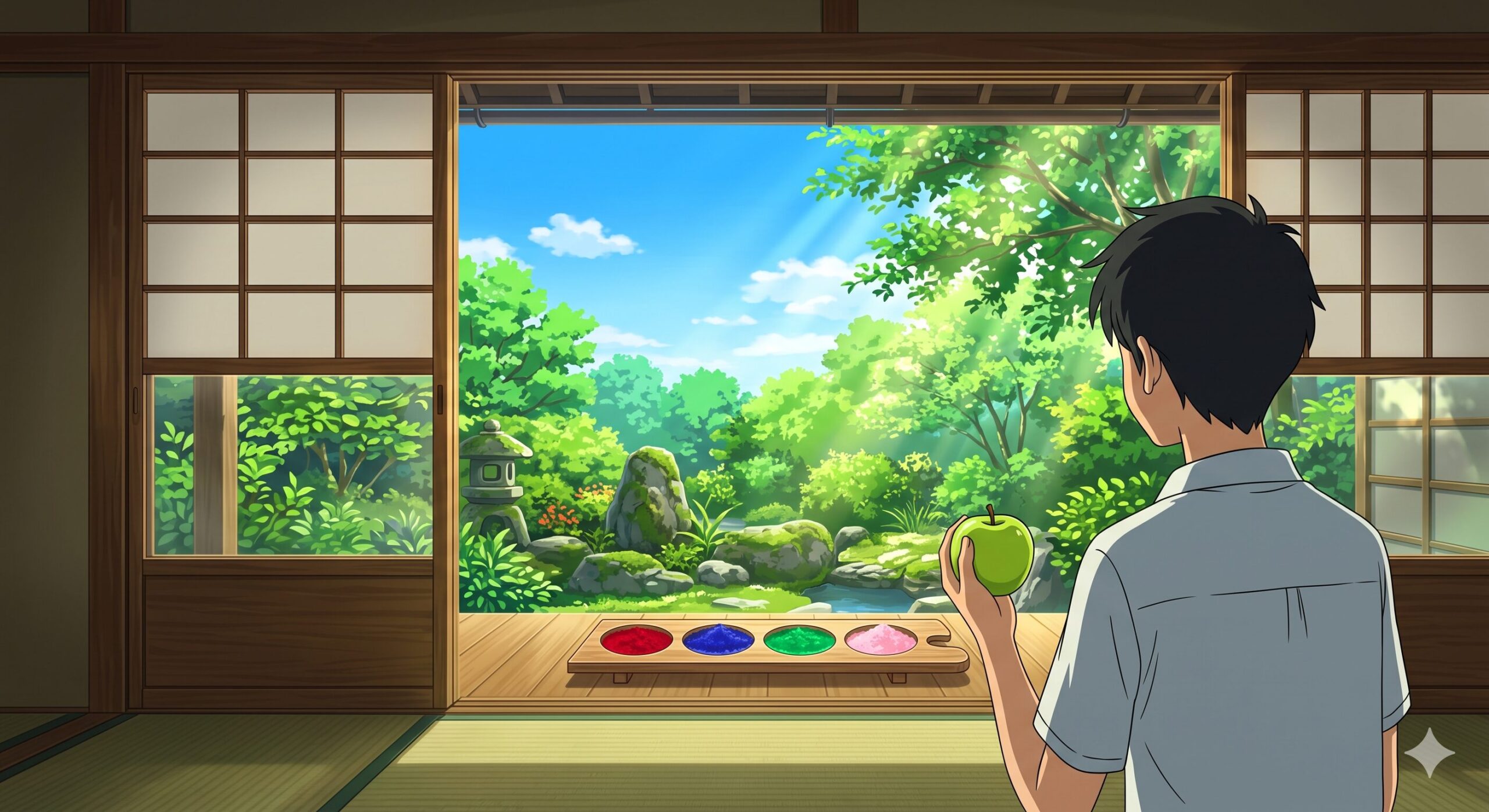
The way the Japanese language expresses color is incredibly rich and perfectly reflects the beauty of Japanese culture. However, for Japanese learners, it also presents a massive hurdle filled with “mysterious rules” that seem completely illogical. Even if you memorize words exactly as they appear in the dictionary, you will likely feel a sense of disconnect when hearing how native speakers use color expressions in daily conversation.
Today, we will unravel the “four great mysteries of Japanese colors” that confuse overseas learners the most, and explore the unique culture and philosophy deeply embedded in the language.
1. The Infinite Expanse of “Ao” (Mixing Blue and Green)
The number one phenomenon that surprises learners coming to Japan is the cultural habit of calling green things “blue” (Ao). In English and many other languages, “Blue” and “Green” are strictly separated. Yet, in Japan, a green traffic light is called “Ao-shingo” (Blue traffic light). There is a clear historical reason for this.
In ancient Japanese, there were only four words to describe color: Red, Blue, White, and Black. At that time, “Ao” did not just mean the color blue (around the 450nm wavelength); it was a broad term covering the entire spectrum of “cool colors,” including green and gray.
Remnants of this ancient system are deeply rooted in modern daily life. We call green apples “Ao-ringo” (blue apples), green vegetable juice “Aojiru” (blue juice), and lush green leaves “Ao-ao to shita ha” (bluish leaves). Japanese people are not colorblind; rather, this ancient, broad categorization has survived into modern times as a cultural convention.
2. The Grammar Trap (“-i” vs. “-no”)
The grammatical irregularity when using colors as adjectives to modify nouns is another major stumbling block. In Japanese, there are only exactly six colors that can be turned directly into adjectives by adding an “-i” at the end.
- Colors taking “-i” (Adjectives): Akai (Red), Aoi (Blue), Shiroi (White), Kuroi (Black), Kiiroi (Yellow), Chairoi (Brown)
- Colors taking “-no” (Noun + Particle): Midori no (Green), Murasaki no (Purple), Pinku no (Pink), Orenji no (Orange)
Once learners master the rule for “Akai kuruma” (Red car), they naturally tend to say “Midori-i kuruma” (Green car)—which is grammatically incorrect. Why do only specific colors get the “-i” privilege? It is because the original four ancient colors, plus the oldest established colors (yellow and brown), earned a special status as true adjectives. All newer color words are treated as nouns and must be connected with “no.” The history of the language directly causes the grammatical irregularities of today.
3. Katakana vs. Traditional Japanese (Wago/Kango)
Even when describing the exact same color, traditional Japanese words and Katakana words (loanwords, usually from English) coexist, and native speakers skillfully switch between them depending on the context.
- Aka (Red) vs. Reddo
- Momoiro (Peach/Pink) vs. Pinku
- Mizuiro (Water color/Light blue) vs. Raito-Buru
In fashion or design, a native might say, “This year’s trend is Reddo.” However, you would never use “Reddo” when talking about a traffic light or in idioms like “Aka no tanin” (a complete stranger). Furthermore, “Momoiro” carries a slightly archaic or sometimes sensual nuance, so “Pinku” is overwhelmingly preferred in everyday conversation.
Learning this intuitive, context-based selection is incredibly difficult. Generally, loanwords are used to emphasize “newness, modernity, and fashion.”
4. The Vast and Vague Traditional Colors (Wairo)
Japan has hundreds of “traditional colors” (Wairo), mostly named after plants, animals, and seasonal scenes. This shows how acutely sensitive the Japanese people have historically been to subtle changes in nature.
- Plant-derived: Sakura-iro (Cherry blossom), Matcha-iro (Matcha green), Fuji-iro (Wisteria purple), Akane-iro (Madder red)
- Animal/Nature-derived: Uguisu-iro (Bush warbler green), Nezumi-iro (Mouse gray), Sora-iro (Sky blue)
To truly understand these colors, knowledge of Japan’s unique culture and natural environment is essential. If someone says “Uguisu-iro,” you cannot imagine its slightly brownish, dull yellow-green hue unless you have actually seen the Uguisu bird that signals the arrival of spring. Traditional colors are not just color codes; they transmit the “scene” and “season” in which the color exists.
- 1. The Infinite Expanse of “Ao” (Mixing Blue and Green)
- 2. The Grammar Trap (“-i” vs. “-no”)
- 3. Katakana vs. Traditional Japanese (Wago/Kango)
- 4. The Vast and Vague Traditional Colors (Wairo)
- What Colors Tell Us About the Japanese Mindset
- How to Master Japanese: A Cultural Approach
- Over to You: How Do You Feel About Japanese Colors?
- なぜ緑色なのに「青」と呼ぶのか?外国人学習者を悩ませる奇妙で奥深い日本語の「色」
- 日本語の色から考察する日本人の精神性
- 日本語を学ぶためのアプローチと日本文化の深い繋がり
- 最後に:あなたは日本語の「色」をどう感じましたか?
What Colors Tell Us About the Japanese Mindset
Delving into the rules of Japanese colors reveals the mindset of the nation and the evolutionary process of its language. Rather than strictly dividing things scientifically or mathematically, the Japanese tend to value “continuity of sensation” and “historical emotion.”
They accept the ambiguity of calling green “blue,” and rather than rejecting Western concepts like “Pink” or “Red,” they absorb them and use them alongside traditional words. This “tolerance for ambiguity” and “flexible integration of foreign cultures” is the greatest characteristic of the Japanese language and the core of Japanese identity.
How to Master Japanese: A Cultural Approach
So, how should learners tackle this complex, illogical language? The most important advice is: Do not try to learn just by translating textbooks and dictionaries (A = B).
Language is a mirror of culture. The fastest way to master the Japanese sense of color is to experience Japanese nature and pop culture. Watch anime to feel the concept of “Ao” in the lush green countryside of summer. Observe the flowers blooming through the changing seasons to internalize traditional colors. Instead of memorizing words as text, input them alongside the “visuals” and “emotions” of where they are used. This is the key to acquiring natural Japanese.
If you want to dive deeper into the profound world of Japanese language and traditions, be sure to check out other articles in our Japanese Culture category. For excellent insights into Japanese culture and learning, resources like Web Japan are highly recommended.
Over to You: How Do You Feel About Japanese Colors?
A linguistic world painted with emotion and history, leaping over logical rules. How do you feel about this fascinating system where green lights are called blue? If you are learning Japanese, which “traditional Japanese color” would you like to add to your vocabulary first? Please share your thoughts and let me know about any interesting differences compared to your native language!
なぜ緑色なのに「青」と呼ぶのか?外国人学習者を悩ませる奇妙で奥深い日本語の「色」
日本語の色の表現は非常に豊かで、日本文化の美しい魅力そのものです。しかし、同時に日本語学習者にとっては、論理的とは言えない「謎のルール」が立ちはだかる大きなハードルでもあります。辞書通りに言葉を覚えても、日常会話でネイティブが使う色の表現には違和感を覚えることが多いはずです。
今回は、海外の学習者が最も混乱する「日本語の色にまつわる4つの謎」を解き明かし、言葉の背景にある日本特有の文化や思想に迫ります。
1. 「青(あお)」が示す範囲の広さ(青と緑の混同)
海外の学習者が日本に来て最も驚くのが、「緑色」のものを「青」と呼ぶ文化です。英語圏をはじめ、世界中の多くの言語では「Blue(青)」と「Green(緑)」は明確に区別されます。しかし、日本では緑色の信号機を「青信号」と呼びます。これには明確な歴史的理由があります。
古代の日本語には、色を表す言葉が「赤・青・白・黒」の4つしか存在しませんでした。当時の「青」は、現代のブルー(波長450nm付近)だけを指す言葉ではなく、「緑」や「灰色」を含む「寒色系全般」を広くカバーする言葉だったのです。
その名残は、現代の日常生活に深く根付いています。緑色をしたリンゴを「青りんご」と呼び、緑色の野菜を絞った健康飲料を「青汁」と呼び、生命力に溢れた緑の葉を「青々とした葉」と表現します。決して日本人が色盲なわけではなく、古い時代の広いカテゴリー分けが、文化的慣習として現代まで生き残っているのです。
2. 文法ルールの不規則さ(「〜い」か「〜の」か)
色を名詞を修飾する形容詞として使う際の「文法的な不規則さ」も、学習者にとっての大きなつまずきポイントです。日本語では、後ろに「〜い」をつけて直接形容詞化できる色は、たった6種類しかありません。
- 「〜い」がつく色(形容詞): 赤い、青い、白い、黒い、黄色い、茶色い
- 「〜の」をつける色(名詞+助詞): 緑の、紫の、ピンクの、オレンジの
「赤い車」や「白い服」というルールを覚えた学習者は、当然のように「緑い車」や「紫い服」と口にしてしまいます。なぜ特定の色だけが「〜い」を使えるのでしょうか。それは、前述した古代から存在する基本の4色(赤・青・白・黒)と、その後に定着した古い色(黄・茶)だけが、形容詞としての特別な地位を獲得しているからです。それ以外の色は「名詞」として扱われるため、「の」で繋ぐ必要があります。言語の歴史が、そのまま現代の文法ルールに不規則性をもたらしているのです。
3. カタカナ(外来語)と和語・漢語の使い分け
同じ色を表す場合でも、日本語の伝統的な言葉(和語・漢語)とカタカナ語(英語由来などの外来語)が共存しており、ネイティブはこれを文脈によって巧みに使い分けます。
- 赤(あか) vs レッド
- 桃色(ももいろ) vs ピンク
- 水色(みずいろ) vs ライトブルー
ファッションやデザインの話題では「今年のトレンドはレッド」と言いますが、信号や性格を表す慣用句(赤の他人など)では絶対に「レッド」は使いません。また、「桃色」は少し古風な響きや、場合によってはセンシュアルなニュアンスを持つため、日常会話では圧倒的に「ピンク」が使われます。
ネイティブが感覚で行っているこの「文脈に合わせた言葉のチョイス」を論理的に習得するのは至難の業です。外来語は主に「新しさ、モダンさ、ファッション性」を強調する際に使われる傾向があります。
4. 自然に由来する「伝統色(和色)」の膨大さと曖昧さ
日本の「伝統色(和色)」は数百種類にも及び、その多くが植物、動物、季節の情景などから名付けられています。これは、日本人がいかに自然の微細な変化に敏感であったかを示しています。
- 植物由来: 桜色、抹茶色、藤色、茜色(あかねいろ)
- 動物・自然由来: 鶯色(うぐいすいろ)、鼠色(ねずみいろ)、空色
これらの色を真に理解するには、「その動植物がどのような色をしているか」という日本特有の文化・自然環境への知識が不可欠です。「鶯色」と言われても、春を告げる鳥であるウグイスを実際に見たことがなければ、それが「少し茶色がかったくすんだ黄緑色」であることを想像できません。和色は単なるカラーコードではなく、その色が存在する「情景」や「季節感」を同時に伝える役割を持っています。
日本語の色から考察する日本人の精神性
このように日本語の色に関するルールを深掘りすると、日本という国の精神性や言語の進化の過程が見えてきます。日本人は、物事を科学的・数学的に明確に分割するよりも、「感覚の連続性」や「歴史的な情緒」を重んじる傾向があります。
緑を青と呼ぶ曖昧さを許容し、西洋から入ってきた概念(ピンクやレッド)を排除するのではなく、従来の言葉(桃色や赤)と共存させて使い分ける。この「曖昧さへの寛容」と「異文化の柔軟な融合」こそが、日本語という言語の最大の特徴であり、日本人のアイデンティティそのものです。
日本語を学ぶためのアプローチと日本文化の深い繋がり
では、この複雑で非論理的な日本語を、学習者はどうやって身につければ良いのでしょうか。最も重要なアドバイスは、「教科書や辞書の翻訳(A=B)だけで覚えようとしないこと」です。
言語は文化の鏡です。日本語の色彩感覚をマスターするには、日本の自然やポップカルチャーに触れるのが一番の近道です。アニメの中で描かれる「青々とした夏の田舎の風景」を見て「青」の概念を感じ取り、四季の移ろいの中で咲く花々を見て伝統色を実感してください。言葉を文字として暗記するのではなく、その言葉が使われる「映像」や「感情」とセットでインプットすることが、自然な日本語を習得する鍵となります。
もっと日本の文化や言語の奥深さを知りたい方は、Japanese Culture(日本文化)カテゴリーの他の記事もぜひチェックしてみてください。また、言語学習のメカニズムに関する優れた洞察については、Web Japanなどの文化紹介サイトも非常に参考になります。
最後に:あなたは日本語の「色」をどう感じましたか?
論理的なルールを飛び越え、感情と歴史で彩られた日本語の世界。緑色なのに「青信号」と呼ぶこの不思議な言語システムについて、あなたはどう感じましたか?もしあなたが日本語を学ぶなら、まずはどの「日本の伝統色」を自分の語彙に加えてみたいですか?ぜひ、あなたの考えや、母国語との面白い違いについて教えてください。

コメント