The Story: Izumi (The Spring)
At the foot of Mount Yatsugatake, near the border of Shinshu in Yamanashi Prefecture, there lived a humble hunter.
One day, the man went into the mountains to hunt as usual. However, for some reason, there was no sign of animals that day, and the mountain was eerily silent. As he walked on, wondering what was wrong, thick smoke suddenly began to fill the area. It was a forest fire. The animals had sensed the danger early and had already fled.
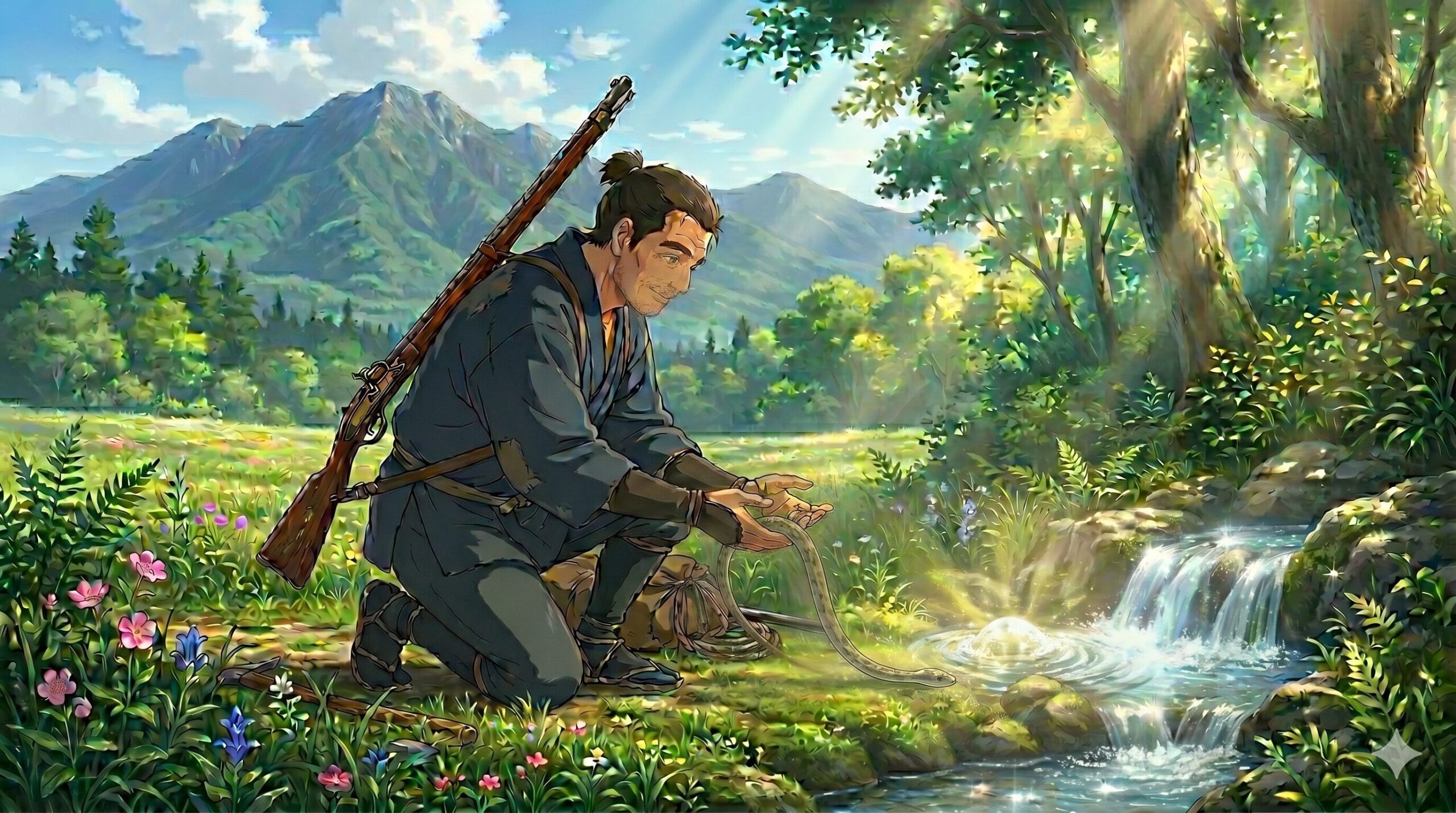
The man hurriedly began to run down the mountain. On his way, he spotted a tiny baby snake left behind on a tree branch. Feeling pity for the creature that had failed to escape, the man gently placed the baby snake on the tip of his gun and ran down the mountain with it. Once they reached the safety of a field, he carefully released the baby snake onto the ground.
After walking for a while longer, something strange happened. Even though it was not yet evening, the surroundings suddenly became pitch black. Confused, the man noticed a dilapidated hut at the end of the road. Thinking, “I should borrow a lantern here,” he stood in front of the house. An old woman emerged from inside and invited him in.
The old woman bowed deeply and said, “I am the mother of the baby snake you just saved. Please allow me to thank you.”
The man couldn’t think of anything he particularly wanted, but since he was thirsty from running down the mountain, he asked, “Could I just have a cup of water (ippai)?” However, the old woman misunderstood the Japanese word “ippai” (one cup) for its homophone “ippai” (a lot/full). She brought a single reed stalk, handed it to the man, and said, “If you drip the water inside this stalk onto the ground, a spring of water will gush forth wherever you please.” With those words, she vanished into thin air.
Suddenly, the area returned to bright daylight. Puzzled but intrigued, the man headed toward his village. When he reached the entrance of the village, he needed to relieve himself, so he propped the reed stalk against a nearby tree. At that exact moment, a strong gust of wind blew the stalk over, spilling the water inside. Instantly, a powerful, clear spring of water gushed forth from the ground where the water had spilled.
Surprised and overjoyed, the man rushed to the center of the village and dripped the remaining water from the stalk onto the ground. However, since there was only a little water left, a smaller spring formed there.
The large spring the man created first is said to be the “Hara-Nagasawa Spring” in Takane Town, Yamanashi Prefecture, and the smaller spring is known as the “Soshido Spring,” both of which are still passed down in local legends today.
Analysis: The Misunderstanding of “Ippai”
A very fascinating aspect of this story is the humorous element of the old woman (the snake’s incarnation) mishearing the hunter’s words. The linguistic misunderstanding of the Japanese homophones “ippai” (one cup) and “ippai” (a lot) ultimately resulted in a rich, inexhaustible water source for the village.
In Japanese folktales, gifts from gods or yokai are often bestowed in response to a human’s modest lack of greed. The hunter did not ask for gold or treasure; he merely sought “one cup of water” to quench his thirst. We can analyze that this selfless attitude drew out a blessing far beyond human imagination. Furthermore, the reed is a plant that grows near water and has been considered sacred and capable of purifying water since ancient times. The depiction of water being contained within a reed stalk expresses the magic of the natural world itself.
Connection to Japanese Culture: The Snake as a Water Deity and Animism
The most important elements of Japanese culture that can be deciphered from this folktale are “Animism” (nature worship) and the “Belief in Water Deities (Suijin).”
In Japan, it has long been believed that gods reside in all things in nature—mountains, rivers, rocks, and trees. Among them, the snake is considered a symbol of “death and rebirth” due to its shedding of skin. Because its slithering form resembles the flow of a river, it has been worshipped as a messenger of the dragon god or as the water deity itself. For the Japanese, traditionally an agricultural people, water is life itself, and the reverence for the gods governing water sources is incredibly strong.
The conclusion, where the hunter saves the snake’s life and is rewarded with “the water of life” (a spring) by the water deity, vividly illustrates the fundamental Japanese view of nature: by treating nature with care and living in harmony with it, nature will in turn bestow its abundant blessings upon us.
What Would You Do?
If you were this hunter and the parent of the animal you saved told you, “I will grant you any reward,” what would you ask for? And where would you create a spring using the magical reed stalk?
Please let us know your thoughts on the gratitude toward nature and the selfless heart that this story teaches!
Related Links
External Link: Wikipedia: Japanese Folklore
Internal Link: Japanese Folktale Series
日本の昔話「泉」:ヘビの恩返しと命の水
昔話のストーリー:泉
山梨県、信州との国境にそびえる八ヶ岳のふもとに、一人の猟師が住んでいました。
ある日のこと、男はいつものように山へ猟に出かけました。しかし、どうしたことか今日に限って山には動物の気配が全くなく、不気味なほど静まり返っています。不思議に思いながら歩を進めていると、にわかに辺りに煙が立ち込めてきました。山火事です。動物たちは火事の危険をいち早く察知し、皆逃げ出していたのです。
男は大急ぎで山を下り始めました。その途中、木の枝に一匹の小さなヘビの子どもが取り残されているのを見つけました。逃げ遅れてしまったヘビの子を不憫に思った男は、自分の鉄砲の先にヘビの子を乗せ、一緒に山を駆け下りました。安全な野原までたどり着くと、男はそっとヘビの子を地面に放してやりました。
それからしばらく歩き続けた時のことです。まだ日も暮れていないというのに、急に辺りが真っ暗闇に包まれました。男が戸惑っていると、道の先に一軒の古びたあばら屋が見えました。「ここで提灯でも借りよう」と男が家の前に立つと、中から一人の老婆が出てきて、男を家の中へと招き入れました。
老婆は深く頭を下げて言いました。「私は、先ほどあなたが助けてくださったヘビの子の母親です。あなたに何かお礼をさせてください」
男は特に欲しいものも思い当たりませんでしたが、山を駆け下りて喉が渇いていたため、「それでは、水を一杯もらえないか」と頼みました。すると老婆は、男が言った「一杯(コップひとつ分)」という言葉を、「いっぱい(たくさん)」と聞き間違えてしまいました。老婆は一本の葦(あし)の茎を持ってきて男に手渡すと、「この中の水を地面にたらせば、どこでも好きな場所から水が湧き出します」と言い残し、フッと姿を消してしまいました。
気がつくと辺りは元の昼間に戻っていました。男は不思議に思いながらも、自分の村へと向かいました。村の入り口まで来た時、男は少し用を足したくなり、手に持っていた葦の茎を近くの木に立てかけました。ところが、その瞬間に強い風が吹き、茎は倒れて中の水がこぼれてしまったのです。すると、水がこぼれた地面から、勢いよく清らかな水が湧き出してきました。
驚き、そして喜んだ男は、村の中心へ行き、残っていた茎の中の水を地面にたらしました。しかし、茎の中の水はすでに残り少なくなっていたため、今度は小さな泉ができました。
男が最初に作った大きな泉は、山梨県北杜市高根町長沢の「原長沢の泉」、そして後に作った小さな泉は同じ地域の「祖師堂の泉」として、今も語り継がれています。
「泉」の考察:なぜ「一杯」と「いっぱい」なのか
この物語の非常に興味深い点は、老婆(ヘビの化身)が猟師の言葉を聞き間違えるというユーモラスな要素が含まれていることです。日本語の「一杯(one cup)」と「いっぱい(a lot)」の同音異義語のすれ違いが、結果として村に枯れることのない豊かな水源をもたらしました。
日本の昔話において、神や妖怪からの贈り物は、人間のささやかな無欲さに対して与えられることが多くあります。猟師は金銀財宝を求めることはなく、ただ喉の渇きを潤す「一杯の水」を求めました。その無欲な態度が、神仏の想像を超える恩恵を引き出したと考察できます。また、葦(あし)は水辺に生える植物であり、古来より水を浄化し、神聖な力を宿すものとされてきました。葦の茎に水が収まっているという描写は、自然界の魔法そのものを表現しています。
日本文化との関連:水神としてのヘビとアニミズム
この昔話から読み解ける最も重要な日本文化の要素は、「アニミズム(自然崇拝)」と「水神信仰」です。
日本では古くから、山や川、岩や木など、自然のあらゆるものに神が宿ると考えられてきました。中でもヘビ(蛇)は、脱皮を繰り返すことから「死と再生の象徴」とされ、またその姿が川の流れに似ていることから、水神や龍神の使い、あるいは水神そのものとして崇拝されてきました。農耕民族である日本人にとって、水は命そのものであり、水源を司る神への畏敬の念は非常に強いものです。
猟師がヘビの命を救ったことで、水神からの恩返しとして「命の水(泉)」を与えられたという結末は、自然を大切に扱い、共生していくことで、自然からも豊かな恵みがもたらされるという日本人の根源的な自然観を如実に表しています。
あなたならどうしますか?
もしあなたがこの猟師だったら、助けた動物の親から「何でもお礼をします」と言われた時、何を願うでしょうか?そして、手に入れた魔法の葦の茎からどこに泉を作りますか?
この物語が教えてくれる自然への感謝と無欲の心について、ぜひあなたの考えを聞かせてください。
関連リンク
外部リンク:富士の国やまなし観光ネット(山梨県公式観光情報)
コメント