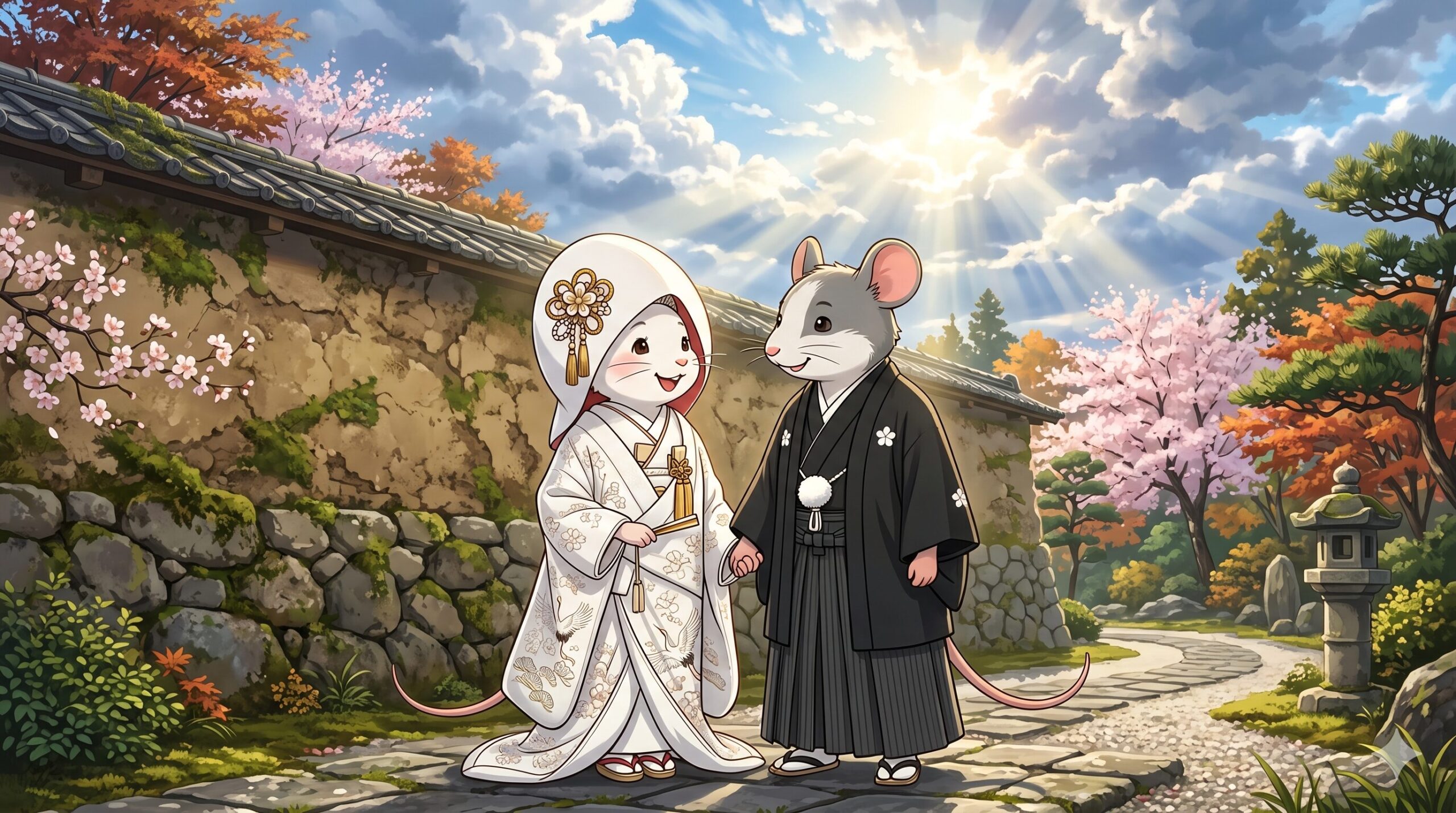
Japan is home to many fascinating folktales that have been passed down through generations. These stories are not merely entertainment for children; they are deeply ingrained with Japanese views on life and death, morality, and the philosophy of coexisting with nature. Today, we introduce a masterpiece filled with humor and profound lessons: “The Mouse’s Marriage.” Through this story, let’s explore the “true happiness” that we so easily lose sight of in our daily lives.
The Story of The Mouse’s Marriage
Once upon a time, there lived a very wealthy and respectable family of mice. The mouse couple had an only daughter whom they loved more than anything in the world. When the daughter reached a marriageable age, the father mouse made a firm decision.
“For our beloved daughter, we must find the greatest and strongest husband in the entire world!”
The father and mother mouse pondered who was the strongest in the world. They concluded, “The Sun, which brightly illuminates this world and nurtures all life, must surely be the greatest.” They immediately went to the Sun and asked him to become their daughter’s husband.
The Sun smiled and replied,
“I am flattered that you consider me the greatest in the world, but there is someone I am no match for. That is the Cloud. No matter how brightly I try to shine, if the Cloud appears and covers me, my light can no longer reach the earth.”
Convinced by this, the mouse couple then went to the Cloud. However, the Cloud said,
“I can hide the Sun, but I am certainly not the greatest. Why? Because if the Wind blows, I am blown away helplessly.”
So, the two headed for the Wind. When they presented their request to the fiercely blowing Wind, the Wind answered,
“I have the power to blow away the clouds and knock down trees. However, there is someone I simply cannot move. That is the Wall. When I come up against a sturdy earthen wall, I am completely stopped in my tracks.”
The mouse couple rejoiced that they had finally found the greatest being in the world and went to the majestic earthen wall. They pleaded, “Oh, strongest Wall in the world, please take our daughter as your bride.”
Then, the Wall said in a troubled voice,
“I appreciate you acknowledging my strength. I can indeed repel the Wind. But there is an opponent I am absolutely terrified of. That is the Mouse. Mice gnaw away at my body with their sharp teeth and make holes in me. The mice, who can destroy me from the inside, are the strongest in this world.”
Upon hearing these words, the mouse couple had a sudden realization.
“What? The strongest in the world were us mice all along!”
Thus, the mouse couple stopped their forced search for the strongest husband in the outside world. They welcomed a fine, hardworking young mouse as their son-in-law, and their daughter lived happily ever after in their own mouse world.
Story Analysis: The Bluebird is at Your Feet
At first glance, this story is a humorous tale of going around in circles, but it brilliantly strikes at universal human psychology. Out of their deep desire for their daughter’s happiness, the mouse parents fixated on the absolute condition of finding “the best in the world.” However, the “ultimate being” they continuously sought in the outside world ultimately brought them right back to their own species.
In our daily lives, we often feel the grass is greener on the other side and tend to seek higher status, more money, or a better partner. If we only look outward, thinking “there must be something better out there,” we fail to notice the wonderful value we already possess and the peaceful happiness that suits us perfectly. “The Mouse’s Marriage” teaches us that true value and happiness are not far away, but actually right at our feet.
Connection to Japanese Culture: The Virtue of “Knowing When You Have Enough”
The most important theme that can be deciphered from this folktale is the traditional Japanese value and Zen philosophy of “Knowing when one has enough” (Taru wo shiru).
Japanese culture, especially the spirit of “Wabi-sabi” represented in tea ceremonies and dry landscape gardens, finds beauty in the imperfect and rustic, and values a heart that is grateful for the present. Rather than endlessly expanding one’s desires to chase “the best in the world,” it is about accepting one’s true self and realizing the happiness that exists right here, right now. The conclusion where the mouse couple finally realizes that “we ourselves are the best” and welcomes a young mouse from their own kind is the exact manifestation of reaching this state of “knowing when enough is enough.”
Furthermore, the circular structure where natural forces (Sun, Cloud, Wind), artificial objects (Wall), and living creatures (Mice) all influence each other also represents the Japanese animistic view of nature (Yaoyorozu no Kami – eight million gods), where everything exists in harmony.
What is Your “Greatest in the World”?
How did you feel after reading this story? If you were the mouse parents, would you have looked at your own peers from the beginning? Or would you have still set off to visit the Sun?
Modern society, often through social media, forces us to constantly compare ourselves with others and aim to be number one. However, someone else’s “best in the world” is not necessarily your “best in the world.” What is the happiness quietly shining right at your feet? We would love to hear your thoughts.
Recommended Links
- Read more from our Japanese Folktale Series here
- Learn more about the origin of this tale (External link: Wikipedia)
日本の昔話「ねずみの嫁入り」:世界一の幸せはどこにある?
日本には、古くから語り継がれてきた魅力的な昔話が数多く存在します。それらの物語は、単なる子供向けのエンターテイメントにとどまらず、日本人の死生観、道徳観、そして自然と共生する哲学が深く刻み込まれています。今回は、その中でも特にユーモアと深い教訓に満ちた名作、「ねずみの嫁入り(The Mouse’s Marriage)」をご紹介します。この物語を通して、私たちがつい見失いがちな「本当の幸せ」について一緒に考えてみましょう。
ねずみの嫁入り:物語のあらすじ
昔々、あるところに、とても裕福で立派なねずみの家族が住んでいました。このねずみの夫婦には、目に入れても痛くないほど可愛らしい一人娘がいました。娘が年頃になると、お父さんねずみはこう決心しました。
「私たちの愛する娘には、この世界で一番偉くて、一番強い相手を婿に迎えよう!」
お父さんねずみとお母さんねずみは、世界で一番強いのは誰かと考えました。そして、「この世界を明るく照らし、すべての命を育む『お日様(太陽)』こそが世界一に違いない」という結論に至りました。二人は早速お日様のところへ行き、娘の婿になってほしいと頼みました。
するとお日様は笑って答えました。
「私を世界一だと言ってくれるのは嬉しいが、私にはかなわない相手がいる。それは『雲』だ。どんなに私が強く照らそうとしても、雲が現れて私を覆い隠してしまえば、私の光は地上に届かなくなってしまうのだから」
なるほどと思ったねずみの夫婦は、今度は雲のところへ行きました。しかし雲はこう言います。
「私はお日様を隠すことはできるが、決して世界一ではない。なぜなら、『風』が吹けば、私はなすすべもなく吹き飛ばされてしまうからだ」
そこで二人は風のところへ向かいました。力強く吹き荒れる風に願いを出ると、風は答えました。
「私は雲を吹き飛ばし、木々をなぎ倒す力を持っている。だが、どうしても動かせない相手がいる。それは『壁』だ。立派な土壁の前に出ると、私はぴたりと止められてしまう」
ねずみの夫婦はついに世界一の存在を見つけたと喜び、立派な土壁のところへ行きました。そして、「世界一強い壁さん、どうかうちの娘を嫁にもらってください」と頼み込みました。
すると、壁は困ったような声で言いました。
「私の強さを認めてくれるのはありがたい。風を跳ね返すこともできる。だが、私にも恐ろしくてたまらない相手がいるのだ。それは『ねずみ』だ。ねずみたちは私の体を鋭い歯でガリガリと齧り、穴を開けてしまう。私を内側から崩すことができるねずみこそが、この世で一番強いのだよ」
その言葉を聞いたねずみの夫婦は、ハッと気づきました。
「なんだ、世界で一番強いのは、私たちねずみだったのか!」
こうしてねずみの夫婦は、無理に外の世界に最強の婿を探すのをやめました。そして、立派で働き者のねずみの若者を婿に迎え、娘は自分たちと同じねずみの世界で、いつまでも幸せに暮らしました。
物語の考察:青い鳥は足元にいる
この物語は、一見すると堂々巡りのユーモラスな話ですが、人間の普遍的な心理を見事に突いています。ねずみの両親は娘の幸せを願うあまり、「世界一」という絶対的な条件に固執しました。しかし、彼らが外の世界へ外の世界へと探し求めた「最高の存在」は、最終的に自分たち自身の種族へと回帰します。
私たちは日常生活の中で、他人の芝生を青く感じ、より高い地位、より多くのお金、より優れたパートナーを求めがちです。「もっと良いものがあるはずだ」と外側にばかり目を向けていると、自分自身がすでに持っている素晴らしい価値や、身の丈に合った穏やかな幸せに気づけなくなってしまいます。「ねずみの嫁入り」は、真の価値や幸せは遠くにあるのではなく、実は自分自身の足元にあるということを教えてくれます。
日本文化との関連:「足るを知る」という美徳
この昔話から読み解くことができる最も重要なテーマは、日本の伝統的な価値観である「足るを知る(Knowing when one has enough)」という禅の哲学です。
日本の文化、特に茶道や枯山水の庭園に代表される「わび・さび」の精神は、不完全なものや素朴なものの中に美しさを見出し、現状に感謝する心を重んじます。際限なく欲望を膨らませて「世界一」を追い求めるのではなく、自分自身の身の丈(ありのままの自分)を受け入れ、今ここにある幸せに気づくこと。ねずみの夫婦が最終的に「自分たちこそが一番だ」と気づき、同族の若者を婿に迎えた結末は、まさにこの「足るを知る」境地に至ったことを示しています。
また、自然界の力(太陽、雲、風)と人工物(壁)、そして生き物(ねずみ)が互いに影響を与え合う循環の構図は、万物に神が宿ると考える日本の「アニミズム(八百万の神)」の自然観や、すべてが調和を保って存在しているという「和」の精神も表しています。
あなたにとっての「世界一」とは何ですか?
この物語を読んで、あなたはどう感じましたか? もしあなたがねずみの親だったなら、最初から自分たちの仲間に目を向けていたでしょうか? それとも、やはりお日様のところへ出かけていったでしょうか。
現代社会は、SNSなどを通じて常に他人と比較し、一番を目指すことを強要されがちです。しかし、誰かにとっての「世界一」が、あなたにとっての「世界一」とは限りません。あなたの足元で、静かに輝いている幸せは何ですか? ぜひ、あなたの考えを聞かせてください。

コメント