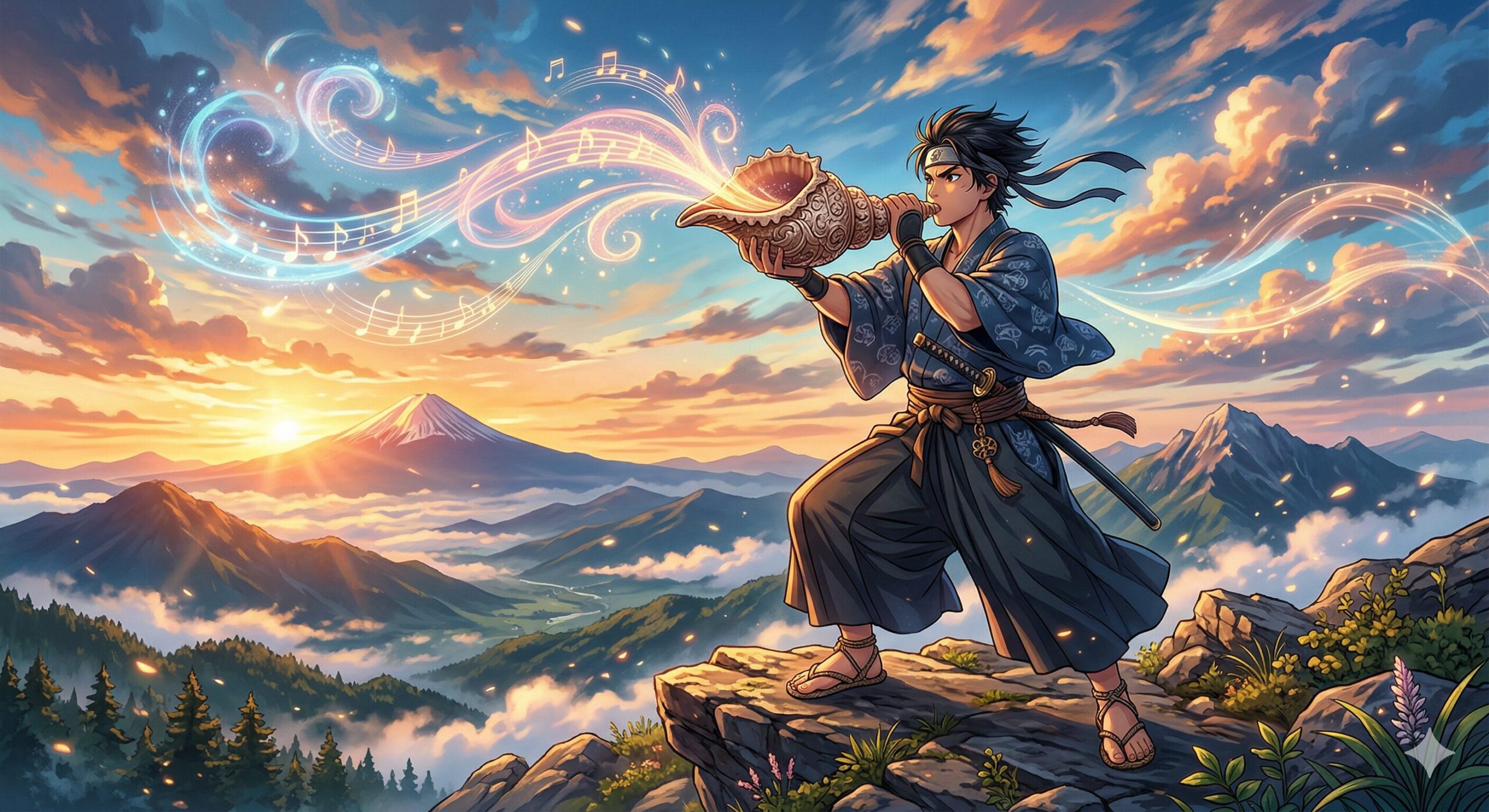
① The Story of “Kaifuki Danji” (Danji the Conch Blower)
Long ago, the feudal lord of Dewa Province (modern-day Yamagata Prefecture) held a grand conch-blowing (horagai) competition in his castle town. As proud and skilled men took turns blowing their conch shells, a young boy named Danji unexpectedly joined the contest. When Danji blew into his shell, the sound was deep, powerful, and breathtakingly beautiful, deeply moving the lord and everyone present.
Thoroughly impressed by his magnificent skill, the lord immediately rewarded Danji and hired him as the castle’s exclusive “Conch Blower.” However, Danji’s heart was not entirely satisfied. He turned to the lord and said, “My Lord, I wish to blow the legendary ‘Giant Conch of Iwaki’ located in Iwaki Province.”
The “Giant Conch of Iwaki” was a legendary, massive conch shell said to be 4 shaku (about 1.2 meters) long. It was considered impossible for any human to produce a sound from it. The lord’s retainers laughed at Danji’s words, but the lord was amused by the boy’s passion. “If I ever travel to Iwaki Province, I promise to take you with me,” the lord declared.
From that day forward, Danji blew his conch at the castle every single day. The stirring sound of his conch echoed throughout Dewa Province, becoming an essential part of the people’s lives. Over time, he became widely renowned as “Kaifuki Danji” (Danji the Conch Blower).
One day, a giant 3-shaku (about 90 cm) conch washed ashore on the beach in Sendai. Mountain ascetics, known as Yamabushi, found it and believed it must be related to the Giant Conch of Iwaki, so they decided to return it to Iwaki Province. Hearing this rumor, Danji could not sit still. He rushed to the Yamabushi and pleaded, “Please, allow me to blow that giant conch!”
As the Yamabushi watched in disbelief, Danji took a deep breath and blew into the 3-shaku conch. “BWOOOOOOSH!” An earth-shattering roar echoed through the air. The sound was so incredibly powerful that the Yamabushi were terrified, falling to their knees believing it was the voice of the gods of Mount Haguro.
Time passed, and Danji turned 27 years old. The day finally came when the lord journeyed to Iwaki Province, and true to his word, he brought Danji along. The “Giant Conch of Iwaki” was carefully enshrined deep in the mountains at a sacred shrine. Standing before the colossal 4-shaku conch, Danji quietly composed his breathing and blew into it with all his soul.
Suddenly, a massive, heaven-reaching roar—even greater than the 3-shaku conch—reverberated across the mountains of Iwaki. Danji had magnificently sounded the legendary conch that everyone said was impossible to blow. The lord shouted in immense praise, “Appare, Danji! (Brilliant, Danji!)” This monumental achievement quickly spread back to Dewa Province, and the legend of “Kaifuki Danji” was passed down among the people for generations to come.
② Deep Analysis: The Message “Kaifuki Danji” Conveys Today
This story is far more than just a success story of a talented boy. From Danji’s way of life, we can learn the spirit of “never settling for the status quo and aiming for the ultimate heights.”
Even after securing a stable position as the castle’s exclusive blower, Danji never abandoned his endless goal of blowing the unblowable giant conch. Though others laughed at him, he thoroughly believed in his skills and potential. Furthermore, in an era where social status was absolute, we cannot overlook the lord who understood a boy’s pure passion and supported his dream. The lord’s open-mindedness to provide an opportunity rather than crushing a talent adds incredible depth to this tale.
The moment Danji spent years preparing for, finally blowing the 4-shaku conch, serves as powerful proof that the limit known as “impossible” is merely an illusion created by human minds.
③ Cultural Connection: Horagai, Shugendo, and the Spirit of “Dō”
To deeply understand this folktale, we must look at the significance of the “Horagai” (conch shell trumpet) and “Shugendo” (mountain asceticism) in Japanese culture.
The “Yamabushi” mentioned in the story are practitioners of Shugendo, a unique Japanese religion blending ancient mountain worship with Buddhism. For them, the horagai is not just a musical instrument. While practically used for signaling in the mountains or warding off beasts, its solemn tone was believed to possess the “voice of Buddha preaching” and the “sacred power to ward off evil spirits.” The history and cultural significance of the Horagai are deeply tied to Japan’s religious views.
The scene where Danji overwhelms the Yamabushi with his conch, making them think it was the voice of a god, perfectly illustrates the Japanese animistic sensibility of sensing the divine in the massive, awe-inspiring sounds of nature.
Furthermore, Danji’s dedication embodies the traditional Japanese spirit of “Dō” (The Way). Just like in Sado (tea ceremony), Kendo (swordsmanship), or Judo, Japanese culture highly values the philosophy that “polishing a single skill to its absolute limit leads to spiritual enlightenment and the ultimate truth.” Through the act of blowing the conch, Danji was walking his own “Way of the Conch,” purifying his very soul.
If you want to discover more unique cultural aspects and life lessons from Japanese myths, be sure to check out other articles in our Japanese Folktale Series.
④ What is the “Giant Conch of Iwaki” in Your Life?
How did the story of “Kaifuki Danji” make you feel?
Have you ever kept your passion burning like Danji, even when people laughed and told you, “That’s impossible” or “Your dream is too big”? If you were Danji, would you have risked your stable position to challenge a giant conch that no one else could blow?
There must be a seemingly impossible “Giant Conch of Iwaki” in our lives as well. Why not take a deep breath and blow into the giant conch standing right in front of you? Please share your thoughts and the “giant conch” you are currently challenging in the comments below!
日本昔話「貝吹き旦次」:不可能に挑んだ少年の魂の音色
① 昔話「貝吹き旦次(かいふきたんじ)」の物語
むかしむかし、出羽の国(現在の山形県)のお殿様が、城下で「貝吹き(法螺貝吹き)の大会」を開きました。腕自慢の者たちが次々と法螺貝を吹き鳴らす中、旦次(たんじ)という一人の少年が飛び入りで参加しました。旦次が息を吹き込むと、その音色は深く、力強く、そして美しく響き渡り、お殿様をはじめとするその場にいた全員の心を激しく揺さぶりました。
その見事な腕前に感銘を受けたお殿様は、すぐさま旦次にご褒美を与え、お城の専属の「貝吹き役」として召し抱えました。しかし、旦次の心は満たされていませんでした。彼は殿様に向かってこう言ったのです。「殿様、私は磐城の国(現在の福島県)にあるという『磐城の大貝』を吹いてみたいのです」
「磐城の大貝」とは、長さが四尺(約1.2メートル)もある伝説の巨大な法螺貝です。人間が吹いて音を出せるような代物ではありません。家来たちは旦次の言葉を鼻で笑いましたが、お殿様は旦次の熱意を面白がり、「いつか磐城の国へ行くことがあれば、お前をお供させてやろう」と約束しました。
それからというもの、旦次は毎日お城で貝を吹き続けました。出羽の国中に響き渡る彼の貝の音色は、人々の生活の一部となり、彼はいつしか「貝吹き旦次」として広く名を轟かせるようになりました。
そんなある日、仙台の浜辺に三尺(約90センチ)もある巨大な貝が打ち上げられました。それを見つけた山伏(やまぶし)たちは、「これは磐城の大貝の仲間に違いない」と考え、磐城の国へ返しに行くことにしました。その噂を聞きつけた旦次は、居ても立っても居られず山伏たちの元へ駆けつけ、「どうか、その大貝を私に吹かせてください」と懇願しました。
山伏たちが半信半疑で見守る中、旦次が三尺の大貝に息を吹き込むと……「ブォォォォォォッ!!」と、大地を震わせるほどの轟音が響き渡りました。その凄まじい音に、山伏たちは「羽黒山の神様の声だ!」と恐れおののき、ひれ伏してしまったほどです。
そして時は流れ、旦次が27歳になった時のこと。ついにお殿様が磐城の国へ赴くことになり、旦次も約束通りお供として同行しました。「磐城の大貝」は、山奥の神聖な神社に大切に祀られていました。四尺の巨大な貝を前に、旦次は静かに息を整え、ありったけの魂を込めて吹き込みました。
すると、三尺の貝をも凌ぐ、天にまで届くような大音声が磐城の山々に響き渡ったのです。誰も音を出せないと言われていた伝説の大貝を見事に吹き鳴らした旦次に対し、お殿様は「旦次、あっぱれであるぞ!」と大声で称賛しました。この偉業はすぐに出羽の国中へ伝わり、「貝吹き旦次」の伝説として、人々の間で永遠に語り継がれることになったのです。
② 「貝吹き旦次」が現代に伝えるメッセージの考察
この物語は、単なる「才能ある少年のサクセスストーリー」にとどまりません。旦次の生き様から、私たちは「現状に満足せず、究極の高みを目指す精神」を学ぶことができます。
お城の専属という安定した地位を手に入れてもなお、旦次は「誰も吹けない大貝を吹く」という果てしない目標を捨てませんでした。周囲に笑われようとも、自分の技術と可能性を信じ抜いたのです。また、身分が絶対であった時代において、お殿様が少年の純粋な情熱を理解し、その夢を後押しした点も見逃せません。才能を潰さず、挑戦する機会を与えたお殿様の度量の広さも、この物語に深みを与えています。
旦次が時間をかけて準備し、ついに四尺の大貝を吹き鳴らした瞬間は、「不可能」という限界は人間が勝手に作り出したものに過ぎないことを証明しています。
③ 日本文化との関連:法螺貝と修験道、そして「道(ドウ)」の精神
この昔話をより深く理解するためには、日本文化における「法螺貝(ほらがい)」と「修験道(しゅげんどう)」の存在が欠かせません。
物語にも登場する「山伏(やまぶし)」は、日本古来の山岳信仰と仏教が結びついた「修験道」の修行者です。彼らにとって法螺貝は、単なる楽器ではありません。山中での合図や獣避けとして実用的に使われただけでなく、その荘厳な音色は「仏の説法」や「邪気を払う神聖な力」を持つと信じられていました。法螺貝の歴史や文化的な意味合いは、日本の宗教観と密接に結びついています。
旦次が法螺貝の音色で山伏たちを圧倒し「神の声」だと思わせた描写は、日本人が自然界の巨大な音に対して「神仏の存在」を感じてきたアニミズム的な感性を表しています。
さらに、旦次の生き方は、日本の伝統的な「道(ドウ)」の精神そのものです。茶道、剣道、柔道などに見られるように、日本では「一つの技術を極限まで磨き上げることで、精神的な悟りや神髄に到達する」という考え方を尊びます。旦次は法螺貝を吹くという行為を通じて、自身の魂を磨き上げる「法螺貝の道」を歩んでいたと言えるでしょう。
その他の日本昔話における独自の文化や教訓について知りたい方は、ぜひJapanese Folktale Seriesの他の記事もご覧ください。
④ あなたの人生における「磐城の大貝」は何ですか?
「貝吹き旦次」の物語を読んで、あなたはどのように感じましたか?
周囲から「それは無理だ」「大きすぎる夢だ」と笑われたとしても、旦次のように己の情熱を燃やし続けた経験はありますか?もしあなたが旦次だったら、安定した地位を捨ててまで、誰も鳴らせない巨大な法螺貝に挑戦したでしょうか。
私たちの人生にも、一見不可能に思える「磐城の大貝」が存在するはずです。あなたの目の前にある大貝に、いま一度、力強く息を吹き込んでみませんか?ぜひ、あなたの考えや、今挑戦している「大貝」についてコメント欄で教えてください!

コメント