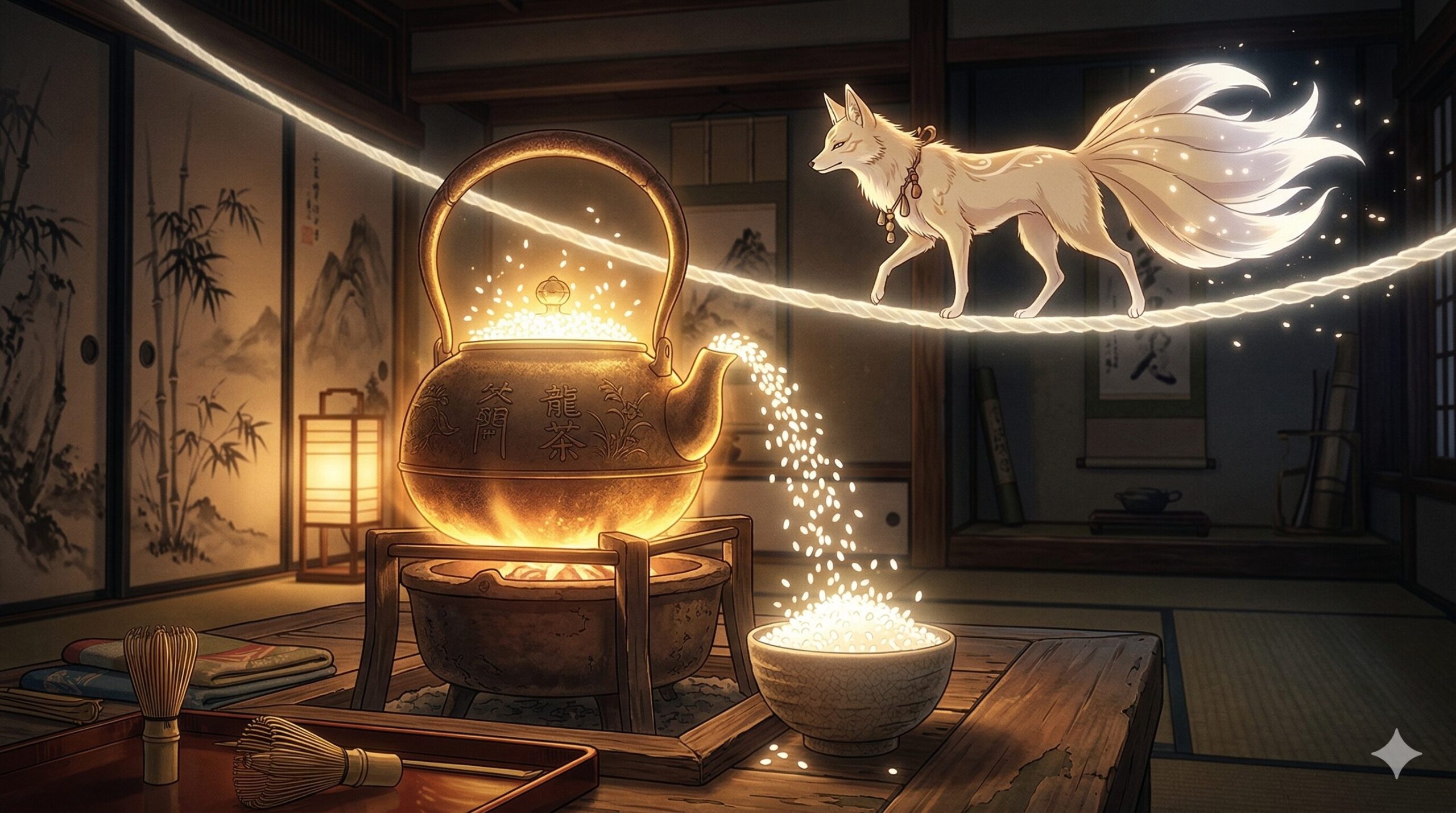
When most people think of the famous Japanese folktale “Bunbuku Chagama,” they picture a magical tea kettle that transforms into a tightrope-walking Tanuki (raccoon dog). However, there is actually another, completely different legend in Japan featuring a Fox (Kitsune) as the main character. This is the story of the “Fox’s Bunbuku Chagama,” passed down in Yonezawa City, Yamagata Prefecture.
Why a fox instead of a tanuki? And what secret was hidden within the tea kettle this fox brought? Today, as part of our Japanese Folktale Series, we will introduce the full story of this lesser-known masterpiece and explore its profound cultural background.
Yahachiro the Fox and the Priest’s Promise
Long ago, at an old temple called Jokeiin in Yonezawa, Yamagata Prefecture, there lived many foxes on the mountain behind the temple. Among them, a fox named “Yahachiro” was known as the absolute master of shapeshifting.
One day, Yahachiro disguised himself as a handsome young man and visited the head priest of Jokeiin Temple. Yahachiro made an earnest request:
“I am traveling to Fushimi Inari in Kyoto to receive a divine rank from the gods. While I am away, could you please guard this precious scroll for me?”
The kind priest readily agreed and securely hid the scroll deep within the temple.
After Yahachiro departed for Kyoto, a series of suspicious individuals visited the temple. They were evil foxes plotting to steal Yahachiro’s scroll through deception. However, the priest saw through every trick and stubbornly kept his promise to Yahachiro, protecting the scroll at all costs.
The Magical Tea Kettle’s Gratitude
A few days later, Yahachiro the Fox returned safely from Kyoto having successfully received his rank. He was deeply moved to find that the priest had protected his scroll perfectly. As a token of his immense gratitude, he presented the priest with an old iron tea kettle (Chagama).
“Please place just a single grain of rice inside this kettle,” Yahachiro instructed.
When the priest placed a single grain of rice in the kettle at night, a miraculous thing happened. By the next morning, the kettle was overflowing with pure white rice! Every day, one grain of rice would multiply into a full kettle overnight. The priest used this magical kettle to feed the poor villagers, saving many lives from starvation.
The Night the Magic Broke
One evening, Yahachiro the Fox visited the temple again. To show even more gratitude, he offered to perform a magical illusion for the priest: a magnificent fox tightrope-walking performance. Using the tea kettle skillfully while dancing lightly on the rope, Yahachiro’s performance was incredibly spectacular and humorous.
Mesmerized by the extraordinary performance, the priest completely forgot himself and shouted out loud,
“This is absolutely wonderful!”
The moment the priest’s voice broke the silence, the magical concentration shattered. Yahachiro the Fox slipped and fell from the tightrope. As he fell, the lid of the tea kettle hit the floor, shattered, and instantly turned into a mere dry leaf. His true form revealed, Yahachiro ran back to the mountain in embarrassment. From that day on, the tea kettle never multiplied rice again.
However, even without its lid, that Bunbuku Chagama is still carefully preserved today as a sacred treasure of Jokeiin Temple.
Analysis: Why do both Tanuki and Fox Tea Kettles Exist?
The standard “Tanuki’s Bunbuku Chagama” is set in Morinji Temple in Gunma Prefecture, where the kettle turns into a Tanuki, performs in a sideshow, and brings money (wealth). On the other hand, this “Fox’s Bunbuku Chagama” set in Yamagata brings “rice” instead of gold.
In Japanese folklore, Tanuki are depicted as charming, slightly foolish creatures who trick humans but are impossible to hate. Foxes (Kitsune), however, possess a dual nature: they are highly respected as divine messengers of the Inari gods, yet feared as Yokai (spirits) who use terrifying illusions. The specific detail that Yahachiro travels to Kyoto’s Inari shrine to receive a “rank” clearly indicates that he is not just an animal, but a spiritual entity seeking divine elevation.
Cultural Connection: The Sanctity of Rice and “Kotodama”
The most important cultural element we can decode from this story is the “sanctity of rice.” In ancient agrarian Japan, rice was never just food; it was a blessing from the gods and the very essence of life. The fact that the ultimate treasure brought by the fox (the messenger of the harvest god Inari) was “endless rice” rather than gold strongly reflects the core spiritual values of the Japanese people.
Furthermore, the ending where “the magic breaks the moment the priest speaks” illustrates the traditional Japanese concept of “Kotodama” (the spiritual power of words) and taboos. It teaches that one must not introduce mundane human voices into sacred rituals or magical illusions. The priest’s very human inability to suppress his emotion in the face of true wonder gives this story a deep, lingering emotional resonance.
What Would You Do?
A magical tea kettle that infinitely multiplies a single grain of rice. The priest used it selflessly for the villagers, but lost the magic due to a momentary burst of pure joy. Yet, the kettle remains in the temple, alongside the memories of the people it saved.
If you possessed a magical vessel that would completely fill up overnight with whatever you needed most, what would you put inside it? And if there was a strict rule to maintain that magic, do you think you could hold back your voice and keep the rule perfectly? Please let us know your thoughts!
Reference: Manga Nippon Mukashibanashi Database (Japanese)
「狐のくれた文福茶釜」とは?山形県に伝わるもう一つの不思議な物語
日本の有名な昔話「文福茶釜(ぶんぶくちゃがま)」といえば、綱渡りをするタヌキが化けた茶釜の物語を思い浮かべる人がほとんどです。しかし、実は日本にはもう一つ、まったく異なる動物が主人公の文福茶釜の伝説が存在します。それが、山形県米沢市に伝わる「狐(キツネ)」の文福茶釜です。
タヌキではなく、なぜキツネなのか。そして、このキツネがもたらした茶釜にはどのような秘密が隠されていたのか。今回は、Japanese Folktale Series(日本の昔話シリーズ)の一つとして、知られざる名作「狐のくれた文福茶釜」の全貌とその奥深い文化的背景をご紹介します。
弥八郎ギツネと和尚さんの約束
むかしむかし、山形県の米沢にある常慶院(じょうけいいん)という古いお寺での出来事です。このお寺の裏山にはたくさんのキツネが住んでおり、その中でも「弥八郎(やはちろう)」という名のキツネは、一番の化け上手として知られていました。
ある日のこと、弥八郎ギツネが立派な若者に化けて、常慶院の和尚さんを訪ねてきました。弥八郎は和尚さんにこう頼みました。
「私はこれから、京都の伏見稲荷へ神様の位をもらいに行ってまいります。留守の間、この大切な巻物を預かっていただけないでしょうか」
和尚さんは快く引き受け、巻物を寺の奥深くに厳重に保管しました。
弥八郎が京都へ旅立った後、お寺には次々と怪しい者たちがやってきました。彼らは弥八郎の巻物を奪おうと企む悪狐(あっこ)たちでした。しかし和尚さんは、どんな手口にも騙されず、弥八郎との約束を頑なに守り抜きました。
不思議な茶釜の恩返し
数日後、京都から無事に位をもらって帰ってきた弥八郎ギツネは、和尚さんが巻物を守り抜いてくれたことに深く感動しました。そして、お礼として古い「茶釜」を和尚さんに差し出しました。
「この茶釜に、米を一粒だけ入れておいてください」
弥八郎が言う通りに、和尚さんが夜に米を一粒だけ入れておくと、翌朝には不思議なことに、茶釜いっぱいに真っ白な米が溢れかえっていたのです。毎日一粒の米が、翌朝には満杯の米になる。和尚さんはこの不思議な茶釜を使い、村の貧しい人々にご飯を振る舞い、多くの人々を救いました。
魔法が解けた夜
ある晩、弥八郎ギツネが再びお寺を訪れました。和尚さんへのさらなるお礼として、キツネの幻術である「見事な綱渡りの芸」を見せてくれるというのです。茶釜を巧みに使いながら、軽やかに綱の上を舞う弥八郎ギツネの姿は、あまりにも見事でユーモラスでした。
その素晴らしい芸に見惚れていた和尚さんは、約束を忘れ、思わず大声を上げてしまいました。
「これは素晴らしい!」
和尚さんが声を出したその途端、幻術の集中が途切れ、弥八郎ギツネは足を滑らせて綱から落ちてしまいました。その拍子に茶釜のふたが床に落ちて割れ、ただの木の葉に変わってしまったのです。正体を現した弥八郎ギツネは恥ずかしそうに山へ逃げ帰り、それ以来、茶釜から米が増えることはなくなってしまいました。
しかし、ふたを失ったその文福茶釜は、今でも常慶院の宝物として大切に保管されています。
考察:なぜタヌキの茶釜とキツネの茶釜が存在するのか?
一般的な「タヌキの文福茶釜」は群馬県の茂林寺が舞台であり、茶釜がタヌキの姿になって綱渡りをして見世物になり、お金(富)をもたらすというストーリーです。一方、今回の「キツネの文福茶釜」は山形県の常慶院が舞台であり、富ではなく「米」をもたらします。
タヌキは日本の民間伝承において「愛嬌があり、人を化かすがどこか憎めない存在」として描かれます。対してキツネは、「神の使い(稲荷信仰)」としての神聖な側面と、「恐ろしい幻術を使う妖怪」としての側面を併せ持っています。弥八郎ギツネがわざわざ「京都の稲荷へ位をもらいに行く」という描写は、彼が単なる動物ではなく、神格化された霊的な存在であることを明確に示しています。
日本文化との関連:「米」の神聖さと「言霊」の力
この物語から読み解ける日本文化の重要な要素は「米の神聖さ」です。古来より農業国である日本では、米は単なる食料ではなく、神様からの恵みであり、命そのものでした。キツネ(稲荷神の使い)がもたらした宝物が、金銀財宝ではなく「尽きることのない米」であったことは、日本人の精神性を強く反映しています。
また、物語の結末で「和尚さんが声を出した瞬間に魔法が解ける」という展開は、日本の伝統的な「言霊(ことだま)」や「禁忌(タブー)」の概念を表しています。神聖な儀式や幻術の最中に、人間の俗なる声を介入させてはならないという教えです。素晴らしいものを前にして感情を抑えきれなかった和尚さんの人間らしさが、この物語に深い余韻を与えています。
あなたなら、どうしますか?
一粒の米を無限に増やしてくれる魔法の茶釜。和尚さんは村人のためにそれを使いましたが、一瞬の感情の爆発によってその魔法を失ってしまいました。しかし、お寺には今でも人々の記憶とともにその茶釜が残っています。
もし、あなたの手元に「翌朝には必ず必要とするものが満杯になる魔法の器」があったら、あなたは何を入れますか?そして、その器を守るための厳しいルールがあったとき、あなたは決して声を上げずにそのルールを守り抜くことができるでしょうか?ぜひ、あなたの考えを聞かせてください。
コメント