
- 1. The Story of “The Dancing Monster”: A Night Banquet of Forgotten Tools
- 2. A Deep Analysis of “The Dancing Monster”
- 3. Cultural Connections: “Tsukumogami”, “Animism”, and the “Mottainai” Spirit
- 4. Final Question: What Would You Do?
- 5. Reference Links
- ① 昔話「踊る化けもの」のストーリー:忘れ去られた道具たちの夜宴
- ② 昔話「踊る化けもの」の深い考察
- ③ 読み解ける日本文化:「付喪神」と「アニミズム」、そして「もったいない」精神
- ④ 最後に:あなたならどうしますか?
- ⑤ 関連情報・参考リンク
1. The Story of “The Dancing Monster”: A Night Banquet of Forgotten Tools
Once upon a time, a shabby traveling monk arrived at a small, remote village deep in the mountains. The sun was already setting, and a cold wind was sweeping down the slopes. When the monk asked the villagers for a place to stay for the night, they exchanged worried glances and pointed to a dilapidated, abandoned temple at the edge of the village. However, they quickly warned him with fearful voices, “You shouldn’t stay at that temple. Rumor has it that mysterious monsters appear there every single night.”
But the monk, who had undergone rigorous ascetic training, was completely unfazed. “Even if monsters do appear, with the Buddha’s protection, there is nothing to fear,” he replied with a smile, and made his way to the ruined temple. The temple had not been cared for in a long time; dust covered the floor, and cobwebs hung from the ceiling. Before night fell, the monk quickly swept the area, sat quietly in Zen meditation, and eventually went to sleep.
In the dead of night, during the “Hour of the Ox” (around 2:00 to 2:30 AM) when even the plants and trees are said to sleep, a strange, rhythmic chanting echoed through the silent main hall from out of nowhere.
“Furu-mino, furu-gasa, furu-gotoku, atcha-bunkura, kotcha-bunkura♪”
(Old straw cape, old umbrella, old trivet, swaying over here, swaying over there)
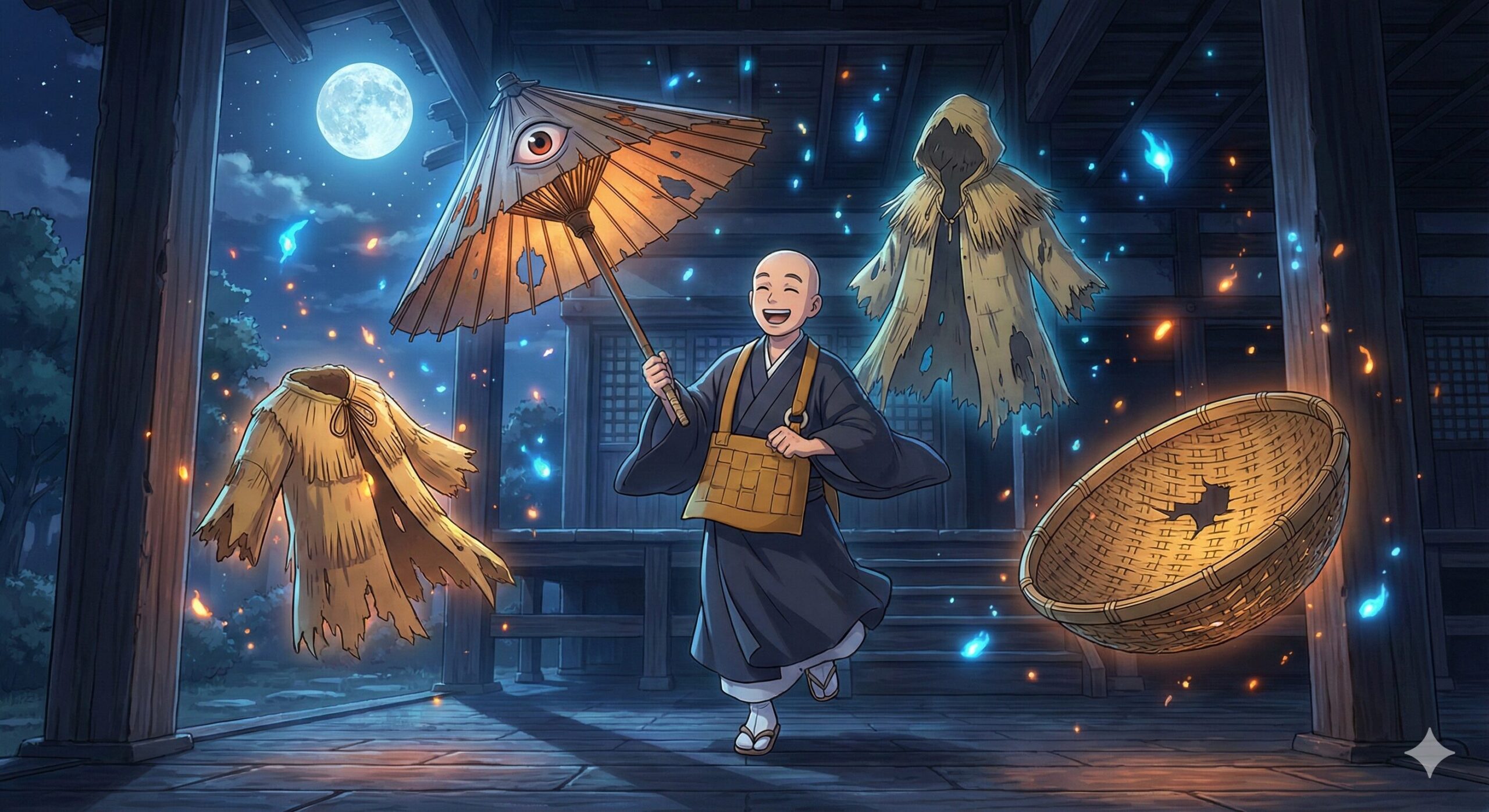
When the monk gently opened his eyes, he saw an unbelievable sight in the center of the hall. Old, broken tools—a torn paper umbrella, a tattered straw raincoat, a rusted iron trivet—had grown arms and legs and were joyfully dancing and singing in a frenzy. These were not terrifying ghosts or evil demons; they were the monsters of old tools that humans had used and eventually discarded.
Seeing this, the monk was not terrified at all. Instead, he became completely captivated by their rhythmic chanting. He stood up and jumped right into the circle of dancing monsters.
“Chan, zaruko, mizuya no sumiko no miso zaruko, zanzako zanzako♪”
(Chan, colander, the miso colander in the corner of the cupboard, zanzako zanzako)
Adding his own new lyrics, the monk lost himself in the moment and continued to dance enthusiastically with the tool monsters until the break of dawn. As the morning sun’s rays pierced the temple, the monsters vanished like an illusion.
The next morning, when the monk came down to the village for alms, the villagers were absolutely astounded. “To spend a night in that monster temple and return alive and unharmed!” deeply impressed by the monk’s extraordinary spiritual power, the villagers prepared a mountain of a feast and treated him with the utmost respect.
That night, the monk returned to the old temple and quietly waited for the monsters to appear. Late at night, the exact moment the old tools began to sing and dance again, the monk took a deep breath and let out a sharp, thunderous Zen shout: “Katsu!” Instantly, the monsters froze, and in the blink of an eye, they reverted back to their original forms—lifeless old tools—and rolled onto the floor.
The following morning, along with the villagers who came to check on him, the monk gathered all the discarded old tools from the corners of the temple. “You have all served people well for many long years. Thank you for your hard work,” he spoke to them gently. As he chanted Buddhist sutras, he respectfully placed them into a fire, allowing their souls to find peace and cross over to the next life. Ever since that incident, the villagers learned to treat even the oldest tools with care, using them with a heart full of gratitude until the very end.
2. A Deep Analysis of “The Dancing Monster”
This folktale holds a very unique and fascinating structure among Japan’s numerous ghost stories and Yokai (monster) legends. Usually, tales featuring monsters or Yokai portray them either as terrifying entities that harm humans or as divine messengers bringing warnings. However, the monsters in this story are not malevolent beings seeking to take human lives. They simply “gather and dance in the middle of the night.”
This highlights a distinctly Japanese sense of humor and tolerance. The monk’s reaction—joining their dance instead of destroying them with violence—symbolizes the Japanese spirit of “Wa” (harmony), which embraces different and alien existences. Wrapping fear in laughter and dance shows the rich imagination of people in the past, who managed to elevate even terror into a form of entertainment.
Furthermore, the scene on the second night where the monk subdues them with the Zen shout “Katsu!” illustrates Buddhist views on life, death, and salvation. He uses his spiritual authority to bring the wandering souls (in this case, the tools’ attachment to the physical world) back to reality. Finally, purifying them with fire and sutras sends them to the next dimension (attaining Buddhahood). This can be analyzed not simply as “exterminating monsters,” but as a “funeral” and a “ceremony of gratitude” for objects that have fulfilled their roles.
3. Cultural Connections: “Tsukumogami”, “Animism”, and the “Mottainai” Spirit
The most crucial essences of Japanese culture conveyed through this story are the concepts of “Tsukumogami” and “Animism.”
Since ancient times, Japanese people have believed that spirits dwell not only in natural elements like mountains, rivers, and trees, but also in the “tools” created by human hands. In particular, folklore states that a tool that has survived for 100 years acquires a spirit and transforms into a Yokai known as “Tsukumogami.” The famous Yokai of a torn paper umbrella (Kasa-obake) is a prime example. The old straw capes, umbrellas, trivets, and colanders in this story are exactly this—objects that have turned into Yokai out of the sadness of being discarded or a desire to assert that “we still exist.”
In Western cultures, objects are generally seen strictly as “matter” and rarely hold spiritual value. In Japan, however, there is a deep-rooted culture of seeing a persona in tools that have supported one’s daily life, treating them almost like family or friends and feeling gratitude toward them. Real-life customs like “Hari-kuyo” (a memorial service where broken sewing needles are thanked and stuck into soft tofu) or “Ningyo-kuyo” (doll memorial services) held annually at shrines and temples stem from the exact same spirit found in this folktale.
The lesson the villagers learned at the end of the story—”treat even old tools with care”—is the very root of the Japanese word “Mottainai,” which is highly acclaimed worldwide today. “Mottainai” is not merely about frugality or ecology. It is a highly spiritual word that encompasses respect for the inherent value of the material, reverence for the nature that produced it, and gratitude toward the person who made it. “The Dancing Monster” is a tale that perfectly embodies this beautiful aspect of the Japanese heart.
4. Final Question: What Would You Do?
How did you feel reading the story of “The Dancing Monster”? If you were to witness old tools dancing wildly in a dark, abandoned temple in the middle of the night, would you run away in fear? Or, like this courageous monk, would you jump into the bizarre circle of dancers and spend the night partying with them?
Look around you. There might be an old smartphone you no longer use, or old clothes sleeping in the back of your closet. Perhaps, they too are secretly gathering in the middle of the night, dancing just for you. The next time you are about to let go of something old, remember this story and try saying “Thank you” to it. That single word of gratitude will surely be the greatest sutra to help them rest in peace in the best possible way.
5. Reference Links
- Internal Link: Read more from our Japanese Folktale Series
- External Link: Learn more about Tsukumogami (Wikipedia)
- External Link: Source material: The Dancing Monster (Japanese Story Database)
【日本昔話】「踊る化けもの」の謎に迫る!付喪神(ツクモガミ)と日本人の「もったいない」精神
① 昔話「踊る化けもの」のストーリー:忘れ去られた道具たちの夜宴
むかしむかし、ある深い山あいの小さな村に、みすぼらしい衣服を身にまとった一人の旅の僧侶がやってきました。日はすでに傾き、冷たい風が山を下りてくる頃でした。僧侶が村人に一夜の宿を求めると、村人たちは顔を見合わせ、村の奥にある古びた無人寺を指さしました。しかし、彼らは恐ろしい声でこう付け加えました。「あのお寺には泊まらないほうがいい。夜な夜な、正体不明の化け物が出るという噂なのです」
しかし、厳しい修行を積んできた僧侶は全く動じません。「化け物が出ようと、仏の加護があれば恐るるに足らず」と笑って答え、その荒れ果てた古寺へと向かいました。寺は長い間手入れされておらず、床には埃が積もり、クモの巣が張っていました。僧侶は日が暮れる前に手早く掃除を済ませ、静かに座禅を組み、やがて床に就きました。
真夜中、草木も眠る「丑三つ時(午前2時〜2時半頃)」のことです。静まり返った本堂のどこからともなく、奇妙な囃子唄(はやしうた)が聞こえてきました。
「古みの、古がさ、古ごとく、あっちゃぶんくら、こっちゃぶんくら♪」
(古い蓑、古い傘、古い五徳が、あっちでゆらゆら、こっちでゆらゆら)
僧侶がそっと目を開けると、なんと本堂の中央で、破れた古い傘、ボロボロの藁の蓑(みの)、錆びついた五徳などの古道具たちが手足を伸ばし、歌いながら楽しそうに踊り狂っているではありませんか。恐ろしい幽霊や悪鬼ではなく、それは長い間人間に使われ、そして捨てられた道具たちの化け物でした。
これを見た僧侶は恐怖するどころか、そのリズミカルな囃子唄にすっかり心を奪われました。そして自らも立ち上がり、化け物たちの輪の中に飛び込んでいったのです。
「ちゃん、ザルコ、水屋のすみこの味噌ザルコ、ざんざこざんざこ♪」
僧侶は自ら新しい歌詞を付け加えながら、古道具の化け物たちと一緒に夜が明けるまで無我夢中で踊り続けました。朝日が差し込むと、化け物たちは幻のように姿を消しました。
翌朝、托鉢(たくはつ)のために村へ下りてきた僧侶を見て、村人たちは腰を抜かさんばかりに驚きました。「あの化け物寺で一夜を過ごして、五体満足で生きて帰ってくるとは!」村人たちは僧侶の並外れた法力に深く感銘を受け、山ほどのご馳走を用意して手厚くもてなしました。
その夜、僧侶は再び古寺へ戻り、じっと化け物たちが現れるのを待ちました。夜更けになり、再び古道具たちが歌い踊り始めたその瞬間、僧侶は大きく息を吸い込み、雷鳴のような声で「喝(かつ)!」と鋭い気合いを放ちました。すると、化け物たちの動きはピタリと止まり、瞬く間に本来の動かない古道具の姿へと戻って床に転がりました。
翌朝、様子を見にきた村人たちと共に、僧侶は寺の隅に打ち捨てられていた古道具たちを一箇所に集めました。「お前たちも、長年人々のために尽くしてくれたのだな。ご苦労であった」と語りかけ、お経を唱えながら丁寧に火にくべ、彼らの魂を成仏させました。この出来事以来、村人たちはどんな古い道具であっても、決して粗末に扱うことなく、最後まで感謝の気持ちを持って大切に使うようになったということです。
② 昔話「踊る化けもの」の深い考察
この「踊る化けもの」は、日本の数ある怪談や妖怪譚の中でも非常に特異で、かつ魅力的な構造を持っています。通常、化け物や妖怪が登場する物語は、人間に危害を加える恐怖の対象として描かれるか、あるいは神聖な存在としての警告をもたらす役割を担います。しかし、この物語の化け物たちは、人間の命を奪うような恐ろしい存在ではありません。彼らはただ「夜中に集まって踊るだけ」なのです。
ここには、日本特有のユーモアと寛容性が表れています。僧侶が彼らを退治する(暴力で破壊する)のではなく、自ら輪に入って一緒に踊り明かすという行動は、異質な存在を受け入れる日本的な調和(和の精神)を象徴しています。恐怖を笑いと踊りで包み込むこの描写は、恐怖心すらもエンターテインメントへと昇華させる昔の人々の豊かな想像力を示しています。
また、二日目の夜に僧侶が「喝!」という禅の気合いで彼らを鎮める場面は、仏教的な死生観と救済のプロセスを描いています。迷い出た魂(この場合は道具の執着)を叱咤によって現実に引き戻し、最後は火と読経によって清め、次の次元(成仏)へと送り出す。これは、単なる「化け物退治」ではなく、役割を終えたものに対する「葬儀」であり「感謝の儀式」としての意味合いを強く持っていると考察できます。
③ 読み解ける日本文化:「付喪神」と「アニミズム」、そして「もったいない」精神
この物語が私たちに伝えている最も重要な日本文化の真髄は、「付喪神(つくもがみ)」の概念と「アニミズム(精霊信仰)」です。
日本では古来より、山や川、木々といった自然物だけでなく、人間が作り出した「道具」にも魂が宿ると信じられてきました。特に、作られてから100年という長い年月を経た道具は、精霊を宿して「付喪神」という妖怪に変化するとされています。破れ傘の妖怪(唐傘お化け)などがその代表例です。この物語に登場する古い蓑や傘、五徳、ザルたちは、まさにこの付喪神の初期段階、あるいは捨てられた悲しみや「まだまだ自分たちは存在している」という自己主張から妖怪化したものと言えます。
西洋の文化圏では、物はあくまで「物質」であり、霊的な価値を持つことは稀です。しかし日本では、長い間自分たちの生活を支えてくれた道具に対して、まるで家族や友人のように人格を見出し、感謝の念を抱く文化があります。毎年全国の神社仏閣で行われる「針供養(折れた縫い針に感謝し、柔らかい豆腐に刺して供養する行事)」や「人形供養」は、この物語と全く同じ精神から生まれた現実の風習です。
そして、物語の結末で村人たちが学んだ「古道具といえども大切に扱う」という教訓は、現代世界で高く評価されている日本の「もったいない(Mottainai)」という言葉のルーツそのものです。「もったいない」は単なる節約やエコの精神ではありません。その物質が持つ本来の価値、それを生み出した自然への敬意、そして作ってくれた人への感謝が込められた、極めて精神性の高い言葉なのです。「踊る化けもの」は、この美しい日本人の心を見事に体現した物語と言えるでしょう。
④ 最後に:あなたならどうしますか?
この「踊る化けもの」の物語を読んで、あなたはどのように感じましたか? もしあなたが、真夜中の暗いお寺で、古い道具たちが踊り狂っているのを目撃したら、恐れをなして逃げ出しますか? それとも、この肝の座ったお坊さんのように、自らその奇妙な踊りの輪に飛び込んで一緒に夜を明かすでしょうか?
私たちの身の回りにも、使われなくなった古いスマートフォンや、クローゼットの奥で眠っている古い服が溢れています。もしかすると、それらも夜中にこっそり集まって、あなたのために踊っているかもしれません。次に何か古い物を手放そうとする時、この物語を思い出し、一度「ありがとう」と声をかけてみませんか? あなたのその一言が、彼らを最高の形で成仏させる最高のお経になるはずです。
コメント