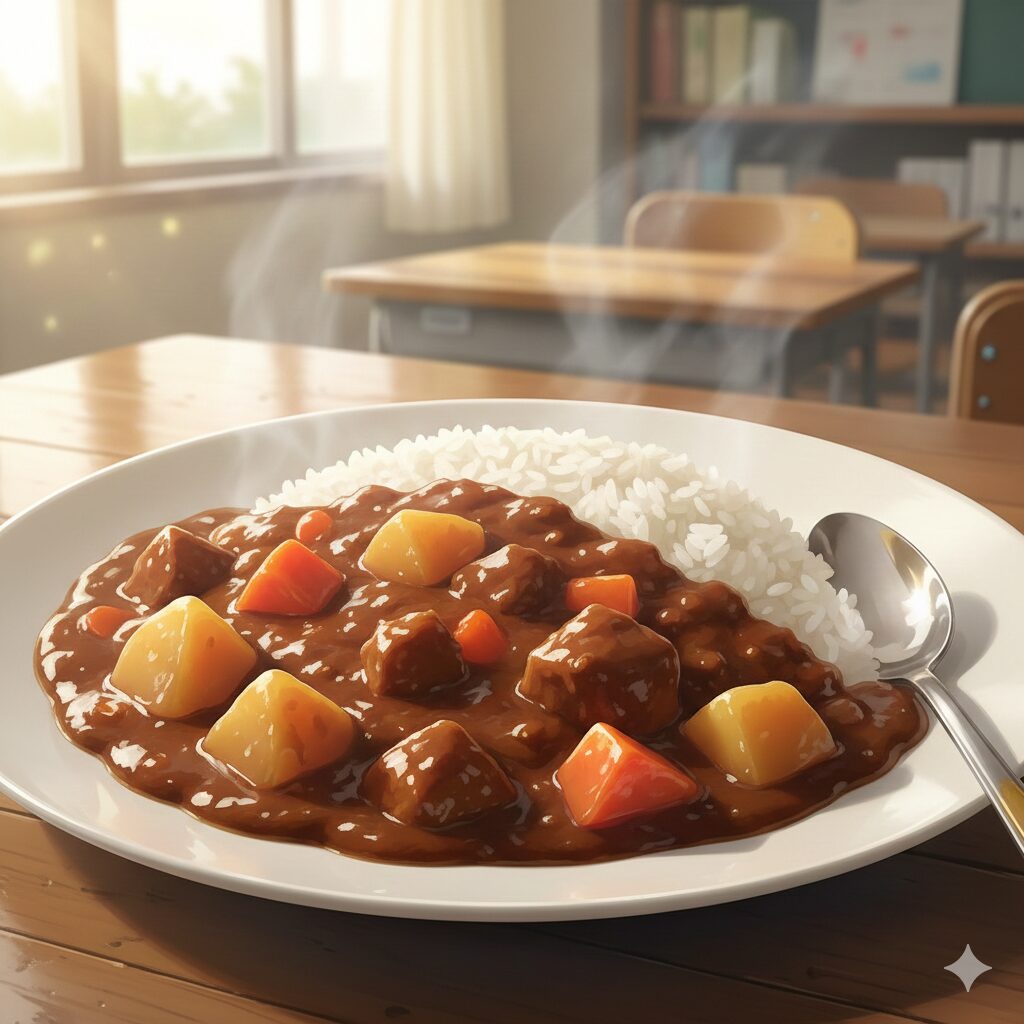
There is a dish that shocks international tourists visiting Japan almost as much as sushi or ramen. It is “Curry Rice.” Neither strictly Indian nor Thai, this brown, thick, savory sauce has evolved uniquely within Japan. January 22nd is “Curry Rice Day,” a day to celebrate this beloved culinary icon.
Why was this specific date chosen? Hidden within the answer are stories of Japan’s post-war reconstruction, childhood nutrition, and the Japanese genius for adapting foreign cultures. Today, let’s unravel not just a story about food, but the history that shapes modern Japanese identity.

Historical Background: The Deep Bond with School Lunches
January 22nd was designated as “Curry Rice Day” in 1982. The decision was made by the National Council of School Dietitians. To commemorate the 35th anniversary of the school lunch program, they called for elementary and junior high schools across the country to serve curry rice simultaneously on this date.
Why School Lunch (Kyushoku)?
The history of school lunches in Japan was not a smooth path. After World War II, amidst food shortages, school lunches were reinstated with aid from organizations like LARA (Licensed Agencies for Relief in Asia) to improve children’s nutrition. By 1976, rice-based school lunches (as opposed to bread only) were fully introduced.
Curry rice was, and remains, the undisputed “No. 1 Popular Menu” for children. Even kids who disliked vegetables would eat carrots and onions if they were in curry. It was nutritionally balanced and encouraged children to eat more rice. The event of eating the same menu nationwide was a national phenomenon that only curry rice could achieve.
Decoding “Curry Rice” as Japanese Culture
Many international readers might wonder, “Why do Japanese people treat curry as their own traditional food?” The answer dates back to the Meiji Era (1868-1912).
Civilization via the UK
Curry did not come to Japan directly from India; it arrived via the United Kingdom. At the time, the British Navy ate a stew-like curry thickened with flour. The Japanese Navy adopted this as a nutritional meal to combat beriberi (a vitamin deficiency). Therefore, Japanese curry retains strong influences of British stew culture: thickened with wheat flour and containing potatoes, carrots, and onions.
The Invention of “Curry Roux”
What solidified curry culture in Japan was the invention of solid “Curry Roux.” Even without knowledge of complex spice blending, anyone could make fail-proof, delicious curry simply by dissolving these blocks in a pot. This convenience elevated curry to the throne of home cooking.
If you visit a Japanese supermarket, you will find countless boxes of curry roux, ranging from sweet to extremely spicy. This is a crystallization of world-class food processing technology born from Japan’s pursuit of both “efficiency” and “quality.”
The “Galapagos” Evolution of Toppings
Furthermore, the spirit of Japanese “fusion” is evident in the toppings.
- Katsu Curry: A pork cutlet (Tonkatsu) on top—the incarnation of volume.
- Curry Udon: Thick Japanese noodles in a dashi-broth curry soup.
- Yaki Curry: Baked curry rice topped with cheese and a raw egg.
These have gone beyond the framework of general “Curry” to establish a unique genre called “Japanese Curry.”
To Our Readers
Japanese Curry Rice is not just a spicy dish. It is a memory of school lunches that supported post-war recovery, a symbol of family togetherness, and the very spirit of Japanese people who accept foreign cultures and transform them into something uniquely their own.
If you visit Japan, please try not only high-end sushi but also curry from a street corner chain or an old-fashioned coffee shop (Kissaten). You will find the unadorned, authentic taste of Japanese daily life there.
What comes to mind when you think of your country’s “Comfort Food”? And if you could try Japanese curry, what topping would you choose?
Related Links
- What’s Today’s Special Day Series – Explore more unique Japanese anniversaries here.
1月22日はカレーライスの日:日本の「国民食」が学校給食で輝いた日
日本を訪れる外国人観光客が、寿司やラーメンと同じくらい衝撃を受ける料理があります。それは「カレーライス」です。インドのカレーとも、タイのカレーとも違う、日本独自に進化を遂げた茶色くとろみのあるソース。1月22日は、この愛すべき料理を祝う「カレーライスの日」です。
なぜこの日が記念日となったのか。そこには、戦後の日本の復興、子供たちの栄養、そして異文化を自国流にアレンジする日本人の天才的な適応能力が隠されています。今日は、単なる食べ物の話ではなく、現代日本のアイデンティティを形成する「食の歴史」を紐解いていきましょう。
1月22日が選ばれた歴史的背景:給食との深い絆
1月22日が「カレーライスの日」と定められたのは、1982年(昭和57年)のことです。決定したのは、全国学校栄養士協議会でした。この年、学校給食創立35周年を記念して、1月22日に全国の小中学校で一斉にカレーライスを給食のメニューとして提供しようと呼びかけたのです。
なぜ学校給食だったのか?
日本の学校給食の歴史は、決して平坦なものではありませんでした。第二次世界大戦後、食糧難に苦しむ日本において、子供たちの栄養状態を改善するために、アメリカのLARA(アジア救済公認団体)などの支援を受けて給食が再開されました。1976年には米飯給食(パンではなくご飯を提供する給食)が本格的に導入されます。
カレーライスは、子供たちにとって「不動の人気ナンバーワンメニュー」でした。野菜嫌いな子供でも、カレーに入っていれば人参や玉ねぎを食べられる。栄養バランスが良く、ご飯が進む。全国一斉に同じメニューを食べるというイベントは、カレーライスだからこそ実現できた国民的行事だったのです。
日本文化としての「カレーライス」を読み解く
ここで多くの海外読者が疑問に思うでしょう。「なぜ日本人はカレーを自分たちの料理のように扱うのか?」と。その答えは、明治時代(1868-1912)にまで遡ります。
英国経由の文明開化
日本にカレーが伝わったのは、インドから直接ではありません。イギリスを経由して伝わりました。当時、イギリス海軍ではシチューのようなとろみのあるカレーが食べられており、これを日本海軍が脚気(かっけ)対策の栄養食として採用したのです。そのため、日本のカレーは「小麦粉でとろみをつける」「ジャガイモ、人参、玉ねぎが入る」という、イギリスのシチュー文化の影響を色濃く残しています。
「カレールー」という発明
日本のカレー文化を決定づけたのは、固形の「カレールー」の発明です。複雑なスパイスの調合を知らなくても、ブロック状のルーを鍋に溶かすだけで、誰でも失敗なく美味しいカレーが作れる。この簡便さが、カレーを家庭料理の王座へと押し上げました。
日本のスーパーマーケットに行けば、甘口から激辛まで、無数のカレールーが棚に並んでいます。これは日本人が「効率」と「品質」を同時に追求した結果生まれた、世界に誇るべき食品加工技術の結晶なのです。
ガラパゴス化するトッピング文化
さらに日本文化の「融合(フュージョン)」の精神が見て取れるのがトッピングです。
- カツカレー:豚肉のフライ(トンカツ)を乗せた、ボリュームの化身。
- カレーうどん:ご飯の代わりに日本の太い麺を入れる、出汁の効いた傑作。
- 焼きカレー:チーズと卵を乗せてオーブンで焼く、グラタン風カレー。
これらはもはや「Curry」という枠を超え、「Japanese Curry」という独自のジャンルを確立しています。
読者の皆様へ
日本のカレーライスは、単なるスパイシーな料理ではありません。それは、戦後の復興を支えた学校給食の記憶であり、家族団欒の象徴であり、異国の文化を受け入れて独自のものに変えてしまう日本人の精神そのものです。
もしあなたが日本を訪れたら、高級な寿司店だけでなく、街角のカレーチェーン店や、古い喫茶店のカレーを食べてみてください。そこには、飾らない日本の日常の味が詰まっています。
あなたは、自分の国の「懐かしい味(Comfort Food)」といえば何を思い浮かべますか?そして、日本のカレーにどんなトッピングをしてみたいですか?
関連リンク
- 今日は何の日シリーズ一覧 – 日本のユニークな記念日をもっと知りたい方はこちら。


コメント