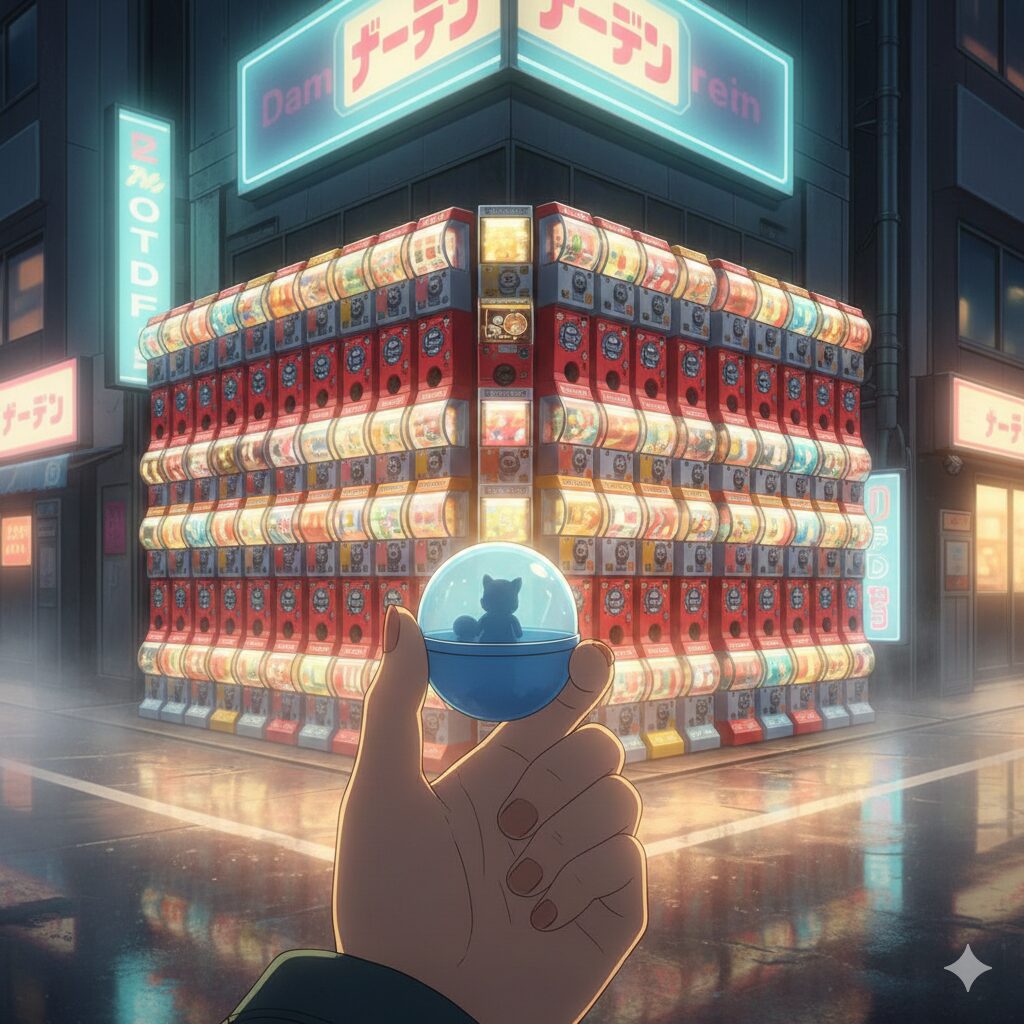
There is a sight that often surprises travelers the moment they land in Japan. It isn’t a temple or a neon sign, but rows upon rows of hundreds of colorful machines lining the arrival lobby. You insert coins, turn a handle with a satisfying click-clack, and out rolls a small plastic sphere. Today, we dive deep into this beloved Japanese culture to celebrate February 17th, officially recognized as “Gacha Day.”

What is Gacha Day? Historical Background
February 17th is certified by the Japan Anniversary Association as “Gacha Day.” Why this specific date? It commemorates the founding of the company that pioneered the history of capsule toys in Japan.
On this day in 1965, “Penny Co., Ltd.” was established, becoming the first company to introduce capsule toy machines to Japan. At that time, these machines imported from the United States were revolutionary. Originally costing just 10 yen per play, they dispensed cheap charms or candy. Yet, Japanese children became captivated by the thrill of “not knowing what you’ll get.”
More than half a century later, the modern “Gacha” (or Gashapon) has evolved far beyond mere child’s play. They have transformed into intricate works of art, costing anywhere from 500 to 1,500 yen per turn. The variety is staggering: from popular anime characters and exquisite miniature Buddhist statues to replicas of designer furniture, and even maniacal items like “bus stop buttons” or “public payphones.” It is said that over 300 new types of items are released every single month.
The Essence of Japanese Culture Condensed in a Capsule
Do not underestimate them as mere plastic toys. Gacha culture deeply reflects Japanese spirituality and aesthetics. Let’s decode the characteristics of Japanese culture through three perspectives found in these machines.
1. The Aesthetic of “Miniaturization”
Since ancient times, Japan has held a cultural appreciation for finding beauty in making large things small and intricate. Representative examples include “Netsuke” (intricate toggles used for kimonos) and “Bonsai” (landscapes recreated in pots).
Modern Gacha is the legitimate successor to this aesthetic. Whether it’s an engine model built with the exact same structure as a real car, or a “squishy” toy that perfectly replicates the texture of freshly baked bread, artisans pour a borderline obsessive level of passion and technology into this palm-sized world. This craftsmanship is why collectors around the world are captivated.
2. The Love of Serendipity
Why do Japanese people pay money for a random machine instead of buying exactly what they want directly? This connects to the spirit of “Omikuji” (fortune slips) found at Shinto shrines and Buddhist temples.
It is the enjoyment of fate—the “thrill of the unknown.” It is the appreciation of a chance encounter beyond one’s own intention. Even if you don’t get the item you wanted, you might think, “This is also destiny,” or conversely, show the tenacity to keep spinning until you win. This process itself is consumed as a small entertainment in daily life.
3. Communication Beyond Language
The reason massive numbers of Gacha machines are installed at airports isn’t just to help tourists get rid of leftover coins. It is because capsule toys are a non-verbal media that can be enjoyed without instructions.
An exquisite sushi keychain or a samurai figure speaks eloquently of “Japan” without needing words. They are beloved across borders as high-quality, yet affordable souvenirs.
So, What Will You Spin?
Right now, Japanese street corners are overflowing with unbelievable Gacha options. “ID photos of complete strangers.” “Handwritten curry recipes from someone’s mother.” “Just a rock.” Believe it or not, these were actual products that sold out due to immense popularity.
If you were in Japan, standing before a wall of 1,000 Gacha machines, what would you do? Would you choose a safe, high-quality anime figure? Or would you challenge yourself with a “mystery item” packed with Japan’s surreal and strange humor?
The heartbeat you feel the moment you open that small capsule is a universal language. We hope you find your own favorite piece of “Little Japan.”
Question for Readers:
Are you the type to keep spinning until you get exactly what you want, or do you accept the destiny of a single spin? Let me know your style in the comments below!
Related Links & References
2月17日は何の日?日本の「ガチャの日」が教える、小さなカプセルに詰まった無限の世界
日本を訪れる旅行者が、空港に降り立って最初に驚く光景があります。それは、到着ロビーにズラリと並んだ数百台ものカラフルな機械の列です。硬貨を入れてハンドルを回し、コロンと出てくる小さなカプセル。そう、今日はこの愛すべき日本の文化、「ガチャ(Gacha)」の記念日、2月17日について深く掘り下げていきます。
ガチャの日とは?その歴史的背景
毎年2月17日は、日本記念日協会によって認定された「ガチャの日」です。なぜこの日付なのか?それは、日本のカプセルトイの歴史を切り拓いたある企業の誕生日に由来します。
1965年(昭和40年)のこの日、日本で初めてカプセルトイのマシンを導入した企業「株式会社ペニイ」が創立されました。当時の日本において、アメリカから輸入されたこの販売機は革命的でした。当初は1回10円。中身は安価なチャームや飴玉でしたが、子どもたちは「何が出るかわからない」というスリルに夢中になりました。
それから半世紀以上が経過し、現在の「ガチャ(またはガシャポン)」は、単なる子供騙しのおもちゃではありません。1回500円〜1500円もするような、精巧な芸術品へと進化を遂げました。アニメキャラクターはもちろん、精巧な仏像のミニチュア、実際の企業の家具、さらには「バスの降車ボタン」や「公衆電話」といったマニアックなアイテムまで、その種類は毎月300種類以上もの新作が発売されていると言われています。
カプセルの中に凝縮された日本文化の真髄
たかがプラスチックのおもちゃと侮ってはいけません。このガチャ文化には、日本人の精神性や美意識が色濃く反映されています。ここから読み解ける日本文化の特性を3つの視点で解説しましょう。
1. 「縮み」の美学(Miniaturization)
日本には古来より、大きなものを小さく精巧にすることに美を見出す文化があります。着物の帯留めとして使われた「根付(Netsuke)」や、小さな庭園を表現する「盆栽(Bonsai)」がその代表です。
現代のガチャは、この「縮みの美学」の正当な後継者です。実車と全く同じ構造で作られたエンジンの模型や、本物のパンの質感を極限まで再現したスクイーズなど、手のひらサイズの世界に狂気じみた情熱と技術を注ぎ込む。この職人芸(クラフトマンシップ)こそが、世界中のコレクターを魅了してやまない理由です。
2. 偶然性を愛する心(Serendipity)
なぜ日本人は、欲しいものを直接買わずに、わざわざランダムに出てくる機械にお金を払うのでしょうか?これは日本の神社仏閣にある「おみくじ(Omikuji)」の精神に通じています。
「何が出るかわからない」という運命性。自分の意図を超えた偶然の出会いを楽しむ心です。欲しいものが出なかったとしても、「これもまた一興」と捉えたり、あるいは出るまで回し続ける執着を見せたり。このプロセス自体が、日常における小さなエンターテインメントとして消費されているのです。
3. 言語を超えたコミュニケーション
空港に大量のガチャが設置されている理由は、それが「余った小銭を消費するため」だけではありません。カプセルトイは説明書がなくても楽しめる、ノンバーバル(非言語)なメディアだからです。
精巧な日本の寿司のキーホルダーや、侍のフィギュアは、言葉を介さずに「日本」を雄弁に語ります。それは安価でありながら、品質の高いお土産(Souvenir)として、国境を超えて愛されているのです。
あなたなら、何を回しますか?
今、日本の街角には信じられないようなガチャが溢れています。 「誰かが手書きした赤の他人の証明写真」 「お母さんの手作りカレーのレシピ」 「ただの石」 これらは実際に販売され、完売するほどの人気を博しました。
もしあなたが日本に来て、目の前に1000台のガチャマシンが並んでいたとしたら。あなたは安全なアニメキャラクターのフィギュアを選びますか?それとも、日本のシュールで奇妙なユーモアが詰まった「謎のアイテム」に挑戦しますか?
小さなカプセルを開ける瞬間のドキドキは、世界共通の言語です。ぜひ、あなたのお気に入りの「小さな日本」を見つけてみてください。
読者の皆様へ:
あなたは「欲しいものが手に入るまで回し続ける」タイプですか?それとも「一度きりの運命を受け入れる」タイプですか?ぜひコメント欄であなたのスタイルを教えてください!


コメント