Japan’s rich natural landscapes and ancient history have birthed countless mystical tales. Today, we introduce “Rokuzae’s Dream” (Takada Rokuzaemon no Yume), a slightly eerie yet deeply philosophical folktale passed down in the Izumo region of Shimane Prefecture—a place famously known as the gathering land of the gods. This story is not merely a heroic tale of monster-slaying. It is an epic time-slip fantasy that questions human courage, hubris, and what truly matters in life.

1. The Story: The Demon’s Cave and the Vanished Village
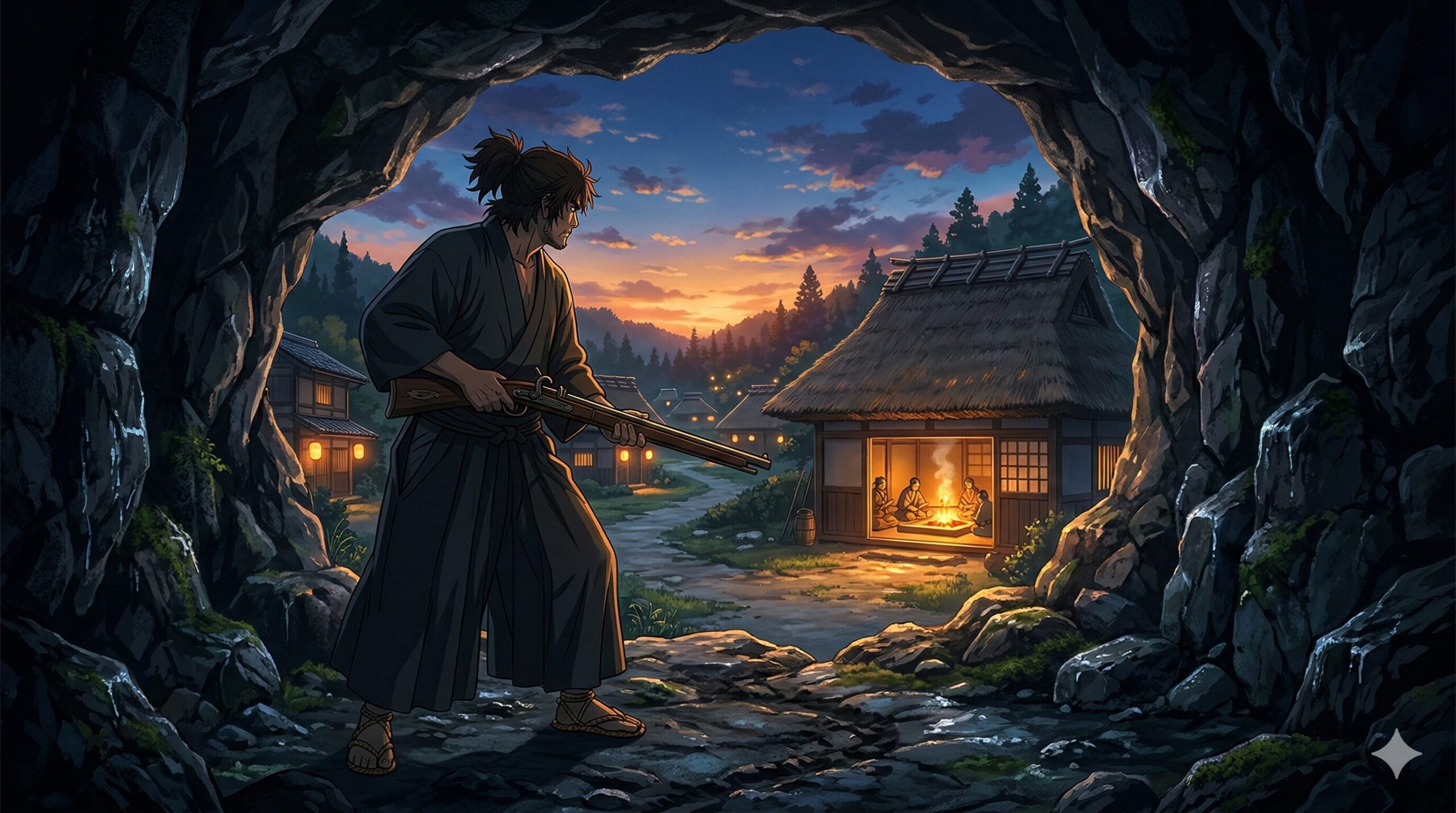
Long ago, in a rural village called Yogoro in Takada, Izumo, lived a highly skilled hunter and gunner named Rokuzae. Known throughout the village as a man who feared nothing, Rokuzae possessed absolute confidence in his strength and bravery.
One winter day, Rokuzae suddenly declared, “I am going to the Demon’s Cave today.” The “Demon’s Cave” (Oni no Ana) was a bottomless cavern rumored to house terrifying demons. It was a taboo place that no villager dared to approach. Despite his wife’s desperate tears and pleas to stay, Rokuzae ignored her, shouldered his matchlock gun, and marched toward the cave early the next morning.
As he trudged deeper into the pitch-black darkness, he lost his footing and fell into a massive, deep abyss. Barely conscious, he stood up and noticed a faint light in the distance. He walked toward the glow, stepped out of the exit, and found himself looking at an unfamiliar, beautiful village surrounded by lush fields.
The village seemed to be hosting a lively festival, with cheerful traditional music echoing through the air. However, from one particular house, Rokuzae heard agonizing cries. Upon asking what was wrong, he learned a horrifying truth: every year, on the night of the local deity’s festival, the village had to offer a young maiden as a human sacrifice to appease a monster. This year, the daughter of that weeping family had drawn the fatal lot.
Bold and fearless, Rokuzae offered, “Alright, I will take the girl’s place and slay this monster for you.” That night, he hid himself inside a nagamochi (a large wooden chest) placed at the shrine, clutching his gun and holding his breath.
Just past midnight, accompanied by a warm, foul wind, two massive monsters emerged from the inner shrine. Seizing the moment, Rokuzae shoved his gun barrel through a hole in the chest and fired with a thunderous roar. When dawn broke, Rokuzae and the villagers went behind the shrine to find two giant mujina (shape-shifting badger yokai) lying dead. These beasts were the true identity of the monsters that had tormented the village for generations.
With tearful gratitude, the villagers showered Rokuzae with gifts. Triumphant, he began his journey back to his own village.
But when he arrived, something was terribly wrong. His house was entirely gone, and the village looked completely different. He asked a passing old man what had happened to his home. The old man replied:
“Rokuzae? Ah, I heard about him from my grandfather’s grandfather. A long time ago, there was a skilled hunter named Rokuzae in this village, but it is said he entered the Demon’s Cave and never returned.”
To his horror, Rokuzae realized that while he had spent only a few days in the alternate world, hundreds of years had passed in his original world. His beloved wife and everyone he knew were long gone.
“If I had known this would happen, I would have listened to my wife. I should never have gone to the Demon’s Cave…”
Rokuzae collapsed in tears in front of a lone, ancient gravestone in the corner of a field—his wife’s grave.
“…Dear. My dear.”
Suddenly, a familiar, loving voice reached his ears. Rokuzae gasped and opened his eyes. He found himself dozing comfortably in front of the warm irori (traditional sunken hearth) in his own home. The fire was crackling, and beside him was his wife, looking at him with concern.
The terrifying cave, the monster hunt, and the despairing passage of time—it had all been a dream.
Rokuzae gripped his wife’s hand tightly and said from the bottom of his heart, “Being by your side is the absolute best.” From that day forward, he never spoke of going to the Demon’s Cave again.
2. Analysis: Why the “Dream Ending”?
In modern terms, this story concludes with a “dream ending” (Yume-ochi). However, this is not a lazy plot device; it carries a highly sophisticated psychological message.
Rokuzae was a man who believed that with strength and courage, he could conquer anything. His journey to the cave was merely a dangerous game to stroke his own ego. But in his dream, he paid the ultimate price for his “heroic glory”—he experienced the absolute despair of permanently losing his ordinary life and his family.
Humans often chase the thrill of the extraordinary, overlooking the quiet happiness right at their feet. Rokuzae’s dream was a severe warning from his subconscious mind about what he truly stood to lose. His final words upon waking are filled with the raw relief and profound realization of a man who survived ultimate terror.
3. Connection to Japanese Culture: Portals and Sacrifices
This folktale serves as a fascinating window into ancient Japanese spirituality and culture.
- The Cave as a Boundary (Kekkai): In Japanese mythology and folklore, caves and tunnels frequently act as borders separating the human world from the “Other World” (Makai or the spirit realm). Falling into the earth to reach another dimension ties deeply into Japan’s ancient views on life and death.
- Human Sacrifice (Hitobashira/Ikenie): The plot of offering a maiden to a monster perfectly mirrors the most famous myth of the Izumo region: the slaying of the eight-headed serpent, Yamata no Orochi. Just as the god Susanoo saved Princess Kushinada, Rokuzae played the role of a mythical hero.
- Yokai “Mujina”: Badgers and raccoon dogs (Mujina/Tanuki) have long been feared in Japan as shape-shifting Yokai that deceive humans or act as corrupted nature spirits demanding worship.
- The Urashima Taro Effect (Time Slip): The concept that time moves differently in the realm of gods and spirits is a recurring theme in Japanese folklore, most notably in the story of Urashima Taro. It reflects the ancient belief that human concepts of time hold no power in the mystical world.
4. What Would You Do?
“Rokuzae’s Dream” leaves us with a sharp, lingering question. If you were in Rokuzae’s shoes, would you ignore your family’s warnings to prove your strength in an unknown abyss?
And when you woke up by the hearth, realizing it was all a dream, how would you feel? Would you be disappointed to return to your boring, daily routine? Or would you weep with gratitude for the mundane reality, just as Rokuzae did?
In our fast-paced modern society, we sometimes feel anxious, believing we need grand adventures or massive success. But perhaps our most priceless treasure is already sitting right beside us by the “warm hearth.” After reading this tale, what is the one thing you want to cherish most today? We invite you to ask your own heart.
References and Related Links
- Japanese Folktale Series (Read more tales here)
- Reference: Manga Nippon Mukashibanashi Database – Rokuzae’s Dream (Japanese)
- Shimane Official Tourism Guide (Visit the land of myths, Izumo)
神話の国・出雲に伝わる異界冒険譚「高田六左衛の夢」
日本の豊かな自然と古い歴史は、数多くの神秘的な物語を生み出してきました。今回は、神々が集う国として知られる島根県出雲地方に伝わる、少し怖くて、そして深く考えさせられる昔話「高田六左衛の夢」をご紹介します。この物語は、単なる化け物退治の英雄譚ではありません。人間の「勇気」と「傲慢さ」、そして「本当に大切なものは何か」を問いかける、壮大なタイムスリップ・ファンタジーでもあります。
① 物語のあらすじ:鬼の穴と消え去った故郷
昔々、出雲の片田舎である高田の予頃(よごろ)という村に、六左衛(ろくざえ)という名の腕利きの鉄砲撃ちが住んでいました。六左衛は「怖いもの知らず」として村でも評判の男で、自分の腕っぷしと度胸に絶対の自信を持っていました。
ある冬の日のこと、六左衛は突然「これから“鬼の穴”へ行く」と言い出します。「鬼の穴」とは、中に恐ろしい鬼が住んでいると噂される底なしの洞窟で、村の者は誰一人として近づかない禁忌の場所でした。女房は泣いて引き止めましたが、六左衛は耳を貸さず、翌朝早くに鉄砲を担いで鬼の穴へと入っていきました。
真っ暗な洞窟の中をズンズン進んでいくと、六左衛は足を滑らせ、深い深い地底の穴へと落ちてしまいます。気を失いかけながらも立ち上がると、遠くにかすかな明かりが見えました。光に向かって歩き、出口を抜けると……そこには、見知らぬ美しい田畑が広がる豊かな村があったのです。
その日はちょうど村のお祭りのようで、陽気なお囃子が聞こえてきました。しかし、一軒の家からだけ、悲痛な泣き声が聞こえてきます。六左衛が事情を尋ねると、この村では毎年、氏神様の祭りの夜に若い娘を「人身御供(いけにえ)」として捧げなければならず、今年はこの家の娘がくじで選ばれてしまったと言うのです。
豪胆な六左衛は「よし、俺がその娘の身代わりになって化け物を退治してやる」と申し出ました。その夜、六左衛は娘の代わりに長持(ながもち:大きな木箱)の中に入り、鉄砲を構えてじっと息を潜めました。
真夜中を過ぎた頃、生暖かい風と共に、社の中から二匹の巨大な化け物が現れました。六左衛はここぞとばかりに長持の穴から銃口を突き出し、轟音と共に化け物を撃ち抜きました。夜が明けて村人たちと確認に行くと、神社の裏手には、二匹の巨大な「むじな(アナグマやタヌキの妖怪)」が息絶えていました。長年村を苦しめていた化け物の正体は、この大むじなだったのです。
村人たちから涙ながらに感謝され、山のようにお土産をもらった六左衛は、意気揚々と自分の村へと帰る道を辿りました。
ところが、どうしたことでしょう。見慣れたはずの村に帰ると、六左衛の家は跡形もなく消え去り、村の様子もすっかり変わっていました。通りかかった見知らぬお爺さんに尋ねると、お爺さんはこう答えました。
「六左衛?ああ、わしの爺さまの、そのまた爺さまから聞いたことがある。ずいぶん昔、この村に六左衛という腕の立つ鉄砲撃ちがいたが、鬼の穴に入ったきり帰ってこなかったそうだ」
なんと、六左衛が異界の村で数日過ごしている間に、元の世界では何百年もの途方もない時間が過ぎ去っていたのです。愛する女房も、知っている村人も、もはやこの世にはいません。
「こんなことなら、女房の言うことを聞いて、鬼の穴なんかに行くんじゃなかった……」
六左衛は、庭の片隅にポツンと残された古い女房の墓の前で、声を上げて泣き崩れました。
「……お前さん、お前さん」
ふと、聞き慣れた愛しい声が耳に届きました。ハッと目を開けると、六左衛は自宅の暖かな囲炉裏(いろり)の前でうたた寝をしていました。火の爆ぜる音、そして隣には心配そうに自分を覗き込む女房の姿がありました。
そう、恐ろしい鬼の穴も、むじな退治も、絶望的な時の流れも、すべては六左衛が見た「夢」だったのです。
六左衛は女房の手を強く握り締め、「かかあの傍(そば)が一番だ」と心の底から言いました。それ以来、六左衛は二度と「鬼の穴に行く」などと無謀なことは言わなくなったそうです。
② 昔話を考察する:なぜ「夢オチ」なのか?
この物語の結末は、現代の言葉で言えば「夢オチ」です。しかし、この夢オチは決して物語を投げ出した結果ではありません。非常に高度な心理的メッセージが込められています。
六左衛は「力と度胸があれば何でもできる」と信じていた、ある種の傲慢さを持つ男でした。彼にとって鬼の穴への探検は、自分の力を証明するための娯楽に過ぎませんでした。しかし夢の中で彼は、化け物を倒すという「英雄としての栄光」を手に入れた代償として、「日常と家族」という何にも代えがたいものを完全に失うという究極の絶望を味わいます。
人は時として、非日常のスリルや名誉を求めて、足元にある幸せを軽視してしまいます。六左衛が見た夢は、彼の潜在意識が発した「本当に失ってはいけないものは何か」という強い警告だったのです。夢から覚めた彼が発した「かかあの傍が一番」という言葉には、底知れぬ恐怖を乗り越えた後の、生々しい安堵と真理が詰まっています。
③ 日本文化との関連:異界への入り口と人身御供
この昔話からは、日本古来の精神性や文化を深く読み解くことができます。
- 洞窟(鬼の穴)という「結界」: 日本の神話や民俗学において、洞窟やトンネルは「現世(この世)」と「異界(あの世や神隠しの世界)」を繋ぐ境界線として頻繁に描かれます。地底に落ちて別の世界へ行くという構造は、日本の死生観と深く結びついています。
- 人身御供(いけにえ)と出雲神話: 娘を化け物の生贄に捧げるという展開は、同じ出雲地方を舞台にした日本神話「ヤマタノオロチ退治」と完全に一致します。スサノオノミコトがクシナダヒメを救うために巨大な蛇の化け物を退治したように、六左衛もまた、神話の英雄と同じ役割を(夢の中で)演じたのです。
- 妖怪「むじな」: むじな(アナグマやタヌキ)は、古くから人を化かしたり、神格化して人々に災いをもたらす妖怪として恐れられてきました。自然への畏怖が妖怪という形になって表れています。
- 浦島太郎現象(時間経過のズレ): 異界でのわずかな時間が、現世での数百年だったという設定は、日本の有名な昔話「浦島太郎」と同じです。神々や妖怪の住む世界では、人間の持つ時間の概念は通用しないという、古代日本人の宇宙観が反映されています。
④ あなたなら、どうしますか?
「高田六左衛の夢」は、私たちに非常に鋭い問いを投げかけてきます。もしあなたが六左衛の立場だったら、家族の反対を押し切ってでも、自分の力を試すために未知の洞窟へ足を踏み入れるでしょうか?
そして、すべてが夢だと気づいて囲炉裏のそばで目覚めたとき、あなたは何を思うでしょうか。退屈な日常に戻ったと落胆しますか?それとも、六左衛のように日常の尊さに涙するでしょうか。
現代の忙しい社会を生きる私たちも、時として「今の自分にはもっと大きな冒険が必要だ」と焦ってしまうことがあります。しかし、本当に大切な宝物は、すでにあなたのすぐ隣、暖かな「囲炉裏のそば」にあるのかもしれません。
この物語を読んで、あなたが今一番大切にしたいと思ったものは何ですか?ぜひ、あなた自身の心に問いかけてみてください。
コメント