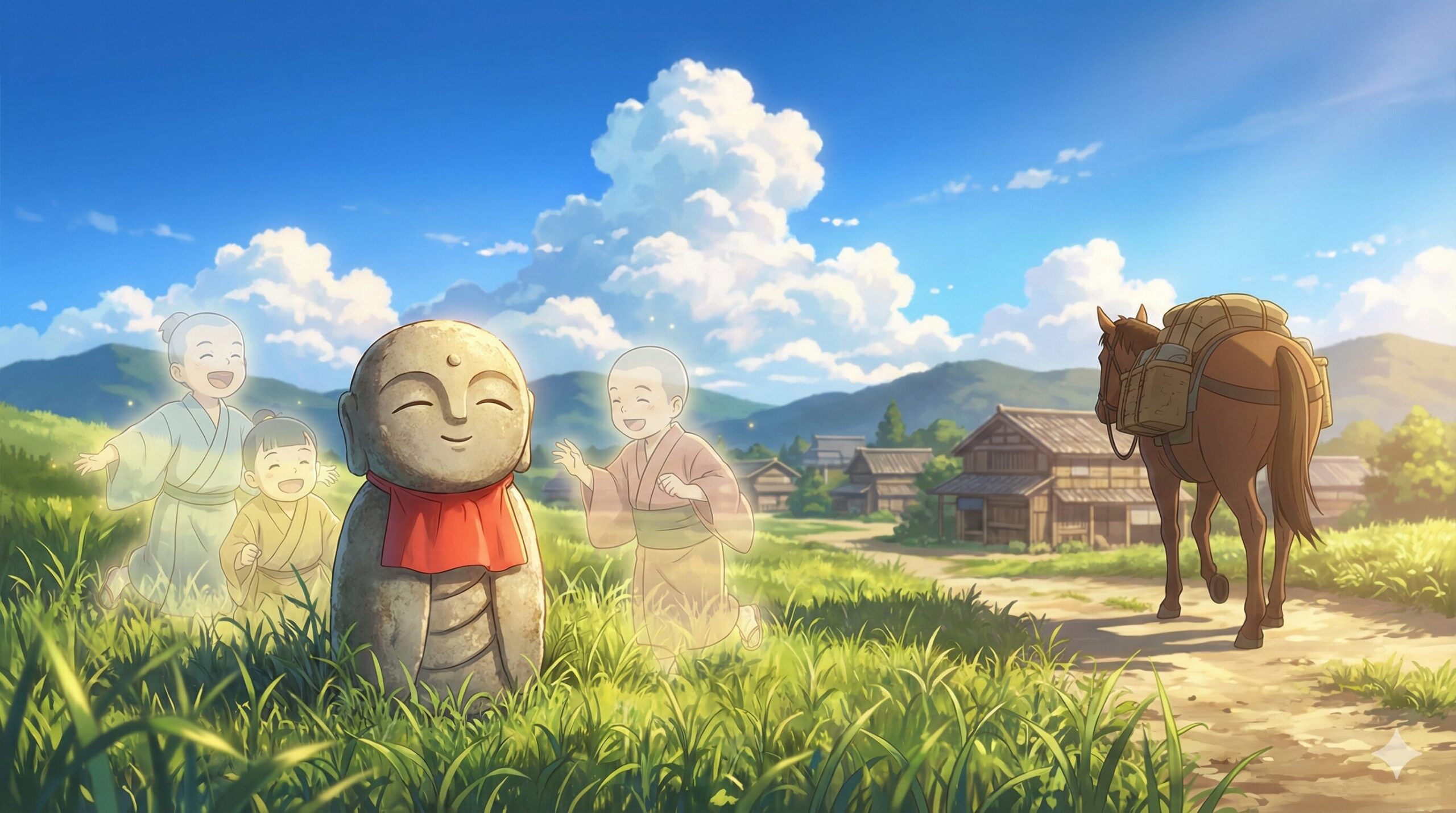
When walking along rural paths in Japan, have you ever noticed small stone statues wearing red bibs? These are “Jizo” (Kshitigarbha). But to the Japanese, they are not just stones. We believe they have a “heart.”
Today, I will introduce a mysterious folktale passed down in the Goryo area of Tamamura Town, Gunma Prefecture. It is a story that is a little funny at first, but ultimately warms the heart.

The Story: Goryo no Jizo-san (The Jizo of Goryo)
Long, long ago, in a village called Goryo in Gunma Prefecture, a solitary Jizo statue stood in a field. This Jizo was the perfect playmate for the village children. They would run around him, sometimes patting his head, playing happily every single day. The Jizo seemed to stand there quietly, smiling as he listened to the children’s laughter.
One sunny day, a Mago (a packhorse driver who transports goods) passed through the village.
The packhorse driver looked troubled. He had loaded goods onto his horse’s back, but one side was much heavier than the other, causing the load to tilt dangerously. “This is a problem. The horse can’t walk properly like this, and the cargo might fall off. Isn’t there a handy stone nearby to use as a counterweight…?”
As he looked around, he spotted a stone of just the right size in the grass. Yes, it was that Jizo statue.
“Oh, this is the perfect weight!”
Shockingly, the driver casually lifted the sacred Jizo and tied him onto the lighter side of the cargo as a mere “counterweight.” The Jizo said nothing and was carried away, swaying on the horse.
The driver traveled to the next post town and finished his work. That night, something strange happened.
While the driver was fast asleep, exhausted from his day, someone appeared in his dream. It was the Jizo he had carried that day. But unlike his calm expression during the day, the Jizo was crying, tears streaming down his stone face.
“Sob, sob… I want to go home to Goryo. I miss Goryo…”
The Jizo wept like a small child.
“Sob, sob… Please take me back to the field in Goryo.”
The crying voice was so sorrowful that the driver woke up with a start. He was drenched in a cold sweat. “What have I done? That Jizo statue… he has a heart and feelings…”
The driver felt deeply ashamed of his actions. Without waiting for dawn, he immediately placed the Jizo on his horse’s back—not as cargo this time, but as a revered guest—and hurried back to Goryo Village.
Upon arriving at the field in Goryo, the driver carefully lowered the Jizo back to his original spot and pressed his hands together in prayer, apologizing profusely. “Jizo-sama, I did a terrible thing. Please forgive me.”
And what do you think happened? Once back in his original spot, the Jizo returned to his usual calm expression. Surrounded once again by the laughter of the gathering children, he seemed to be smiling happily.
Analysis: Why Did the Jizo Cry?
This story is very simple, but it hides a deep message.
1. Attachment to “Place” (Genius Loci)
The reason the Jizo cried wasn’t just because he was treated as a weight. He specifically pleaded, “I want to go home to Goryo.” This illustrates how Japanese deities and spirits are strongly connected to the “land.” He wasn’t just a stone statue; he was a member of the Goryo community, and being separated from that landscape and the children was likely lonelier than anything else.
2. Childhood Innocence vs. Adult Convenience
The children treated the Jizo as a “friend,” whereas the adult driver treated him as a “convenient tool.” This contrast is vivid. However, the driver immediately corrected his mistake after receiving the message in his dream. This teaches the importance of “realizing one’s errors and fixing them.” In Japanese folktales, those who honestly apologize and amend their behavior are often forgiven.
Reading Japanese Culture: 8 Million Gods and Animism
From this story, we can decipher Japan’s unique spirituality.
A Soul in Everything (Animism)
Japan has the concept of “Yaoyorozu no Kami” (Eight Million Gods). It is the belief that gods or souls dwell in mountains, rivers, trees, and even roadside stones. The driver in this story initially treated the Jizo as a mere object, but realized the existence of a “soul” through his dream. The root of the Japanese culture of cherishing objects lies in this philosophy that “things also have hearts.”
The Role of Jizo
Jizo (Kshitigarbha) is a Buddhist guardian deity, but in Japan, he is especially loved as the “guardian of children” and “guardian of travelers.” The fact that the Goryo Jizo was playing with children fits perfectly with his role as their protector. When you see a smiling (or peaceful) Jizo in the Japanese countryside, reading this story helps you understand why.
A Question for You
How did you feel reading this story?
- If you were the driver, would you ignore it as “just a dream”? Or would you go out of your way to return him?
- Does your country have stories of statues or spirits that protect children?
Even in something that looks like a mere stone, there might be someone’s prayers or memories of a place locked inside. The next time you travel and see an old statue, remember the story of “Goryo no Jizo-san” and try speaking to it softly in your heart.
Reference: Manga Nippon Mukashibanashi Database – Goryo no Jizo-san
Read more Japanese Folktales here: Japanese Folktale Series Category
荷物の重しにされた地蔵様!?群馬県「五料の地蔵さん」で学ぶ、物言わぬ石像の心
日本の田舎道を歩いていると、赤いよだれかけをした小さな石像を見かけることはありませんか?それは「お地蔵さん(Jizo)」です。彼らはただの石ではありません。日本人は、そこに「心」があると信じています。
今回は、群馬県玉村町の五料(ごりょう)という地域に伝わる、少し笑えて、でも最後には心が温かくなる不思議な昔話をご紹介します。
昔話:五料の地蔵さん(Goryo no Jizo-san)
むかしむかし、群馬県の五料(ごりょう)という村に、ぽつんと立っているお地蔵さんがいました。このお地蔵さんは、村の子供たちの格好の遊び相手でした。子供たちは、お地蔵さんの周りを走り回ったり、時にはその頭を撫でたりして、毎日楽しそうに遊んでいました。お地蔵さんも、そんな子供たちの笑い声をじっと微笑んで聞いているようでした。
ある晴れた日のことです。一人の馬子(まご/馬に荷物を積んで運ぶ仕事をする人)が、この村を通りかかりました。
馬子は困った顔をしていました。馬の背中に荷物を積んだのですが、片方だけが重すぎて、荷物が傾いてしまうのです。「困ったなあ。これじゃあ馬が歩きにくいし、荷崩れしちまうぞ。何か重しになるような手頃な石はないか…」
馬子が辺りを見回すと、草むらの中にちょうど良い大きさの「石」があるではありませんか。そう、あのお地蔵さんです。
「おお、これはちょうどいい重さだ!」
なんと馬子は、罰当たりなことにお地蔵さんをひょいと持ち上げると、軽い荷物の方へ「重し」としてくくりつけてしまったのです。お地蔵さんは何も言わず、そのまま馬に揺られて運ばれていきました。
馬子は隣の宿場町まで行き、仕事を終えました。その夜のことです。
疲れ果ててぐっすり眠っていた馬子の夢の中に、誰かが現れました。それは、昼間運んできたあのお地蔵さんでした。お地蔵さんは、昼間の穏やかな顔とは打って変わって、ポロポロと涙を流して泣いているのです。
「えーん、えーん。五料へ帰りたいよう。五料が恋しいよう」
お地蔵さんは子供のように泣きじゃくります。
「えーん、えーん。五料の原っぱへ帰してくれよう」
その泣き声があまりに悲痛で、馬子は「はっ!」と飛び起きました。全身にびっしょりと冷や汗をかいていました。「なんてことをしてしまったんだ。あのお地蔵様には心があったんだ…」
馬子は自分の行いを深く恥じました。夜明けを待たず、馬子はすぐにお地蔵さんを馬の背に乗せ(今度は荷物としてではなく、大切なお客様として)、大急ぎで五料村へと引き返しました。
五料の原っぱに着くと、馬子は丁寧にお地蔵さんを元の場所に下ろし、手を合わせて何度も謝りました。「地蔵様、申し訳ねえことをした。勘弁してくだせえ」
するとどうでしょう。元の場所に戻ったお地蔵さんは、いつもの穏やかな顔に戻り、また集まってきた子供たちの笑い声に包まれて、嬉しそうに微笑んでいたそうです。
考察:なぜ地蔵は泣いたのか?
この物語は非常にシンプルですが、深いメッセージが隠されています。
1. 「場所」への愛着(Genius Loci)
お地蔵さんが泣いた理由は「重しにされたから(扱いが雑だったから)」だけではありません。「五料へ帰りたい」と訴えたのです。これは、日本の神々や精霊が「土地」と強く結びついていることを示しています。彼はただの石像ではなく、五料というコミュニティの一員であり、そこの風景や子供たちと離れることが何よりも寂しかったのでしょう。
2. 子供の無垢さと大人の都合
子供たちは地蔵を「友達」として扱いましたが、大人の馬子は地蔵を「便利な道具(重し)」として扱いました。この対比は鮮やかです。しかし、馬子は夢のお告げを受けてすぐに過ちを正しました。ここには、「過ちに気づき、それを修正することの大切さ」が説かれています。日本の昔話では、正直に謝罪し行動を改める者は許される傾向にあります。
日本文化を読み解く:八百万の神とアミニズム
この物語から、日本独自の精神性を読み解くことができます。
すべてのものに魂が宿る(Animism)
日本には「八百万(やおよろず)の神」という考え方があります。山、川、木、そして路傍の石にさえも神様や魂が宿るという考えです。この物語の馬子も、最初は地蔵を石として扱いましたが、夢を通じて「魂」の存在に気づきました。物を大切にする日本文化の根底には、この「物にも心がある」という思想が流れています。
お地蔵様(Jizo)の役割
Jizo(Kshitigarbha)は、仏教の守護尊でありながら、日本では特に「子供の守り神」や「旅人の守り神」として親しまれています。五料の地蔵さんが子供たちと遊んでいたのは、まさに彼が子供を守る存在だからです。日本の田舎で見かけるお地蔵さんが、なぜいつも笑顔(あるいは穏やかな顔)なのか、この物語を読むと納得がいきますね。
あなたへの問いかけ
この物語を読んで、あなたはどう感じましたか?
- もしあなたが馬子だったら、ただの夢だと思って無視しますか?それとも、わざわざ元の場所へ返しに行きますか?
- あなたの国には、子供たちを守ってくれる「像」や「精霊」の話はありますか?
ただの石に見えるものでも、そこには誰かの祈りや、場所の記憶が詰まっているかもしれません。次にどこかへ旅行して古い像を見かけたときは、この「五料の地蔵さん」の話を思い出して、そっと心の中で話しかけてみてください。
参考リンク:まんが日本昔ばなしデータベース – 五料の地蔵さん
もっと日本の昔話を読みたい方はこちら:Japanese Folktale Series Category


コメント