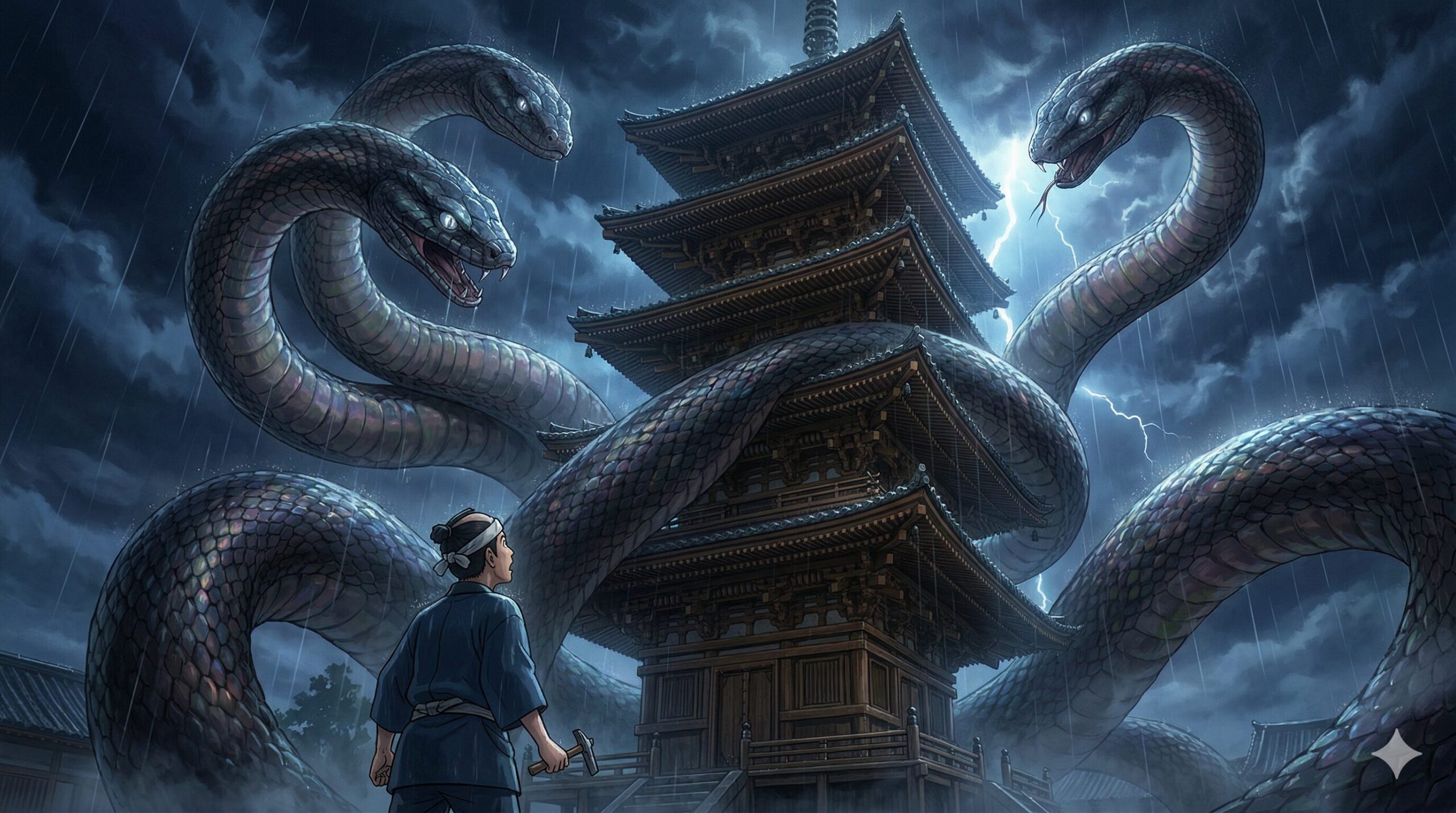
Japanese folktales often go far beyond simple fairy tales; they are profound narratives depicting the deep karma of humanity, the unreasonableness of society, and the awe-inspiring power of nature. “The Orochi’s Tower” (Daija no Tou), which we introduce today, is exactly such a story. While it is a beautiful romance, it is also a highly dramatic and cruel tale that portrays the absolute barrier of the class system, human egoism, and judgment by beings beyond human comprehension.
Let us dive deep into the world of this story, where you can glimpse the abyss of Japanese culture.
① The Story of “The Orochi’s Tower”
Long ago, in the village of Yamashiro in Suou Province (modern-day Yamaguchi Prefecture), there lived a young and highly skilled carpenter named Goro. Due to his sincere personality and exceptional architectural talent, Goro was entrusted with work even at the mansion of the local Daikan (a powerful regional magistrate).
The Daikan had a breathtakingly beautiful only daughter named Onami. As Goro frequented the mansion, he and Onami naturally fell in love, forming a deep and passionate bond. However, this was an era of strict social hierarchy. A union between the daughter of a powerful magistrate and a mere artisan carpenter was something society would absolutely never permit.
When the Daikan discovered their relationship, he was furious. “How dare a lowly carpenter approach my daughter!” he raged. He banished Goro and locked Onami deep within the mansion. Furthermore, the Daikan decided to force Onami into an arranged marriage with the son of another powerful family.
Separated from her beloved Goro and pushed to the brink of despair, Onami wandered deep into the forest. She arrived at a lake rumored to be inhabited by a terrifying Orochi (giant mythical snake) and, in her profound grief, threw herself into the freezing waters, ending her own life.
Upon learning of his daughter’s death, the Daikan went mad with grief and directed all his anger at Goro. However, executing a highly respected artisan without a valid reason would invite the villagers’ wrath. Therefore, the Daikan confronted Goro with an absolutely impossible task.
“To console Onami’s soul, you must build a ‘Five-Story Pagoda’ by the lake. You have exactly one day. You must not use a single iron nail. However, I will allow you to use just one wooden wedge (kusabi). If you fail, I will execute you.”
Building a five-story pagoda in a single day without nails is an act only a god could perform. Goro sat by the lake, utterly lost and helpless. As the darkness of night deepened and despair enveloped him, the sky was suddenly covered with black clouds.
Along with a storm-like wind, a massive giant snake descended from the sky. The Orochi spoke to the trembling Goro in a low, resonant voice: “Carve a single wedge right now. Then, drive that wedge into the top of the five-story pagoda that will appear before you.”
As Goro frantically carved the wedge just as he was told, miraculously, the Orochi’s body transformed into a magnificent unpainted wooden five-story pagoda. Goro rushed up the tower and drove the wedge into the peak. The moment he did, the entire pagoda began to radiate a blinding gold and silver light.
The next morning, the Daikan was astounded to see the divine five-story pagoda towering by the lake. At the same time, he felt intense terror and jealousy toward Goro’s unfathomable power to accomplish this in one night. Seeing Goro praying defenselessly in front of the pagoda, the Daikan cowardly snuck up behind him and ruthlessly struck him down with his sword.
At that exact moment, the sky plunged into darkness once again. With a deafening roar, the five-story pagoda collapsed and reverted to its original form of the giant snake. The enraged Orochi gently picked up Goro’s bleeding, lifeless body in its jaws, soared high into the sky, and disappeared beyond the dark clouds. All that was left behind was the paralyzed, trembling Daikan and the silent, still lake.
Afterward, fearing the curse of the Orochi, the villagers built a small shrine by the lake to eternally mourn the tragic lovers, Goro and Onami, together.
② Deep Analysis of the Folktale: Who Was the Real “Monster”?
At first glance, this story might seem like a typical Japanese ghost story where “Giant Snake = Terrifying Yokai (monster).” However, a deeper reading reveals a completely different dynamic.
The most terrifying entity in this story is not the giant snake, but the “Daikan.” He clung to human-made rules like social class, robbed his daughter of her happiness, and drove her to death. Furthermore, he shifted the blame for his own sins and sorrow onto a powerless youth and used his authority to attempt murder. Even after a miracle occurred and the pagoda was completed, instead of keeping his promise, he resorted to the cowardly act of assassination from behind. This perfectly depicts the egoism of those in power and the “true ugliness” hidden deep within the human heart.
On the other hand, what about the supposedly terrifying giant snake? The Orochi helped Goro, who was about to be killed under false pretenses, and even sacrificed its own body (by turning into the tower) to help him overcome the impossible task. And after Goro was killed, it took his body to the heavens. This Orochi might have been the “incarnation of Onami” who threw herself into the pond. Or, it can be interpreted as a “god of nature” that resonated with the sorrow of the two whose pure love was trampled. In stark contrast to the ugly human society of power, the Orochi is portrayed as a symbol of “pure love and justice.”
③ Connection to Japanese Culture: Animism and Master Craftsmanship
This “Orochi’s Tower” strongly reflects traditional Japanese culture and spirituality.
- Nature Worship (Animism) and Water Gods: In Japan, snakes and dragons have long been worshipped as “water gods.” The lake where the giant snake lives represents a sacred domain where humans must not tread. The reverence for nature and the concept of punishment (curses) from the natural world for human arrogance are core to Japanese Shinto and indigenous beliefs.
- The Mysticism of Miyadaiku and Wooden Architecture: Goro’s profession as a carpenter, specifically a “Miyadaiku” who builds shrines and temples, was considered not just a laborer but someone possessing special skills connected to the divine. The technique mentioned in the story, “building without a single nail, using only a wedge,” is a real characteristic of traditional Japanese architecture (Kigumi). Japanese five-story pagodas are built with a flexible structure to absorb earthquake tremors, using meticulously interlocking wood rather than iron nails. The story includes a deep respect for this astonishing Japanese craftsmanship.
- The Class System of the Edo Period: The strict class system known as “Shi-no-ko-sho” (Samurai, Farmers, Artisans, Merchants) serves as the background. There was an insurmountable wall between the ruling class (Samurai/Daikan) and the ruled class (Artisans/Farmers). It is highly likely that this folktale also served as a quiet protest (antithesis) by the common people against such an unreasonable social structure.
④ To Our Readers: How Would You Live?
“The Orochi’s Tower” is not just a story of tragic love; it is a work that makes us think deeply about justice, love, and human karma. The fate of the two torn apart by authority, and Goro, who fell to human cowardice despite bringing about a miracle. After the Orochi flew into the sky, the Daikan left behind must have lived the rest of his life in inescapable terror and regret.
If you were in Goro’s position, how would you face an absurd and impossible demand? If you were Onami, what decision would you have made to protect the one you love? Moreover, in our modern society, can we truly say that “monsters in human form” like this Daikan no longer exist?
Please let us know your thoughts and what you felt after reading this beautiful yet sorrowful Japanese folktale.
[Reference Links & Categories]
Reference (External Link): Manga Nippon Mukashibanashi Database – Daija no Tou
Read more Japanese Folktales here (Internal Link): Japanese Folktale Series Category
悲恋と大蛇の復讐:日本昔話「大蛇の塔」が伝える真実
日本の昔話には、単なるおとぎ話の枠を超え、人間の深い業や社会の理不尽さ、そして自然界の畏怖を描いた作品が数多く存在します。今回ご紹介する「大蛇の塔(だいじゃのとう)」もその一つです。美しい恋愛物語でありながら、身分制度という絶対的な壁、人間のエゴイズム、そして人智を超えた存在による裁きが描かれた、非常にドラマチックで残酷な物語です。
日本文化の深淵を覗くことができるこの物語の世界へ、深く潜ってみましょう。
① 昔話「大蛇の塔」のストーリー
昔々、周防の国(現在の山口県)の山代の里に、五郎という若く腕の立つ大工がいました。五郎はその誠実な人柄と類まれなる建築の才能で、地域の権力者である代官の屋敷の仕事まで任されるようになりました。
その代官には、「お波(おなみ)」という息を呑むほど美しい一人娘がいました。屋敷に出入りするうち、五郎とお波は自然と惹かれ合い、深く愛し合うようになります。しかし、当時は厳格な身分制度の時代。権力者である代官の娘と、一介の職人である大工が結ばれることなど、到底許されるものではありませんでした。
二人の関係を知った代官は激怒します。「大工の分際で、我が娘に近づくとは何事だ!」と五郎を遠ざけ、お波を屋敷の奥深くに閉じ込めてしまいました。さらに代官は、お波を別の有力者の息子と強制的に結婚させることを決めてしまいます。
愛する五郎と引き離され、絶望の淵に立たされたお波。彼女は、深い悲しみの中、森の奥にある「恐ろしい大蛇が棲む」と噂される池へと向かい、冷たい水の中へ身を投じて、自らの命を絶ってしまったのです。
娘の死を知った代官は、悲しみのあまり狂乱し、その怒りの矛先をすべて五郎に向けました。しかし、腕の立つ五郎を理由なく処刑すれば、周囲の反感を買います。そこで代官は、五郎に絶対に不可能な「無理難題」を突きつけました。
「お波の霊を慰めるため、あの池のほとりに『五重の塔』を建てよ。期限はたったの一日。釘は一本も使ってはならぬ。ただし、楔(くさび)だけは一つだけ使うことを許そう。もし出来なければ、お前を処刑する」
五重の塔をたった一日で、しかも釘なしで建てるなど、神にしかできない所業です。五郎は池のほとりに座り込み、途方に暮れました。夜の闇が深まり、絶望が彼を包み込んだその時、空がにわかに黒雲に覆われました。
嵐のような風と共に、空から巨大な大蛇が舞い降りてきたのです。大蛇は、震える五郎に向かって低く響く声で告げました。「今すぐ楔を一つ作れ。そして、目の前に現れる五重の塔の頂上に、その楔を打ち込むのだ」
五郎が言われるがままに楔を削り出すと、驚くべきことに大蛇の体が変化し、見事な白木の「五重の塔」へと姿を変えました。五郎が塔を駆け上がり、頂上に楔を打ち込むと、塔全体が金銀の眩い光を放ち始めたのです。
翌朝。池のほとりにそびえ立つ神々しい五重の塔を見た代官は、驚愕しました。そして同時に、これを一晩で成し遂げた五郎の底知れぬ力に激しい恐怖と嫉妬を覚えたのです。代官は、塔の前で静かに祈りを捧げている無防備な五郎の背後に忍び寄り、無残にも刀で斬り殺してしまいました。
その瞬間、空は再び暗黒に包まれました。五重の塔は轟音を立てて崩れ落ち、元の大蛇の姿へと戻りました。怒り狂った大蛇は、血を流して倒れる五郎の亡骸を優しくくわえ上げると、そのまま天高く舞い上がり、黒雲の彼方へと消えていきました。後に残されたのは、腰を抜かして震える代官と、静まり返った池だけでした。
その後、村人たちは大蛇の祟りを恐れ、池のほとりに小さな祠(ほこら)を建てて、悲運の恋人である五郎とお波の霊を、永遠に一緒に祀ったと伝えられています。
② 昔話の深い考察:誰が本当の「怪物」だったのか
この物語は、一見すると「大蛇=恐ろしい妖怪」という日本の典型的な怪談のように思えますが、深く読み解くと全く異なる構図が見えてきます。
物語の中で最も恐ろしい存在は、巨大な蛇ではなく「代官」です。彼は身分の違いという人間の作ったルールに固執し、娘の幸せを奪い、死に追い詰めました。さらに、自らの罪と悲しみを無力な若者に責任転嫁し、権力を使って殺そうとします。奇跡が起きて塔が完成した後も、約束を守るどころか背後から暗殺するという卑劣な手段をとりました。ここには、権力者のエゴイズムと人間の心の底にある「真の醜さ」が描かれています。
一方で、恐ろしいはずの大蛇はどうでしょうか。大蛇は、無実の罪で殺されようとしている五郎を助け、自らの体を犠牲(塔へと変化)にしてまで難題をクリアさせます。そして五郎が殺された後は、彼の亡骸を天へと連れ去りました。この大蛇は、もしかすると池に身を投げた「お波の化身」だったのかもしれません。あるいは、純粋な愛を踏みにじられた二人の悲しみに共鳴した「自然界の神」だったとも解釈できます。人間の醜悪な権力社会に対し、大蛇は「純粋な愛と正義」の象徴として描かれているのです。
③ 日本文化との関連:自然信仰と職人技術の結晶
この「大蛇の塔」には、日本の伝統的な文化や精神性が色濃く反映されています。
- 自然信仰(アニミズム)と水神: 日本において、蛇や竜は古くから「水神」として信仰の対象でした。大蛇が棲む池は、人間が足を踏み入れてはならない神聖な領域を意味します。自然に対する畏敬の念と、人間の傲慢さに対する自然界からの罰(祟り)という概念は、日本の神道や土着信仰の根幹を成すものです。
- 宮大工(みやだいく)の神秘と木造建築: 五郎の職業である大工、特に寺社仏閣を建てる「宮大工」は、日本において単なる労働者ではなく、神仏と繋がる特別な技術を持つ者とされていました。物語に登場する「釘を一本も使わず、楔(くさび)だけで建てる」という技術は、実際の日本の伝統建築(木組み)の特徴です。日本の五重の塔は、地震の揺れを吸収する柔構造で作られており、釘ではなく木と木を精巧に組み合わせる技術が使われています。物語は、この日本の驚異的な職人技術へのリスペクトを含んでいます。
- 江戸時代の身分制度: 「士農工商(しのうこうしょう)」という厳格な身分制度が背景にあります。支配層(武士・代官)と被支配層(職人・農民)の間には決して越えられない壁がありました。この昔話は、そうした理不尽な社会構造に対する庶民の静かなる抗議(アンチテーゼ)の役割も果たしていたと考えられます。
④ 読者の皆様へ:あなたならどう生きるか?
「大蛇の塔」は、ただの悲恋の物語ではなく、正義、愛、そして人間の業について深く考えさせられる作品です。権力によって引き裂かれた二人の運命、そして奇跡を起こしながらも人間の卑劣さに倒れた五郎。大蛇が空へ飛び去った後、残された代官は一生拭えない恐怖と後悔の中で生きたことでしょう。
もしあなたが五郎の立場なら、不条理な難題を突きつけられた時、どう立ち向かいますか? もしあなたがお波なら、愛する人を守るためにどのような決断を下したでしょうか。また、現代社会において、この代官のように「人間の形をした怪物」は存在しないと言い切れるでしょうか?
ぜひ、この悲しくも美しい日本の昔話を読んで感じたこと、あなたの考えを教えてください。
【参考リンク・カテゴリー】
参考元(外部リンク):まんが日本昔ばなし〜データベース〜 大蛇の塔
もっと日本の昔話を読みたい方はこちら(内部リンク):Japanese Folktale Series カテゴリー一覧

コメント