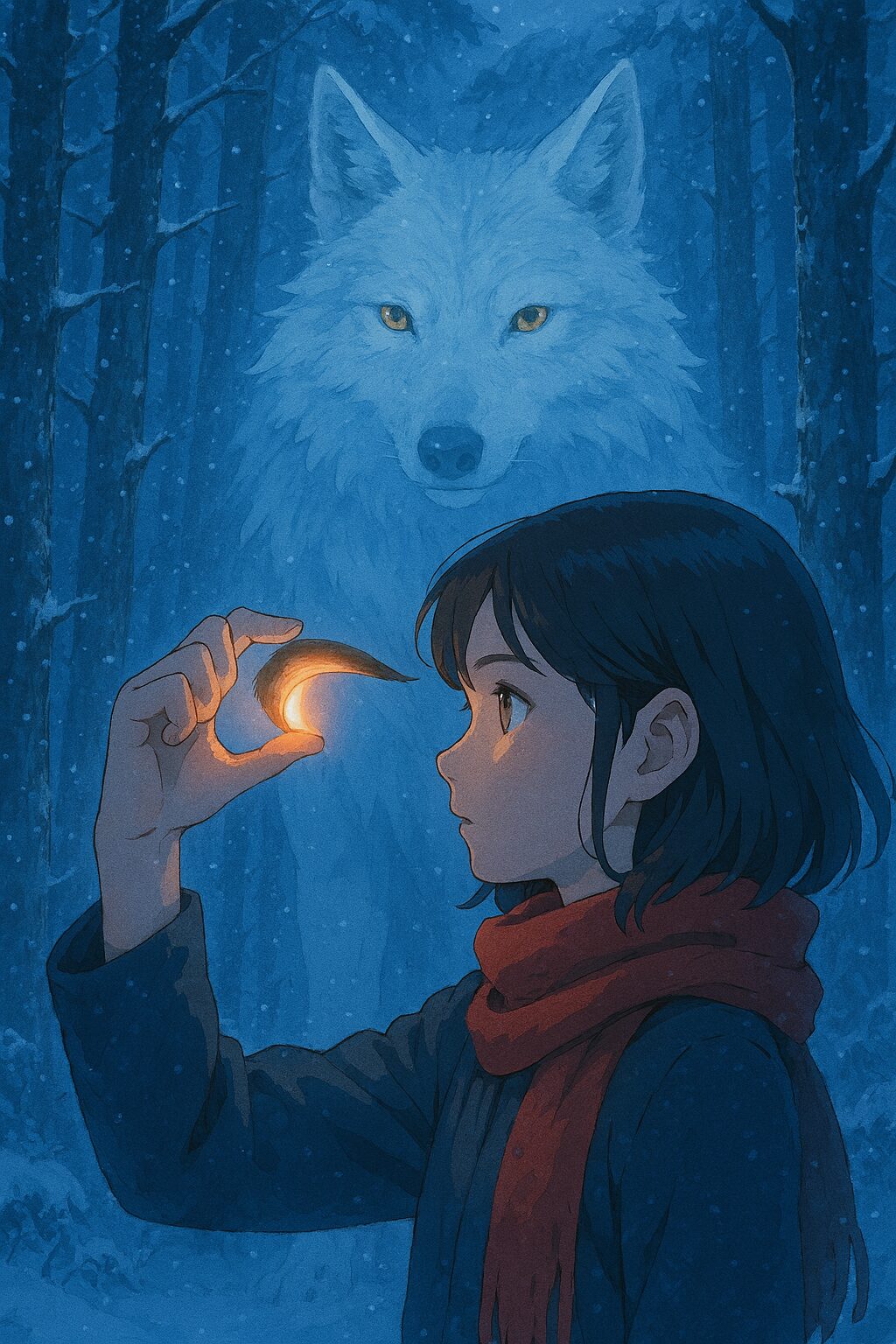
Deep within the mountains of Japan, wolves were once worshipped as gods. While Western fairy tales often portray the wolf as a villain, Japanese folklore paints a very different picture. Today, I will introduce a poignant story about a lonely girl and a mystical wolf. This tale, known as “The Wolf and the Daughter” or “The Wolf’s Eyelashes,” poses a sharp question about human nature that resonates deeply even in the modern world.

The Story: The Wolf and the Daughter
Once upon a time, in a village at the foot of a deep mountain, there lived a girl named Ochiyo. She was kind-hearted and hardworking, but her stepmother hated her and forced her to do difficult chores every day.
One freezing winter, the stepmother ordered her, “Go into the mountains and find the most delicious mushrooms. Do not return until you find them.” Of course, mushrooms do not grow in the winter snow. It was merely an excuse to let Ochiyo freeze to death in the wilderness.
Ochiyo wandered through the snow, but soon the sun set and a fierce blizzard began. “This is the end,” she thought, curling up at the base of a great tree, prepared to die.
Suddenly, two glowing pale eyes appeared from the darkness. It was a giant silver wolf, the master of the mountain. With sharp fangs and steel-like fur, it was the “man-eating wolf” the villagers feared.
But Ochiyo did not run. With trembling hands, she clasped them in prayer and spoke quietly:
“Great Wolf God. I will soon freeze to death. If I am to lose my life, please eat me and let me become sustenance for you, so that I may be of use to the mountain.”
The wolf gazed into Ochiyo’s clear eyes and gently brought his nose close to her. Surprisingly, instead of eating her, he curled his warm body around her, protecting her from the cold all night long. The wolf spoke, not in human words, but directly to her heart:
“Your soul is pure. But be warned, the human world is far more terrifying than any beast.”
The next morning, the blizzard had stopped. As they parted, the wolf plucked a single eyelash from his right eye and gave it to Ochiyo.
“I give this to you. Return to the village. When you can no longer trust the appearance of people, look through this eyelash. Now, go.”
Deeply grateful, Ochiyo returned to the village. Her stepmother was shocked to see her alive but quickly hugged her with a fake smile, saying, “I was so worried about you.”
Remembering the wolf’s words, Ochiyo secretly held the eyelash to her eye and looked at her stepmother.
To her horror, standing there was not a human, but an old, greedy “Tanuki” (Raccoon Dog), licking its lips.
Terrified, Ochiyo ran out of the house and walked through the village. Looking through the eyelash, the richest merchant appeared as a greedy pig, and the arrogant official looked like a cunning fox. Even though they wore fine kimonos, almost no one had the form of a true human inside.
Just as she was about to leave the village in despair, she passed a poor charcoal maker. His face was covered in soot, and his clothes were tattered. However, when she looked through the wolf’s eyelash, she saw a “true human” radiating a noble, divine light.
Ochiyo married the charcoal maker. Though they were poor, they cherished each other. Eventually, the quality of his charcoal became famous, and they lived happily ever after.
Analysis: The “True Sight” Given by the Wolf
This story strongly reflects Japanese spirituality, particularly regarding the role of the wolf and the deception of visual appearances.
1. The Wolf as a Benevolent Guardian
Unlike the “Big Bad Wolf” in Western tales like Little Red Riding Hood, the wolf here acts as a sage who saves an innocent girl and grants her wisdom. This is rooted in ancient Japanese faith where the wolf is considered a messenger of the Mountain God, or a god itself. The wolf embodies the harshness of nature, but also its deep mercy.
2. The Disconnect Between Appearance and Reality
The scene where the stepmother and the wealthy are revealed as animals is a sharp satire. It suggests that social status does not equal human worth. The wolf’s eyelash acts as a lens to remove social bias. It asks us: when you strip away money and fame, what shape does a person’s soul take?
Cultural Insight: Wolf Worship and “Honne vs. Tatemae”
Here are two key Japanese cultural concepts to understand this story better.
Okami (Wolf) and Okami (Great God)
In Japanese, the word for wolf is “Okami.” Phonetically, this is identical to “Great God” (大神). Historically, farmers worshipped wolves because they preyed on deer and boars that destroyed crops. Even today, shrines like the Mitsumine Shrine in Saitama Prefecture worship wolves as guardians (Oinu-sama) instead of the usual lion-dogs.
Honne (True Sound) and Tatemae (Facade)
Japanese culture emphasizes the distinction between Honne (one’s true feelings) and Tatemae (public behavior). In the story, the stepmother used Tatemae to act worried, but her Honne was cruel. The wolf’s eyelash is a magical tool that forces the visualization of Honne. While reading between the lines is considered a virtue in Japan, this story explores the ultimate form of that ability through fantasy.
Would You Use the Eyelash?
If you were given this “Wolf’s Eyelash,” would you use it?
Would you dare to look at your partner, your friends, or your boss? Or would you throw it away, afraid of seeing the truth?
Perhaps, the scariest thing of all would be to look at yourself in the mirror.
I hope this story changes the way you look at the world around you.
References & Useful Links:
Read more Japanese Folktales here:
Japanese Folktale Series Archive
【日本昔話】オオカミと娘:真実を見抜く不思議な力
日本の深い山々には、かつて神として崇められたオオカミたちが生きていました。西洋の童話では「悪役」にされがちなオオカミですが、日本の伝承ではまったく異なる顔を持っています。今回は、不思議な力を授かった娘と、孤独なオオカミの物語を紹介します。この物語は、人間の「本性」とは何かを鋭く問いかけてくる、大人にこそ読んでほしい昔話です。
昔話:オオカミと娘(狼の眉毛)
むかしむかし、ある深い山のふもとの村に、お千代(おちよ)という娘が住んでいました。お千代はとても心が優しく働き者でしたが、継母(ままはは)に疎まれ、毎日つらい仕事を押し付けられていました。
ある寒い冬のこと。継母は「山に行って、一番美味しいキノコを採ってこい。見つかるまでは帰ってくるな」と、お千代を雪深い山奥へと追い出しました。冬の山にキノコなどあるはずがありません。それは、お千代を山で野垂れ死にさせるための口実でした。
お千代は雪の中を彷徨い歩きましたが、やがて日が暮れ、猛吹雪が始まります。「もう、これまでだ」と大木の根元でうずくまり、死を覚悟したその時です。
闇の向こうから、青白く光る二つの眼が現れました。それは、山の主(ぬし)である巨大な銀色のオオカミでした。鋭い牙、鋼のような毛並み。村人が恐れる「人食いオオカミ」です。
しかし、お千代は逃げませんでした。震える手で合わせ、静かに言いました。
「オオカミ様。私はもうすぐ凍えて死ぬでしょう。どうせ命を落とすなら、あなたの糧(かて)となって、山の役に立ちたいのです」
オオカミはお千代の澄んだ目を見つめ、静かに鼻を近づけました。そして、驚くべきことに、その温かい体でお千代を包み込み、一晩中、彼女を寒さから守ったのです。オオカミは、人間の言葉ではなく、心に直接響く声で語りかけました。
『お前の心は清らかだ。だが、人間の世は魔物よりも恐ろしいぞ』
翌朝、吹雪は止んでいました。オオカミは別れ際、自分の右目の眉毛(まゆげ)を一本引き抜き、お千代に手渡しました。
『これを授けよう。里へ戻り、人々の姿が信じられなくなった時、この眉毛を通して相手を見るがよい。さあ、行け』
お千代はオオカミに深く感謝し、村へ戻りました。家に戻ると、継母は驚いた顔をしていましたが、すぐに猫なで声で「心配していたのよ」と抱きついてきました。
お千代はふと、オオカミの言葉を思い出し、そっと眉毛を目にかざして継母を見ました。
するとどうでしょう。そこにいたのは人間ではなく、意地汚い顔をした「古狸(ふるだぬき)」が、舌なめずりをしていたのです。
恐ろしくなったお千代は家を飛び出し、村の中を歩きました。眉毛を通して見ると、村一番の金持ちの商人は欲深い「豚」に、威張っている役人は狡猾な「キツネ」に見えました。立派な着物を着ていても、中身が人間の姿をしている者は、ほとんどいなかったのです。
絶望して村を出ようとした時、一人の貧しい炭焼きの男とすれ違いました。顔は煤(すす)だらけ、着物はボロボロです。しかし、眉毛を通して見ると、その男は後光が差すような、美しく誠実な「真の人間」の姿をしていました。
お千代はその炭焼きの男の元へ嫁ぎました。二人は貧しいながらも互いを大切にし、やがて男が焼く炭の良さが評判となり、幸せに暮らしたということです。
考察:オオカミが与えた「真実の目」
この物語には、日本の精神性が色濃く反映されています。特に注目すべきは「オオカミの役割」と「視覚の欺瞞(ぎまん)」です。
1. 善なる守護者としてのオオカミ
グリム童話の「赤ずきん」など、西洋においてオオカミはしばしば「悪」「破壊」「欲望」の象徴です。しかし、この物語のオオカミは、無欲な娘を助け、知恵(眉毛)を授ける「賢者」として描かれています。これは、オオカミが山の神の使い、あるいは神そのものであるという日本古来の信仰に基づいています。オオカミは、自然の厳しさと同時に、慈悲深さも併せ持っているのです。
2. 外見と中身の乖離
継母や金持ちが、動物(狸や豚)として描かれるシーンは痛烈です。これは「立派な社会的身分=立派な人間」とは限らないという、当時の庶民の皮肉と洞察が含まれています。オオカミの眉毛は、現代で言うところの「社会的バイアスを取り払うレンズ」です。富や名声というフィルターを外した時、その人の魂は何の形をしているのか? この物語は、私たちにそう問いかけています。
日本文化の視点:大神(オオカミ)信仰と本音・建前
この昔話から読み解ける日本文化のキーワードを2つ紹介します。
大神(Okami)と狼(Okami)
日本語で「狼(Wolf)」は「オオカミ」と読みますが、これは「大神(Great God)」と同じ発音であり、語源とも言われています。かつて日本の農民にとって、オオカミは畑を荒らすシカやイノシシを退治してくれる益獣であり、神の使い(御眷属・ごけんぞく)でした。現在でも、埼玉県の三峯神社(Mitsumine Shrine)のように、狛犬ではなくオオカミを祀る神社が存在し、「お犬様」として厚く信仰されています。
本音(Honne)と建前(Tatemae)
日本文化の大きな特徴に「本音(真の感情)」と「建前(公的な振る舞い)」の使い分けがあります。物語の中で、継母は「心配していた(建前)」と言いながら、心の中ではお千代の死を望んでいました(本音)。オオカミの眉毛は、この「建前」を強制的に剥がし、「本音」を視覚化するアイテムと言えます。日本人は、言葉の裏にある真意を察することを美徳としますが、この物語は「察する」ことの究極系をファンタジーとして描いているのです。
あなたなら、その眉毛を使いますか?
もし、あなたがこの「オオカミの眉毛」を手に入れたら、どうしますか?
恋人、友人、あるいは尊敬する上司に向けてみたいと思うでしょうか。それとも、真実を知るのが怖くて、捨ててしまいますか?
もしかしたら、鏡の前で自分自身を見るのが、一番恐ろしいことかもしれませんね。
この物語を読んで、あなたの周りの世界が少し違って見えたなら幸いです。
参考リンク:
もっと日本の昔話を読みたい方はこちら:
Japanese Folktale Series Archive


コメント