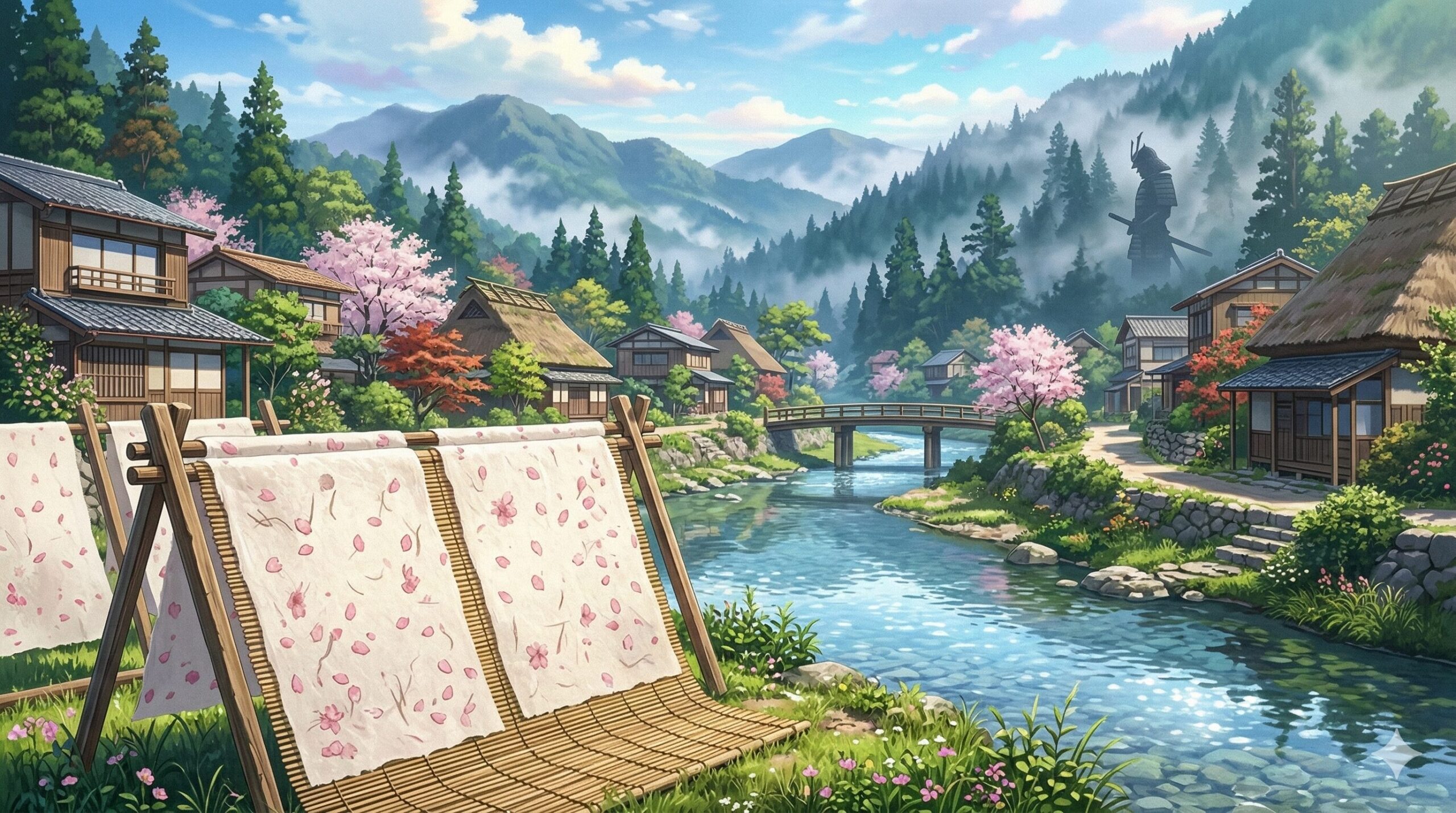
Behind Japan’s beautiful nature and rich culture sometimes lie stories of tragic and sorrowful history. Today, I will introduce you to “Kamisuku Sato” (The Papermaking Village), a folktale that depicts the birth of traditional Japanese paper (Washi) and the human karma surrounding it. How was this beautiful paper made, and how was its technique protected? Through this story, let’s explore the craftsman’s spirit and the history of harsh rules that have continued since ancient times in Japan.

1. The Story of “Kamisuku Sato”
Long ago, deep in the mountains of Tosa (modern-day Kochi Prefecture) in Shikoku, by the clear waters of the Niyodo River, there was a small village called Naruyama. In this village lived a noble Buddhist nun named Yohoni. She was once the wife of a great warlord who ruled the region, but after losing her husband in a brutal war, she grieved the impermanence of the world and became a nun. Her nephew, Saburoza, also came to live with her, and the two led a quiet, humble life.
One day, while Yohoni was gathering firewood in the mountains, she found an unfamiliar samurai lying on the ground, deeply wounded. The compassionate Yohoni carried him to her hermitage and devotedly nursed him back to health. The man, who eventually regained his strength, was Shinnojo, a samurai from the neighboring province of Iyo (modern-day Ehime Prefecture).
To repay her for saving his life, Shinnojo decided to teach Yohoni and Saburoza his special skill. It was the highly advanced, secret technique of making “paper” from wild Kozo (paper mulberry) trees—a method entirely unknown in Tosa at the time. Yohoni and Saburoza immediately built a papermaking hut and, under Shinnojo’s guidance, enthusiastically immersed themselves in the craft.
As winter passed and spring arrived, Yohoni had the brilliant idea of embedding beautiful cherry blossom petals into the paper. This paper, blending the pure river water, craftsmanship, and the beauty of Japan’s four seasons, was vibrantly dyed with seasonal plants and soon became known as “Nanairo-gami” (Seven-Color Paper). The paper, of unearthly beauty, was highly praised and became the highest-grade specialty product of the Tosa domain, presented as a tribute to the Shogun.
Because of this great achievement, the nephew Saburoza was appointed by the domain lord as a high-ranking official in charge of paper management, bringing great honor to their family. Everything seemed to be going perfectly.
However, tragedy struck suddenly. Shinnojo, who had been away from his hometown for a long time, announced, “It is time for me to return to the province of Iyo.” Hearing this, the blood drained from Saburoza’s face. If Shinnojo returned to another province and spread the secret of Nanairo-gami, Tosa’s monopoly on this valuable specialty product would be lost, and his own position would be in jeopardy. Consumed by the domain’s interests and self-preservation, Saburoza made a terrifying decision.
On a dark night, Saburoza coldly assassinated Shinnojo from behind—the very man who had saved their livelihoods and sweated alongside them. The beautiful papermaking village was henceforth protected by a man’s blood and a heavy secret that must never be revealed. Only Yohoni’s deep sorrow echoed eternally into the mountains along with the murmuring of the river.
2. Deep Analysis: Why Did the Tragedy Occur?
This story is not just a fairy tale; it sharply depicts the harsh reality of Japan’s strict feudal society at the time. The biggest cause of the tragedy was the highly realistic issue of “the value of information” and “the survival of the domain.” In pre-Edo period Japan, it was an absolute condition for economic survival that each domain (regional territory) possessed its own unique specialty products. The manufacturing methods of these products were literally treated as “top-secret military intelligence.”
While Saburoza’s actions seem like madness from a modern moral perspective, in the values of that era, they could be interpreted as “ruthless justice to protect the domain’s interests and secrets.” The cruelty of organizational rules taking precedence over personal friendship and gratitude is the shadow of “loyalty” in Japanese history.
3. A Window into Japanese Culture: Washi and the Weight of “Hidden” (Secrets)
The core of Japanese culture that can be deciphered from this story is the spirituality of the traditional craft of Washi and the culture that reveres techniques as sacred. Washi has been treated not merely as a recording medium, but as the crystallization of nature’s blessings (pure water, plants) and the human soul. Just as Yohoni embedded cherry blossoms into the paper, the Japanese have historically been geniuses at finding natural beauty in everyday practical items.
Also, pay attention to Japan’s unique culture of “Hiden” (secret transmission). It is a system where techniques are not documented and widely shared, but rather passed down orally and experientially from master to chosen disciple. This not only prevented the leakage of techniques but also elevated the value and quality of the techniques themselves to the absolute limit. The tragedy of “Kamisuku Sato” symbolizes the ultimate exclusivity of this “Hiden” system.
4. What Would You Do?
A tale of human desire and betrayal hidden behind beautiful Washi. How do you feel about the darkness in Saburoza’s heart, having to kill his savior and friend, Shinnojo?
If you were in Saburoza’s position, would you obey the absolute rules of the domain and commit the act to protect the secret? Or would you throw everything away, save your benefactor’s life, and flee the village together? Please let me know your thoughts in the comments section.
Related Links:
- Read more from the Japanese Folktale Series
- Reference: Manga Nippon Mukashibanashi Database “Kamisuku Sato” (Japanese)
和紙に秘められた悲劇の物語:日本昔話「紙すく里」の深層
日本には、美しい自然や豊かな文化の裏側に、時に残酷で哀しい歴史を秘めた物語が存在します。今回は、日本の伝統工芸である「和紙」の誕生と、それを巡る人間の業を描いた昔話「紙すく里(かみすくさと)」をご紹介します。美しい和紙がいかにして作られ、その技術がどう守られたのか。この物語を通じて、古代から続く日本の職人魂と、過酷な掟の歴史に触れてみましょう。
1. 昔話「紙すく里」のストーリー
昔々、四国の土佐(現在の高知県)の深い山奥、美しい水が流れる仁淀川のほとりに「成山」という小さな村がありました。この村には、養甫尼(ようほに)という一人の気高い尼僧がひっそりと暮らしていました。彼女はかつて、この地を治める立派な武将の妻でしたが、過酷な戦によって夫を失い、世の無常を嘆いて仏門に入ったのでした。彼女の元には甥の三郎左(さぶろうざ)も身を寄せ、二人は静かで慎ましい日々を送っていました。
ある日のこと、養甫尼が山へ薪を拾いに行くと、見知らぬ武士が深い傷を負って倒れていました。慈悲深い養甫尼は彼を自分の庵へ運び、献身的に介抱しました。やがて元気を取り戻したその男は、隣国の伊予(現在の愛媛県)からやって来た新之丞(しんのじょう)という武士でした。
新之丞は、命を救ってくれた恩返しとして、自分の持つ特別な技術を養甫尼たちに教えることにしました。それは、山に自生する楮(こうぞ)の木から「紙」を漉き出すという、当時の土佐では誰も知らない高度な秘伝の技でした。養甫尼と三郎左はさっそく紙すき小屋を建て、新之丞の指導のもと、夢中になって紙作りに没頭しました。
冬が過ぎ春が訪れる頃、養甫尼は美しい桜の花びらを紙の中に漉き込むことを思いつきます。澄み切った川の水と職人の技、そして日本の四季の美しさが融合したその紙は、季節の草花で鮮やかに染め上げられ、いつしか「七色紙(なないろがみ)」と呼ばれるようになりました。この世のものとは思えないほど美しい七色紙は、幕府へ献上する土佐藩の最高級の特産品として絶賛されました。
この功績により、甥の三郎左は藩から紙を管理する立派な役人に取り立てられ、一族は大きな栄誉を手にしました。すべては順風満帆に見えました。
しかし、悲劇は突然訪れます。故郷を長く離れていた新之丞が、「そろそろ伊予の国へ帰りたい」と言い出したのです。この言葉を聞いた三郎左の顔から血の気が引きました。もし新之丞が他国へ帰り、この七色紙の製法を広めてしまえば、土佐藩の独占的な特産品としての価値は失われ、己の地位も危うくなります。藩の利益と己の保身に憑りつかれた三郎左は、恐ろしい決断を下します。
ある暗い夜、三郎左は命の恩人であり、共に汗を流した新之丞を背後から冷酷に斬り殺してしまったのです。美しい和紙の里は、一人の男の血と、決して漏らしてはならない重い秘密によって守られることとなりました。養甫尼の深い悲しみだけが、川のせせらぎと共に永遠に山奥へ響き渡ったのでした。
2. 「紙すく里」の深い考察:なぜ悲劇は起きたのか
この物語は、単なるおとぎ話ではなく、当時の日本の厳しい封建社会の現実を鋭く描写しています。悲劇の最大の要因は、「情報の価値」と「藩の存続」という極めて現実的な問題です。江戸時代以前の日本では、各藩(地方の領地)が独自の特産品を持つことが、経済的に生き残るための絶対条件でした。特産品の製法は文字通り「門外不出の軍事機密」と同等の扱いを受けていたのです。
三郎左の行動は、現代の道徳から見れば狂気の沙汰ですが、当時の価値観においては「藩の利益と機密を守るための冷徹な正義」として解釈される側面もありました。個人の友情や恩義よりも、組織(藩)の掟が優先される残酷さ。これが、日本の歴史の裏側にある「忠誠」の影の部分です。
3. 日本文化への窓:和紙と「秘伝」の重み
この物語から読み解ける日本文化の核心は、「和紙(Washi)」という伝統工芸の精神性と、技術を神聖視する文化です。和紙は単なる記録媒体ではなく、自然の恵み(清らかな水、植物)と人間の魂の結晶として扱われてきました。作中で養甫尼が桜の花を漉き込んだように、日本人は古来より、実用品の中に自然の美しさを見出す天才でした。
また、日本独自の「秘伝(Hiden)」という文化にも注目してください。技術を文書化して広く共有するのではなく、師匠から選ばれた弟子へと口伝や体感で受け継ぐシステムです。これは技術の流出を防ぐだけでなく、技術そのものの価値と質を極限まで高める役割を果たしました。「紙すく里」の悲劇は、この「秘伝」のシステムが持つ究極の排他性を象徴しています。
4. あなたならどうしますか?
美しき和紙の裏に隠された、人間の欲望と裏切りの物語。命の恩人であり、友でもあった新之丞を殺さなければならなかった三郎左の心の闇を、あなたはどう感じたでしょうか?
もしあなたが三郎左の立場だったら、絶対的な権力を持つ藩の掟に従い、秘密を守るために手を下しますか?それとも、全てを捨てて恩人の命を助け、共に村を逃げ出しますか?ぜひ、あなたの考えをコメント欄で教えてください。
関連リンク:


コメント