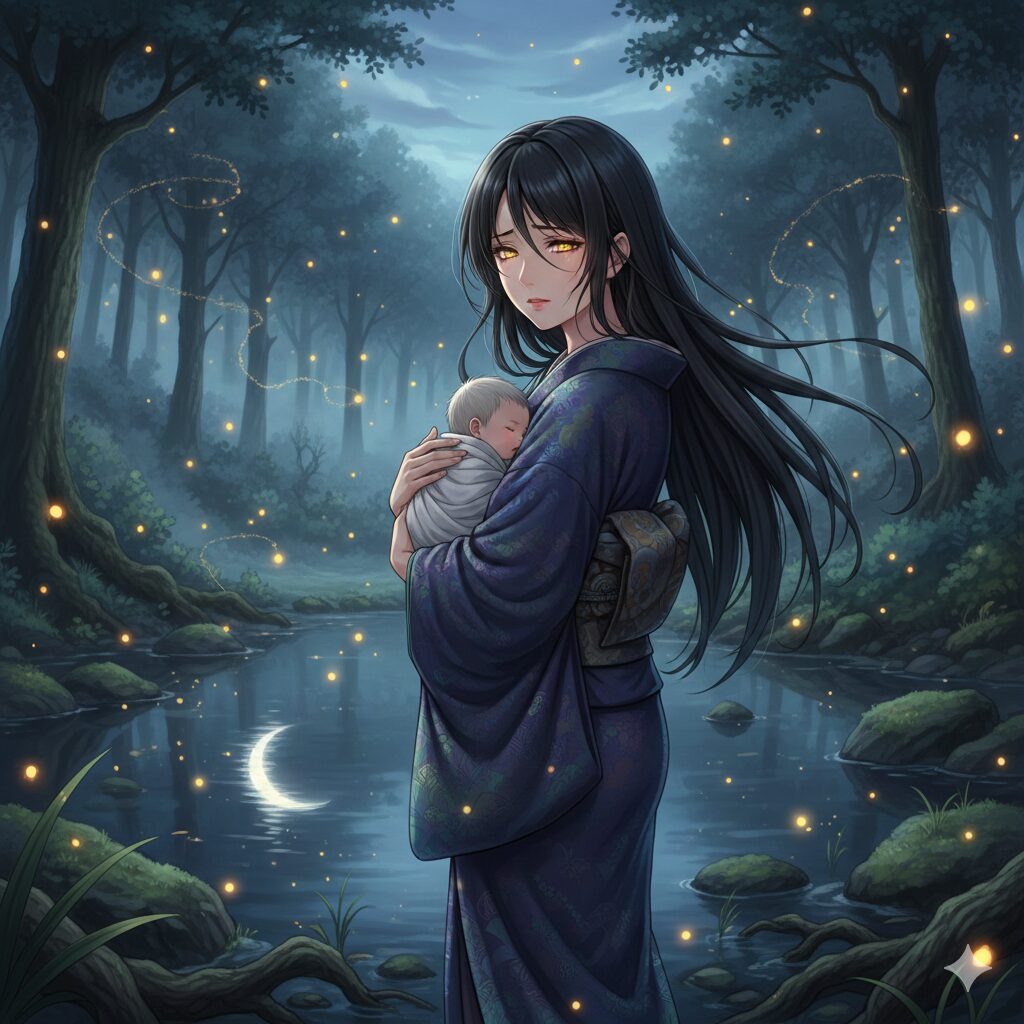
Japanese folklore is filled with stories of animals transforming into humans to repay a kindness. While “The Crane Wife” (Tsuru no Ongaeshi) is the most famous, the story I am introducing today, “The Snake Wife” (Hebi Nyobo), is a far deeper and more poignant depiction of “maternal love.” It is not merely a fantasy, but a heartbreaking drama of self-sacrifice and human greed that pierces the heart of the reader.

The Story: A Mother’s Sacrifice of Her Eyes
A Fateful Encounter
Long ago, there lived a young man in a village. One day, while working in his rice field, he found a snake being tormented by children and on the verge of death. Feeling pity, the young man chased the children away and gently released the snake, saying, “Go back to the mountains.”
A few days later, a beautiful woman visited the young man’s house. “I have lost my way,” she said. “Could you please let me stay for the night?” Although poor, the young man invited her in. She was kind-hearted and hardworking, and soon they fell in love and became husband and wife.
The Taboo of Looking
As time passed, the wife became pregnant. As the time for birth approached, she made a request to her husband.
“While I am in the birthing hut, you must never look inside. No matter what sounds you hear, you must absolutely not look.”
The husband promised and waited outside. However, from inside the hut came sounds like a violent storm and agonizing groans he had never heard before. Overcome with worry, the husband finally broke his promise and peeked through a crack in the door.
There, he did not see his human wife, but a giant coiled snake, suffering as it gave birth to a human baby.
Separation and the Left Eye
After the birth, the wife returned to her human form and appeared before her husband holding the baby. She smiled sadly and said:
“Now that you have seen my true form, I can no longer stay here. I must return to the pond in the mountains.”
The husband apologized desperately and begged her to stay, but her resolve was firm. She gouged out her own left eye with her finger and handed it to her husband.
“My only regret is that I cannot nurse this child. Instead of milk, let the child suckle on this eyeball. It will satisfy his hunger, and he will grow up healthy.”
Leaving these words behind, the wife vanished.
The Stolen Light
The husband raised the baby alone. Whenever the baby cried, he let it suckle on the mother’s eye. Miraculously, the baby would stop crying immediately and grew quickly.
However, rumors of this mysterious jewel reached the ears of the greedy local Lord. “If it is such a rare jewel, it belongs to me,” he declared. Officials stormed the house, and despite the husband’s resistance, the eye was confiscated.
Robbed of the eye, the baby screamed as if on fire and would not stop crying for days. At his wit’s end, the husband headed to the pond in the mountains where his wife lived.
The Final Sacrifice
“My wife, oh my wife, please come out. Our baby is going to die.”
When the husband shouted at the edge of the pond, the water rippled, and his one-eyed wife appeared. Upon hearing the tragic story, she said nothing. She simply gouged out her remaining right eye and gave it to her husband.
“Now I can see nothing. I will never see you or our child again. Please, I ask only this: ring the temple bell every morning and evening. By that sound, I will know the time and pray for your safety.”
The blind giant snake quietly sank to the bottom of the pond. It is said that thereafter, the sad yet gentle sound of the bell echoed through the village every morning and evening.
Analysis: The Price of Inter-species Marriage and Maternal Instinct
“The Snake Wife” possesses the typical structure of Japanese “Animal Wife” tales, yet it is exceptionally cruel and beautiful.
The Psychology of the Forbidden Chamber
The core of this story is the promise to “never look.” This motif is common in global mythology (Pandora’s Box, Psyche and Eros), but in Japanese folklore, knowing the true identity signifies the “end of the relationship.” This reflects the ancient Japanese view of life and death, suggesting there is a boundary between the “natural world (the other world)” and the “human world” that must not be crossed.
The Ultimate Love of Giving One’s Eyes
What sets this apart from other tales is that the wife physically detaches a part of her body (her eyes) to give to her child. This is not a metaphor but a literal physical sacrifice. For a snake (a messenger of water gods), vision is a symbol of spiritual power. Sacrificing this to raise a child represents a ferocious maternal instinct that prioritizes the child even over one’s own divinity.
Cultural Perspective: Water Gods and Gratitude
In Japan, snakes have long been revered as sacred creatures governing “water.” In agriculture, water is life itself, and mistreating a snake was feared to lead to poor harvests or disasters.
This story serves as a warning about receiving blessings (wife, child, the eye) from nature (snake/god) and losing them due to human greed (exploitation by the Lord). The final “sound of the bell” is the only remaining bond connecting humans and nature, resonating with the husband’s repentance and gratitude.
What Would You Do?
If you had to offer your “light” (your vision or most precious possession) to save the life of a loved one, could you do it without hesitation? And could you continue to love the one who broke their promise to you, even after losing everything?
This story quietly questions us, living in the modern world, about the “weight of love” and the “weight of promises.”
Read More:
Snake Wife Variations (Wikipedia)
Japanese Folktale Series Category
悲劇と愛の異類婚姻譚:へび女房(The Snake Wife)
日本の昔話には、動物が人間に化けて恩を返す物語が数多く存在します。「鶴の恩返し」が最も有名ですが、今回紹介する「へび女房」は、それよりも遥かに深く、そして痛ましい「母の愛」を描いた物語です。単なるファンタジーではなく、見る者の心をえぐるような自己犠牲と、人間の欲望が交錯するドラマチックな展開にご注目ください。
あらすじ:眼球を捧げた母の愛
運命の出会い
むかしむかし、ある村にひとりの若者が住んでいました。ある日、彼が田んぼで仕事をしていると、一匹の蛇が子供たちにいじめられ、死にそうになっているのを見つけました。若者は不憫に思い、子供たちを追い払って蛇を助け、「山へお帰り」と優しく逃がしてやりました。
それから数日後、若者の家にひとりの美しい娘が訪ねてきました。「道に迷ってしまいました。一晩泊めていただけませんか」と娘は言います。若者は貧しいながらも彼女を招き入れました。娘は気立てが良く、働き者で、二人はやがて惹かれ合い、夫婦になりました。
見るなのタブー
月日が流れ、妻は子供を授かりました。出産の時が近づくと、妻は夫にこう頼みました。
「私が産屋(うぶや)に入っている間、決して中を覗かないでください。どんな音がしても、絶対に見てはいけません」
夫は約束し、外で待っていました。しかし、産屋の中からは激しい嵐のような音や、聞いたこともないような苦しげな唸り声が聞こえてきます。心配でたまらなくなった夫は、ついに約束を破り、戸の隙間から中を覗いてしまいました。
そこには人間の妻の姿はなく、とぐろを巻いた巨大な蛇が、苦しみながら赤ん坊を産み落としていたのです。
別れと片目
出産を終え、人間の姿に戻った妻は、赤ん坊を抱いて夫の前に現れました。彼女は悲しげに微笑みながら言いました。
「正体を見られた以上、もうここにはいられません。私は山の沼へ帰ります」
夫は必死に謝り、引き止めましたが、妻の決意は変わりません。彼女は自分の左目を指でえぐり出し、夫に手渡しました。
「この子にお乳をあげられないのが心残りです。お乳がわりに、この眼玉をしゃぶらせてください。そうすればお腹も満たされ、元気に育つでしょう」
そう言い残し、妻は姿を消しました。
奪われた光
夫は男手一つで赤ん坊を育てました。赤ん坊が泣くと、母親の眼玉をしゃぶらせました。すると不思議なことに、赤ん坊はすぐに泣き止み、すくすくと育っていきました。
しかし、この不思議な眼玉の噂は、強欲な領主(殿様)の耳に入ってしまいます。「そんな珍しい宝玉なら、儂のものだ」と、役人が押し寄せ、夫の抵抗も虚しく眼玉は没収されてしまいました。
眼玉を奪われた赤ん坊は、火がついたように泣き叫び、何日も泣き止みません。困り果てた夫は、妻が住むという山の沼へと向かいました。
最後の犠牲
「お前、お前、出てきておくれ。赤ん坊が死んでしまう」
夫が沼のほとりで叫ぶと、水面が揺れ、隻眼の妻が現れました。夫が事の顛末を話すと、妻は何も言わず、残っていた右目をえぐり出し、夫に渡しました。
「これで私は何も見えなくなりました。もう二度と、あなたや子供の顔を見ることはできません。お願いです、朝と夕方に、お寺の鐘を突いてください。私はその音で時間を知り、家族の無事を祈って暮らします」
両目を失った盲目の大蛇は、静かに沼の底へと沈んでいきました。その後、村には毎日、朝と夕方に悲しくも優しい鐘の音が響き渡ったといいます。
考察:異種間婚姻の代償と母性
「へび女房」は、日本の民話における「異類婚姻譚(いるいこんいんたん)」の典型的な構造を持ちながら、非常に残酷で美しい物語です。
「見るなのタブー」の心理
この物語の核となるのは「決して見てはいけない」という約束です。これは世界中の神話(パンドラの箱、プシュケとエロスなど)に共通するモチーフですが、日本の昔話では「鶴の恩返し」のように、正体を知られることは「関係の終わり」を意味します。ここには、「自然界(異界)」と「人間界」の間には超えてはならない境界線があるという古代日本人の死生観が見て取れます。
眼玉を与えるという究極の愛
他の動物女房譚と一線を画すのは、妻が自分の身体の一部(眼球)を切り離して子供に与える点です。これは比喩的な表現ではなく、文字通りの身体的犠牲です。蛇(水神の使い)にとって眼力は霊力の象徴でもあります。それを子供の養育のために捧げる行為は、神性を捨ててでも子供を守ろうとする、凄まじい母性本能を表しています。
日本文化の視点:水神信仰と感謝
日本では古来より、蛇は「水」を司る神聖な生き物とされてきました。農業において水は命そのものであり、蛇を粗末に扱うことは凶作や災害につながると恐れられていました。
この物語の背景には、自然(蛇・神)から恩恵(妻・子供・眼玉)を受けながら、それを人間の欲望(殿様による搾取)によって失ってしまうことへの警鐘が含まれています。最後の「鐘の音」は、人間と自然が辛うじて繋がっていられる唯一の絆であり、夫の懺悔と感謝の響きなのです。
あなたなら、どうしますか?
もしあなたが、愛する人の命を救うために、自分の「光(視力や最も大切なもの)」を差し出さなければならないとしたら、躊躇なく差し出すことができるでしょうか?そして、約束を破った夫を、すべてを失ってもなお愛し続けることができるでしょうか?
この物語は、現代を生きる私たちに「愛の重さ」と「約束の重さ」を静かに問いかけています。


コメント