- Introduction: The Cyberpunk Masterpiece That Shocked the World
- Synopsis: What is the “Ghost” Lurking in the Sea of the Net?
- Evaluation and Popularity in Japan: Interpreting Through History and Culture
- Must-Read Points: What Makes It So Special?
- Conclusion: The Net is Vast and Infinite
- はじめに:世界に衝撃を与えたサイバーパンクの最高峰
- 『攻殻機動隊』の作品内容と要約:ネットの海に潜む「ゴースト」とは
- 日本の歴史・文化から読み解く『攻殻機動隊』の評価と人気の理由
- ここを読むべき!おすすめポイント
- まとめ:ネットの海は広大だ
Introduction: The Cyberpunk Masterpiece That Shocked the World
Do you know the Japanese anime masterpiece that profoundly influenced creators worldwide, especially Hollywood sci-fi film directors? It is “Ghost in the Shell”, based on the manga by Masamune Shirow and adapted into an animated film by director Mamoru Oshii in 1995. This work is not merely a sci-fi action flick; it presents profound themes such as the human soul, the evolution of AI, and the fusion of technology and the flesh, radiating a brilliance that never fades. In this article, we will thoroughly explain the synopsis, offer deep insights rooted in Japanese culture and history, and highlight the must-see points.
Synopsis: What is the “Ghost” Lurking in the Sea of the Net?
The story is set in a fictional Japanese city (New Port City) in the mid-21st century. After World War III and IV, it is a near-future where science and technology have advanced dramatically. “Cyberbrain” technology, which connects human brains directly to the internet, has become commonplace, and “prosthetic body (cyborg)” technology, replacing most of the physical body with machines, is widespread. As a result, the boundary between humans and machines has become extremely blurred.
The protagonist, Motoko Kusanagi, is a full-body cyborg (retaining only a portion of her human brain and spinal cord) and the leader of Public Security Section 9, an independent unit directly under the Ministry of Home Affairs. She and her team confront heinous crimes such as cyber-terrorism, assassinations, and cyberbrain hacking. The core of the story revolves around the investigation of the “Puppet Master,” a brilliant hacker who hacks into people’s cyberbrains to alter their memories. Through the investigation, Motoko faces existential questions: “Am I truly human? Is my ‘ghost’ (soul) real?” Eventually, she arrives at a shocking truth that shakes the very definition of life.
Evaluation and Popularity in Japan: Interpreting Through History and Culture
Why was this work born in Japan, and why is it so highly acclaimed? It is deeply connected to Japan’s traditional views on life and death, and its history of rapid post-war technological development.
1. “Animism” (Yaoyorozu no Kami) and Affection for Machines
In Western sci-fi, we often see a “Human vs. Machine (AI)” conflict structure. However, Japan has an ancient animistic belief (Yaoyorozu no Kami) that “a soul (god) dwells in all things.” It is a culture that believes souls reside not only in mountains and rivers but even in well-used tools. Because of this philosophy, Japanese people do not inherently harbor a strong fear of AI or cyborgs; instead, there is a cultural foundation to naturally accept that “machines might also develop a ‘ghost’ (soul).” The birth of the information-based lifeform, the Puppet Master, and the process of the Tachikoma AI tanks acquiring ego in the series are exact modern, cyberpunk revivals of traditional Japanese spirituality.
2. The Post-War Economic Miracle and the Antithesis to Technological Overconfidence
After WWII, Japan achieved miraculous economic growth from the ashes, becoming one of the world’s top technological superpowers. While there is a strong success story that technological advancement brings wealth, by the 1990s (when the anime was released), along with the collapse of the bubble economy, a vague anxiety began to cover society: “Does technology truly make humans happy?” The characters who discard their flesh to connect to the network sharply pierce the wavering identity of modern people who are being swallowed up by the information society and losing themselves.
Must-Read Points: What Makes It So Special?
The greatest point of enjoying “Ghost in the Shell” is the fusion of overwhelming “visual expression” and “philosophical questioning.”
- Meticulous World-Building and Future Prediction: Despite being created in the late 1980s and early 90s, it predicted the current internet society, wearable devices, and the evolution of AI with terrifying accuracy.
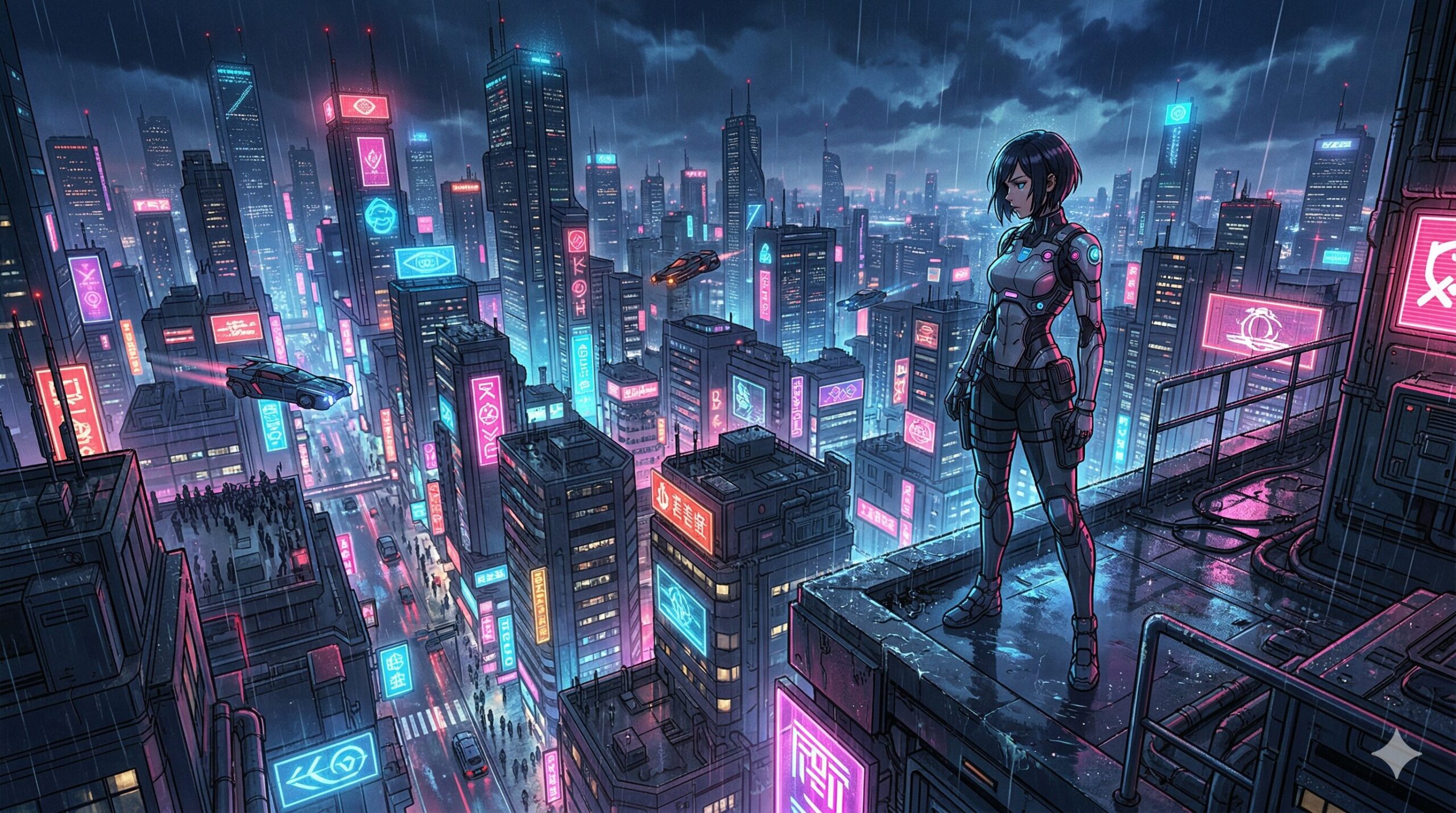
- Top-Tier Animation Techniques: The detailed animation by Production I.G is a must-see, especially the decadent and chaotic cityscape modeled after Hong Kong, and the cyborgs’ inorganic yet sensual movements.
- The Universal Theme of “What is ‘I’?”: In a world where memories can be altered as data, what defines “oneself”? Motoko Kusanagi’s loneliness and ultimate decision pierce deeply into the hearts of anyone, transcending borders.
Conclusion: The Net is Vast and Infinite
“Ghost in the Shell” is more than just entertainment; it is a bible that gives us an opportunity to deeply consider the ethics of the technological society we are facing and the definition of humanity. Please dive into this overwhelming universe at least once.
Reference Links for Deeper Dive:
・Ghost in the Shell V-STORAGE Special (Japanese)
・Ghost in the Shell – Wikipedia (English)
Explore More Japanese Pop Culture:
We introduce the deep charm of other Japanese anime and culture. Please check here:
・Read more in the Japanese Culture / Anime Category
日本アニメの金字塔『攻殻機動隊』:サイバーパンクと日本固有の精神世界が交錯する傑作
はじめに:世界に衝撃を与えたサイバーパンクの最高峰
世界中のクリエイター、特にハリウッドのSF映画監督たちに多大な影響を与えた日本アニメの傑作をご存知でしょうか。士郎正宗による漫画を原作とし、1995年に押井守監督によってアニメーション映画化された『攻殻機動隊(Ghost in the Shell)』です。本作は単なるSFアクションにとどまらず、人間の魂、AIの進化、そしてテクノロジーと肉体の融合という深遠なテーマを提示し、今なお色褪せない輝きを放っています。この記事では、本作のあらすじから、日本文化や歴史的背景に根ざした深い考察、そして必見のポイントまでを徹底的に解説します。
『攻殻機動隊』の作品内容と要約:ネットの海に潜む「ゴースト」とは
舞台は21世紀中葉の架空の日本(ニューポートシティ)。第四次非核大戦を経て、科学技術が飛躍的に進歩した近未来です。人々の脳は直接インターネットに接続される「電脳化」が一般化し、肉体の大部分を機械に置き換える「義体化(サイボーグ化)」技術が普及しています。これにより、人間と機械の境界線は極めて曖昧になりました。
主人公の草薙素子(くさなぎ もとこ)は、脳と脊髄の一部を除く全身を義体化した完全サイボーグであり、内務省直属の独立部隊「公安9課(通称:攻殻機動隊)」を率いるリーダーです。彼女と彼女のチームは、電脳犯罪やテロリズム、暗殺などの凶悪犯罪に立ち向かいます。物語の中心となるのは、他人の電脳をハッキングして記憶を改ざんする凄腕のハッカー「人形使い」を巡る事件です。捜査を進める中で、素子は「自分は本当に人間なのか?自分の『ゴースト(魂)』は本物なのか?」という実存的な問いに直面し、やがて生命の定義を揺るがす驚愕の真実へとたどり着きます。
日本の歴史・文化から読み解く『攻殻機動隊』の評価と人気の理由
本作がなぜ日本で生まれ、そしてこれほどまでに高く評価されているのか。それは、日本の伝統的な死生観と、戦後の急激なテクノロジー発展という歴史が深く関わっています。
1. 「八百万の神(アニミズム)」と機械への愛情
欧米のSF作品では、しばしば「人間 vs 機械(AI)」という対立構造が描かれます。しかし日本には、古来より「万物に魂(神)が宿る」とするアニミズム(八百万の神)の思想があります。山や川だけでなく、使い込まれた道具にさえ魂が宿ると考える文化です。この思想があるため、日本人はAIやサイボーグに対して強い恐怖心を抱くのではなく、「機械にも『ゴースト(魂)』が芽生えるのではないか」と自然に受け入れる土壌がありました。『攻殻機動隊』における「人形使い」という情報生命体の誕生や、思考戦車タチコマが自我を獲得していく過程は、まさに日本の伝統的な精神世界をサイバーパンクという形で現代に蘇らせたものと言えます。
2. 戦後の高度経済成長とテクノロジーへの過信へのアンチテーゼ
日本は第二次世界大戦後、焼け野原から奇跡的な高度経済成長を遂げ、世界トップクラスの技術大国となりました。科学技術の発展が豊かさをもたらすという強烈な成功体験がある一方で、1990年代(本作のアニメ化時期)に入ると、バブル崩壊とともに「テクノロジーは本当に人間を幸福にするのか」という漠然とした不安が社会を覆い始めました。肉体を捨ててまでネットワークに接続する登場人物たちの姿は、情報化社会に飲み込まれ、自己を見失いつつある現代人のアイデンティティの揺らぎを鋭く突いています。
ここを読むべき!おすすめポイント
『攻殻機動隊』を楽しむための最大のポイントは、圧倒的な「ビジュアル表現」と「哲学的な問い」の融合です。
- 緻密な世界観と未来予測:1980年代後半〜90年代前半に作られた作品でありながら、現在のインターネット社会、ウェアラブルデバイス、AIの進化を恐ろしいほどの精度で予見しています。
- 最高峰のアニメーション技術:Production I.Gによる緻密な作画、特に香港をモデルにした退廃的で混沌とした都市風景と、サイボーグの無機質でありながら官能的な動きは必見です。
- 「私」とは何かという普遍的テーマ:記憶がデータとして改ざん可能な世界で、それでも「自分」を定義するものは何か。草薙素子の孤独と決断は、国境を越えてあらゆる人の心に深く突き刺さります。
まとめ:ネットの海は広大だ
『攻殻機動隊』は、ただのエンターテインメントにとどまらず、これから私たちが直面するテクノロジー社会の倫理や人間の定義について、深く考えるきっかけを与えてくれるバイブルです。ぜひ一度、この圧倒的な世界観にダイブしてみてください。
さらに深く知るための参考リンク(外部リンク):
・攻殻機動隊 V-STORAGE 徹底解説(日本語)
・Ghost in the Shell – Wikipedia (English)
日本のポップカルチャーをもっと楽しむ(内部リンク):
他にも日本のアニメや文化の深い魅力を紹介しています。ぜひこちらをご覧ください。
・Japanese Culture / Anime Category をもっと読む


コメント