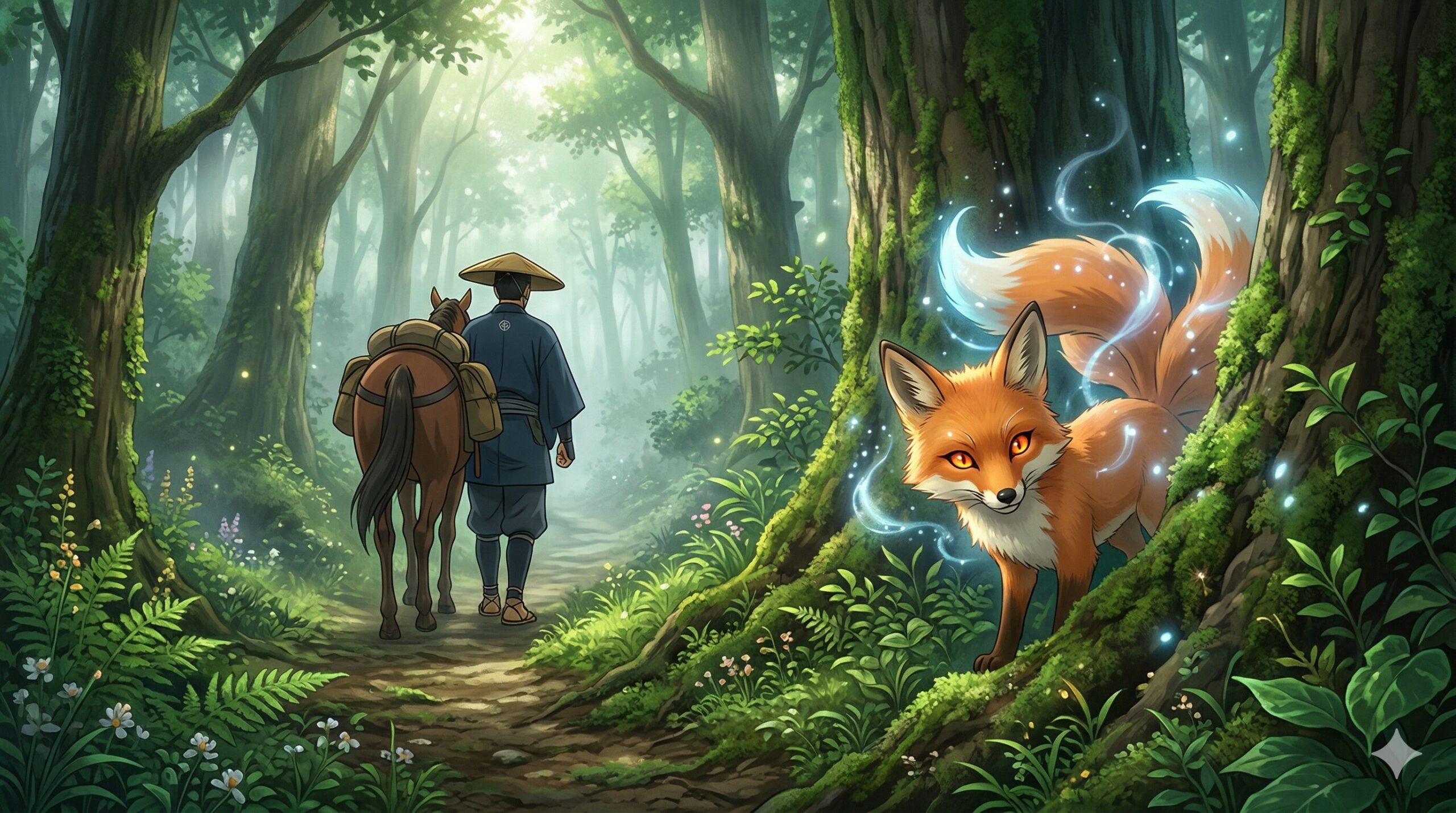
Deep within the lush, verdant nature of Japan exists a mystical space where humans, animals, and spirits have historically crossed paths. The folktale “The Fox of Battarisawa” from Iwate Prefecture perfectly captures this mysterious yet humorous daily life of ancient Japan. Woven with a fox’s mischievous pranks, human wit, and a child’s pure intuition, this story transcends a simple fairy tale to offer us profound insights.
① The Folktale: The Fox of Battarisawa
Once upon a time, in a village in Iwate Prefecture, there was a dense, overgrown ravine known as Battarisawa. Dark even during the day, this ravine was home to an ancient fox notorious for tricking and playing pranks on any human who dared to pass through.
A man called a “Betto” (a shrine horseman and porter) from the local village was one of the fox’s favorite targets. One day, as the Betto was walking through the ravine, the ground suddenly shook, and a wild horse charged at him with terrifying speed. Startled, the Betto ducked for cover, yelling “Look out!” In that split second of panic, the fox snatched away all the fish the Betto had worked so hard to acquire. The charging horse had been nothing but a clever illusion.
On another occasion, as the Betto approached Battarisawa, the surroundings suddenly plunged into a pitch-black night. The single path before him fractured into multiple dark trails, leaving him completely lost and unable to find his way home. At a loss, he sat down for a smoke and suddenly saw a familiar face approaching—his village friend, Gohei. Relieved, the Betto half-jokingly asked, “You aren’t the fox in disguise, are you?” Gohei laughed and denied it, so the two safely began walking together.
However, as they walked, the luggage on the Betto’s back began to feel unnaturally heavy. Unable to bear the weight, he asked, “Gohei, I’m sorry, but could you carry this for a bit?” The moment Gohei took the luggage, both he and the precious cargo vanished into thin air like smoke! Instantly, the surroundings returned to daylight. The Betto had been completely fooled once again.
The fox’s ultimate prank, however, occurred right inside the Betto’s own home. One evening, the Betto returned to find two identical wives sitting by the hearth! They had the same face, the same voice, and wore the exact same kimono. The Betto was entirely incapable of telling which was his real wife and which was the disguised fox. Villagers gathered to help, but everyone was completely stumped.
Desperate, the Betto resorted to a final measure. He went to the back room, woke up his deeply sleeping toddler, and brought the child out. Rubbing their sleepy eyes, the child stared intently at the two “mothers” for a while. As the adults watched with bated breath, the child unhesitatingly leaped into the arms of one of the women, crying out, “Mama!”
“That’s it! This one is the real one!”
The Betto and the villagers immediately grabbed the woman the child had ignored and threw her toward the roaring fire of the hearth. With a shriek of “Hot!”, the illusion shattered, revealing a large, old fox.
“Damn it! No matter how well I disguise myself, I can never beat the eyes of a child!” the fox cried. Brushing off the sparks, the fox fled into the dark night, hurling sour insults as it ran: “Terasawa’s Betto, idiot Betto! Hippuri-aburi Daimyojin! Hyaa~n!”
Though the fox was thoroughly humiliated and its true identity revealed, it did not learn its lesson. Season after season, the fox continued to trick the people passing through Battarisawa, just as it always had.
② Analysis: Why Did the Fox Trick Humans?
A deeper reading of this folktale reveals several fascinating themes. The first point of interest is the “cleverness and limits of the fox’s illusions.”
The fox is depicted as a genius at exploiting human psychological blind spots. It uses the hallucination of a wild horse to instill “fear and shock” to steal fish; it creates darkness and fake paths to incite “anxiety”; and it borrows the face of a close friend to offer a false “sense of security” before stealing the luggage. These tricks all prey upon the “preconceptions” and “flaws in logical judgment” of adults. The Betto logically convinced himself he was safe after verbally confirming with “Gohei,” and that logic was exactly what the fox exploited.
Yet, this flawless phantom magic was utterly useless against a young child. Why could the child see through the disguise? It is because a child recognizes the world not through “visual data” or “logic,” but through intuitive bonds that defy words—the “scent of the mother,” her “warmth,” and the “presence of her soul.” The narrative twist—that while adults are confused by reason, only a pure-hearted child can see the truth—delivers a powerful message that our most essential human connections are not based on outward appearances.
③ Cultural Connection: Animism and Coexisting with Nature
The tale of the “Fox of Battarisawa” vividly illustrates the traditional Japanese spirituality of Animism (the belief in eight million gods) and the concept of coexisting with nature.
In Western fairy tales and myths, beasts or monsters that deceive humans are typically portrayed as “absolute evil” and are ultimately slain and eradicated by a hero. However, the foxes, tanuki (raccoon dogs), and yokai (spirits) in Japanese folktales are different. They are troublesome entities that cause headaches for humans, but they simultaneously symbolize the “power beyond human comprehension” inherent in nature.
The ending of this story is highly symbolic. The fox’s true identity is revealed, and it runs away hurling insults, but the villagers do not form a hunting party to kill it. Furthermore, the fox does not repent and stop its pranks; it simply continues to trick people in Battarisawa.
This encapsulates the Japanese view of nature. Nature provides immense blessings, but it also occasionally bares its fangs and plays unpredictable “pranks” on humans (such as natural disasters or bad luck). Historically, rather than attempting to completely dominate or eradicate these forces, the Japanese chose a path of “coexistence.” They maintained an appropriate distance with a mix of awe and humor, thinking, “There’s a pesky fox in Battarisawa, so we better be careful.” This tolerance and acceptance of the fox’s existence is the very spirit that flows at the foundation of unique Japanese culture.
④ To Our Readers: What Would You Do?
How did you feel after reading this folktale? Were you surprised by the fox’s clever tricks? Or were you touched by the pure intuition of the child who found their real mother without a second’s hesitation?
If you were in the Betto’s shoes, what method would you use to tell apart two identical loved ones? Today, we often find ourselves walking through our own “dark ravine of Battarisawa,” overwhelmed by information and struggling to see what is real. In times like these, relying not just on logic and appearances, but on our own childlike “pure intuition,” might be the key to seeing the truth.
Please share your thoughts or any unique ideas you have on how you would expose the disguised fox! And if you ever visit Japan, try to feel the faint presence of those mischievous spirits hiding deep within the lush forests.
References and Related Articles
Reference data for the folktale in this article: Manga Nippon Mukashi Banashi Database: The Fox of Battarisawa
We introduce many other fascinating and mysterious Japanese folktales. Please enjoy reading them from this category: Japanese Folktale Series
ばったり沢の狐:イタズラ狐と子供の純心が見破る幻惑の物語
日本の豊かな自然の中には、古くから人間と動物、そして精霊たちが交差する不思議な空間が存在します。岩手県に伝わる「ばったり沢の狐」は、そんな日本の神秘的で少しユーモラスな日常を切り取った魅力的な昔話です。狐のイタズラと、人間の知恵、そして純真無垢な子供の直感が織りなすこの物語は、単なるおとぎ話を超えて、私たちに多くの気づきを与えてくれます。
① 昔話「ばったり沢の狐」のあらすじ
むかしむかし、岩手県のある村に「ばったり沢」と呼ばれる鬱蒼とした沢がありました。昼間でも薄暗いこの沢には、一匹の古狐が住み着いており、ここを通りかかる人間を化かしてはイタズラを楽しむことで有名でした。
村の神社で神馬の世話や荷運びをする「別当(べっとう)」と呼ばれる男も、この狐の格好の標的でした。ある日のこと、別当が沢を歩いていると、突然、地響きとともに物凄い勢いで荒馬が駆け寄ってきました。別当が「危ない!」と驚き、思わず身をすくめたその一瞬の隙に、彼が苦労して手に入れた魚はすべて狐に持ち去られてしまったのです。荒馬の幻影は、狐の巧妙な罠でした。
また別の日、別当がばったり沢に差し掛かると、急に辺りが夜のように暗闇に包まれました。目の前の道はいくつにも枝分かれし、どの道を進めば村に帰れるのか全く分からなくなってしまいました。途方に暮れて一服していると、向こうから馴染みの村人である五平どんが歩いてくるのが見えました。別当は安堵し、「まさかお前、狐じゃあるめえな?」と冗談交じりに確認し合いました。五平どんも笑って否定したため、二人は一緒に歩き始めました。
しかし、歩いているうちに別当の背負っている荷物が異常に重く感じられるようになりました。耐えきれなくなった別当は「五平どん、すまねえが少し荷物を持ってくれないか」と頼みました。五平どんが荷物を受け取ったその瞬間です。五平どんの姿も、大切な荷物も、まるで煙のようにふっと掻き消えてしまいました。と同時に、辺りは元の明るさを取り戻しました。またしても狐に化かされていたのです。
そして、狐の最大のイタズラは別当の自宅で起こりました。ある晩、別当が家に帰ると、なんと囲炉裏の前に「自分の女房」が二人座っていたのです。顔も、声も、着ている着物も全く同じ。どちらが本物の妻で、どちらが化けた狐なのか、別当には全く見分けがつきません。村人たちも集まってきましたが、皆首をひねるばかりです。
困り果てた別当は、最後の手段に出ました。奥の部屋でぐっすりと眠っている幼い子供を起こして連れてきたのです。寝ぼけ眼の子供は、目の前にいる二人の「母親」をしばらくじっと見比べていました。大人たちが息を呑んで見守る中、子供は迷うことなく、片方の女房の胸に「おっかあ!」と飛び込んでいきました。
「それっ!本物はこっちだ!」
別当と村人たちは、子供が選ばなかったもう一人の女房を捕まえ、囲炉裏の火のそばへと放り投げました。すると、「熱い!」という悲鳴とともに化けの皮が剥がれ、大きな古狐が姿を現しました。
「畜生!どんなに上手く化けても、子供の目には敵わん!」と狐は叫びました。そして火の粉を払いながら、「寺沢の別当、馬鹿別当!ひっぷりあぶりの大明神!ひゃ~ん!」と負け惜しみの悪態をつきながら、夜の闇へと逃げていきました。
正体がバレて大恥をかいた狐ですが、それで大人しくなることはありませんでした。その後も四季折々、ばったり沢では相変わらず狐に化かされる人々が後を絶たなかったということです。
② 昔話の考察:なぜ狐は人を化かすのか?
この物語を深く読み解くと、いくつかの非常に興味深いテーマが浮かび上がってきます。まず注目すべきは、「狐のイタズラの巧妙さと限界」です。
狐は人間の心理的な死角を突く天才として描かれています。荒馬の幻覚で「恐怖と驚き」を与えて魚を奪い、暗闇と偽の道で「不安」を煽り、親しい友人の姿を借りて「安心感」を与えたところで荷物を奪います。これらはすべて、大人が持つ「先入観」や「論理的な判断の隙」を利用したものです。別当は「五平どん本人に確認したから安全だ」と論理的に納得してしまいましたが、そこがまさに狐の狙いでした。
しかし、そんな狐の完璧な幻術も、幼い子供の前では全く通用しませんでした。なぜ子供には見破れたのでしょうか?それは、子供が「視覚的な情報」や「論理」ではなく、「母親の匂い」「温もり」「魂の気配」といった、言語化できない直感と愛情の絆で世界を認識しているからです。大人が理性で迷う中、純真な魂を持つ子供だけが真実を見抜くという展開は、人間の本質的な繋がりは見た目ではないという強いメッセージを持っています。
③ 日本文化との関連:自然との共生とアニミズム
「ばったり沢の狐」は、日本の伝統的な精神性である「アニミズム(八百万の神々の信仰)」や「自然との共生」を如実に表しています。
西洋の童話や神話において、人間を騙す獣や怪物は「完全なる悪」として描かれ、最終的には勇者によって退治され、排除されるのが一般的です。しかし、日本の昔話に登場する狐や狸、妖怪たちは少し異なります。彼らは人間に迷惑をかける厄介な存在ですが、同時に自然の持つ「人知を超えた力」の象徴でもあります。
この物語の結末は非常に象徴的です。狐は正体を見破られ、悪態をついて逃げ帰りますが、村人たちは山狩りをして狐を殺すようなことはしません。そして、狐も反省してイタズラをやめるわけではなく、その後もばったり沢で人を化かし続けます。
ここに、日本の「自然観」が凝縮されています。自然は恵みをもたらすと同時に、時に人間に牙を剥き、予測不可能なイタズラ(災害や不運)を仕掛けてきます。昔の日本人は、それらを完全に支配したり排除したりするのではなく、「ばったり沢には厄介な狐がいるから気をつけよう」と、畏れとユーモアを持って適度な距離を保ちながら「共生」する道を選んできました。狐の存在を許容するこの寛容さこそが、日本独特の文化の根底に流れる精神なのです。
④ 読者の皆様へ:あなたならどうしますか?
この昔話を読んで、あなたはどのように感じましたか?狐の巧妙なイタズラに驚きましたか?それとも、迷いなく本物の母親を見つけ出した子供の純真さに心を打たれたでしょうか。
もしあなたが別当の立場だったら、同じ顔をした二人の愛する人を見分けるために、どのような方法をとるでしょうか?現代の私たちも、情報が溢れ、何が真実か見えにくい「暗闇のばったり沢」を歩いているようなものです。そんな時、論理や見た目だけでなく、子供のような「純粋な直感」を信じることが、真実を見抜く鍵になるのかもしれません。
ぜひ、あなたの考えや、「私ならこうやって狐を見破る!」というユニークなアイデアがあれば教えてください。そして、日本を訪れた際には、鬱蒼とした森の奥に潜むイタズラ好きな精霊たちの気配を、少しだけ感じてみてください。
参考リンクと関連記事
本記事の昔話の参考元データ:まんが日本昔ばなし〜データベース:ばったり沢の狐
他にも日本の魅力的で不思議な昔話を多数紹介しています。ぜひこちらのカテゴリーからお楽しみください:Japanese Folktale Series(日本の昔話シリーズ)

コメント