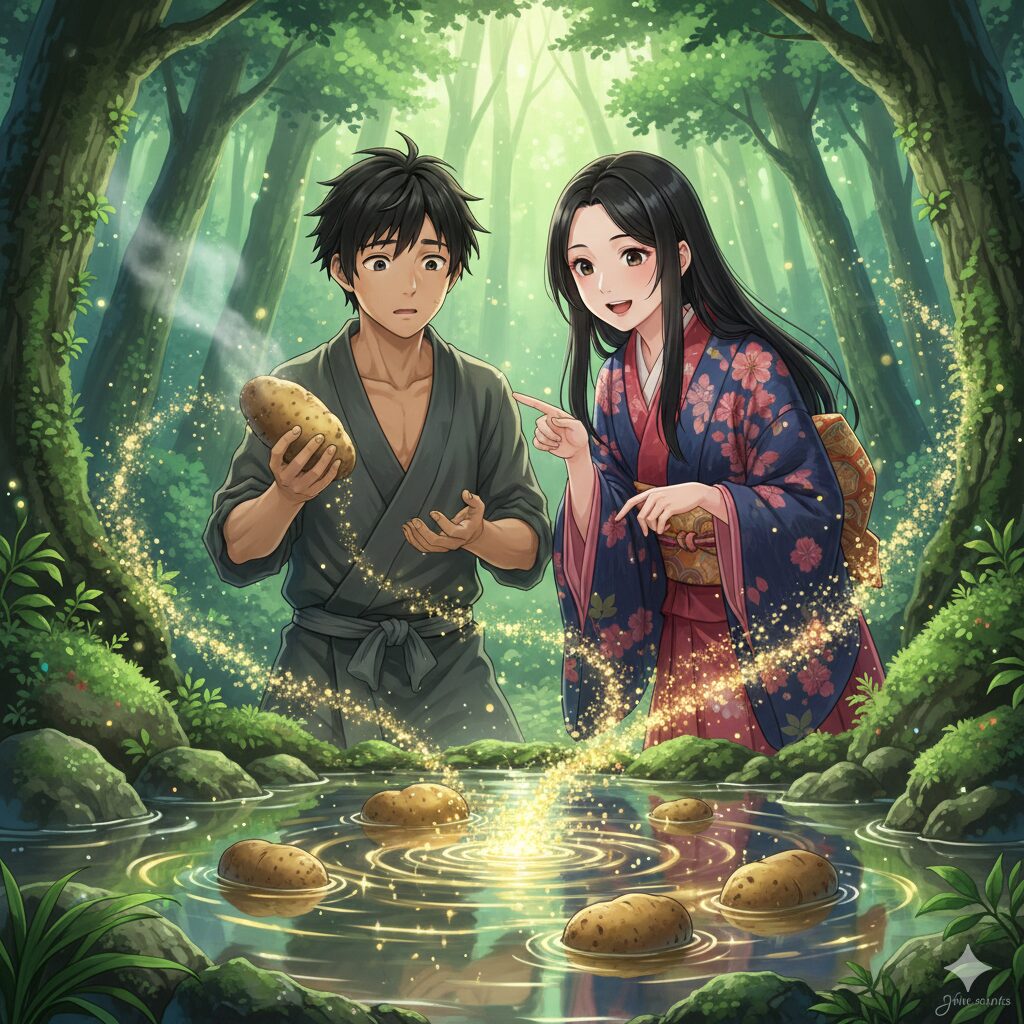
While Japan has countless folktales, few illustrate the triumph of selflessness and the power of partnership quite like “Imohori Choja” (The Potato-Digging Millionaire). At first glance, it seems like a story of pure luck. However, a deeper reading reveals profound insights into Japanese spirituality and the historical background of Kanazawa City in Ishikawa Prefecture.
In this article, we will unravel this fascinating tale and explore what lessons it holds for us living in the modern world.

Chapter 1: The Story of “Imohori Choja”
Long, long ago, in the province of Kaga (modern-day Ishikawa Prefecture), lived a young man named Togoro.
Togoro lived in poverty that shocked everyone who knew him. However, his heart was as beautiful as brocade; he was honest and completely free of greed. Every day, he went to the mountains to dig for wild yams (jinenjo) to survive. Because of this, the villagers affectionately called him “Imohori Togoro” (Potato-Digging Togoro).
Meanwhile, far away in the province of Yamato (modern-day Nara Prefecture), lived a very wealthy man. This millionaire had a beautiful only daughter named Kazuko. Kazuko was not only beautiful but also extremely wise, possessing the ability to see the true essence of things.
One day, Kazuko received a divine revelation in a dream: “Go to the province of Kaga and marry a man named Imohori Togoro. If you do, your family will prosper.”
Her parents were fiercely opposed. “We cannot give our precious daughter to a pauper of unknown lineage!” But Kazuko’s resolve was firm. Taking only a small bag of gold dust as a dowry, she left her home.
A Fated Meeting and a Shocking Truth
After a long journey, Kazuko arrived at Togoro’s humble shack. Togoro was startled by the sudden appearance of such a beautiful woman, but overwhelmed by her sincere gaze, they began their life together.
One day, Kazuko handed Togoro the gold dust she had brought and asked, “Please go to the town and buy rice and miso with this.” Togoro agreed and set out. On his way back, however, he saw a flock of wild geese flying in the sky. Thinking, “I want to catch that bird and feed it to my wife,” he instinctively threw the bag of gold dust at the geese.
The bag missed the birds and fell deep into a valley. When Togoro returned empty-handed and told his story, Kazuko was astounded. “That bag contained precious money! What a waste!”
But Togoro looked at her blankly and said:
“What? You wanted those little stones? If that’s what you want, there are plenty of them lying around the mountain where I dig for potatoes.”
The Birth of Kanazawa
Now it was Kazuko’s turn to be surprised. Half in doubt, she followed Togoro to the spring where he always washed his potatoes. There, she saw gold dust glittering in the water. The mud on the potatoes, which Togoro had thought were just “heavy stones” and washed away, was actually filled with gold.
Kazuko explained, “This is called gold, and it is a treasure of great value.” Together, they gathered the gold and built a magnificent estate. Instead of hoarding their wealth, they shared it with the villagers and lived happily ever after.
The spring where Togoro washed his potatoes came to be called “Kanearai no Sawa” (Marsh of Gold Washing). It is said that this is the origin of the name “Kanazawa,” which remains the name of the capital city of Ishikawa Prefecture today.
Chapter 2: Analysis – “Lack of Greed and Insight”
This story contains deep lessons beyond a simple success story.
1. The Paradox of Mu-yoku (No Greed)
Togoro thought the gold was just “stones.” His value system was based on “potatoes” for survival, not accumulated wealth. Paradoxically, because he was not obsessed with gold, he attracted the ultimate treasure—his wife, Kazuko—and consequently gained material wealth. Had he been a greedy man, he might have sold the land long before Kazuko arrived.
2. The Partner with Keigan (Insightful Eye)
The true protagonist of this story is the wife, Kazuko. She was not blinded by the superficial condition of “poverty” and trusted her intuition (the divine message). Most importantly, she had the wisdom to recognize the “overlooked value” that Togoro possessed and transform it into wealth. This parallels the role of a great producer or manager in modern business.
Chapter 3: Cultural Significance of Imohori Choja
The “Imohori Choja” legend symbolizes the Japanese view of nature and marriage.
- Nature’s Bounty: Since ancient times, Japanese people have believed that gods dwell in mountains and rivers, providing blessings. The gold attached to the potatoes is a gift from nature given to an honest man who lives in harmony with the land.
- Naijo no Ko (The Success of the Husband through the Wife’s Support): In Japan, there is a virtue known as “Naijo no Ko,” where a husband succeeds thanks to his wife’s wise support behind the scenes. Kazuko is the epitome of this, and success was achieved by combining her knowledge with Togoro’s honest labor.
Furthermore, this legend is crucial for tourism in Kanazawa City. Many travelers visiting Kenrokuen Garden or Kanazawa Castle learn that this land has a deep connection with “gold” (in fact, Kanazawa produces almost all of Japan’s gold leaf). The legend bridges the gap between history and imagination, giving the land a narrative soul.
Chapter 4: What Would You Do?
If you were Togoro, would you have noticed the gold lying at your feet? Or would you have been too busy with daily struggles, discarding it as muddy stones?
Alternatively, if you were Kazuko, would you have had the courage to leave a stable life behind and jump into an unknown world based solely on potential?
There may be gold sleeping around us right now, disguised as “mud on potatoes.” We hope that after reading this story, the scenery of your daily life looks a little different.
Related Links:
- Read more Japanese folktales here: Japanese Folktale Series
- Learn more about the setting of the legend (External Link): Visit Kanazawa (Official Tourism Website)
日本の隠れた黄金伝説:芋ほり長者が教える「本当の豊かさ」
日本には数多くの昔話が存在しますが、「芋ほり長者(Imohori Choja)」ほど、無欲の勝利と、パートナーシップの重要性を説いた物語はありません。一見、ただの運が良い男の話に見えますが、深く読み解くと、そこには日本人の精神性や、現在の石川県金沢市の地名の由来ともなった歴史的な背景が見えてきます。
今回は、この興味深い物語を紐解き、現代に生きる私たちが何を学べるのかを深掘りしていきます。
第一章:物語「芋ほり長者」
昔々、加賀の国(現在の石川県)に、藤五郎(Togoro)という一人の若者が住んでいました。
藤五郎は、誰もが呆れるほど貧しい暮らしをしていました。しかし、彼の心は錦のように美しく、正直で、欲というものが全くありませんでした。彼は毎日山へ行き、自然薯(野生の山芋)を掘って暮らしていました。そのため、村の人々は彼を親しみを込めて「芋ほり藤五郎」と呼んでいました。
一方、遠く離れた大和の国(現在の奈良県)に、大金持ちの長者が住んでいました。この長者には、美しい一人娘がいました。和子(Kazuko)という名のその娘は、美しいだけでなく、非常に賢く、物事の本質を見抜く目を持っていました。
ある日、和子は夢のお告げを聞きます。「加賀の国に住む、芋ほり藤五郎という男のもとへ嫁ぎなさい。そうすれば、家は栄えるであろう」
両親は大反対しました。「どこの馬の骨とも分からぬ貧乏人のもとへ、大切な娘をやれるわけがない!」しかし、和子の決意は固く、わずかな持参金としての砂金袋を持って、家を出てしまいました。
運命の出会いと衝撃の事実
長い旅の末、和子は藤五郎の粗末な小屋にたどり着きました。藤五郎は突然現れた美しい女性に驚きましたが、彼女の真剣な眼差しに押され、二人の共同生活が始まりました。
ある日、和子は持ってきた砂金を藤五郎に渡し、「これで町へ行って、お米や味噌を買ってきてください」と頼みました。藤五郎は承知して出かけましたが、帰り道、空を飛ぶ雁(がん)の群れを見つけました。「あの鳥を捕まえて、妻に食べさせてやりたい」と思った藤五郎は、とっさに懐にあった砂金の袋を雁に向かって投げつけました。
砂金袋は雁に当たらず、そのまま深い谷底へ落ちてしまいました。手ぶらで帰ってきた藤五郎の話を聞いて、和子は驚愕しました。「あの袋には、大切なお金が入っていたのですよ!なんと勿体ないことを!」
しかし、藤五郎はキョトンとして言いました。
「なんだ、あんな石ころが欲しかったのか?あんなものなら、俺が芋を掘っている山の周りに、いくらでも転がっているぞ」
金沢の誕生
今度は和子が驚く番でした。半信半疑で藤五郎に連れられ、彼がいつも芋を洗っている泉へ行ってみると、そこには砂金がキラキラと輝いていたのです。藤五郎が「ただの重い石」だと思って捨てていた芋の泥には、大量の砂金が付着していたのでした。
和子は言いました。「これは黄金といって、とても価値のある宝物なのです」。二人はその砂金を集め、大きな屋敷を建てました。彼らはその富を独り占めすることなく、村の人々にも分け与え、末永く幸せに暮らしました。
藤五郎が芋を洗ったその泉は「金洗いの沢(Kanearai no Sawa)」と呼ばれ、やがてそれが「金沢(Kanazawa)」という地名になり、現在の石川県金沢市の由来となったと伝えられています。
第二章:物語の考察「無欲と慧眼」
この物語には、単なるサクセスストーリー以上の深い教訓が含まれています。
1. 無欲(Mu-yoku)のパラドックス
藤五郎は、黄金を「石ころ」だと思っていました。彼にとっての価値は、今日食べるための「芋」であり、富ではありませんでした。逆説的ですが、彼が金に執着していなかったからこそ、和子という最高の宝(妻)を引き寄せ、結果として物質的な富も手に入れました。欲にまみれた人間であれば、和子が来る前にその土地を売り払っていたかもしれません。
2. 慧眼(Keigan)を持つパートナー
この物語の真の立役者は、妻の和子です。彼女は「貧乏」という表面的な状況にとらわれず、神のお告げ(直感)を信じて行動しました。そして何より、藤五郎が持っている「見過ごされていた価値」を認識し、それを富に変える知恵を持っていました。これは、優れたプロデューサーやマネージャーの役割にも通じます。
第三章:日本文化における「芋ほり長者」の意義
「芋ほり長者」は、日本人の自然観と夫婦観を象徴しています。
- 自然の恵み:日本人は古来より、山や川には神が宿り、恵みをもたらすと信じてきました。芋についてくる砂金は、自然と共生する正直者に与えられた大自然からのギフトです。
- 内助の功(Naijo no Ko):日本には、妻の賢明なサポートによって夫が出世するという「内助の功」という美徳があります。和子はまさにその典型であり、彼女の知識と藤五郎の実直な労働が組み合わさることで、成功が成し遂げられました。
また、この伝説は石川県金沢市の観光資源としても重要です。兼六園や金沢城を訪れる多くの旅行者は、この地が「金」と深い縁があることを知ります(実際、金沢は金箔の生産量が日本一です)。伝説は史実と空想の間を繋ぎ、土地に物語を与えているのです。
第四章:あなたならどうしますか?
もしあなたが藤五郎だったら、足元に転がっている黄金に気づくことができたでしょうか?それとも、日々の忙しさに追われ、泥だらけの石として捨ててしまっていたでしょうか?
あるいは、あなたが和子だったら、安定した実家の生活を捨てて、可能性だけを信じて未知の世界へ飛び込む勇気を持てたでしょうか?
私たちの周りにも、まだ「芋についた泥」だと思われている黄金が眠っているかもしれません。この物語を読んだ後、あなたの日常の景色が少し違って見えることを願っています。
関連リンク:
- もっと日本の昔話を読みたい方はこちら:Japanese Folktale Series
- 伝説の舞台、金沢市について知る(外部リンク):金沢市観光協会公式サイト


コメント