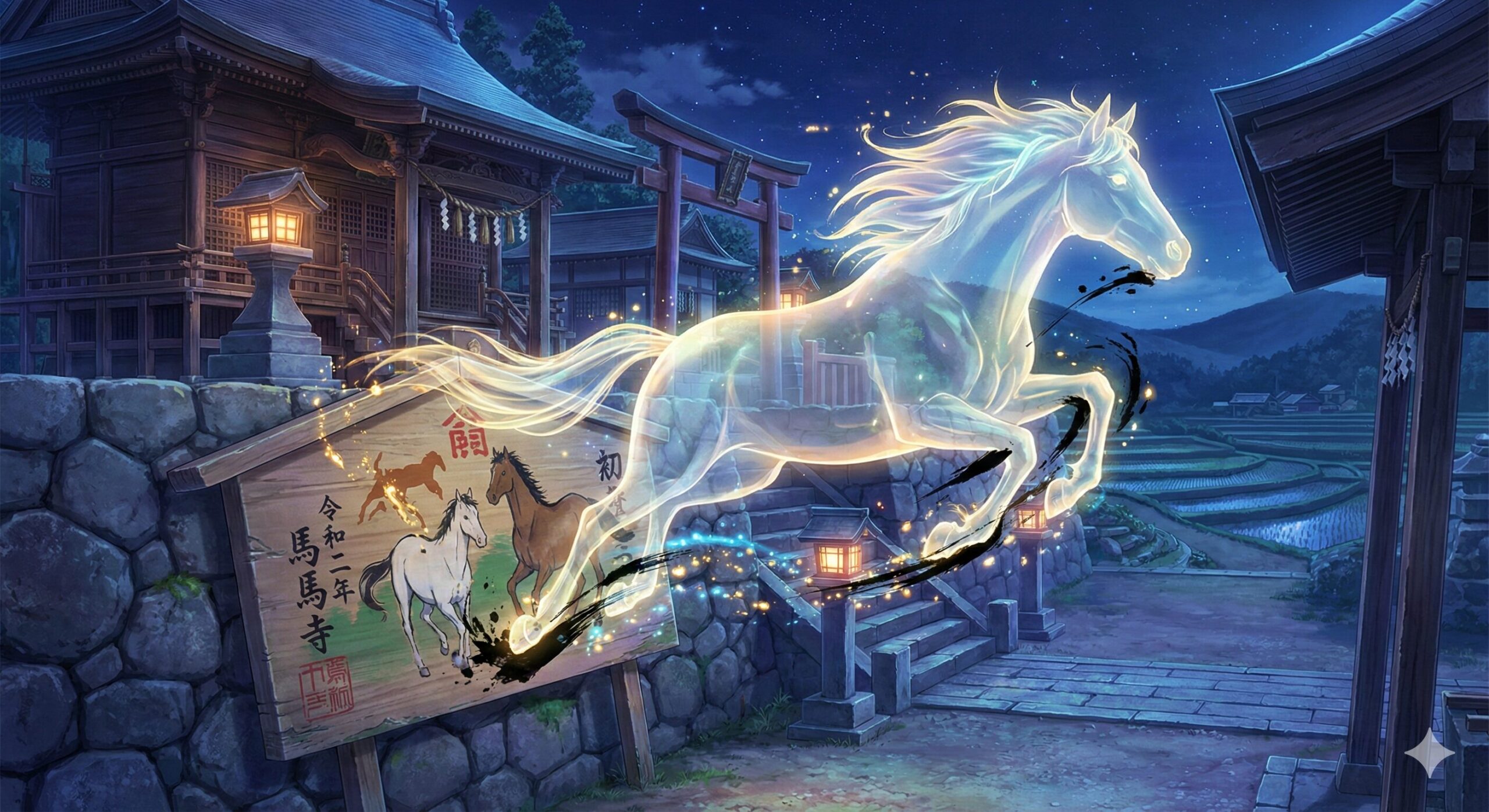

① The Story of Abare Ema: The Horse That Escaped the Canvas
Long ago, deep in the mountains of Ueno Province (modern-day Gunma Prefecture), there lived a local magistrate. He had a young son whom he loved more than anything in the world. One day, however, the boy fell severely ill. Despite the best efforts of the village doctors, his condition did not improve. Driven to desperation, the magistrate resolved to rely on the power of the gods.
To pray for his son’s recovery, the magistrate summoned the greatest master painter in all of Japan to create an “Ema” (a wooden votive plaque) to be dedicated to the local Hotaka Shrine. An Ema is a wooden tablet upon which prayers to the gods are inscribed. The master artist poured his absolute soul into the wood, painting a magnificent, powerful “Shinme” (sacred horse). Its overwhelming vitality and flawless execution made the villagers gasp in awe, declaring, “It looks as if it is truly alive!”
However, a few days after the Ema was dedicated, bizarre incidents began plaguing the village. Every night, something ravaged the village’s rice paddies, devouring their precious crops. Believing it to be the work of wild beasts, the villagers decided to stand guard in the fields overnight. Deep into the night, under the moonlight, what the villagers witnessed was none other than the painted horse from the Hotaka Shrine’s Ema.
The horse was galloping fiercely through the fields, eagerly eating the crops. Shocked and terrified, the villagers chased after it. The horse fled toward the shrine and, right before their eyes, seamlessly vanished back into the wooden Ema hanging in the hall. The next morning, when they inspected the plaque, they found actual mud and grass stuck to the painted horse’s mouth.
Taking this matter extremely seriously, the villagers and the magistrate summoned the master painter once more. To prevent the horse from escaping the Ema again, they had the artist paint a solid wooden stake and a strong tether (reins) directly onto the picture, binding the horse in place.
From the night the tether and stake were added, the horse never ruined the fields again. Miraculously, at that exact same time, the magistrate’s son completely recovered from his illness, and lasting peace returned to the village.
② Analysis of the Folktale: Why Did the Painted Horse Rampage?
The story of “Abare Ema” is not merely a fairy tale. It clearly depicts the extraordinary energy inherent in true art and the human wisdom required to control it.
The sole reason the horse came to life is that “the artist’s skill had reached the realm of the gods.” In classical Japanese philosophy, an object crafted with supreme skill and absolute sincerity undeniably houses a “soul.” The intense obsession of the artist praying for the young lord’s recovery, fused with his transcendent brushwork, caused ink on wood to defy the laws of physics and elevate into a three-dimensional living entity.
However, this horse lacked a “tether”—a control mechanism. A horse without a tether is a mass of pure energy that runs rampant on instinct alone. This signifies a universal truth: when human desires and passions are exceptionally strong but lack proper guidance, they can lead to violent, destructive outcomes. The solution of painting a tether and stake represents a highly intellectual and peaceful approach. It demonstrates that art must be balanced and given order by art itself.
③ The Message from Japanese Culture: Animism and Kotodama
The greatest elements to decode from this story are the essence of Japan’s underlying “Animism” and the culture of “Ema.”
In ancient times, Japanese people offered real, living horses (sacred horses) to the gods when making a prayer. However, dedicating and caring for a living horse was extremely difficult for commoners. Thus, a unique culture was born: “drawing a horse on a wooden plaque and offering it instead.” This is the origin of the Ema. By imitating the form, it acquires the exact same value and spiritual power as the real thing. This embodies the philosophy of “Katadama” (the spirit of form), where spiritual power dwells in the shape itself.
Japanese people inherently believe that “gods dwell in all things” (Yaoyorozu no Kami—Eight Million Gods). They believe souls reside not only in nature like mountains and rivers but also in tools and artworks created by humans. Just as a legendary sword chooses its master, or a statue carved by a master artisan performs miracles, the stronger the willpower infused into an object, the more it ceases to be a mere thing and transforms into a living existence.
“Abare Ema” is a story that most beautifully and dramatically expresses the Japanese spiritual reverence for objects and art. Even today, Japanese people visit shrines and write their wishes on Ema. We do this because we fundamentally believe in the power of infusing our souls into words and pictures to manifest miracles.
④ What Would You Do?: When Imagination Surpasses Reality
A breathtaking piece of art takes on a life of its own and impacts the real world. How did you feel reading this story?
If a picture you drew or words you wrote suddenly came to life tomorrow, what kind of “tether” would you prepare for them? The ideas and creations we produce every day actually harbor invisible souls. How will you master the wild horse that is your own creativity? Please share your thoughts and tell us what deep wish you would paint on your very own Ema!
Related Articles & References
- Internal Link: Read more from the Japanese Folktale Series
- Source Material: Manga Nihon Mukashibanashi Database – Abare Ema
- External Link: Learn more about Ema (Shinto) on Wikipedia
日本昔話「あばれ絵馬」:命を宿した芸術と信仰のミステリー
① 傑作が引き起こした怪異「あばれ絵馬」の物語
昔、深い山々に囲まれた上野国(現在の群馬県)に、あるお代官様が住んでいました。お代官様には目に入れても痛くないほど可愛がっている若君がいましたが、ある日、若君は重い病に倒れてしまいます。村の医者たちが手を尽くしても病状は一向に回復せず、お代官様は神仏にすがる決意を固めました。
お代官様は、若君の病気平癒を祈願するため、当代きっての日本一の絵師を呼び寄せ、地元の武尊(ほたか)神社に奉納するための「絵馬」を描かせました。絵馬とは、神様への願いを込めて奉納する木の板です。絵師が精魂込めて描き上げたのは、今にも走り出しそうなほど逞しく美しい「神馬(しんめ)」の姿でした。その圧倒的な生命力と見事な出来栄えに、村人たちは「まるで生きているようだ」と感嘆の声を上げました。
しかし、絵馬を奉納した数日後から、村に異変が起きます。毎晩のように、何者かが村の田畑を荒らし、大切に育てた農作物を食い荒らすようになったのです。「野生の獣の仕業に違いない」と考えた村人たちは、夜の田畑で見張りを決行しました。そして深夜、月明かりの下で村人たちが目撃したのは、なんと武尊神社に奉納したはずの、あの「絵馬の馬」でした。
馬は猛然と田畑を駆け回り、作物を貪り食っていました。驚き慌てた村人たちが一斉に追いかけると、馬は神社の方向へ逃げ出し、お堂に飾られた絵馬の中へ「スッ」と吸い込まれるように消えていきました。翌朝、絵馬を確認すると、描かれた馬の口元には泥や草がべっとりと付着していたのです。
事態を重く見た村人とお代官様は、再びあの絵師を呼び寄せました。そして、絵馬から馬が抜け出せないように、馬を繋ぎ止めるための「杭(くい)」と「手綱(たづな)」を絵に描き足させたのです。
杭と手綱が描き加えられたその夜から、馬が田畑を荒らすことは二度となくなりました。そして不思議なことに、時を同じくして若君の病もすっかり完治し、村には再び平和な日々が戻りました。
② 昔話の考察:なぜ絵馬の馬は暴れ出したのか?
この「あばれ絵馬」の物語は、単なるおとぎ話ではありません。ここには、芸術の持つ異常なエネルギーと、それを制御する人間の知恵が明確に描かれています。
馬が動き出した理由はただ一つ、「絵師の技術が神の領域に達していたから」です。日本の古典的な考え方において、極限まで高められた技術や、真心を込めて作られた造形物には、間違いなく「魂」が宿ります。絵師が若君の回復を強く願う執念と、超絶的な筆さばきが融合した結果、木の板に描かれたインクの染みは、物理的な法則を超えて三次元の生命体へと昇華しました。
しかし、この馬には「手綱」という制御装置が欠けていました。手綱がない馬は、純粋なエネルギーの塊であり、本能のままに暴走します。これは、人間の強力な「願い」や「情熱」が、正しい方向へ制御されなければ、時に周囲を破壊する暴力的な結果を招くという真理を示しています。杭と手綱を描き足すという解決策は、物理的な破壊ではなく、芸術には芸術をもって秩序を与えるという、非常に理知的で平和的なアプローチです。
③ 日本文化から読み解くメッセージ:アニミズムと「言霊・形霊」
この物語から読み取るべき最大の要素は、日本の根底に流れる「アニミズム(精霊信仰)」と「絵馬文化」の真髄です。
古来、日本人は神様に祈りを捧げる際、本物の生きた馬(神馬)を献上していました。しかし、生きた馬を奉納し、世話をし続けることは一般の人々にとって極めて困難です。そこで、本物の馬の代わりに「木に馬の絵を描いて奉納する」という独自の文化が生まれました。これが「絵馬」の起源です。形を模すことで、本物と同等の価値と霊力を持たせる。ここには、形そのものに霊力が宿るという「形霊(かただま)」の思想が存在します。
日本人は「万物に神が宿る(八百万の神)」と信じています。山や川などの自然だけでなく、人間が作り出した道具や芸術作品にも魂が宿ると考えます。名刀が持ち主を選ぶように、名工が彫った仏像が奇跡を起こすように、込められた念が強ければ強いほど、物は単なる物体であることをやめ、命を持つ存在へと変わります。
「あばれ絵馬」は、物や芸術に対する畏敬の念を忘れない日本人の精神性を、最も美しく、そして劇的に表現した物語です。私たち日本人は、現代においても神社を訪れ、絵馬に願いを書きます。それは、文字や絵に魂を込め、奇跡を起こす力を信じているからです。
④ あなたならどうする?:想像の力が現実を超える時
見事すぎる芸術が命を持ち、現実世界に影響を与える。この物語を読んで、あなたはどう感じましたか?
もし、あなたが描いた絵が、あるいはあなたが書いた言葉が、明日突然命を持って動き出すとしたら。あなたはそれに、どのような「手綱」を用意しますか?私たちが日々生み出すアイデアや作品にも、実は見えない魂が宿っています。あなたの創造力という暴れ馬を、あなた自身の力でどう乗りこなすのか。ぜひ、あなたの考えや、あなただけの「絵馬」に描きたい願いを教えてください。
コメント