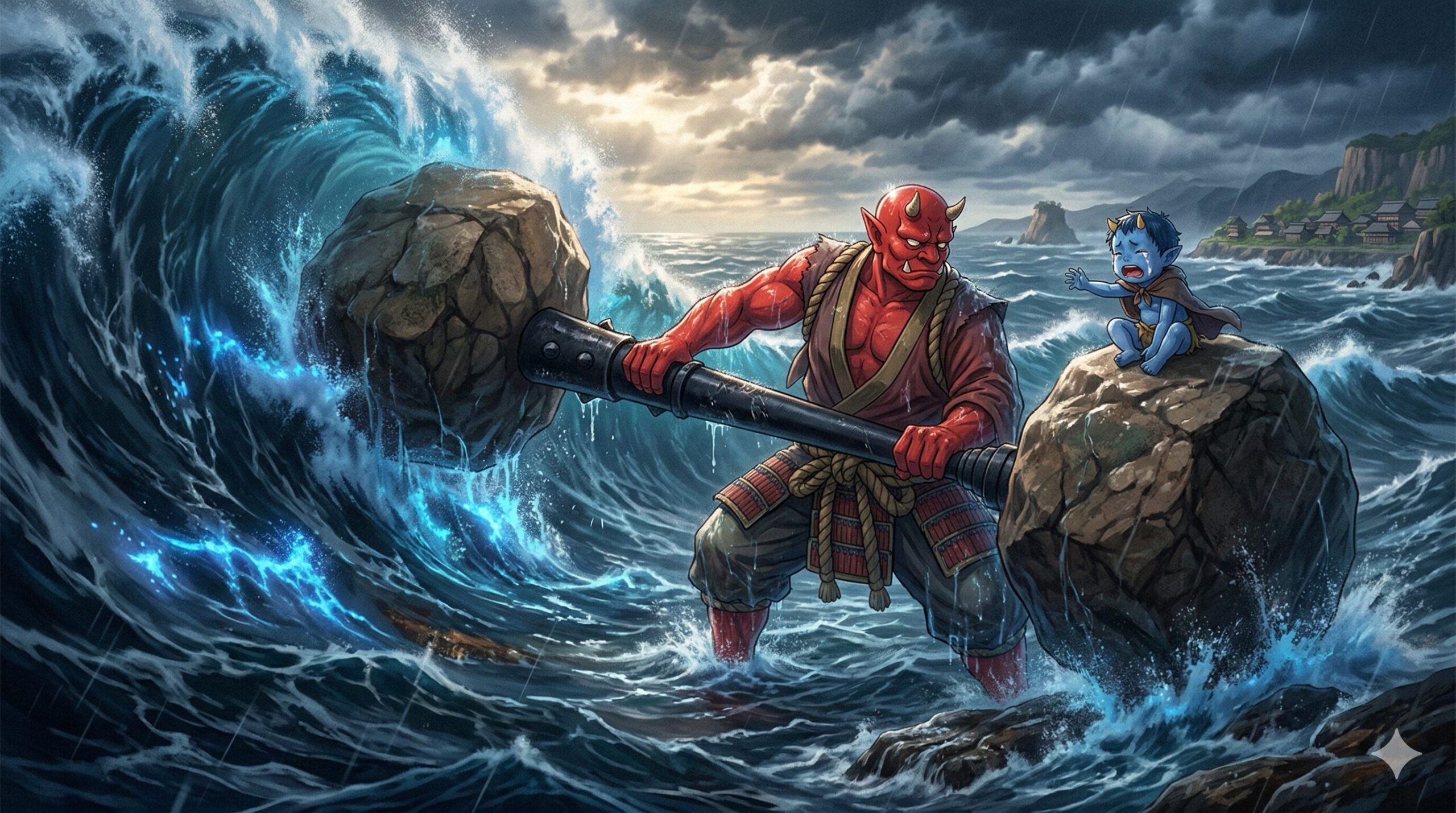
Countless “Oni” (demons/ogres) appear in Japanese folktales. Generally, Oni are depicted as terrifying villains who harm humans. However, the Oni in the folktale “The Demon That Sank Into the Sea” (海に沈んだ鬼) from Kochi Prefecture is completely different from our typical imagination. He is a deeply gentle being who meets a tragic fate. This story of the overwhelming power of nature, the self-sacrifice required to overcome it, and the profound bond between parent and child deeply moves all who read it. Today, let’s unravel the culture and view of nature flowing through the roots of Japan through this heartwarming yet tragic tale.

The Story: The Demon That Sank Into the Sea
Long, long ago, deep in the mountains of Kure Beach in Tosa Province (modern-day Kochi Prefecture), a region known for its rich fishing grounds, lived a giant parent Oni (demon) as large as a mountain, and his small child Oni. They lived quietly and peacefully. They were incredibly calm and kind, building a good relationship with the villagers on the beach. There was a beautiful coexistence that transcended species: the villagers would offer fresh Katsuo (bonito fish) caught each season to the Oni, and the Oni would joyfully accept it.
However, nature sometimes bares its cruel fangs. One year, the sea of Kure raged day after day, and relentless storms swept in. The sky was covered with black clouds, and giant waves crashed against the village beach. The fishermen could not go out to sea, losing their means to catch fish for a living. Worse still, boats that forced their way out were swallowed by the high waves, resulting in the tragic loss of many precious lives. On the beach, the heartbreaking cries of people who had lost loved ones and the desperate prayers of elders begging the gods to calm the raging waves echoed loudly.
One day, while the parent and child Oni were playing in the valley, the wind carried the screams and prayers of the villagers to them. When the parent Oni gently looked down from the mountain, he saw the villagers desperately fighting the storm, tying sickles to the tips of bamboo poles to ward it off, even as they were nearly swept away by the waves. The giant Oni’s heart ached deeply. The kind villagers who always shared their delicious fish with them were suffering so much. The Oni made a decision: he would use his own power to calm this raging sea and save the villagers.
The giant Oni pierced two mountain-sized boulders onto both ends of his favorite massive iron club. He then told the child Oni, “Wait here in the mountains.” The parent knew exactly how dangerous the place he was going to be was. However, the child Oni refused to leave his father’s side. “No, I’m going with Otto (father)!” he cried. The parent Oni, with a somewhat troubled but deeply affectionate face, told him, “Then, you must absolutely not cry,” and placed the child Oni gently on top of one of the giant boulders on his club.
Then, the giant Oni stepped into the stormy, raging sea. Splashing through the waves, he headed toward the entrance of the bay. The waves mercilessly battered his massive body, trying to push him back. But the Oni stood firm, desperate to save the village and protect the child on his back. Step by step, the giant Oni’s body slowly sank into the cold sea. Finally, he was submerged up to his neck, making it hard to breathe.
At that moment, breaking his promise, the child Oni cried out loudly for the first time, “Otto! Otto!” But the parent Oni did not look back. Mustering his last ounce of strength, he firmly planted the two giant boulders attached to his iron club at the entrance of the bay. The giant Oni’s massive body completely disappeared beneath the waves, never to surface again.
The giant boulders and the Oni’s massive body, sunken at the cost of his own life, became a powerful breakwater. The raging waves were shattered there, and silence returned to the beach of Kure. The village was saved. However, left behind on top of the giant boulder, the child Oni continued to cry, “Otto, Otto,” longing for his father who vanished into the sea. He cried day after day, until eventually, his small body turned into stone, transforming into a small rock.
Even today, off the coast of Kure in Nakatosa Town, Kochi Prefecture, the two rocks sunk by the giant Oni stand side by side as “Futana Island” (Futana-jima). Right beside them, protruding from the surface of the sea as if snuggling up, is “Eboshi Rock” (Eboshi-iwa), said to be the transformed figure of the child Oni. These rocks continue to protect the beach of Kure from rough waves to this day, and local fishermen deeply worship this island as a “Guardian Deity,” praying for safety at sea and a bountiful catch.
Deep Analysis of “The Demon That Sank Into the Sea”
The reason this folktale strikes our hearts so strongly is that it is not merely a heroic tale, but a depiction of ultimate “self-sacrifice” and “sorrow.” The giant Oni did not make the waves disappear with magical powers. He used his own flesh as a wall, literally laying down his life to protect the village. The limitation that, despite being a being of overwhelming power, he had no choice but to sacrifice himself in the face of nature’s fury, gives the story deep realism and heartache.
Furthermore, the presence of the child Oni accentuates the tragedy of this story. The child’s refusal to be left behind, only to break his promise and cry out at the end, is heartbreakingly helpless and human. The parent Oni fulfilled the great cause of saving the villagers, but at the same time, he left his beloved child behind in eternal loneliness. He did the right thing, yet it can never be called a happy ending. This lingering echo of complex emotions is exactly why this story has been passed down for so long.
Connection to Japanese Culture: Nature Worship and Guardian Deities
From this story, we can clearly decipher the traditional Japanese “view of nature” and “beliefs.” Since ancient times, Japan has had the concept of Animism and “Yaoyorozu no Kami” (Eight Million Gods), where gods reside in all things in nature, such as mountains, seas, giant rocks, and giant trees. By attaching the story that “an Oni brought these rocks to protect the village” to the actual natural topography of Futana Island, a mere reef was elevated to a “Sacred Guardian Deity.”
Also, while Japanese Oni are often depicted as symbols of “disaster” or “plagues,” they sometimes possess the aspect of a “Good Being” or “Visiting Deity” (Marebito) who wards off evil with great power. The structure of a natural threat (the raging sea) being calmed by another natural threat (a giant Oni) sacrificing itself strongly reflects the spirituality of the Japanese people, who live alongside nature and never forget their awe and gratitude toward it. The fact that the fishermen of Kure still worship Futana Island as a guardian deity of the sea is a beautiful characteristic of Japanese culture, where mythology and reality are deeply connected.
What Would You Do?
The giant Oni protected those he owed gratitude to, even at the cost of his own life. And the child Oni, who longed for his father so much that he turned into stone. What emotions did you feel after reading this story? If you were in the giant Oni’s position, could you have made the decision to save the village in exchange for your life? Or would you have stayed in the mountains to protect your quiet life with your child? Please face your own heart regarding this unanswerable question. And please share your thoughts and feelings with us in the comments!
Reference Links & Related Information
- Reference: Manga Nippon Mukashibanashi Database – The Demon That Sank Into the Sea
- Read more Japanese Folktales: Japanese Folktale Series
涙なしでは読めない日本の昔話「海に沈んだ鬼」〜自己犠牲と親子の絆から学ぶ日本文化〜
日本の昔話には、数多くの「鬼」が登場します。一般的に鬼と言えば、恐ろしい姿で人間に危害を加える悪者として描かれることがほとんどです。しかし、今回ご紹介する高知県に伝わる昔話「海に沈んだ鬼」に登場する鬼は、私たちの想像とは全く異なる、あまりにも優しく、そして悲しい運命を辿る存在です。大自然の驚異と、それを乗り越えようとする自己犠牲、そして深い親子の絆を描いたこの物語は、読む者の心を強く揺さぶります。今回は、この心温まる悲話を通じて、日本の根底に流れる文化や自然観を紐解いていきましょう。
昔話のあらすじ:海に沈んだ鬼
むかしむかし、豊かな漁場として知られる土佐国(現在の高知県)の久礼(くれ)の浜の奥深い山に、山のように巨大な体を持つ大鬼と、その子どもである小さな子鬼がひっそりと、しかし平和に暮らしていました。彼らは非常に穏やかで心優しく、浜の村人たちとも良好な関係を築いていました。村人たちは季節ごとに獲れた新鮮なカツオを鬼の親子にお供えし、鬼たちはそれを喜んで受け取るという、種族を超えた美しい共存関係があったのです。
しかし、自然は時に残酷な牙を剥きます。ある年のこと、久礼の海は連日のように荒れ狂い、嵐が絶え間なく押し寄せました。空は黒い雲に覆われ、巨大な波が牙をむいて村の浜へと打ち寄せます。漁師たちは海に出ることができず、生活の糧である魚を獲ることができません。それどころか、無理をして海に出た船が高波に飲み込まれ、多くの尊い命が海の藻屑と消えてしまうという悲劇が続きました。浜辺では、愛する家族を失った人々の悲痛な泣き声や、荒れ狂う波を鎮めようと神に祈る老人たちの切実な声が響き渡っていました。
ある日、大鬼と子鬼が谷間で遊んでいると、風に乗って村人たちの悲鳴と祈りの声が聞こえてきました。大鬼がそっと山から見下ろすと、そこには波にさらわれそうになりながらも、竹の先に鎌を結びつけて嵐を追い払おうと必死に抗う村人たちの姿がありました。大鬼の心は激しく痛みました。いつも自分たちに美味しいカツオを分けてくれる優しい村人たちが、これほどまでに苦しんでいる。大鬼は決意しました。自らの力で、この荒れ狂う海を鎮め、村人たちを救うのだと。
大鬼は、愛用の巨大な金棒の両端に、山のように大きな二つの岩を突き刺しました。そして、子鬼に向かって「お前は山で待っていなさい」と告げます。これから行く場所がどれほど危険か、大鬼には分かっていたからです。しかし、子鬼はどうしても父親のそばを離れようとしません。「いやだ、おっ父と一緒にいく!」と泣き叫びます。大鬼は少し困ったような、しかし深い愛情に満ちた顔で「ならば、絶対に泣くな」と言い聞かせ、金棒の先の大岩の上に子鬼をちょこんと乗せました。
そして大鬼は、荒れ狂う嵐の海へと足を踏み入れました。ざぶざぶと波をかき分け、湾の入り口を目指して進んでいきます。波は容赦なく大鬼の巨体に打ち付け、押し戻そうとします。しかし大鬼は、村を救うため、そして背中の子鬼を守るために、必死に踏ん張りました。一歩、また一歩と進むうちに、大鬼の体は少しずつ冷たい海の中へと沈んでいきます。とうとう首まで海に浸かり、息をするのも困難になってきました。
その時です。「おっ父!おっ父!」と、約束を破って子鬼が初めて大声を上げて泣き叫びました。しかし、大鬼は振り返ることはありませんでした。最後の力を振り絞り、金棒に刺した二つの大岩を湾の入り口にしっかりと固定すると、大鬼の巨体は完全に波の下へと姿を消し、二度と浮かび上がってくることはありませんでした。
大鬼が自らの命と引き換えに沈めた大岩と、その巨大な体は、強力な防波堤となりました。荒れ狂う波はそこで打ち砕かれ、久礼の浜には静寂が戻りました。村は救われたのです。しかし、大岩の上に取り残された子鬼は、海に消えた父親を想い、「おっ父、おっ父」と泣き続けました。来る日も来る日も泣き続け、やがてその小さな体は石となり、小さな岩へと姿を変えてしまいました。
現在でも、高知県中土佐町久礼の沖合には、大鬼が沈めた二つの岩が「双名島(ふたなじま)」として並び立っており、そのすぐそばには子鬼が姿を変えたと言われる「烏帽子岩(えぼしいわ)」が寄り添うように海面に顔を出しています。これらの岩は今もなお、久礼の浜を荒波から守り続けており、地元の漁師たちは海の安全と大漁を願う「守り神」として、この島を深く信仰しています。
「海に沈んだ鬼」の深い考察
この昔話が私たちの胸を強く打つ理由は、単なる英雄譚ではなく、究極の「自己犠牲」と「悲哀」が描かれている点にあります。大鬼は魔法のような力で波を消し去ったわけではありません。自らの肉体を壁とし、文字通り命を投げ打って村を守りました。圧倒的な力を持つ存在でありながら、自然の猛威の前では自らを犠牲にするしかなかったという限界が、物語に深いリアリティと切なさを与えています。
また、子鬼の存在がこの物語の悲劇性を一層際立たせています。父親についていくことを強要し、最後には約束を破って泣き叫んでしまう子鬼の姿は、あまりにも無力で人間臭いものです。大鬼は村人を救うという大義を果たしましたが、同時に最愛の我が子を永遠の孤独の中に置き去りにしてしまいました。正しい行いをしたはずなのに、決してハッピーエンドとは言えない。この複雑な感情の余韻こそが、この物語が長く語り継がれてきた理由でしょう。
日本文化との繋がり:自然信仰と守り神
この物語からは、日本の伝統的な「自然観」と「信仰」を明確に読み解くことができます。日本では古来より、山や海、巨岩や巨木などに神が宿るとする「アニミズム(精霊信仰)」や「八百万(やおよろず)の神」の概念があります。双名島という現実の自然地形に対して、「鬼が村を守るために運んできた岩である」という物語を付与することで、ただの岩礁は「神聖な守り神」へと昇華されました。
また、日本の鬼は「災害」や「疫病」の象徴として描かれることが多い一方で、時に強力な力で厄災を祓ってくれる「善き存在(善鬼)」や「来訪神(まれびと)」としての側面も持っています。自然の脅威(荒れる海)を、別の自然の脅威(巨大な鬼)が身を挺して鎮めるという構造は、自然と共に生き、自然への畏怖と感謝を忘れない日本人の精神性を強く反映しています。久礼の漁師たちが今でも双名島を海の守り神として信仰している事実は、神話と現実が地続きになっている日本文化の美しい特徴です。
あなたならどうしますか?
自らの命を犠牲にしてでも、恩義ある他者を守り抜いた大鬼。そして、父を慕い続け、岩になってしまった子鬼。この物語を読んで、あなたはどのような感情を抱きましたか?もしあなたが大鬼の立場であれば、自らの命と引き換えに村を救う決断ができたでしょうか。それとも、子鬼との静かな暮らしを守るために山に残ったでしょうか。正解のないこの問いについて、ぜひご自身の心と向き合ってみてください。そして、あなたの考えや感想を、ぜひコメントで教えてください。
参考リンク・関連情報
- 参考:まんが日本昔ばなし〜データベース〜 海に沈んだ鬼
- 日本の昔話をさらに読む:Japanese Folktale Series(日本の昔話シリーズ)

コメント