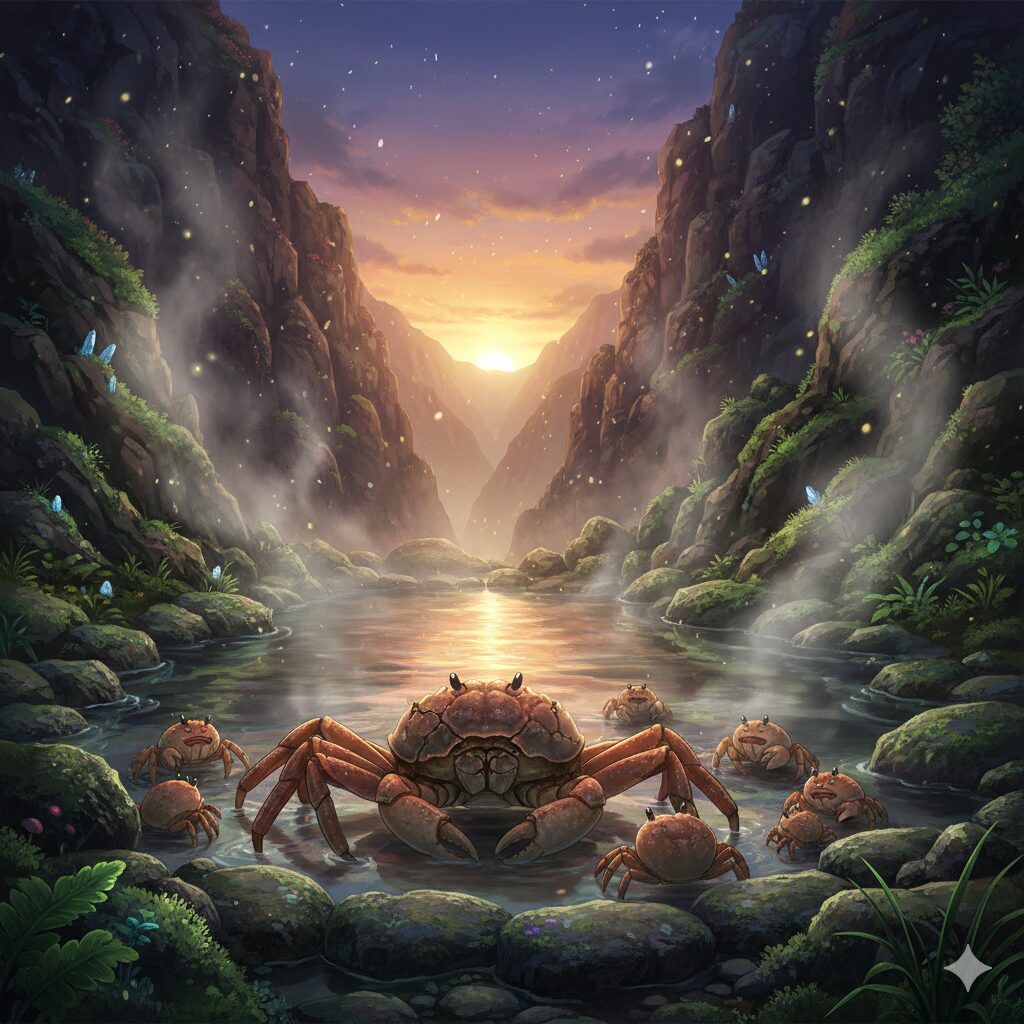
To truly understand Japan, you must look beyond the samurai, ninjas, and anime. You must touch the spiritual essence of “Onsen” (hot springs). Why do Japanese people love hot springs so passionately? One of the answers lies hidden in this ancient folktale, “The Crab’s Hot Spring Cure” (Kani no Toji).

Chapter 1: The Story of “The Crab’s Hot Spring Cure”
Long, long ago, in a deep mountain valley, a family of crabs lived peacefully by a clear stream.
One day, the father crab ventured out of the water and onto the land to find delicious food for his children. He climbed over sun-drenched rocks and pushed through the grass, walking with determination. Suddenly, a large shadow fell from the sky.
“Caw!”
A malicious crow swooped down and violently pecked the father crab’s shell with its sharp beak. With a loud crack, the father crab suffered a deep, terrible wound. The crow flew away, leaving the father crab paralyzed and unable to move.
As evening approached, the little crabs, worried that their father had not returned, came up from the river. There, they found their father, blowing faint bubbles, on the verge of death.
“Father! Stay with us!”
“Someone, please help!”
The children cried out in despair. They tried to lift their father with their tiny claws, but he was too heavy. Just then, a kite (some versions say a kind crow) heard their sorrowful cries and landed on a nearby branch.
“Oh my, how pitiful. With that wound, he may not survive. But if you truly wish to save your father, take him to the place where the ‘hot water springs’ beyond this mountain. The water there has mysterious powers.”
The children believed these words. The tiny crabs united their strength, lifting their father, who was many times larger and heavier than them, onto their backs. The rocky path was steep, their feet were cut, and they nearly fell many times. Yet, driven by the single thought, “We won’t let Father die,” they kept walking.
How many hours, or perhaps days, did they walk? Suddenly, they arrived at a place where warm steam rose with the scent of sulfur. It was the magical hot water gushing out from between the rocks.
“This is it! Let’s put him in here!”
The children gently lowered their father crab into the water. Miraculously, the father, who had been struggling to breathe, began to calm down. The wound on his cracked shell began to close before their eyes. After soaking in the water for several days, the father crab completely regained his health.
The family cried tears of joy, thanked the bird, and returned happily to their home in the valley stream. This is said to be one of the origins of “Toji” (hot spring therapy) in Japan.
Chapter 2: Analysis – Why Did the Crabs Seek the Hot Spring?
This story is not merely an animal fable. It depicts the Japanese people’s “absolute trust in the healing power of nature.”
1. The Concept of “Toji”
“Toji” is a traditional Japanese medical practice of staying at a hot spring resort for an extended period to cure illnesses or injuries. In an era without modern medicine or surgery, Japanese people believed that onsen, the energy of the earth, was the strongest medicine. Just as the crabs instinctively sought the hot water, Japanese people seek onsen when they are hurt.
2. The Unity of the Small
A single small crab is powerless, but by working together, the siblings were able to carry their dying father. This symbolizes the virtue of Japanese collectivism and the spirit of “Wa” (harmony). It teaches that the bond of family and community, rather than individual power, creates miracles.
Chapter 3: Decoding the Depths of Japanese Culture
From “The Crab’s Hot Spring Cure,” we can see unique Japanese views on religion and nature.
Animism and Animal Guidance
In Japanese legends, it is often animals (deer, monkeys, herons), not humans, who discover hot springs. In this story, a bird guides them, and the crabs prove the water’s efficacy. This is based on ancient Japanese Animism (spirit worship), which believes that “animals are closer to the gods than humans and know the secrets of nature.” There is a stance here of humility, learning from animals rather than dominating nature.
The Aesthetic of Filial Piety
The image of children carrying their parent while getting hurt themselves strongly reflects the spirit of “Ko” (filial piety), influenced by Confucianism. The moral message that cherishing one’s parents results in happiness (the father’s recovery) is still deeply rooted in modern Japanese society.
Chapter 4: A Question for You
What did you think of this story? The crabs chose to dive into nature rather than seek a pharmacy when they were hurt.
Perhaps what we, exhausted by modern society, need is not the latest technology, but the blessings of the earth that have continued since ancient times. If you were deeply wounded, where would you go to heal? And would you be able to go to such lengths for your family?
On your next vacation, please visit a Japanese Onsen resort and feel the warmth of the “miracle water” that these crabs found.
Related Links & References
- Japanese Folktale Series (Kiri53.com) – Read more Japanese folktales
- Balneotherapy (Wikipedia) – Understanding the science of bathing
【日本昔話】蟹の湯治:愛と癒しの温泉物語が教える日本の心
日本という国を深く理解したいなら、侍や忍者、そしてアニメだけでなく、「温泉(Onsen)」の精神性に触れなければなりません。日本人はなぜ、これほどまでに温泉を愛するのか。その答えの一つが、古くから伝わるこの『蟹の湯治(かにのとうじ)』という物語に隠されています。
第一章:物語「蟹の湯治」
むかしむかし、ある深い山奥の谷川に、沢山の蟹(カニ)の親子が住んでいました。
ある日のことです。お父さん蟹が、子供たちのために美味しい餌を探そうと、川から陸へと上がっていきました。太陽が照りつける岩場を越え、草むらをかき分け、一生懸命に歩いていました。すると突然、空から大きな影が落ちてきました。
「カァーッ!」
一羽の意地悪なカラスが舞い降り、鋭いクチバシでお父さん蟹の甲羅を激しく突いたのです。バリッという音がして、お父さん蟹は深い傷を負ってしまいました。カラスはそのまま飛び去りましたが、お父さん蟹は動けなくなってしまいました。
夕方になり、帰ってこないお父さんを心配して、子供の蟹たちが川から上がってきました。そこで彼らが見たのは、瀕死の重傷を負って泡を吹いているお父さんの姿でした。
「お父ちゃん!しっかりして!」
「誰か、誰か助けて!」
子供たちは泣き叫びました。その小さなハサミで懸命にお父さんを抱えようとしますが、重たくて動きません。その時です。一羽のトビ(または親切なカラスという説もある)が、彼らの悲痛な叫びを聞きつけて枝にとまりました。
「おやおや、可哀想に。その傷ではもう助からないかもしれないな。だが、もし本当にお父さんを助けたいのなら、この山の向こうにある『湯の湧く場所』へ連れて行きなさい。あそこのお湯には不思議な力がある」
子供たちはその言葉を信じました。小さな蟹たちは力を合わせ、自分たちよりも何倍も大きくて重いお父さん蟹を背負い上げました。岩場は険しく、足は傷つき、何度も転びそうになりました。それでも、「お父ちゃんを死なせない」という一心だけで、彼らは歩き続けました。
何時間、あるいは何日歩いたでしょうか。ふと、硫黄の香りと共に、温かい湯気が立ち上る場所に出ました。岩の間からこんこんと湧き出る、魔法のお湯です。
「ここだ!ここに入れてあげよう!」
子供たちはお父さん蟹をそっとお湯の中に浸しました。するとどうでしょう。今まで苦しそうに泡を吹いていたお父さんの呼吸が落ち着き、割れた甲羅の傷口がみるみるうちに塞がっていきます。数日湯に浸かり続けると、お父さん蟹はすっかり元気を取り戻しました。
親子は涙を流して喜び合い、トビにお礼を言って、仲良く谷川の家へと帰っていきました。これが、日本における「湯治(Toji)」の始まりの一つだと語り継がれています。
第二章:考察・なぜ蟹は温泉を目指したのか
この物語は、単なる動物のおとぎ話ではありません。ここには、日本人の「自然治癒力への絶対的な信頼」が描かれています。
1. 「湯治(Toji)」という文化概念
物語の核となる「湯治」とは、温泉地に長期間滞在し、病気や怪我を治す日本の伝統的な医療行為です。現代のような薬や手術がなかった時代、日本人は大地のエネルギーである温泉こそが、最強の薬であると信じていました。蟹が本能的に湯を目指したように、日本人は傷つくと温泉を目指すのです。
2. 小さき者の団結
一匹の小蟹では無力ですが、兄弟全員が力を合わせることで、瀕死の父を運ぶことができました。これは日本の集団主義の美徳、「和」の精神を象徴しています。個の力よりも、家族やコミュニティの絆が奇跡を起こすという教えです。
第三章:日本文化の深層を読み解く
『蟹の湯治』から、日本特有の宗教観や自然観が見えてきます。
アニミズムと動物の導き
日本の伝説では、温泉を発見するのは人間ではなく、しばしば動物です(鹿、猿、白鷺など)。この物語でも、トビが場所を教え、蟹がその効能を証明します。これは「動物は人間よりも神に近い存在であり、自然の秘密を知っている」という日本古来のアニミズム(精霊信仰)に基づいています。人間は自然を支配するのではなく、動物たちから謙虚に学ぶ姿勢がここにはあります。
親孝行の美学
子供たちが傷つきながら親を運ぶ姿は、儒教の影響を受けた「孝(こう)」の精神を強く反映しています。親を大切にすることが、結果として幸福(お父さんの回復)をもたらすという道徳的メッセージは、現代の日本社会にも根付いています。
第四章:あなたへの問いかけ
いかがでしたでしょうか。傷ついた時、薬局に行くのではなく、自然の中へ飛び込むという蟹たちの選択。
現代社会で疲弊した私たちに必要なのは、最新のテクノロジーではなく、このような太古から続く大地の恵みかもしれません。もしあなたが深い傷を負ったとしたら、それを癒やすためにどこへ向かいますか?そして、家族のためにそこまで必死になれるでしょうか?
ぜひ、次の休暇には日本の温泉地を訪れ、この蟹たちが見つけた「奇跡の湯」の温かさを肌で感じてみてください。
関連リンク・参考文献
- Japanese Folktale Series (Kiri53.com) – 日本の昔話をもっと読む
- 湯治 (Wikipedia) – 湯治文化の詳細

コメント