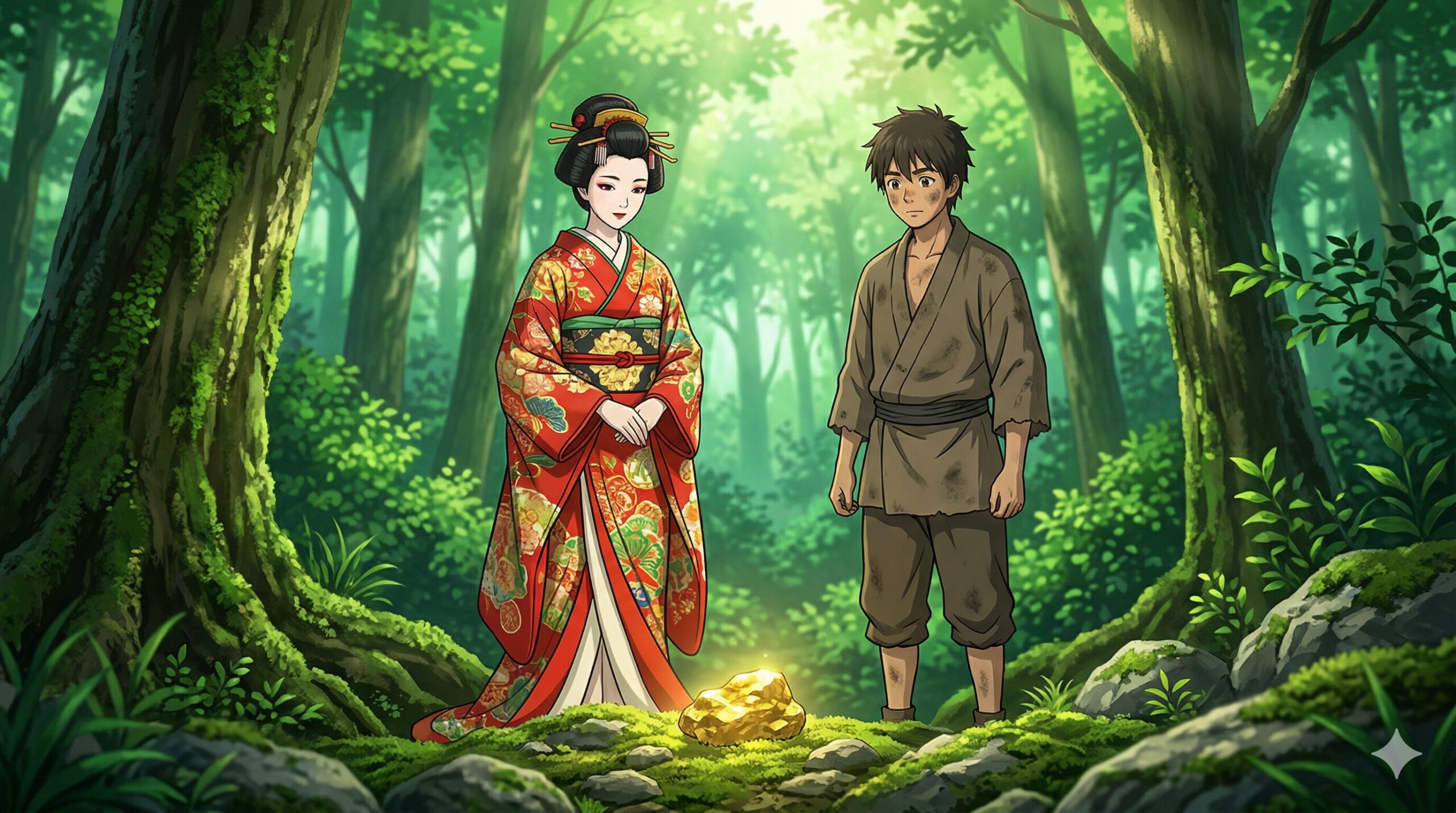
Once upon a time, deep in the mountains of Japan, there lived a young man named Tota. His daily work was cutting timber and burning it in a kiln to make charcoal. His face, hands, and clothes were always pitch-black from the soot, but his heart was as clear as a mountain spring. Despite his extreme poverty, Tota lived a peaceful life, deeply grateful for the blessings of nature and content with the simple flora and fauna around him.
A Fateful Encounter: The Noblewoman and the Charcoal Maker
One day, a beautiful palanquin arrived at Tota’s humble hut. Out stepped a young woman, the daughter of a wealthy aristocrat from the capital, wearing dazzlingly gorgeous silk kimono. She told Tota, “Guided by a divine revelation from the Goddess of Mercy (Kannon), I have come to be your wife.” It was a meeting of two people from completely different social classes and environments. Astonished, Tota refused, saying, “I have absolutely nothing to feed someone of your high status.” However, the woman’s determination was unwavering, and they began their life together as husband and wife.
A Clash of Values: Gold Coins vs. Ordinary Stones
After a few days, their food supply ran out. The bride took out several shining gold coins (koban) from a bag she had brought from the capital and handed them to Tota, saying, “Please go to the town and buy some rice with this.” Tota accepted the coins, completely unaware of their immense value.
On his way to town, Tota spotted a flock of waterbirds resting by a pond and decided to catch one to bring home. Without a second thought, he threw the gold coins at the birds as if they were ordinary rocks. The birds flew away, and the gold sank deep to the bottom of the pond. When Tota returned empty-handed and told his wife what had happened, she cried out in disbelief, “How could you throw away such valuable treasure!”
The Discovery of a Miracle: A Mountain of Gold
Tota looked puzzled and replied, “If it’s those yellow stones you want, there are plenty of them scattered all over the valley where I make charcoal every day.” Shocked, the bride asked Tota to guide her to the valley. There, they found countless gold nuggets and gold dust shining literally like a mountain. To Tota, they were just “yellow stones,” but in reality, it was gold of unimaginable worth. Through this discovery, the couple became immensely wealthy. They generously shared the mountain’s bounty with the villagers and lived happily ever after.
- A Fateful Encounter: The Noblewoman and the Charcoal Maker
- A Clash of Values: Gold Coins vs. Ordinary Stones
- The Discovery of a Miracle: A Mountain of Gold
- Exploring the Depths of the Folktale: Why Did She Choose Him?
- Connection to Japanese Culture: Nature Worship and the Aesthetic of “Honorable Poverty”
- To Our Readers: Where Does Value Lie?
- 炭焼きのむこ入り:無欲がもたらす黄金の奇跡
- 昔話の深層を考察する:なぜ娘は炭焼きを選んだのか
- 日本文化との関連:自然崇拝と「清貧」の美学
- 読者の皆様へ:価値の基準はどこにあるのか
Exploring the Depths of the Folktale: Why Did She Choose Him?
This story is not just a reverse Cinderella tale. The hidden background of a wealthy woman abandoning everything to marry a poor charcoal maker represents the importance of letting go of an attachment to “visible wealth.” Living a privileged life in the capital, she must have felt that material wealth alone could not fulfill her soul. The divine revelation was an inevitable process to guide her to Tota, who possessed the “selfless and pure heart” her soul sought. Tota’s ignorance of money is not foolishness; it is the ultimate symbol of purity untainted by worldly desires.
Connection to Japanese Culture: Nature Worship and the Aesthetic of “Honorable Poverty”
This folktale vividly reflects ancient Japanese values. One is the philosophy of “Seihin” (honorable poverty). Living with a pure heart and being completely satisfied with one’s given environment, even in poverty, has long been considered a virtue in Japan. Tota knew the abundant blessings of nature, which was enough for him to survive, even if he didn’t know the value of the gold under his feet.
Another element is Animism (nature worship). The Japanese believe that gods reside in the mountains, and nature bestows unexpected blessings upon the selfless. It is highly significant that Tota’s profession was a charcoal maker, someone who transforms natural wood into a livelihood. The story perfectly expresses the Japanese view of nature: those who converse with and respect nature will ultimately receive its greatest wealth.
To Our Readers: Where Does Value Lie?
For Tota, gold was just a rock; for his bride, it was a valuable asset for survival. Absolute value does not exist; the world changes completely depending on what we prioritize.
After reading this story, what do you think true wealth is? If there was a hidden treasure right at your feet that no one else noticed, how would you define its value, and what action would you take? I encourage you to search for the “yellow stones” in your own life.
For more fascinating Japanese folklore, please continue to enjoy our Japanese Folktale Series. If you wish to dive deeper into the historical background of these stories, Wikipedia’s page on Japanese folktales is an excellent external resource.
炭焼きのむこ入り:無欲がもたらす黄金の奇跡
昔々、日本の深い山奥に、藤太という若者が一人で住んでいました。彼の仕事は、毎日木を切り出し、窯で炭を焼くことでした。顔も手も衣服も常に炭の煤で真っ黒でしたが、彼の心は山の湧き水のように澄み切っていました。貧しい暮らしの中にあっても、藤太は自然の恵みに深く感謝し、野の草花や鳥たちと共に穏やかな日々を送っていました。
運命の出会い:都の娘と山の炭焼き
ある日のこと、藤太の質素な小屋に、美しい輿(こし)に乗った一人の娘がやってきました。彼女は都の裕福な長者の娘であり、身に纏う着物は目を奪うほど煌びやかでした。娘は藤太に向かい、「観音様のお告げにより、あなたを夫とするために参りました」と告げました。身分も生活環境も全く異なる二人の出会いです。藤太は驚き、「私にはあなたのような高貴な方に食べさせるものなど何もない」と断りましたが、娘の決意は固く、二人は夫婦として共に暮らし始めました。
価値観の衝突:黄金の小判とただの石
数日が経ち、食べるものが底をつきました。娘は都から持参した袋から、光り輝く黄金の小判を数枚取り出し、「これで町へ行き、お米を買ってきてください」と藤太に渡しました。藤太は小判を受け取りましたが、それがどれほど価値のあるものか全く知りませんでした。
町へ向かう途中、池のほとりで水鳥の群れを見つけた藤太は、鳥を捕まえて持ち帰ろうと考えました。そして、手に持っていた小判を石の代わりに水鳥に向かって力いっぱい投げつけたのです。水鳥は逃げ去り、小判は深い池の底へ沈んでいきました。手ぶらで帰宅した藤太から事の顛末を聞いた娘は、信じられないという表情で「あんなに価値のある宝を投げてしまうなんて!」と叫びました。
奇跡の発見:黄金の山と夫婦の繁栄
藤太は不思議そうな顔をして、「あんな黄色い石ころなら、俺が毎日炭を焼いている谷間にいくらでも転がっているぞ」と答えました。驚愕した娘が藤太に案内されて谷へ向かうと、そこには無数の砂金や金塊が文字通り山のように輝いていました。藤太にとってそれはただの「黄色い石」でしたが、実際には途方もない価値を持つ黄金だったのです。この発見により、二人は大長者となり、山の恵みを村人たちにも分け与えながら、末長く幸せに暮らしました。
昔話の深層を考察する:なぜ娘は炭焼きを選んだのか
この物語は単なるシンデレラストーリーの逆転版ではありません。裕福な娘がすべてを捨てて貧しい炭焼きの元へ嫁いだ背景には、「目に見える富」への執着を捨てることの重要性が隠されています。娘は都での不自由のない生活の中で、物質的な豊かさだけでは満たされない何かを感じていたのでしょう。観音様のお告げは、彼女の魂が求める「無欲で純粋な心」を持つ藤太へと導くための必然的なプロセスでした。藤太の持つ無知は愚かさではなく、世俗の欲にまみれていない純真さの象徴です。
日本文化との関連:自然崇拝と「清貧」の美学
この昔話からは、日本古来の価値観が色濃く読み取れます。一つは「清貧(せいひん)」の思想です。貧しくとも心が清らかで、与えられた環境で満足する生き方は、日本では古くから美徳とされてきました。藤太は足元にある黄金の価値を知らなくても、生きていくのに十分な自然の恵みを知っていました。
もう一つは「アニミズム(自然崇拝)」です。山には神が宿り、無欲な者には自然(神)が思いがけない恩恵をもたらすという考え方です。藤太が炭焼きという、自然の木材を生活の糧に変える仕事をしている点も重要です。自然と対話し、自然を敬う者こそが、最終的に最大の豊かさを手にするという日本人の自然観が見事に表現されています。
読者の皆様へ:価値の基準はどこにあるのか
藤太にとって黄金はただの石であり、娘にとっては生きるための価値ある財産でした。絶対的な価値など存在せず、私たちが何に重きを置くかによって、世界は全く違う姿を見せます。
この物語を読んで、あなたは真の豊かさとは何だと思いますか?もしあなたの足元に、誰も気づいていない宝物があったとしたら、あなたならそれにどう価値を見出し、どう行動しますか?ぜひ、あなた自身の人生における「黄色い石」を探してみてください。
他の魅力的な日本の伝承については、当ブログのJapanese Folktale Seriesを引き続きお楽しみください。また、日本の昔話の歴史的背景についてさらに深く知りたい方は、WikipediaのJapanese folktalesもあわせてご覧ください。


コメント