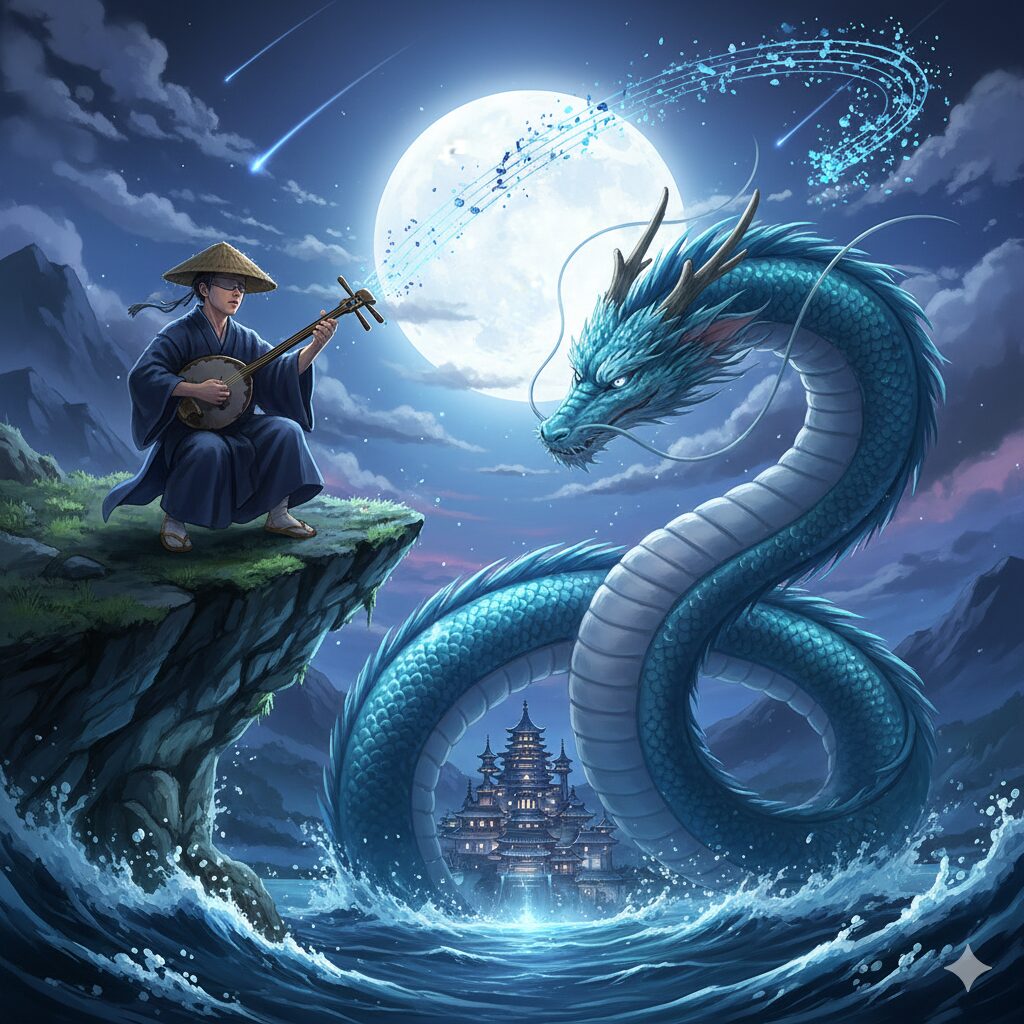
The Biwa—a traditional Japanese lute—produces a sound that resonates deep within the soul, sometimes fierce, sometimes sorrowful. In ancient Japan, there was a group of blind monks known as “Biwa Hoshi.” They traveled the land, not merely as musicians, but as storytellers who channeled the voices of gods and restless spirits.
Today, we explore the tale of Genson, a Biwa Hoshi of extraordinary talent, whose encounter with a “Dragon”—a being far beyond human understanding—changed his destiny forever.

- Part 1: The Lute Player and the Mysterious Lady
- Part 2: The Performance and the Shadow of the Giant Centipede
- Part 3: The Gift of the Dragon
- Analysis: Why Did the Dragon Seek Music?
- Cultural Connection: Kotodama and the Way of Art
- To Our Readers: What Would You Do?
- 第一部:琵琶法師と不思議な女
- 第二部:龍宮城での演奏と巨大な影
- 第三部:別れと残された宝物
- 考察:なぜ竜は「音楽」を求めたのか
- 日本文化との関連:言霊と芸道
- 読者の皆さんへ:あなたならどうしますか?
Part 1: The Lute Player and the Mysterious Lady
Long ago, on the shores of Lake Biwa, the largest lake in Japan, lived a young monk named Genson. His playing was legendary, said to capture the whisper of the wind, the babble of brooks, and the deepest grief of the human heart.
On a night bathed in silver moonlight, as Genson played alone by the water, the lake’s surface parted, and a noble lady of ethereal beauty emerged. She knelt before him, tears shimmering in her eyes.
“Your music has healed my parched soul,” she whispered. “Please, would you come to the Dragon Palace (Ryugu-jo) and perform for my master, the Dragon King?”
Surprised yet moved by her sincerity and the realization that his art had reached the divine realm, Genson accepted. With a wave of her sleeve, a bubble of mystical light enveloped him, and they sank into the deep, dark blue of the lake.
Part 2: The Performance and the Shadow of the Giant Centipede
At the Dragon Palace, decorated with brilliant coral and gems, the Dragon King awaited. He welcomed Genson with a grand feast, yet a shadow of worry hung over the King’s face.
The moment Genson struck the strings, the entire palace trembled. He wove a tapestry of sound, from the tranquility of the heavens to the roaring fires of hell. But as the performance reached its peak, a thunderous roar shook the palace walls.
It was the “O-Mukade”—a giant centipede, the ancient enemy of the dragon clan. Even the mighty Dragon King struggled against this mountain-sized monster. Without missing a beat, Genson’s music grew sharper and more powerful. The vibrations of his strings emboldened the Dragon King, who transformed into his true dragon form and finally drove the monster away.
Part 3: The Gift of the Dragon
As peace returned, the Dragon King expressed his deepest gratitude. He presented Genson with an ancient Biwa. “This is a treasure of our clan. To him who holds this, no sound in this world shall be impossible to play.”
Returning to the surface, Genson found the lake as calm as ever. In his hands, however, was a lute adorned with carvings of celestial beauty. He cherished it all his life, and his melodies are said to have saved countless souls across Japan.
Analysis: Why Did the Dragon Seek Music?
In this story, the “Dragon” represents the formidable powers of nature (water, lightning, rain), while the “Biwa Hoshi” symbolizes human spirituality and the pinnacle of art. Why would a god-like dragon need human music?
It stems from the Japanese belief that “Art has the power to soothe the wild spirits of nature (Chinkon).” Since ancient times, music and dance have been offered to the gods to appease disasters. Genson’s performance was not just entertainment; it was a “prayer” that brought order to a chaotic world.
Cultural Connection: Kotodama and the Way of Art
- Kotodama (Power of Sound/Word): The belief that spirits reside within words and sounds. Genson’s music literally empowered the Dragon King.
- The Proximity of the Otherworld: In Japanese folklore, the “Otherworld” (Ikai) exists right next to our daily lives—at the bottom of a lake or deep in the mountains.
- Geido (The Way of Art): The philosophy that mastering a craft allows one to communicate with the divine.
To Our Readers: What Would You Do?
If a messenger from another world appeared before you tonight and asked to borrow your “talent” for the sake of the gods, how would you respond?
Would you overcome your fear and dive into the unknown, trusting in your skills? Or would you choose the safety of your daily life? The legendary Biwa Genson received was proof of his courage. If your “craft” had the power to change the world, what would it be? Share your thoughts in the comments below!
Related Links
External Resources:
【日本昔話】琵琶法師と竜:旋律が繋ぐ異界との契約と、芸の極致
日本の伝統楽器「琵琶(びわ)」。その音色は、時に激しく、時に物悲しく、聴く者の魂を揺さぶります。かつて日本には、琵琶を奏でながら各地を旅する「琵琶法師」と呼ばれる盲目の僧侶たちがいました。彼らは単なる演奏家ではなく、神仏や怨霊の声を代弁する語り部でもあったのです。
今回は、ある一人の類まれなる才能を持った琵琶法師が、人間界を超越した存在である「竜」と出会い、その運命を大きく変える物語をご紹介します。
第一部:琵琶法師と不思議な女
昔々、今の滋賀県にある日本最大の湖、琵琶湖のほとりに、一人の若き琵琶法師が住んでいました。彼の名は源尊(げんそん)。源尊の奏でる琵琶は、風のささやきや水のせせらぎ、さらには人々の心の奥底にある悲しみまでをも表現すると評判でした。
ある月明かりの美しい夜、源尊が湖畔で独り琵琶を奏でていると、湖面が静かに割れ、見たこともないほど美しい高貴な女性が現れました。彼女は源尊の前に跪き、涙を流しながらこう言いました。
「あなたの奏でる音色は、私の乾いた魂を癒してくれました。お願いです、私の主君である竜王のために、龍宮城(りゅうぐうじょう)でその芸を披露してはいただけないでしょうか」
源尊は驚きましたが、その女性の真摯な眼差しと、自らの芸が異界にまで届いたという喜びに突き動かされ、彼女の誘いに応じることにしました。女性が袖を振ると、源尊の周りに不思議な光の泡が包み込み、二人は湖の底深くへと消えていきました。
第二部:龍宮城での演奏と巨大な影
たどり着いたのは、珊瑚で飾られた壮麗な龍宮城でした。そこには、威厳に満ちた竜王が待ち構えていました。竜王は源尊を歓迎し、豪華な宴を開きましたが、その表情にはどこか陰りがありました。
源尊が琵琶を取り出し、弦を弾いた瞬間、龍宮城全体が震えました。彼は、天上の平穏から地獄の劫火までを音に込め、物語を語り出しました。竜王をはじめ、城に住む者たちは息を呑み、その調べに聞き惚れました。しかし、演奏が佳境に入ったその時、城の外から地響きのような唸り声が聞こえてきました。
それは、竜一族の宿敵である巨大な「大百足(おおむかで)」の襲来でした。竜王といえども、この山の如き巨体を持つ怪物には手を焼いていたのです。源尊は怯むことなく、琵琶の音をより鋭く、より力強く響かせました。彼の指先から放たれる音の波動が、竜王に勇気を与え、ついに竜王は自らの姿を巨大な竜へと変え、大百足を撃退することに成功したのです。
第三部:別れと残された宝物
戦いが終わり、再び静寂が訪れた龍宮城で、竜王は源尊に深く感謝しました。竜王は礼として、一つの古い琵琶を源尊に授けました。「これは我ら竜一族の宝。これを持つ者に、もはやこの世に奏でられぬ音はない」と。
源尊が地上に戻ると、そこには以前と変わらぬ琵琶湖が広がっていました。しかし、彼が手にしていたのは、人間界のものとは思えないほど美しい装飾が施された琵琶でした。源尊はその琵琶を終生大切にし、その音色は日本中に広まり、多くの人々の心を救ったと伝えられています。
考察:なぜ竜は「音楽」を求めたのか
この物語における「竜」は、自然界の強大な力(水、雷、雨)を象徴しています。一方で「琵琶法師」は、人間の精神性や芸術の極致を象徴しています。なぜ、神にも等しい力を持つ竜が、人間の音楽を求めたのでしょうか。
それは、「芸術には、自然の荒ぶる魂を鎮める(鎮魂の)力がある」と日本人が信じていたからです。古来より、日本では災害や疫病を鎮めるために音楽や舞を神に奉納してきました。琵琶法師の演奏は、単なる娯楽ではなく、混沌とした世界に秩序をもたらす「祈り」そのものだったのです。
日本文化との関連:言霊と芸道
この昔話から読み解ける日本文化の特徴は以下の3点です。
- 言霊(ことだま)と音霊: 言葉や音には霊的な力が宿るという思想です。源尊の琵琶が大百足を退ける助けとなったのは、音に宿る霊力が実体化したことを意味します。
- 異界との隣接性: 日本の神話や民話では、湖の底や山の奥など、日常のすぐ隣に「異界」が存在すると考えられています。龍宮城は、その代表的なシンボルです。
- 芸の修行: 一つの道を極めることで、人間を超越した存在と対等に渡り合えるようになるという「芸道」の精神が色濃く反映されています。
読者の皆さんへ:あなたならどうしますか?
もし、ある晩、あなたの目の前に美しい異界の使者が現れ、「あなたの才能を神々のために貸してほしい」と頼まれたら、あなたはどうしますか?
見知らぬ世界へ行く恐怖に打ち勝って、自分の可能性を信じて飛び込みますか?それとも、今の平穏な日常を守ることを選びますか?源尊が手にした伝説の琵琶は、彼の勇気と執念の証でした。あなたが大切にしている「自分の芸(スキル)」が、もし世界を変える力を持っているとしたら……。ぜひ、コメントであなたの考えを聞かせてください。
関連リンク
日本の伝説をもっと知りたい方は、以下のカテゴリーもチェックしてみてください:
参考文献(外部リンク):


コメント