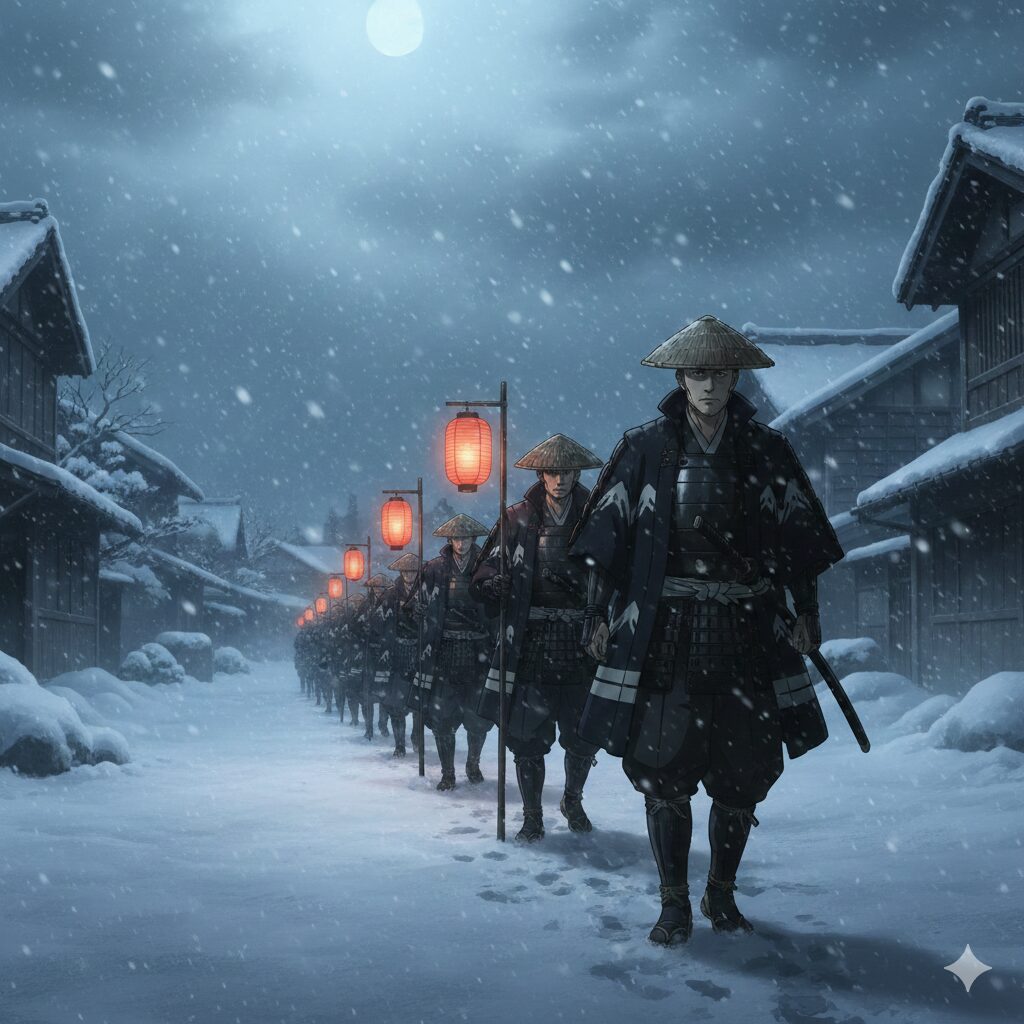
When winter deepens in Japan, particularly towards the end of January, a specific “snowy night” comes to the minds of history enthusiasts. While the legendary raid of the 47 Ronin (Ako Roshi) is traditionally celebrated in Japan on December 14th (based on the old lunar calendar), if we convert that historical moment precisely to our modern Gregorian calendar, the event actually took place on January 30, 1703.
Today, we delve beyond the bloodshed of this famous vendetta to explore the core of the Japanese spirit found in “Chushingura.” Why does this story continue to captivate people around the world more than 300 years later?

The Day History Derailed: The Incident at the Pine Corridor
The story begins about two years prior to the raid, with a shocking incident inside Edo Castle. Asano Naganori, the feudal lord (Daimyo) of the Ako Domain, drew his sword and attacked Kira Yoshinaka, a high-ranking master of ceremonies, in the “Corridor of Pines” (Matsu no Roka).
Attacking someone within the Shogun’s castle was a capital offense. Asano was immediately subdued. The Shogunate’s judgment was swift and harsh: “Immediate Seppuku (ritual suicide) and the revocation of his domain.” Conversely, Kira, the victim of the attack but also the instigator through his insults, received no punishment.
This ruling ignored the samurai custom of “Kenka Ryoseibai” (both parties in a fight are punished equally). This one-sided judgment devastated Asano’s retainers and lit an unquenchable fire in their hearts.
A Time of Dormancy: Oishi Kuranosuke’s Lonely War
Having lost their lord and their jobs, the retainers became “Ronin” (masterless samurai). Their leader, Oishi Kuranosuke, did not seek immediate revenge. Initially, he petitioned for the restoration of the Asano house, attempting to follow the law.
However, when that hope was extinguished, his purpose unified into a single goal: Vendetta. What makes this story remarkable is Oishi’s thorough information warfare and psychological strategy. To deceive the spies of Kira and the Shogunate, he spent his days drinking and gambling in Kyoto’s Gion district, enduring the humiliation of being called a “cowardly drunkard.” This was a desperate performance to make his enemies lower their guard.
January 30, 1703: The Fateful Snowy Night
Finally, the night arrived. On the 14th day of the 12th month of Genroku 15 (January 30, 1703). Heavy snow was falling over Kira’s mansion in Edo (modern-day Tokyo).
Oishi Kuranosuke led the 47 Ronin, fully armored, in a surprise raid. They carried with them only one thing: “Gi” (Justice/Righteousness) to clear their late lord’s regret. After a fierce battle, they found Kira Yoshinaka and took his head.
They marched with the head to Sengakuji Temple, where their lord Asano was buried, to report their success to his grave. Afterwards, instead of fleeing, they waited for the Shogunate’s judgment. Eventually, they were ordered to commit Seppuku. This was not an execution for criminals, but a gesture of respect from the Shogunate, allowing them to die with their honor as samurai intact.
Decoding Japanese Culture through “Chushingura”
This event, known historically as the “Ako Incident,” became the national legend “Chushingura” through Kabuki and Bunraku plays. It contains essential elements for understanding the Japanese psyche.
1. The Embodiment of “Bushido”
As Inazo Nitobe introduced to the world in his book Bushido: The Soul of Japan, for a samurai, “Honor” and “Loyalty” are heavier than life itself. The 47 Ronin chose death for their lord over living in shame. This “aesthetics of death” still influences modern Japanese ethics, visible in the intense dedication to one’s organization or team (though arguably, sometimes to a fault).
2. The Conflict of “Tatemae” and “Honne”
Under the Shogunate’s law (Tatemae/Public facade), private revenge was a grave crime. However, in samurai morality (Honne/True feeling), avenging one’s master was a praiseworthy act. The order for them to commit Seppuku was a sophisticated political balance: upholding the law while honoring their spirit. This episode symbolizes the complex structure between rules and emotions in Japanese society.
3. The Spirit of “Hogan-biiki” (Sympathy for the Tragic Hero)
Historically, Japanese people tend to find beauty in and sympathize with the underdog or the defeated hero who stands against mighty power. The sight of the Ronin, unreasonably oppressed by authority (the Shogunate/Kira), striking back and then scattering like cherry blossoms, stimulates the ultimate catharsis for the Japanese soul.
A Question for You
On this day, January 30th, cast your thoughts back to that snowy night over 300 years ago. In our modern society, words like “Loyalty” and “Vengeance” might sound archaic or even dangerous.
However, perhaps what they truly wanted to protect was not just their lord’s life, but “the justice they believed in” and “their pride as human beings.”
If you lost everything and stood alone against society, is there a belief you would stake your life to protect?
Was their action righteous justice or madness? The answer lies within your heart as you finish reading this.
Related Links
- Back to “What’s Today’s Special Day Series”
- Ako City Tourism Association – The hometown of the Ronin.
雪の赤穂浪士:1月30日に刻まれたサムライの真髄
日本の冬、特に1月後半になると、歴史愛好家たちの心にはある一つの「雪の夜」が浮かび上がります。一般的に日本では「12月14日」として知られる赤穂浪士(あこうろうし)の討ち入りですが、現在の我々が使うカレンダー(グレゴリオ暦)に正確に換算すると、その歴史的瞬間は1703年1月30日の出来事となります。
今日は、単なる復讐劇を超え、日本人の精神的支柱となった「忠臣蔵(ちゅうしんぐら)」の真実と、なぜこの物語が300年以上経った今も世界中の人々を魅了し続けるのか、その深層に迫ります。
歴史の歯車が狂った日:松の廊下の刃傷
物語は討ち入りの約2年前、江戸城の中で起きた衝撃的な事件から始まります。播磨国赤穂藩の主君、浅野内匠頭(あさのたくみのかみ)が、高家肝煎である吉良上野介(きらこうずけの介)に対し、殿中「松の廊下」で斬りかかったのです。
「殿中でござる!」という叫び声と共に取り押さえられた浅野に対し、幕府の裁定は迅速かつ過酷なものでした。「即日切腹、御家取り潰し」。一方、斬りつけられた吉良には「お咎めなし」。
この「喧嘩両成敗(けんかりょうせいばい)」の慣習を無視した片手落ちの裁定が、浅野の家臣たちの運命を大きく狂わせ、そして彼らの心に消えない炎を灯すことになります。
雌伏の時:大石内蔵助の孤独な戦い
主君を失い、職を失い、「浪人(ろうにん)」となった家臣たち。その筆頭家老であった大石内蔵助(おおいしくらのすけ)は、即座に報復に出ることはしませんでした。彼はまず、お家再興の嘆願を行い、幕府の法に従おうとしました。
しかし、その望みが絶たれた時、彼の目的は「復讐」へと一本化されます。ここで特筆すべきは、大石の徹底した情報戦と心理戦です。彼は敵である吉良側や幕府の目を欺くため、京都の祇園で放蕩三昧の日々を送り、「腰抜け」と罵られる屈辱に耐え抜きました。これは、敵の油断を誘うための命がけの演技だったのです。
1703年1月30日:運命の雪の夜
そして迎えた、元禄15年12月14日(新暦1703年1月30日)。深夜、江戸の本所松坂町にある吉良邸。空からは深々と雪が降り積もっていました。
大石内蔵助率いる47人の浪士たちは、完全武装で吉良邸を急襲します。彼らが掲げたのは、亡き主君の無念を晴らすという「義」の一文字でした。激しい乱闘の末、彼らは吉良上野介を見つけ出し、その首を討ち取りました。
彼らはその首を掲げ、主君・浅野内匠頭が眠る泉岳寺(せんがくじ)まで行進し、墓前に報告を行いました。その後、彼らは逃亡することなく幕府の裁きを待ち、最終的には「切腹」を命じられます。これは、彼らを「罪人」として処刑するのではなく、「武士」としての名誉を守らせるという幕府の配慮でもありました。
「忠臣蔵」から読み解く日本文化:なぜ彼らは死を選んだのか
この事件は「赤穂事件」として歴史に刻まれ、後に歌舞伎や人形浄瑠璃で『仮名手本忠臣蔵』として演じられることで、日本人のDNAに深く刻まれる国民的物語となりました。ここには、日本文化を理解する上で不可欠な要素が詰まっています。
1. 「武士道」の具現化
新渡戸稲造が『武士道』で世界に紹介したように、サムライにとって命よりも重いもの、それが「名誉」と「忠義」です。47人の浪士たちは、生き延びて恥をさらすことよりも、主君のために死ぬことを選びました。この「死に様の美学」は、現代の日本人の倫理観、例えば組織への献身や自己犠牲の精神にも(良し悪しは別として)色濃く影響を残しています。
2. 「建前」と「本音」の葛藤
当時の幕府の法(建前)では、私的な復讐は重罪です。しかし、武士の道徳(本音)では、主君の仇を討つことは賞賛されるべき行為でした。幕府が彼らに「切腹」を命じたのは、法を守りつつも、彼らの精神性を称えるという、高度な政治的バランスの結果でした。このエピソードは、日本社会における規則と感情の狭間にある複雑な構造を象徴しています。
3. 判官贔屓(ほうがんびいき)の精神
日本人は歴史的に、強大な権力に立ち向かい、散っていった敗者や弱者に美を見出し、共感する傾向があります(源義経などが代表例)。権力(幕府・吉良)によって理不尽に虐げられた者たち(赤穂浪士)が、一矢報いて散っていく姿は、日本人の涙腺を最も刺激するカタルシスなのです。
あなたへの問いかけ
1月30日の今日、300年以上前の雪の夜に思いを馳せてみてください。現代社会において、「忠義」や「復讐」といった言葉は古臭く、あるいは危険に聞こえるかもしれません。
しかし、彼らが本当に守りたかったのは、単なる主君の命ではなく、「自分たちが信じる正義」そして「生き方としての誇り」だったのではないでしょうか。
もしあなたが全てを失い、社会的に孤立したとしても、命を懸けて守り抜きたい「信念」はありますか?
彼らの行動が正しかったのか、狂気だったのか。その答えは、この記事を読んでいるあなたの心の中にあります。
コメント