
The Folktale: Old Man Nihei and the Tanuki
Once upon a time, in the province of Chiba, there lived a hardworking old man named Nihei. Every year, as the harsh winter approached, Old Man Nihei would build a small hut deep in the mountains away from the village. There, he would live for several months, making a living by burning wood to create a year’s supply of charcoal.
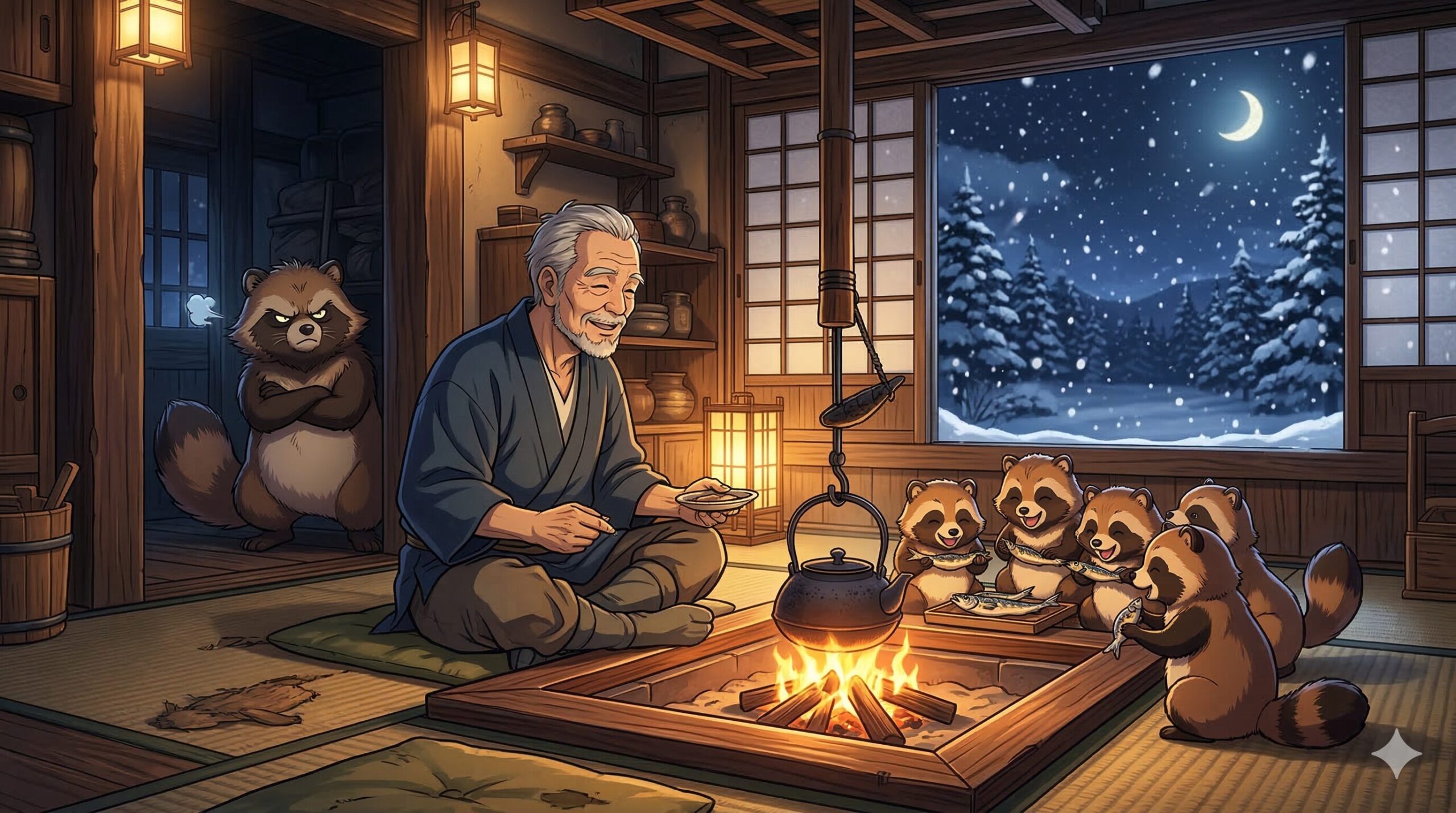
One biting cold night, with snow threatening to fall, Old Man Nihei was warming himself by the irori (traditional sunken hearth) in the center of his hut, grilling some dried sardines (mezashi) for his dinner. Suddenly, a mother Tanuki (Japanese raccoon dog) poked her head through the entrance. Behind her, several small baby Tanuki huddled together, shivering in the freezing cold.
“Oh my, on a cold night like this. You must be starving,” muttered Nihei.
Feeling pity for them, Old Man Nihei tore off the head of a freshly grilled sardine and tossed it to them. The mother Tanuki immediately ran over, picked it up, and instead of eating it herself, gently divided it among her hungry babies. Deeply moved by this profound parental love, Old Man Nihei gave the rest of his own dinner to the Tanuki family. The Tanuki ate happily and then returned to the mountain.
The next evening, as Old Man Nihei was again grilling sardines by the hearth, a strange boy emitting a terribly foul odor walked into the hut. Old Man Nihei instantly realized that this was not a boy, but a mean-spirited, ancient Tanuki who fancied himself the boss of the mountain, disguised in human form. Feigning ignorance, the old man secretly tossed a handful of acorns he had collected into the roaring fire of the hearth.
The fire crackled, and soon, the heated acorns popped violently with a loud “Bang!” The hot, bursting acorns hit the disguised boy right in the crotch. Screaming “Ouch, ouch, ouch!” the boy reverted to his true form as the ancient Tanuki and fled in a panic. A little while later, the mother Tanuki from the previous night arrived, this time disguised as a cute little girl. Old Man Nihei treated her to all the sardines he had prepared, and they spent a pleasant time together.
However, the story does not end there. Late that night, just as Old Man Nihei got into his futon and was drifting off to sleep, the hut suddenly began to shake violently, like a massive earthquake. Along with a nose-piercing, pungent stench, the mean ancient Tanuki—furious from the acorn burns he suffered earlier that day—reappeared.
Driven mad by anger, the ancient Tanuki violently tore a large hole in the roof of the hut. From above, he unleashed a powerful stream of incredibly stinky urine right onto Old Man Nihei. The ancient Tanuki’s body and his urine were of an unearthly, horrific stench. It was an experience so dreadful that Old Man Nihei learned a very hard lesson he would never forget.
Analysis of the Folktale: Good Will and the Absurdity of Nature
The story of “Old Man Nihei and the Tanuki” is not just a simple tale of animal gratitude or mischief; it contains profound moral lessons and deep humor. First, there is the “chain of goodwill” born between Old Man Nihei and the mother Tanuki. The human’s empathy for the unconditional love of a parent for its child, leading him to share his own food, illustrates a heartwarming connection that transcends species.
On the other hand, the presence of the mean ancient Tanuki adds spice to the narrative. Old Man Nihei sees through the ancient Tanuki’s disguise and brilliantly repels him using acorns, symbolizing the triumph of human wisdom and quick thinking. Yet, the story does not end with a satisfying victory. The ancient Tanuki’s vindictive revenge—resulting in the absurd and extreme act of being sprayed with unimaginably foul urine—demonstrates a sense of awe: humans cannot completely control nature or the spirits (yokai) of the mountains. The greatest charm of this folktale lies in its humorous depiction of the unpredictable energy and troublesome nature of the wild, rather than a simple narrative of good conquering evil.
Connection to Japanese Culture: Satoyama Life and Shape-shifting Animals
This folktale provides deep insights into traditional Japanese lifestyles and spirituality. The “charcoal burning” practiced by Old Man Nihei was a crucial winter occupation in historical Japan. Before gas and electricity, charcoal was an indispensable energy source for daily life. Charcoal makers would isolate themselves in the mountains, communicating with nature while mastering the fire. The irori (sunken hearth) was not only for warmth but also served as a cooking stove and the center of communication where family and guests gathered.
Furthermore, in Japanese folklore, Tanuki and foxes frequently appear as creatures capable of shape-shifting and tricking humans. Unlike the absolute demons or witches found in Western fairy tales, Japanese Tanuki are portrayed as somewhat human-like, comical, sometimes returning favors, and sometimes playing pranks—essentially acting as “close neighbors.” This stems from Japan’s ancient animistic beliefs, where spirits reside in all things. The story vividly reflects the concept of a “symbiotic society” in the Satoyama (the borderland between mountain foothills and arable flat land), where humans, wild animals, and mountain deities shared territory, sometimes clashing and sometimes helping each other survive.
To Our Readers: What Would You Do?
Old Man Nihei treated the caring mother Tanuki with kindness but showed no mercy in punishing the mean ancient Tanuki. However, as a result, he fell victim to an unimaginable disaster of foul odors. If you were in Old Man Nihei’s shoes, what would you have done?
When the mean ancient Tanuki arrived in disguise, would you have played a painful prank like throwing acorns into the fire to teach him a lesson? Or, fearing a terrifying revenge later, would you have avoided making waves and simply shared a small piece of your fish to let the situation pass smoothly? We would love to hear your thoughts on this question, which relates deeply to how we handle both human relationships and our interaction with nature.
If you want to read more fascinating Japanese folktales, please check out our Japanese Folktale Series.
Reference: Manga Nippon Mukashibanashi Database – Old Man Nihei and the Tanuki
仁兵衛じいさんとたぬき:冬の夜の不思議な出会い
昔話のストーリー:仁兵衛じいさんとたぬき
昔々、千葉の国に仁兵衛(にへえ)という名の働き者のおじいさんが住んでいました。仁兵衛じいさんは毎年、厳しい冬が近づいてくると、人里離れた裏山に小さな小屋を建て、そこで数ヶ月間寝泊まりしながら一年分の炭を焼いて生計を立てていました。
雪が降りそうな、身を切るように寒いある夜のことです。仁兵衛じいさんが小屋の中央にある囲炉裏(いろり)の火にあたりながら、夕飯のおかずであるメザシを焼いていると、小屋の入り口からひょっこりと一匹の親タヌキが姿を現しました。その後ろには、まだ小さな子タヌキたちが寒そうに震えながら身を寄せ合っています。
「おや、こんなに寒い夜に。さてはお腹を空かせているのだな」
不憫に思った仁兵衛じいさんが、焼きたてのメザシの頭をちぎって投げてやると、親タヌキはすぐに走り寄ってそれを拾い上げ、自分が食べるのではなく、お腹を空かせた子タヌキたちに優しく分けてやりました。その深い親心にすっかり感心した仁兵衛じいさんは、自分の夕飯にするはずだった残りのメザシもすべて、タヌキの親子に食べさせてやりました。タヌキたちは嬉しそうに平らげ、山へと帰っていきました。
さて、次の日の晩のことです。仁兵衛じいさんがまた囲炉裏でメザシを焼いていると、今度はひどく臭いにおいを漂わせた見知らぬ男の子が小屋に入ってきました。仁兵衛じいさんは、山の主気取りの意地悪な古ダヌキが人間に化けた姿だとすぐに気がつきました。そこでじいさんは知らん顔をして、こっそりと囲炉裏の燃え盛る火の中に、拾っておいたドングリを一掴み放り込みました。
パチパチと火が燃え盛り、やがて熱せられたドングリが「パンッ!」と勢いよく弾け飛びました。弾けた熱いドングリは見事に男の子の股に命中し、「アチチチッ!」と悲鳴を上げた男の子は、本来の古ダヌキの姿に戻って慌てて逃げていきました。しばらくすると、今度は可愛らしい女の子の姿に化けた昨夜の親タヌキがやってきたので、仁兵衛じいさんは用意していたメザシを全部ご馳走し、楽しいひとときを過ごしました。
しかし、物語はここでは終わりません。その夜遅く、仁兵衛じいさんが布団に入ってウトウトと眠りにつこうとした時、突然、小屋が大きな地震のようにグラグラと揺れ始めました。鼻をつくような強烈な悪臭とともに現れたのは、昼間ドングリで火傷を負わされ、すっかり腹を立てたあの意地悪な古ダヌキでした。
怒り狂った古ダヌキは小屋の屋根に乱暴に大穴を開けると、その上から強烈に臭いおしっこを「シューッ!」と仁兵衛じいさんめがけて勢いよくひっかけたのです。その古ダヌキの体も、おしっこも、この世のものとは思えないほどの恐ろしい臭さで、仁兵衛じいさんはすっかり懲りてしまったということです。
昔話の深い考察:善意と自然の理不尽さ
この「仁兵衛じいさんとたぬき」という物語は、単なる動物の恩返しやイタズラ話にとどまらない、非常に奥深い教訓とユーモアを含んでいます。まず第一に、仁兵衛じいさんと親タヌキとの間に生まれた「善意の連鎖」です。親が子を想う無償の愛に人間が共感し、自らの食料を分け与えるという行為は、種族を超えた心の交流を描き出しています。
一方で、意地悪な古ダヌキの存在が物語のスパイスとなっています。仁兵衛じいさんは古ダヌキの変装を見破り、ドングリを使って見事に撃退しました。これは人間の知恵と機転の勝利を意味します。しかし、物語の結末は痛快な勝利では終わりません。古ダヌキの執念深い復讐、しかも「とてつもなく臭いおしっこをかけられる」という理不尽かつ強烈な結末は、人間が自然や山の精霊(妖怪)を完全にコントロールすることは不可能であるという、畏怖の念を示しています。勧善懲悪ではなく、自然界の持つ予測不可能なエネルギーと厄介さを、ユーモアを交えて表現している点がこの昔話の最大の魅力です。
日本文化との関連:里山の暮らしと「化ける」動物たち
この物語からは、日本の伝統的な生活様式と精神性を深く読み解くことができます。仁兵衛じいさんが行っていた「炭焼き」は、かつての日本では冬の重要な仕事でした。ガスや電気がなかった時代、炭は人々の生活に欠かせないエネルギー源であり、炭焼き職人は山にこもり、自然と対話しながら炎を操っていました。囲炉裏(いろり)は暖を取るだけでなく、調理を行い、家族や客人が集うコミュニケーションの中心地でした。
また、日本の伝承において、タヌキやキツネは人間を「化かす(だます)」存在として頻繁に登場します。西洋の童話に登場するような絶対的な悪魔や魔女とは異なり、日本のタヌキはどこか人間臭く、滑稽で、時に恩返しをし、時にイタズラをする「身近な隣人」として描かれます。これは、日本古来の「アニミズム(万物に魂が宿るという信仰)」に基づいています。人間と野生動物、そして山の神々が、里山という空間で互いのテリトリーを共有しながら、時にはぶつかり合い、時には助け合って生きてきた「共生社会」の姿が、この物語には色濃く反映されています。
読者の皆様へ:あなたならどうしますか?
仁兵衛じいさんは、子を想う親タヌキには優しく接し、意地悪な古ダヌキには容赦なくお灸を据えました。しかし、その結果としてとんでもない悪臭の被害に遭うことになってしまいました。もしあなたが仁兵衛じいさんの立場だったら、どうしていたでしょうか?
意地悪な古ダヌキが化けてやってきたとき、痛い目を見せるためにドングリを火にくべるようなイタズラを仕掛けますか?それとも、後々の恐ろしい復讐を恐れて、波風を立てずにメザシを少しだけ分けてやり過ごしますか?人間関係や自然との接し方にも通じるこの問いについて、ぜひあなたの考えを聞かせてください。
もっと日本の魅力的な昔話を読みたい方は、ぜひこちらのJapanese Folktale Series(日本の昔話シリーズ)をご覧ください。

コメント