- The Poignant Story of “Nezumi to Jisa”
- Story Analysis: The Weight of a Promise and Human Frailty
- Connection to Japanese Culture: The Longing for Hometown and the Spirit of “Kuyo”
- To Our Readers: What Would You Do?
- 昔話「ねずみと爺さ」の切なくも美しいストーリー
- 物語の考察:約束の重さと、取り返しのつかない人間の弱さ
- 日本文化との関連:故郷への強い執着と「供養」の精神
- 読者の皆様へ:あなたなら、どうしますか?
The Poignant Story of “Nezumi to Jisa”
Once upon a time, many people traveled to worship the Great Buddha in Nara. However, some spent all their travel money and found themselves unable to return to their distant hometowns. Among them was an old man who had traveled all the way from the southern part of Iwate Prefecture.
As the old man stood at a loss in a strange land, a single mouse suddenly appeared before him. The mouse introduced himself as “Chuta.” Surprisingly, Chuta was also born in the same southern region of Iwate as the old man. He had been snatched by a flying kite (a bird of prey) and carried all the way to this distant land of Nara.
Finding a shared bond in a foreign land, the man and the mouse deeply understood each other’s intense longing for home. They resolved to help one another and set off on a grueling journey back to their faraway hometown in Iwate.
During the journey, Chuta asked the old man to make one firm promise.
“Old man, when we stay at an inn, please promise me that you will never stay at an inn that has a cat. I beg this of you.”
The old man nodded deeply and strictly kept this promise, continuing their journey through rain and wind.
However, the day finally came when their hometown in the south was drawing near. The old man, completely exhausted from the long journey, let his guard down at the very last inn they visited. Without noticing the presence of a cat, he carelessly decided to stay the night.
That night, the feared tragedy struck. Attacked by the inn’s resident cat, Chuta suffered a deep, fatal wound.
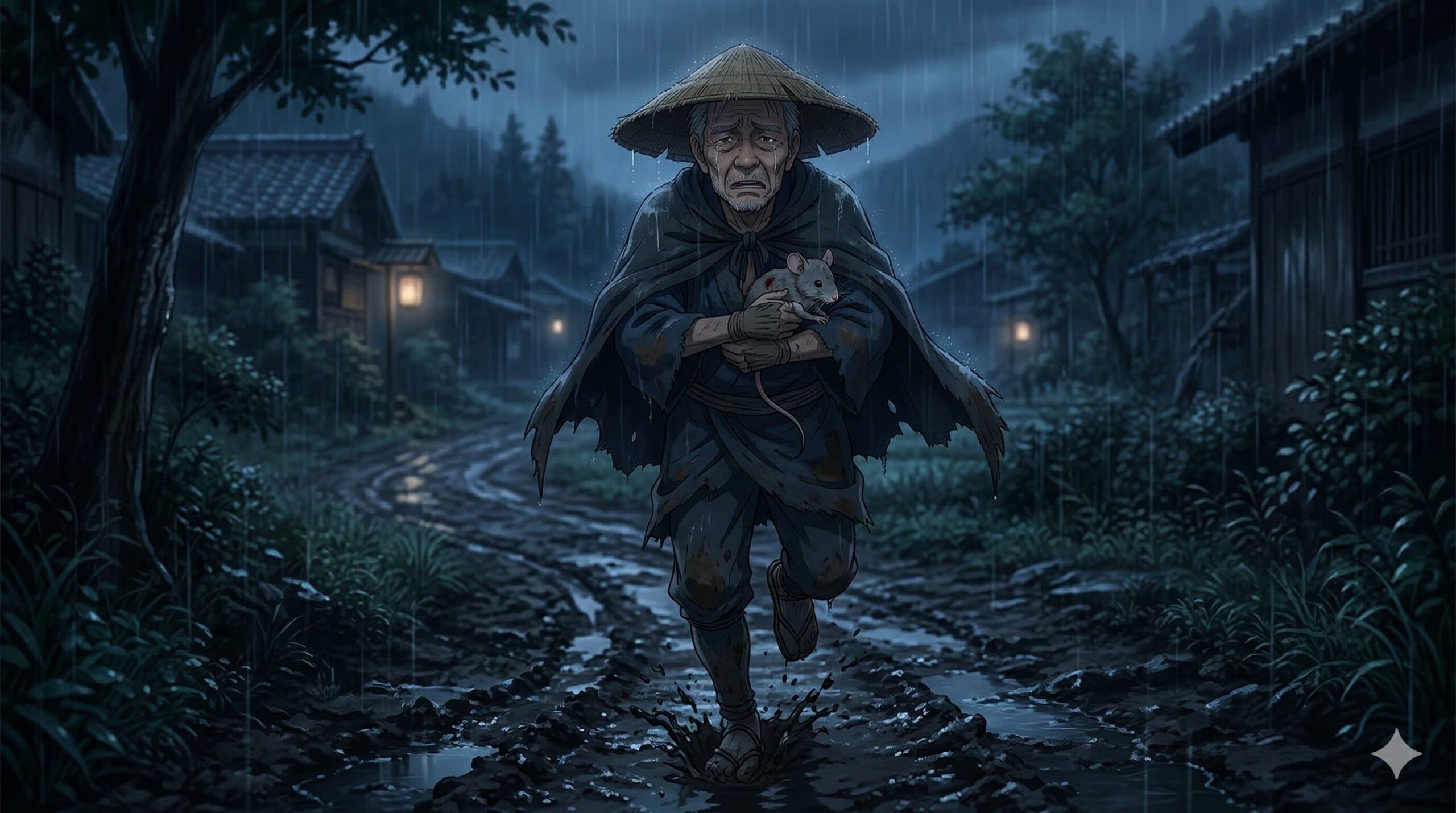
In the middle of the night, under a cold, heavy rain, the old man intensely regretted his carelessness. Clutching the limp, bleeding Chuta to his chest, he ran toward their hometown through the dark roads, shedding large tears.
“Chuta, don’t die! We’re almost there! You’ll see your mother soon! Hold on!”
But the old man’s desperate cries were in vain. Gathering the very last of his strength, Chuta whispered faintly, “Mother…” and grew cold in the old man’s arms.
Having barely reached their hometown in the south, the old man immediately sought out Chuta’s mother. He gently handed over Chuta’s lifeless body, bowing deeply to the ground in apology for failing to keep his promise.
Though grief-stricken by the sudden death of her son, the mother did not blame the old man. She was deeply grateful for the old man’s kindness in bringing her son back to his hometown from a distant, unknown land, and she thanked him repeatedly through her tears. As a heartfelt token of her gratitude, the mother handed the old man a magical red “Juban” (an under-kimono) that possessed the power to produce anything the owner desired.
The old man received a treasure capable of granting any wish, but there was not a shred of joy in his heart. Deeply mourning Chuta’s death, he returned to his own village with heavy steps.
Story Analysis: The Weight of a Promise and Human Frailty
The most defining characteristic of this story, and the reason it strikes the reader’s heart so strongly, is that it does not have a happy ending. Many Japanese folktales follow a structure of poetic justice—”good deeds are rewarded, and bad deeds are punished”—but “Nezumi to Jisa” is not such a simple tale.
The protagonist, the old man, is by no means a bad person. Rather, he is a compassionate man who treats a creature of a different species as an equal friend and strives to reach their hometown together. However, by breaking (or carelessly overlooking due to extreme exhaustion) the single, absolute promise of “not staying at an inn with a cat,” he triggers an irreversible, decisive tragedy.
Humans are not perfect creatures. No matter how careful we try to be, fatigue and a moment of laxity can lead to grave mistakes. This story mercilessly depicts the raw vulnerability of human beings and the harsh reality that a single moment of carelessness can take a precious life.
Furthermore, at the end of the story, the old man acquires the ultimate treasure: a red Juban that grants any wish. Yet, the old man does not rejoice. The story clearly illustrates the truth that material wealth and magical power can never fill the void of a lost life. This contains a powerful lesson and message: life and our bonds with others must be valued above any material wealth.
Connection to Japanese Culture: The Longing for Hometown and the Spirit of “Kuyo”
From this story, we can clearly decipher two unique aspects of Japanese spirituality: an intense attachment to one’s “Furusato” (hometown) and an animistic empathy toward animals.
In ancient Japan, where transportation networks were undeveloped, dying in a strange land away from home (客死, kakushi) was considered highly ominous and sorrowful, as the soul would become lost. That is precisely why Chuta’s mother, even though her son had perished, was deeply grateful that his body was able to step on the soil of his hometown and thanked the old man for bringing him back. The belief that “even after death, the soul wishes to return home” is a view of life and death that flows deeply at the core of Japanese culture, visible in customs such as the Obon festival.
Additionally, this story does not treat the mouse merely as an animal or a pest, but portrays him as an emotional being who longs for his hometown and loves his mother exactly as a human would. This heavily reflects Japan’s traditional view of nature and religion (animism), which does not draw a clear boundary between humans, nature, and animals, believing that a soul dwells within all things. The spirit of “Kuyo” (memorial service)—respectfully mourning a deceased animal and sharing in the sorrow—can be deeply felt from this ending.
To Our Readers: What Would You Do?
“Nezumi to Jisa” meets a tragic end. What emotions did you feel reading this story?
If you were utterly exhausted during a grueling journey, just like the old man, and carelessly overlooked a promise with a small friend, bringing about a tragic end, how would you live the rest of your life carrying that guilt?
And could you bring yourself to use a “treasure that grants any wish” obtained in exchange for a lost life for your own benefit?
Folktales ask heavy questions of our hearts across generations. Please, take a moment to reflect deeply on your own thoughts and feelings.
Related Links
- Japanese Folktale Series (Read other stories on this blog)
- Reference: Manga Nihon Mukashibanashi Database – “Nezumi to Jisa” (Japanese)
ねずみと爺さ:小さな命との約束と、心打たれる日本の絆
昔話「ねずみと爺さ」の切なくも美しいストーリー
昔々、奈良の大仏様にお参りに来たものの、路銀(お金)を使い果たしてしまい、遠い故郷へ帰れなくなってしまった人々がたくさんいました。その中に、岩手県の南部地方からやって来た、一人のお爺さんがいました。
途方に暮れ、見知らぬ土地で途方に暮れていたお爺さんの前に、一匹のネズミがひょっこりと姿を現しました。そのネズミは「チュー太」と名乗りました。驚くべきことに、チュー太はお爺さんと同じ岩手南部の生まれであり、空を飛ぶトンビにさらわれて、遠く離れたこの奈良の地まで運ばれてきてしまったというのです。
遠い異郷の地で偶然出会った、同郷の一人と一匹。お互いに故郷を強く恋い焦がれる気持ちを分かち合った二人は、共に助け合いながら、はるか遠く離れた岩手南部を目指して過酷な旅に出ることを決意しました。
旅の道中、チュー太はお爺さんに一つだけ、どうしても守ってほしいと固い約束をお願いしました。
「お爺さん、宿に泊まるときは、絶対に猫のいる宿屋には泊まらないでくだされ。それだけはどうか、お願いします。」
お爺さんはチュー太の願いを深く頷き、その約束をしっかりと守りながら、雨の日も風の日も旅を続けました。
しかし、ついに故郷の南部が近づいてきたある日のことでした。長旅の疲労がピークに達していたお爺さんは、最後に立ち寄った宿屋で、気の緩みから猫がいることに気づかず、うっかり泊まってしまったのです。
その夜、恐れていた悲劇が起きました。宿屋に飼われていた猫に襲われ、チュー太は命に関わる深い傷を負ってしまったのです。
冷たい雨が激しく降る真夜中。お爺さんは自らの不注意と過ちを激しく悔やみ、ぐったりと血を流すチュー太を自らの懐に抱きかかえ、大粒の涙を流しながら夜の道を故郷へと全力で走りました。
「チュー太、死ぬな!もうすぐだ、もうすぐおっかあに会えるぞ!頑張れ!」
しかし、お爺さんの悲痛な叫びも虚しく、チュー太は最期に残された力を振り絞り、かすかな声で「おっかあ…」と呟くと、そのままお爺さんの腕の中で冷たくなってしまいました。
なんとか故郷の南部にたどり着いたお爺さんは、真っ先にチュー太の母親を訪ねました。そして、動かなくなったチュー太の亡骸をそっと渡し、約束を守れなかったことを土下座して深く詫びました。
突然の息子の死に悲しみに暮れる母親でしたが、彼女はお爺さんを責めませんでした。遠く離れた見知らぬ土地から、息子を故郷に連れて帰ってきてくれたお爺さんの優しさに深く感謝し、涙ながらに何度もお礼を言いました。そして、母親は「欲しい物が何でも出てくる」という不思議な力を持った宝物の赤い襦袢(じゅばん)を、心からのお礼としてお爺さんに手渡しました。
お爺さんは、どんな願いも叶うという宝物を手にしましたが、その心に喜びは微塵もありませんでした。ただただチュー太の死を深く悲しみ、重い足取りで自らの村へと帰っていきました。
物語の考察:約束の重さと、取り返しのつかない人間の弱さ
この物語が持つ最大の特徴であり、読者の胸を強く打つ理由は、「ハッピーエンドではない」という点にあります。日本の昔話の多くは、「善いことをすれば報われる」「悪いことをすれば罰を受ける」という勧善懲悪の構造を持っていますが、「ねずみと爺さ」はそのような単純な物語ではありません。
主人公のお爺さんは、決して悪人ではありません。むしろ、異形の存在であるネズミを対等な友として扱い、共に故郷を目指す慈愛に満ちた心の持ち主です。しかし、「猫のいる宿には泊まらない」という、たった一つの、しかし絶対的な約束を破ってしまった(あるいは極度の疲労による不注意で見落としてしまった)ために、取り返しのつかない決定的な悲劇を引き起こしてしまいます。
人間は完璧な生き物ではありません。どれだけ気をつけていても、疲れや気の緩みから重大な過ちを犯してしまうことがあります。この物語は、そうした人間の生々しい弱さと、「たった一度の不注意が尊い命を奪うことがある」という冷酷な現実を、一切の容赦なく描いています。
また、物語の結末で、お爺さんは「何でも願いが叶う赤い襦袢」という究極の宝物を手に入れます。しかし、お爺さんは喜びません。物質的な豊かさや魔法の力が、失われた命の重さを埋めることは決してできないという真理を明確に示しています。これは、物質的な富よりも、命や他者との絆を何よりも尊ぶべきであるという、強い教訓とメッセージを内包しています。
日本文化との関連:故郷への強い執着と「供養」の精神
この物語からは、日本特有の精神性である「故郷(ふるさと)への強い執着」と、「動物に対するアニミズム的な共感」を鮮明に読み解くことができます。
かつての日本では、交通網が発達しておらず、見知らぬ土地で客死(旅先で死ぬこと)することは、魂が迷子になる非常に不吉で悲しいこととされていました。だからこそ、チュー太の母親は、息子が息絶えてしまっていても、遺体となって故郷の土を踏めたこと、そしてそれを連れ帰ってくれたお爺さんに心から感謝したのです。「死してなお、魂が故郷に帰ることを願う」という思想は、お盆の風習などにも見られる、日本文化の根底に深く流れる死生観です。
また、この物語ではネズミを単なる動物や害獣として扱うのではなく、人間と全く同じように故郷を想い、母親を慕う感情豊かな存在として描いています。ここには、人間と自然、動物の間に明確な境界線を引かず、万物に魂が宿ると考える日本の伝統的な自然観・宗教観(アニミズム)が色濃く反映されています。命を落とした動物を手厚く弔い、悲しみを共有する「供養」の精神も、この結末から深く感じ取ることができます。
読者の皆様へ:あなたなら、どうしますか?
悲劇的な結末を迎える「ねずみと爺さ」。あなたはこの物語を読んで、どのような感情を抱きましたか?
もしあなたが、お爺さんと同じように過酷な旅の途中で疲労困憊し、小さな友との約束をつい見落としてしまい、悲しい結末を招いてしまったとしたら、その自責の念を抱えながら、その後の人生をどう生きていくでしょうか。
そして、失った命と引き換えに手に入れた「何でも願いが叶う宝物」を、あなたは自分のために使うことができるでしょうか?
昔話は、時代を超えて私たちの心に重い問いを投げかけます。ぜひ、あなたの考えや感情を深く見つめ直してみてください。

コメント