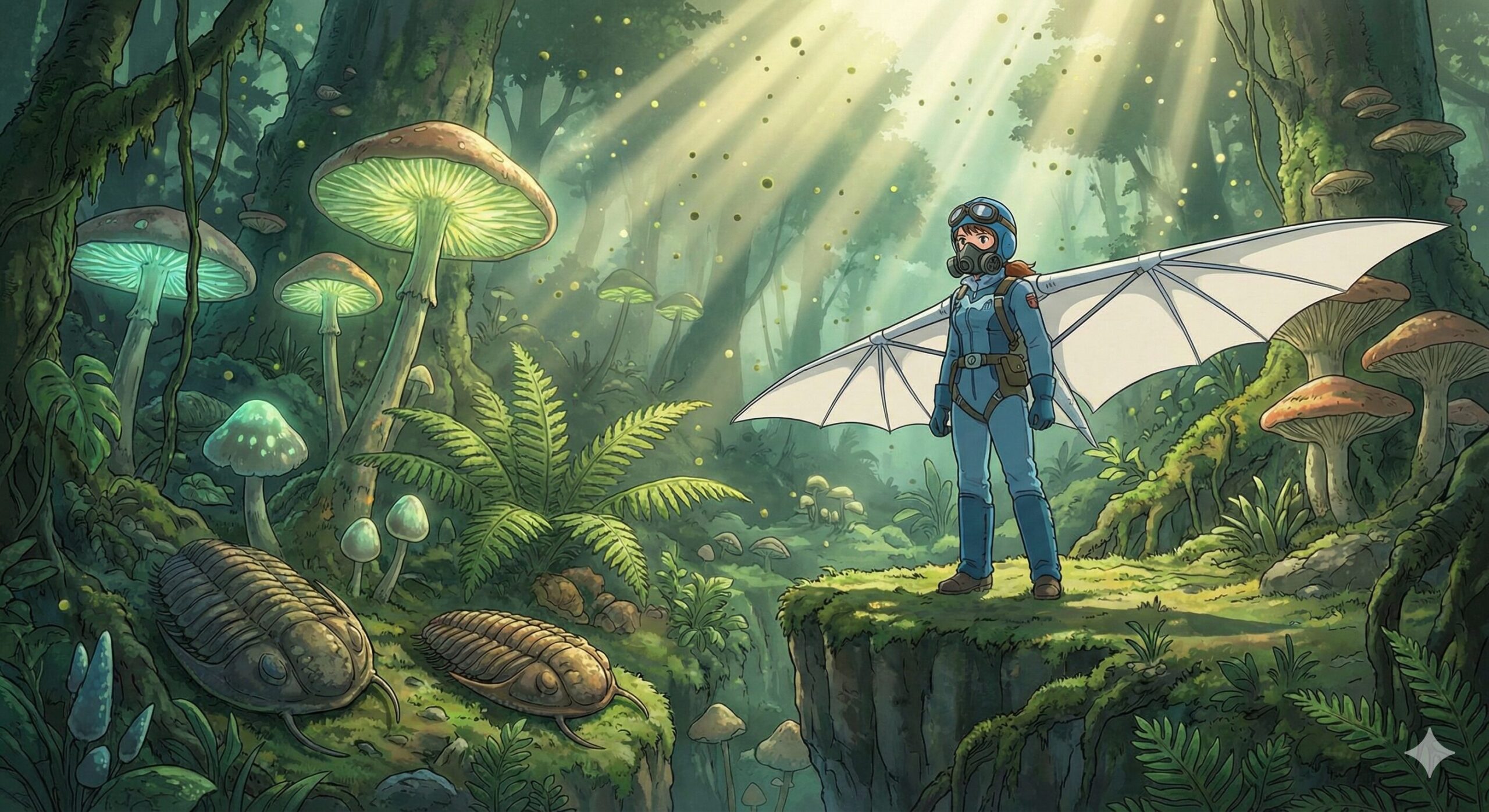
For anime fans and cinema lovers around the globe, the name “Studio Ghibli” is synonymous with magic. However, are you familiar with the grand epic that serves as the brilliant origin of this history and reflects director Hayao Miyazaki’s philosophy most vividly? That is the 1984 release, “Nausicaä of the Valley of the Wind.”
This work is not merely a fantasy anime. It is a masterpiece that uses overwhelming visuals and deep philosophy to depict the most serious themes facing modern society: environmental destruction, war, the karma of humanity, and coexistence with nature. In this article, we will thoroughly explore everything from the synopsis of the story to deep insights based on Japan’s unique religious views and historical background, and why you must experience this work right now.

- 1. The Collapse of Industrial Civilization and a World Swallowed by the “Sea of Decay” (Synopsis)
- 2. Reasons for Its Overwhelming Acclaim and Popularity in Japan: A Historical and Cultural Perspective
- 3. Why You Should Read (or Watch) It Now: 3 Highly Recommended Points
- Conclusion: A Compass for the Future We Live In
- External Links for Deeper Understanding
- Related Articles
- 1. 産業文明の崩壊と「腐海」に飲まれる世界(作品内容の要約)
- 2. 日本での圧倒的な評価と人気の理由:歴史・文化からの考察
- 3. なぜ今こそ読む(観る)べきなのか?絶対におすすめしたい3つのポイント
- 結論:私たちが生きる未来への羅針盤
- もっと深く知るための参考リンク
- 関連記事
1. The Collapse of Industrial Civilization and a World Swallowed by the “Sea of Decay” (Synopsis)
The story is set on Earth 1,000 years after an advanced industrial civilization was destroyed in an apocalyptic war known as the “Seven Days of Fire.” The earth has been transformed into a world covered by the “Sea of Decay” (Fukai)—a forest of fungi releasing highly toxic miasma—and ruled by giant mutant insects. The remnants of humanity live precariously on the few remaining patches of land, terrified of the encroaching toxic jungle.
In the “Valley of the Wind,” a small, peaceful kingdom on the periphery protected from the toxic miasma by ocean winds, lives Princess Nausicaä. She is a compassionate young woman with a mysterious power to communicate with nature and the giant insects. Unlike others who despise the Sea of Decay and the massive, pill bug-like insects called “Ohm,” she never shows hostility towards them and strives to understand their purpose in the world.
However, her peaceful days come to an end when a transport plane from the powerful military empire of Tolmekia crashes in the Valley. The plane carries the embryo of a “Giant Warrior,” a biological weapon from the old world that once burned the earth to ashes. Kushana, the Tolmekian princess, plans to resurrect the Giant Warrior to burn away the Sea of Decay with its overwhelming power. Meanwhile, destroying the toxic jungle incurs the terrifying wrath of the insects, an act that drives humanity to the brink of extinction. Nausicaä must put her own life on the line to stop the foolish wars between humans and a cataclysm caused by the wrath of the natural world.
2. Reasons for Its Overwhelming Acclaim and Popularity in Japan: A Historical and Cultural Perspective
“Nausicaä of the Valley of the Wind” is spoken of as a “myth” in the history of Japanese animation. The reason for this is not simply its excellent visual beauty or music. It is because the fundamental essence of this work is deeply rooted in Japan’s unique spirituality and the painful history experienced by modern Japan.
Animism (Yaoyorozu no Kami) and the Awe of Nature
While Western values often center around the idea that “humans conquer and cultivate nature,” Japan has held the concept of “Animism” since ancient times. This is the belief in “Yaoyorozu no Kami” (eight million gods), meaning that gods dwell in all natural things—mountains, rivers, trees, and even insects.
The attitude Nausicaä displays toward the giant insects in the film perfectly embodies this traditional Japanese view of nature. Rather than trying to control nature, she holds it in awe and seeks a path of coexistence through dialogue. The reason Japanese people resonate so deeply with Nausicaä is that she embodies the spirit of “awe and harmony with nature” carved into their DNA.
The Historical Trauma of the High Economic Growth Period and Pollution
In the early 1980s, when this work was released, Japan had just achieved a miraculous economic recovery from the scorched earth of World War II. However, as the price of this rapid modernization and industrialization, severe “pollution problems” occurred. As typified by Minamata disease, toxic wastewater from factories polluted the seas and rivers, claiming the lives and health of many people.
Director Hayao Miyazaki witnessed the reality that humanity’s endless desires destroy the natural environment, which eventually turns its fangs against humans themselves. The “Sea of Decay” in Nausicaä is depicted as a “natural immune system” designed to purify the earth’s environment, which was polluted by past humanity, over thousands of years. This setting is a scathing critique of environmental destruction and is born from deep reflection on the negative aspects of modernization experienced by the Japanese.
The Philosophy of “Kegare” (Impurity) and “Purification”
Japanese Shintoism has the concept of “Kegare” (impurity or defilement). Death, disease, and sin are considered “Kegare” and must be “purified” (often with water). While the trees of the Sea of Decay emit deadly toxins, a truth is revealed in the story: they are actually absorbing polluted soil and water, transforming them into clean crystals, and purifying the earth. This paradoxical structure—where something seemingly ugly and terrifying is actually cleansing the world—is deeply connected to the traditional Japanese philosophy of “purification,” giving the story immense philosophical depth.
3. Why You Should Read (or Watch) It Now: 3 Highly Recommended Points
① The Movie is Just the Prologue! The “Despair and Truth” Depicted in the Original Manga
Many people only know the movie version, but the film’s story actually covers only up to “the middle of the second volume” of the seven-volume original manga. While the movie has a hopeful ending, the original manga, which took Hayao Miyazaki 12 years to complete, is far darker and more complex. The cruel plans orchestrated by the Old Humanity, the true creators of the Sea of Decay and the insects, and Nausicaä’s “certain decision” regarding the future of humanity. To experience an ultimate worldview where good and evil completely collapse, I strongly recommend reading the original manga.
② “Independent Female Characters” Way Ahead of Their Time
Back in the 1980s, anime heroines were generally “beings protected by men.” However, Nausicaä is an outstanding warrior, a scientist, and a great leader. At the same time, the enemy commander Kushana is depicted as a highly complex and fascinating woman who is cruel yet commands deep respect from her subordinates. Years before Disney began portraying independent princesses, Hayao Miyazaki had already achieved perfect female empowerment.
③ The Ultimate Prescription for Modern Climate Change and a Divided Society (Eco-fiction)
Global climate change, endless wars, and viral pandemics. The crises we face today are astonishingly similar to the world of “Nausicaä of the Valley of the Wind.” In response to the question, “Is humanity a virus to the Earth?”, Nausicaä delivers a powerful message: “We must live,” even under desperate circumstances. Especially now, when the daily news causes anxiety, this work will serve as a compass that pierces deeply into your heart.
Conclusion: A Compass for the Future We Live In
“Nausicaä of the Valley of the Wind” is not a work that should merely be consumed as a masterpiece anime of the past. It is a universal bible that fundamentally questions the foolishness of humanity, the greatness of nature, and the dignity of life. If you experience this work with an understanding of its deep Japanese cultural and religious background, you will surely find new emotions and discoveries like never before. Please, watch the movie, and step into the overwhelming world of the original manga.
External Links for Deeper Understanding
- The Untold Truth of the World: A Thorough Analysis of the Original Nausicaä (Japanese)
- Nausicaä of the Valley of the Wind & Why Humans are not the Virus | An Analysis (English)
Related Articles
【風の谷のナウシカ】宮崎駿が描く、美しくも残酷な終末世界への旅と日本文化の深層
世界中のアニメファン、そして映画を愛するすべての人にとって、「スタジオジブリ」という名前は魔法と同義です。しかし、その輝かしい歴史の原点であり、宮崎駿監督の思想が最も色濃く反映された壮大な叙事詩をご存知でしょうか?それが1984年に公開された『風の谷のナウシカ(Nausicaä of the Valley of the Wind)』です。
本作は単なるファンタジーアニメではありません。環境破壊、戦争、人間の業、そして自然との共生という、現代社会が抱える最も深刻なテーマを、圧倒的なビジュアルと深い哲学で描き出したマスターピースです。本記事では、作品のあらすじから、日本特有の宗教観や歴史的背景に基づく深い考察、そしてなぜ今こそこの作品に触れるべきなのかまで、徹底的に解説します。
1. 産業文明の崩壊と「腐海」に飲まれる世界(作品内容の要約)
物語の舞台は、高度な産業文明が「火の7日間」と呼ばれる最終戦争によって崩壊してから1000年後の地球です。大地は「腐海(ふかい)」と呼ばれる、猛毒の瘴気(しょうき)を放つ菌類の森に覆われ、巨大な蟲(むし)たちが支配する世界へと変貌していました。人類の生き残りは、腐海の侵食に怯えながら、わずかに残された土地で細々と暮らしています。
海からの風によって瘴気から守られている辺境の小国「風の谷」には、自然や蟲たちと心を通わせる不思議な力を持った心優しい王女、ナウシカが住んでいました。彼女は、人々が忌み嫌う腐海や王蟲(オーム)と呼ばれる巨大なダンゴムシのような蟲たちに対しても、決して敵意を向けず、その存在意義を理解しようと努めています。
しかし、その平穏な日々は、強大な軍事国家トルメキアの輸送機が風の谷に墜落したことで終わりを告げます。輸送機には、世界を焼き尽くした旧世界の生物兵器「巨神兵(きょしんへい)」の胚が積まれていました。トルメキアの皇女クシャナは巨神兵を復活させ、その圧倒的な力で腐海を焼き払おうと企みます。一方、腐海の破壊は蟲たちの恐るべき怒りを買い、人類を滅亡の淵へと追いやる行為でした。ナウシカは、人間同士の愚かな戦争と、自然界の怒りによる大惨事を食い止めるため、自らの命を懸けて奔走することになります。
2. 日本での圧倒的な評価と人気の理由:歴史・文化からの考察
『風の谷のナウシカ』は、日本のアニメーション史において「神話」として語り継がれています。その理由は、単に映像美や音楽が優れているからだけではありません。この作品の根底には、日本独自の精神性や、近代日本が経験した痛ましい歴史が深く根付いているからです。
アニミズム(八百万の神)と自然への畏怖
西洋の価値観では「人間が自然を支配し、開拓する」という考え方が主流になりがちですが、日本には古来より「アニミズム(精霊信仰)」の考え方があります。山、川、木、そして虫に至るまで、すべての自然物に神が宿るという「八百万の神(やおよろずのかみ)」の思想です。
劇中でナウシカが巨大な蟲たちに対して示す態度は、まさにこの日本の伝統的な自然観の体現です。彼女は自然をコントロールしようとするのではなく、畏敬の念を持ち、対話を通して共生する道を模索します。日本人がナウシカに深く共感するのは、私たちのDNAに刻まれた「自然への畏怖と調和」という精神を彼女が体現しているからです。
高度経済成長と公害問題という歴史的トラウマ
この作品が発表された1980年代前半、日本は戦後の焼け野原から奇跡的な経済復興(高度経済成長)を成し遂げた後でした。しかし、その急速な近代化と工業化の代償として、深刻な「公害問題」が発生しました。水俣病などに代表されるように、工場からの有毒な排水が海や川を汚染し、多くの人々の命と健康を奪ったのです。
宮崎駿監督は、人間の果てしない欲望が自然環境を破壊し、やがて人間自身に牙を剥くという現実を目の当たりにしていました。『ナウシカ』に登場する「腐海」は、過去の人類が汚染した地球の環境を、数千年かけて浄化するための「自然の免疫システム」として描かれています。この設定は、環境破壊に対する痛烈な批判であり、日本人が経験した近代化の負の側面に対する深い反省から生まれています。
「穢れ(けがれ)」と「浄化」の思想
日本の神道には「穢れ(けがれ)」という概念があります。死や病、罪などは「穢れ」とされ、水などで「祓い清める(浄化する)」必要があります。腐海の木々は猛毒を放ちますが、実は汚染された土と水を吸い上げ、きれいな結晶にして浄化しているという真実が劇中で明かされます。一見すると醜く恐ろしいものが、実は世界を清めているというこの逆説的な構造は、日本の伝統的な「浄化」の思想と深く結びついており、非常に哲学的な深みを与えています。
3. なぜ今こそ読む(観る)べきなのか?絶対におすすめしたい3つのポイント
① 映画版はほんの序章!原作漫画が描く「絶望と真実」
多くの人は映画版しか知りませんが、実は映画版のストーリーは全7巻ある原作漫画の「第2巻の途中まで」に過ぎません。映画版は希望を持たせた結末になっていますが、宮崎駿本人が12年の歳月をかけて完結させた原作漫画は、はるかにダークで複雑です。旧人類が仕組んだ残酷な計画、腐海と蟲の本当の創造主、そして人類の未来に対するナウシカの「ある決断」。善悪が完全に崩壊した究極の世界観を味わうために、絶対に原作漫画を読むことを強くおすすめします。
② 時代を遥かに先取りした「自立した女性像」
1980年代当時、アニメの女性ヒロインと言えば「男性に守られる存在」が一般的でした。しかし、ナウシカは卓越した戦士であり、科学者であり、偉大なリーダーです。同時に、敵国トルメキアの司令官クシャナもまた、残酷でありながら部下からの人望が厚い、非常に複雑で魅力的な女性として描かれています。ディズニーが自立した女性のプリンセスを描き始める何年も前に、宮崎駿はすでに完璧な女性のエンパワーメントを実現していました。
③ 現代の気候変動や分断社会への究極の処方箋(エコフィクション)
世界的な気候変動、終わりの見えない戦争、ウイルスによるパンデミック。現在私たちが直面している危機は、驚くほど『風の谷のナウシカ』の世界と酷似しています。「人類は地球にとってのウイルスなのか?」という問いに対し、ナウシカは絶望的な状況下でも「生きねばならない」という力強いメッセージを投げかけます。現代社会のニュースを見て不安を感じている今だからこそ、この作品は心に深く刺さる羅針盤となるはずです。
結論:私たちが生きる未来への羅針盤
『風の谷のナウシカ』は、単に過去の傑作アニメとして消費されるべき作品ではありません。人間の愚かさと自然の偉大さ、そして生命の尊厳を根源的に問い直す、普遍的なバイブルです。日本の深い文化的・宗教的背景を知った上でこの作品に触れれば、これまでにない新しい感動と発見があるはずです。ぜひ、映画を観て、そして原作漫画の圧倒的な世界へと足を踏み入れてみてください。
もっと深く知るための参考リンク
- 映画『風の谷のナウシカ』語られなかった世界の真実・原作ナウシカを徹底考察(日本語)
- Nausicaä of the Valley of the Wind & Why Humans are not the Virus | An Analysis(英語)


コメント