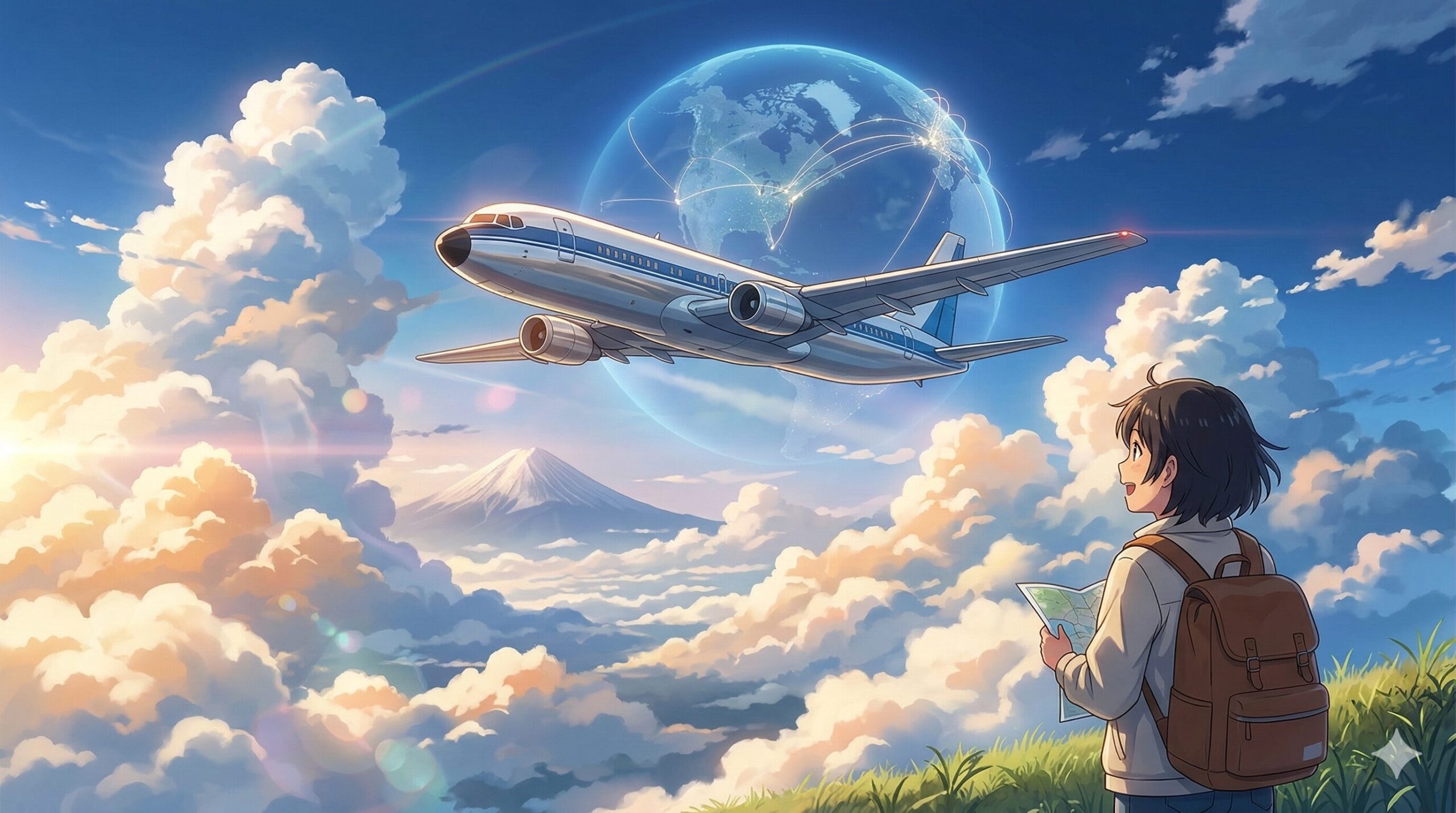
March 6th is remembered in Japan as “Round-the-World Trip Day” (Sekai Isshu Kinenbi). Today, we can access information from the other side of the globe instantly with a smartphone, and hop on budget airlines to travel abroad with ease. However, there was a time when traveling around the world was a lifelong dream for individuals and a massive project carrying national prestige.
In this article, we will delve into the historical background of this anniversary and unravel how Japan, an island nation, connected with the world and nurtured its unique travel culture.

March 6, 1967: The Day Japanese Wings Connected the Globe
The origin of “Round-the-World Trip Day” dates back to March 6, 1967 (Showa 42). On this day, Japan Airlines (JAL) officially launched its round-the-world route. Departing from Tokyo, the epic journey connected Hong Kong, Bangkok, New Delhi, Tehran, Cairo, Rome, Frankfurt, Paris, London, New York, San Francisco, Honolulu, and finally returned to Tokyo—literally circling the Earth.
At that time, a Japanese airline circling the globe on its own wings meant far more than just expanding a transportation network. For Japan, which had successfully hosted the 1964 Tokyo Olympics and was in the midst of rapid economic growth, the inauguration of this westbound round-the-world route was a symbolic event. It strongly signaled to the world the “completion of post-war reconstruction” and Japan’s “full return to the forefront of the international community.”
The Douglas DC-8, the flagship aircraft of the era, soared through the skies, carrying businessmen and cultural figures across the world. From this day forward, the perspective of the Japanese people expanded dramatically—both physically and mentally—toward the global stage.
The Concept of “Travel” in Island-Nation Japan and the Longing for the World
To fully appreciate this anniversary, we must understand Japan’s historical background and its cultural values regarding “travel.” Japan is an island nation surrounded by the sea. Furthermore, during the Edo period, the country maintained a policy of national isolation (“Sakoku”) for over 200 years. Interaction with foreign countries was strictly limited to a few specific areas like Nagasaki. For the common people, the lands beyond the sea were a completely different, almost mythical world.
Does this mean the Japanese had no culture of travel? Not at all. In fact, domestic travel developed in uniquely fascinating ways. Pilgrimages for religious purposes, such as the “Oise-mairi” (visiting the Ise Grand Shrine) and the “Shikoku 88 Temple Pilgrimage,” became incredibly popular among the masses. Additionally, as epitomized by Matsuo Basho’s “The Narrow Road to the Deep North” (Oku no Hosomichi), Japanese culture deeply embeds a spirituality that equates travel with life and art itself. In Japan, travel was never just about moving from point A to point B; it was a space for “dialogue with oneself” and “spiritual growth through the extraordinary.”
When Japan opened its doors in the Meiji era, modern Western culture flooded in. As a reaction to the long-closed doors, the Japanese people’s “quest for the unknown world” exploded. A “round-the-world trip” was the ultimate extraordinary experience—something unimaginable during the isolation period—and became a symbol of modern Japan’s intense drive to catch up with and surpass the West.
The Era When “Ichigo Ichie” Became Global
In the Japanese tea ceremony, there is a proverb: “Ichigo Ichie” (一期一会). It translates roughly to “one time, one meeting.” It means that the exact moment you are sharing with someone will never come again; therefore, you should cherish this once-in-a-lifetime encounter and offer the utmost hospitality.
The launch of the round-the-world route in 1967 expanded this spirit of “Ichigo Ichie” to a global scale. Interacting with people of entirely different cultures, languages, and values in foreign lands became a way to realize the “encounter with a new self”—something Japanese travelers once sought on domestic roads—on a planetary scale.
Today, we can connect with the world anytime via the internet. Yet, the profound emotion of “Ichigo Ichie”—breathing the air of a foreign land, looking directly into the eyes of the locals, and exchanging words—can never be replaced by digital interactions. Round-the-World Trip Day reminds us of the invaluable nature of real-world experiences.
If You Held a Ticket to the World Right Now…?
Looking back at history, we can see the immense passion and effort our predecessors poured into building bridges with the world. Since that day on March 6, 1967, when a Japanese airplane first circled the globe, the world has undoubtedly become smaller, while our possibilities have expanded infinitely.
Finally, I want to ask you: If you were handed a “Round-the-World Ticket” right now, free to choose any starting point and destination, where would you go? What would be the first country you visit, who do you want to meet, and what do you want to experience?
Take a moment to imagine your dream route and reflect on what you felt reading this article. That imagination itself is the beginning of your new journey.
Reference Links
- Internal Link: Read more from “What’s Today’s Special Day” Series
3月6日は「世界一周記念日」:空の旅が変えた日本の歴史と文化の軌跡
3月6日。この日は日本において「世界一周記念日」として記憶されています。現代では、スマートフォンひとつで地球の裏側の情報が瞬時に手に入り、格安航空券を使って気軽に海外へ飛び立つことができます。しかし、かつて「世界一周」は、人々の生涯をかけた夢であり、国家の威信をかけた大プロジェクトでした。
今回は、この「世界一周記念日」の歴史的背景を深掘りし、島国である日本がいかにして世界と繋がり、独自の旅の文化を育んできたのかを紐解いていきます。
1967年3月6日:日本の翼が地球を繋いだ日
「世界一周記念日」の由来は、1967年(昭和42年)3月6日に遡ります。この日、日本航空(JAL)が世界一周路線の営業を開始しました。東京を出発し、香港、バンコク、ニューデリー、テヘラン、カイロ、ローマ、フランクフルト、パリ、ロンドン、ニューヨーク、サンフランシスコ、ホノルルを経て、再び東京へと戻るという、まさに地球をぐるりと回る壮大なルートです。
当時、日本の航空会社が自国の翼で世界を一周することは、単なる交通網の拡大以上の意味を持っていました。1964年の東京オリンピックを成功させ、高度経済成長期の真っ只中にあった日本にとって、この西回り世界一周路線の開設は「戦後復興の完了」と「国際社会の第一線への完全な復帰」を世界に強くアピールする象徴的な出来事だったのです。
当時主力であったダグラスDC-8型機が空を駆け抜け、多くのビジネスマンや文化人がこの路線を利用して世界中を飛び回りました。この日を境に、日本人の視野は物理的にも精神的にも、劇的に世界へと広がっていきました。
島国・日本における「旅」の概念と世界への憧憬
この記念日をより深く理解するためには、日本の歴史的背景と「旅」に対する文化的な価値観を読み解く必要があります。日本は四方を海に囲まれた島国であり、さらに江戸時代には約200年以上もの間「鎖国」政策を敷いていました。海外との交流は長崎などのごく一部に制限され、庶民にとって海の外は完全な「異世界」でした。
では、日本人に旅の文化がなかったのかと言えば、そうではありません。むしろ、国内における旅は独自の発展を遂げていました。「お伊勢参り(伊勢神宮への参拝)」や「四国八十八ヶ所のお遍路」など、信仰を目的とした旅は庶民の間で大流行しました。また、松尾芭蕉の『奥の細道』に代表されるように、旅そのものを人生や芸術と重ね合わせる精神性が日本文化には深く根付いています。日本における旅は、単なる移動ではなく「自己との対話」であり「非日常を通じた精神的成長」の場でした。
開国後、明治時代に入ると、岩倉使節団などを通じて欧米の近代文化が怒涛のように流れ込んできました。閉ざされていた扉が開かれた反動で、日本人の「未知なる世界への探求心」は爆発的に高まりました。「世界一周」は、鎖国時代には想像すらできなかった究極の非日常であり、西洋に追いつき追い越そうとする近代日本の熱量の象徴となったのです。
「一期一会」が地球規模になる時代へ
日本の茶道には「一期一会(いちごいちえ)」という言葉があります。「あなたとこうして出会っているこの時間は、二度と巡っては来ないたった一度きりのものです。だから、この一瞬を大切に思い、今出来る最高のおもてなしをしましょう」という意味です。
1967年の世界一周路線の就航は、この「一期一会」の精神を地球規模に押し広げました。異国の地で出会う全く異なる文化、言語、価値観を持つ人々との交流。それは、かつての日本人が国内の旅で見出していた「新しい自分との出会い」を、グローバルなスケールで実現する手段となりました。
現代の私たちは、インターネットを通じていつでも世界と繋がることができます。しかし、物理的にその土地の空気を吸い、そこで暮らす人々と直接目を合わせて言葉を交わすことでしか得られない「一期一会」の感動は、決してデジタルでは代替できません。世界一周記念日は、私たちが忘れてはならない「リアルな体験の尊さ」を教えてくれます。
もし、あなたが今、世界への切符を手にしたら?
歴史を振り返ると、先人たちがどれほどの情熱と努力をもって世界との架け橋を築いてきたかがわかります。1967年3月6日、日本の飛行機が初めて地球を一周したその日から、世界は確実に狭くなり、同時に私たちの可能性は無限に広がりました。
最後に、あなたに問いかけます。もし今、出発地も目的地も自由に選べる「世界一周の切符」を一枚手渡されたら、あなたはどこへ向かいますか? 最初に訪れる国はどこで、そこで誰と出会い、何を体験したいですか?
この記事を読んで感じたことや、あなたの夢のルートを、ぜひゆっくりと思い描いてみてください。その想像こそが、あなたにとっての新しい「旅」の始まりです。
参考リンク
- 内部リンク:今日は何の日シリーズをもっと読む

コメント