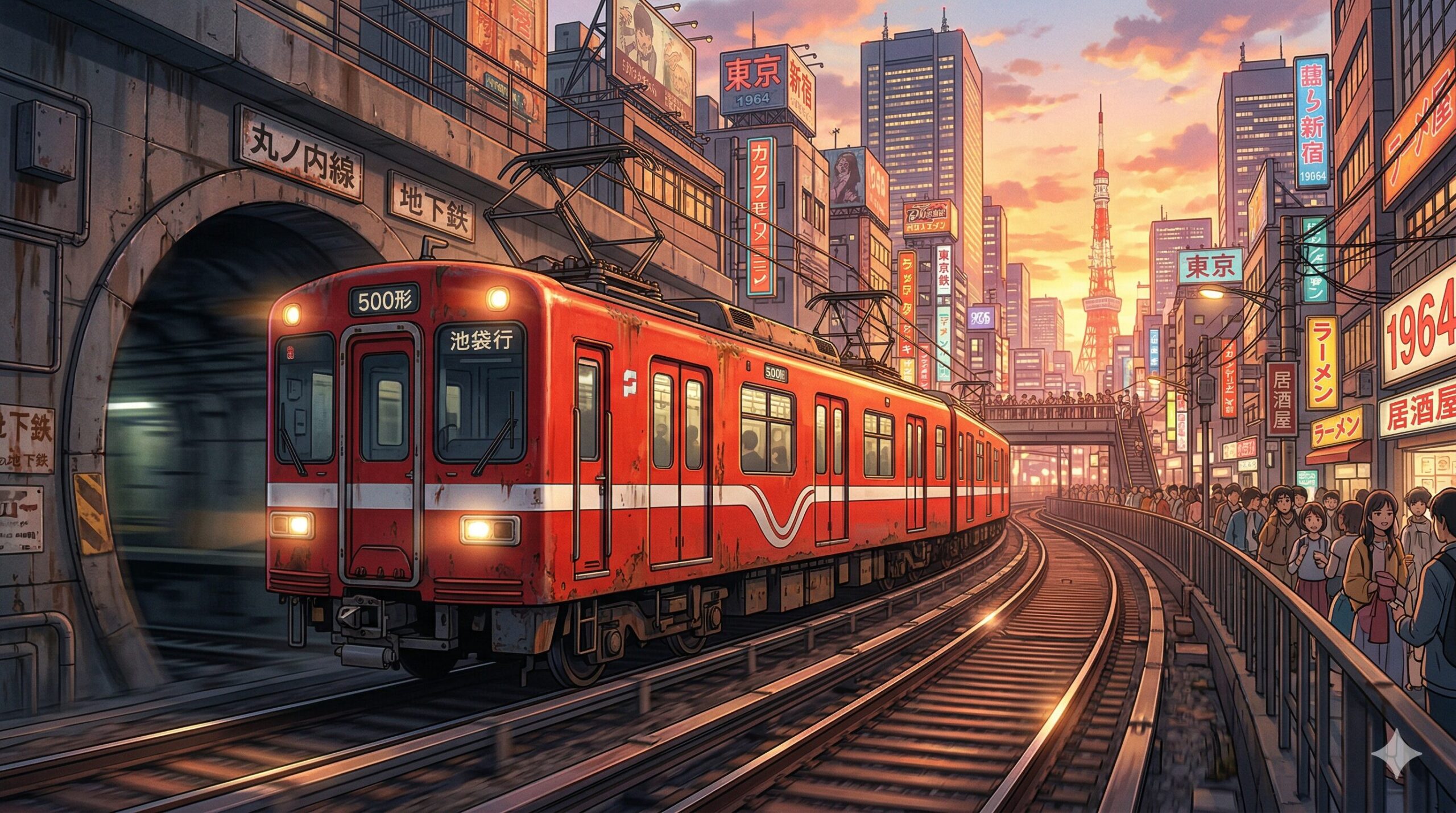
March 23, 1962. This day marks a historic milestone that brought the framework of modern-day megacity Tokyo much closer to completion. The Eidan Subway (now Tokyo Metro) Marunouchi Line fully opened its entire route from Ogikubo Station to Ikebukuro Station. In a Japan that had risen from the ashes of post-war devastation and was brimming with the energy of rapid economic growth, this subway—featuring bright red cars adorned with a silver sine wave—was more than just a means of transportation. It was the very embodiment of “hope for the future.”
The History of the Marunouchi Line and Its Groundbreaking Design
The history of Japan’s subway system began with the Ginza Line (Ueno to Asakusa), which opened in 1927. However, the Marunouchi Line, planned as the second subway line, drew an incredibly bold and complex U-shaped route through the center of Tokyo. Starting in Ikebukuro, connecting the major hubs of Tokyo, Ginza, Kasumigaseki, and Shinjuku, and finally ending in Ogikubo, this line was designed as the main artery to support Tokyo’s explosively growing population and notorious commuter rush hours.
When discussing the Marunouchi Line, its innovative vehicle design cannot be overlooked. At the time, Japanese railway cars were predominantly painted in sober colors like brown or dark green. However, the Marunouchi Line’s “300 Series” cars were painted in an eye-catching scarlet red, featuring a white band and a stainless-steel sine wave (wave pattern). It is said that this vibrant red was inspired by the color of a Benson & Hedges cigarette tin that the president of Eidan Subway purchased during an inspection tour in London. The dynamism of a Japan that had completed its post-war reconstruction and was ready to soar onto the world stage was perfectly encapsulated in these beautiful trains.
Understanding Japan’s Commuting Culture and Underground Evolution Through the Marunouchi Line
The full opening of the Marunouchi Line decisively shaped Japan’s unique urban culture of “Tsukin” (commuting). Japan’s railway system, operating strictly on time without a minute or second of delay, is unparalleled in the world. As the Marunouchi Line began transporting massive numbers of “salarymen” to the central business districts minute by minute, the modern Japanese lifestyle of living in the suburbs and working in the city center was firmly established.
Furthermore, the development of the Marunouchi Line is deeply connected to the evolution of Japan’s “Underground City.” Beneath stations like Tokyo, Shinjuku, and Ginza lie vast, intricate networks of underground malls, “depachika” (basement food halls in department stores), and restaurants. To maximize limited land area and overcrowded urban spaces, Japanese people expanded their living spheres underground. The Marunouchi Line plays a crucial role in connecting these massive subterranean labyrinths.
When you ride a Japanese subway, you might also be surprised by the “silence.” Even in a packed train, people lower their voices, read on their smartphones, or simply close their eyes and remain quiet. This is a manifestation of “Wa” (harmony), the Japanese spirit of being considerate to others in limited shared spaces. Inside the red cars of the Marunouchi Line, cutting-edge technology and the traditional public spirit of the Japanese people coexist harmoniously.
Rails Connecting the Past to the Present and Future
Today, the newest “2000 Series” trains run on the Marunouchi Line. As a modern homage to the classic 300 Series, these new trains have revived that brilliant red color and the iconic sine wave design. The passion that fueled the full opening of the line in 1962 continues to be firmly passed down to modern Tokyo, albeit in a new form. Riding the Marunouchi Line is not just about moving from point A to point B; it is about tracing the trajectory of Tokyo’s history of recovery and growth.
Have you ever ridden the subway in Tokyo? Or, what unique characteristics reflect your country’s culture and history in its public transportation? Please think about how you felt or would feel about the punctuality of Japanese subways and the atmosphere of the stations. And the next time you visit Japan, make sure to ride this red artery and explore the profound depths of Tokyo.
Reference Links
- Japan National Tourism Organization (JNTO) Official Website
- Read more in the “What’s Today’s Special Day Series”
1962年3月23日:東京の地下を駆け抜ける赤い動脈、丸ノ内線全線開通の歴史と文化
1962年(昭和37年)3月23日。この日は、現代の巨大都市・東京の骨格が完成へと大きく近づいた歴史的な一日です。営団地下鉄(現在の東京メトロ)丸ノ内線が、荻窪駅から池袋駅までの全線を開通させました。戦後の焼け野原から立ち直り、高度経済成長期の熱気にあふれていた日本において、この真っ赤な車体に銀色のサインカーブ(波模様)を描いた地下鉄は、単なる交通機関を超えた「未来への希望」そのものでした。
丸ノ内線誕生の歴史と、その画期的なデザイン
日本の地下鉄の歴史は、1927年に開業した銀座線(上野〜浅草間)から始まります。しかし、それに次ぐ2番目の路線として計画された丸ノ内線は、東京の中心部を「U字型」に結ぶという極めて大胆で複雑なルートを描いていました。池袋から始まり、東京、銀座、霞ヶ関、新宿という東京の主要な心臓部をすべて繋ぎ、最終的に荻窪へと至るこの路線は、爆発的に増加する東京の人口と通勤ラッシュを支える大動脈として設計されました。
丸ノ内線を語る上で絶対に外せないのが、その斬新な車両デザインです。当時の日本の鉄道車両といえば、茶色や深い緑色など、地味な色合いが主流でした。しかし、丸ノ内線の「300形」車両は、目にも鮮やかなスカーレット・レッドで塗られ、白の帯にステンレスのサインカーブ(波模様)があしらわれました。この赤い色は、当時の営団地下鉄の総裁がロンドン視察の際に購入したタバコ(ベンソン&ヘッジス)の缶の色からインスピレーションを得たと言われています。戦後の復興を終え、世界に向けて羽ばたこうとしていた日本のダイナミズムが、この美しい車両に込められていたのです。
丸ノ内線から読み解く、日本の「通勤文化」と「地下空間」の発展
丸ノ内線の全線開通は、日本の特異な都市文化である「通勤(Tsukin)」のスタイルを決定づけました。定刻通りに1分1秒の狂いもなく運行される日本の鉄道システムは、世界でも類を見ません。丸ノ内線が分刻みで大量の「サラリーマン」を都心のオフィス街へ運び始めたことで、郊外に住み、都心で働くという現代日本のライフスタイルが確立されました。
さらに、丸ノ内線の発展は、日本の「地下都市(Underground City)」の進化と深く結びついています。東京駅や新宿駅、銀座駅などの地下には、広大な地下街が広がり、デパ地下(百貨店の地下食料品売り場)やレストラン、ショッピングモールが複雑に絡み合っています。限られた国土と過密する都市空間を最大限に活用するため、日本人は地下へと生活圏を広げました。丸ノ内線は、それらの巨大な地下迷宮を繋ぐ重要な役割を果たしています。
また、日本の地下鉄に乗ると、その「静けさ」に驚くかもしれません。満員電車であっても、人々は声を潜め、スマートフォンで読書をし、あるいは目を閉じて静かに過ごしています。これは、限られた空間の中で他者に配慮する日本の「和(Wa)」の精神の表れです。丸ノ内線の赤い電車の中には、最新のテクノロジーと、古来から続く日本人の公共精神が同居しているのです。
過去から現代、そして未来へ繋がるレール
現在、丸ノ内線には最新型の「2000系」車両が走っています。この車両は、かつての300形へのオマージュとして、あの鮮やかな赤色とサインカーブのデザインを現代風に復活させました。1962年に全線開通した当時の情熱は、形を変えながらもしっかりと現代の東京に受け継がれています。丸ノ内線に乗ることは、単に地点から地点へ移動することではなく、東京という都市が歩んできた復興と成長の歴史の軌跡をたどることなのです。
あなたは、東京の地下鉄に乗ったことがありますか?または、あなたの国の公共交通機関には、その国の文化や歴史を反映したどのような特徴がありますか?日本の地下鉄の正確さや駅の雰囲気について、あなたがどう感じたか、ぜひ考えてみてください。そして、次に日本を訪れた際は、ぜひこの赤い大動脈に乗って、東京の深部を探索してみてください。


コメント