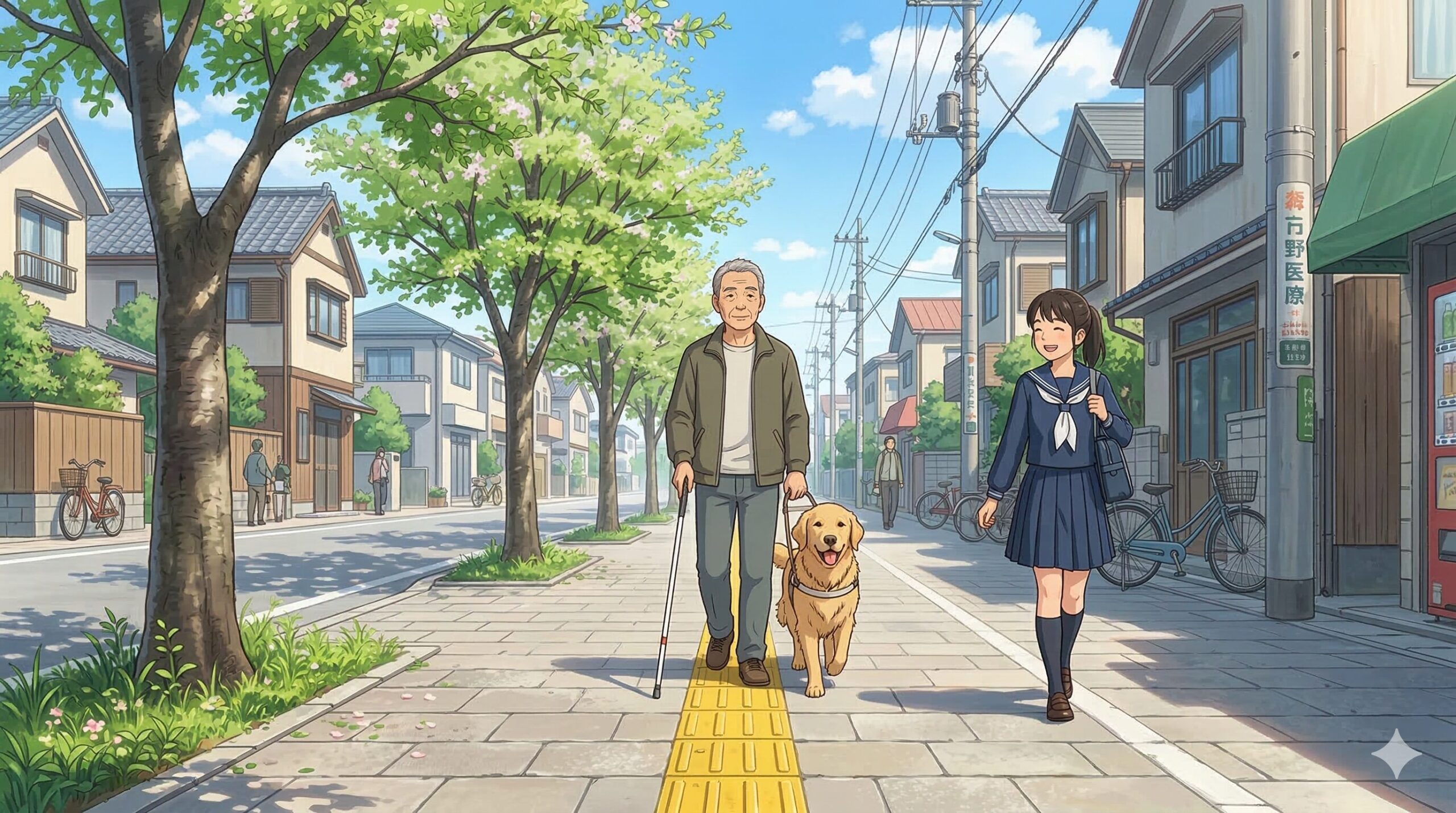
If you walk through any city, you will inevitably see yellow blocks with raised patterns on train station platforms, pedestrian crossings, and the entrances of public facilities. These are called “Tactile Paving” (or Tenji Blocks in Japanese), and they serve as vital guideposts for the visually impaired to navigate the streets safely. Did you know that this brilliant innovation was actually invented in Japan and subsequently spread across the globe? March 18th is celebrated as “Tactile Paving Day,” commemorating the very first time these blocks were installed in the world.
An Invention Born from the Desire to Save a Friend
The inventor of tactile paving was Seiichi Miyake, who ran a ryokan (traditional Japanese inn) in Okayama Prefecture. In the 1960s, a tragic event occurred: his close friend gradually began to lose his vision. At that time, Japan was in the midst of a rapid economic boom. The number of cars on the road was increasing explosively, making walking the streets a life-threatening act for the visually impaired. Witnessing visually impaired individuals navigating dangerous roads with white canes alongside heavy traffic, Miyake agonized over how to provide them with a safe way to walk.
He focused his attention on the “sensation of the soles of the feet.” He realized that people can feel the unevenness of the ground even through their shoes. This led to the idea of paving streets with blocks featuring raised protrusions to indicate safe routes. Pouring his personal wealth into the project and enduring repeated failures and trial-and-error, Miyake finally completed the prototype of the tactile paving we know today. There are two types of blocks: “directional blocks” with parallel ridges indicating the direction of travel, and “warning blocks” with dots indicating hazards, intersections, or stops. This simple yet perfect system is still used exactly as it is all over the world today.
On March 18, 1967, 230 tactile blocks were installed at an intersection on National Route 250 near the Okayama School for the Blind. This historic first step is the origin of today’s “Tactile Paving Day.”
Interpreting Japanese “Omoiyari” and “Omotenashi” Through Tactile Paving
The widespread adoption of tactile paving is more than just the development of transport infrastructure; it symbolizes the spirit of “Omoiyari” (compassion/consideration) and “Omotenashi” (hospitality) that flows at the very foundation of Japanese culture. Since ancient times, the Japanese have considered it a virtue to put themselves in others’ shoes and show meticulous care, often in ways that are unseen.
Seiichi Miyake’s actions are the ultimate expression of this spirit. It was not a government or a massive corporation that took the initiative, but a single citizen who stood up “for a friend” and “for someone in need,” risking his own life and fortune to change society. Furthermore, the fact that tactile paving is now intricately laid out across almost all public transport and sidewalks in Japan reflects the Japanese spirit of “Wa” (harmony), which seeks to include the vulnerable in society, and demonstrates a remarkably high level of public awareness.
Moreover, tactile paving in Japan continues to evolve. Research is constantly being done on colors that do not ruin the landscape but remain highly visible. Slip-resistant materials for rainy days have been developed, and there are even the latest “smart tactile blocks” that link with smartphones to provide audio guidance. This embodies the very spirit of Japanese “Monozukuri” (craftsmanship)—never being satisfied with the status quo and always striving for higher quality and usability.
To You, the Reader
The yellow blocks we casually step on every day hold the deep love of a single Japanese man and a strong sense of mission to protect the lives of the visually impaired. The next time you go out into the city, take a moment to look at the tactile paving beneath your feet. And if you ever see a bicycle parked or luggage left on top of them, you will realize that such an act is severing someone’s lifeline.
How are measures for safe and accessible walking for all people implemented in your country or city? Also, what small act of “Omoiyari” (compassion) can you start doing today? Please share your thoughts and let us know what you would do.
Related Links
- Internal Link: Read more from the “What’s Today’s Special Day” Series
- External Link (Reference): Japan Braille Library
- External Link (Reference): Okayama Tourism WEB (The birthplace of Tactile Paving)
3月18日は「点字ブロックの日」:世界を変えた日本の優しさ
街を歩けば、駅のホームや横断歩道、公共施設の入り口など、至る所で目にすることができる黄色い凹凸のあるブロック。これは「点字ブロック(視覚障害者誘導用ブロック)」と呼ばれ、視覚に障害を持つ人々が安全に街を歩くための重要な道しるべです。実はこの点字ブロック、日本で発明され、世界中へと広まった素晴らしいイノベーションであることをご存知でしょうか。3月18日は、この点字ブロックが世界で初めて敷設されたことを記念する「点字ブロックの日」です。
友人を救いたいという一心から生まれた発明
点字ブロックの発明者は、岡山県で旅館業などを営んでいた三宅精一(みやけ せいいち)氏です。1960年代、彼の友人が徐々に視力を失っていくという悲しい出来事がありました。当時の日本は高度経済成長期の真っ只中。自動車の数が急激に増加し、視覚障害者にとって街を歩くことは命がけの行為となっていました。三宅氏は、白い杖をつきながら車の行き交う道路を危険と隣り合わせで歩く視覚障害者の姿を目の当たりにし、「彼らが安全に歩ける方法はないか」と強く思い悩みます。
そこで彼が着目したのが「足の裏の感覚」でした。靴を通してでも地面の凹凸を感じ取ることができる点を利用し、突起を付けたブロックを道に敷き詰めることで、安全なルートを知らせるというアイデアを思いついたのです。三宅氏は私財を投げ打ち、度重なる失敗と試行錯誤の末、ついに現在の点字ブロックの原型を完成させました。ブロックには2種類あり、進行方向を示す線状の「誘導ブロック」と、危険な場所や曲がり角を示す点状の「警告ブロック」があります。このシンプルかつ完璧なシステムは、現在も世界中でそのまま採用されています。
そして1967年3月18日、岡山県立岡山盲学校に近い国道250号線の交差点に、世界で初めて230枚の点字ブロックが敷設されました。この歴史的な一歩が、現在の「点字ブロックの日」の由来となっています。
点字ブロックから読み解く日本の「思いやり」と「おもてなし」の文化
点字ブロックの普及は、単なる交通インフラの整備にとどまらず、日本文化の根底に流れる「思いやり」と「おもてなし」の精神を象徴しています。日本人は古来より、他者の立場に立って物事を考え、見えないところで配慮をする「細やかな気配り」を美徳としてきました。
三宅精一氏の行動もまた、この精神の極致と言えます。国や大きな企業が主導したのではなく、一人の市民が「友人のために」「困っている誰かのために」と立ち上がり、自らの人生と財産を懸けて社会を変えたのです。また、現在日本のほぼすべての公共交通機関や歩道に点字ブロックが緻密に張り巡らされている事実は、社会全体で弱者を包摂しようとする日本特有の「和」の精神と、高い公共意識の表れでもあります。
さらに、日本の点字ブロックは常に進化を続けています。景観に配慮しつつも視認性を損なわない色の研究、雨の日でも滑りにくい素材の開発、さらにはスマートフォンと連動して音声案内を行う最新のスマート点字ブロックまで登場しています。これは、常に現状に満足せず、より高い品質と使いやすさを追求する日本の「モノづくり」の精神そのものです。
この記事を読んだあなたへ
私たちが普段何気なく踏んでいる黄色いブロックには、一人の日本人の深い愛情と、視覚障害者の命を守るという強い使命感が込められています。今度街に出たとき、足元の点字ブロックを少しだけ意識して見てください。そして、もし点字ブロックの上に自転車が停められていたり、荷物が置かれたりしていたら、それが誰かの命綱を断ち切る行為であることに気づくはずです。
あなたの住む国や街では、すべての人にとって安全で歩きやすい工夫がどのようにされていますか? また、あなた自身が今日からできる、ちょっとした「思いやり」の行動は何でしょうか? ぜひ、あなたの考えを聞かせてください。
関連リンク
- 内部リンク:今日は何の日シリーズをもっと読む
- 外部リンク(参考):社会福祉法人 日本点字図書館
- 外部リンク(参考):岡山観光WEB(点字ブロック発祥の地・岡山)


コメント