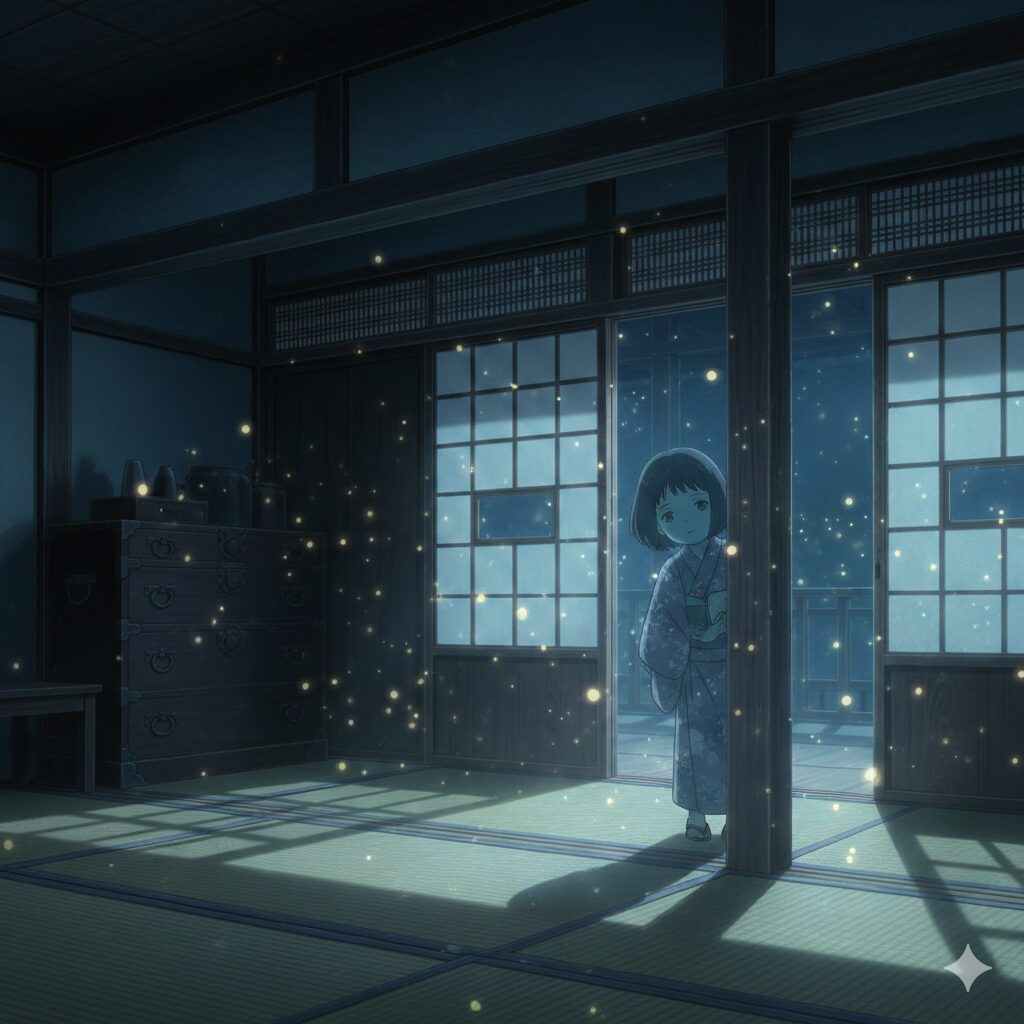
In Japanese folklore, there is an entity that is both the most famous and the most mysterious. This is the “Zashiki Warashi” (Guestroom Child). They are not merely “Yokai” (monsters/spirits). They are guardians of destiny, bearing the burden of a household’s prosperity and its ultimate downfall.
Today, we will unravel the story of this spirit, passed down from ancient times in the Tohoku region, centering on Iwate Prefecture. We will thoroughly explain the deep psychological and cultural background of why Japanese people both fear and cherish them.

1. The Story: The Invisible Roommate
This is a tale from an old, traditional house deep in the mountains of Iwate Prefecture, in northern Japan.
The house was known as the wealthiest farming household in the village. They owned vast fields, their storehouses were piled high with rice bales to the ceiling, and servants worked busily every day. However, there was a “secret” to this family’s prosperity.
Late at night, when the house fell silent, the sound of light footsteps—pata pata—like a child running around, could be heard from the inner parlor where no one was supposed to be. At other times, guests sleeping in the house would wake to see a child with a bobbed haircut wearing a kimono, standing by their pillow, staring intently at their face.
“There is a Zashiki Warashi in this house.”
The villagers whispered this to one another. The Zashiki Warashi appeared as a child of about five or six years old with a flushed red face. Sometimes, it would play pranks on the residents, such as pulling off their blankets while they slept or flipping their pillows. Yet, no one ever tried to chase the child away.
This was because a house inhabited by a Zashiki Warashi is guaranteed to prosper. They were “Wealth” incarnate.
However, it is the way of the world that eternal prosperity does not exist.
One sunny afternoon, as the master of the house was napping on the veranda, he saw a single child walking briskly out of the main gate. The bobbed hair, the fine kimono… but from the child’s back drifted an indescribable sense of melancholy.
“Hey, where are you going?”
The moment the master tried to call out, the child’s figure vanished like shimmering heat haze.
Immediately after that, the family’s fate took a dark turn. Mysterious illnesses struck the family, crops failed continuously, and business ventures collapsed. The servants left, and the house that had once enjoyed extreme glory fell into ruin without a trace within just a few years.
“A house from which the Zashiki Warashi departs will perish.”
This legend was proven as a cruel reality.
2. Analysis: What is the Zashiki Warashi?
This story is not merely a horror tale. The existence of the Zashiki Warashi embodies the Japanese faith in the “Ie” (Household) and a sense of awe toward “Children.”
The Boundary Between God and Yokai
The Zashiki Warashi sits somewhere between a God and a Yokai. They possess the aspect of a “God of Fortune” who brings wealth, but also the aspect of a “Cursing God” who destroys a house by whimsically leaving. This symbolizes how uncontrollable and fleeting destiny and luck truly are.
The Sanctuary of Childhood
Why do they take the form of a child (Warashi)? In ancient Japanese thought, children up to the age of seven were considered “among the gods,” sacred beings who could travel between this world and the spirit world. Pure and innocent, yet governed by logic beyond human understanding—that is the true nature of the Zashiki Warashi.
3. Depth of Japanese Culture: The Paradox of Fragility and Prosperity
The core of Japanese culture that can be deciphered from the Zashiki Warashi legend is the spirit of “Jo-sha Hissui” (Those who flourish are destined to decline).
While Western philosophies of success often emphasize “acquisition and maintenance,” this Japanese folklore teaches “fear of loss” and “gratitude.” Even today, at traditional inns in the Tono region of Iwate Prefecture and Ninohe City (such as Ryokufuso), tourists from all over the world visit in hopes of meeting a Zashiki Warashi. They are not just seeking wealth. They are seeking the sensation of being watched over by a greater, invisible force.
The Zashiki Warashi asks us this question:
“Is your current happiness solely due to your own ability? Or is it the grace of something invisible?”
4. Question to the Reader
If a Zashiki Warashi appeared in your home, what would you do?
You would gain immense wealth and fortune, but you would also shoulder the risk of losing everything if he were to leave. Would you still accept this “invisible roommate”? Or would you choose to carve out your life with your own strength alone?
I would love to hear your thoughts.
Related Information & Links
- Japanese Folktale Series Category: Japanese Folktale Series Category
【日本の伝説】幸運と破滅を運ぶ無邪気な精霊「座敷童(Zashiki Warashi)」の真実
日本の民間伝承において、最も有名でありながら、最も謎に満ちた存在。それが「座敷童(ざしきわらし)」です。彼らは単なる妖怪(Yokai)ではありません。家の繁栄と没落を一身に背負う、運命の守護者なのです。
今回は、岩手県を中心とする東北地方に古くから伝わるこの精霊の物語を紐解き、なぜ日本人が彼らを恐れながらも愛してやまないのか、その深層心理と文化背景を徹底的に解説します。
1. 物語:見えない同居人
これは、日本の北国、岩手県の山深い村に伝わる、ある古い旧家のお話です。
その家は、村一番の豪農として知られていました。広大な田畑を持ち、蔵には米俵が天井まで積み上げられ、使用人たちは毎日忙しく働いていました。しかし、この家の繁栄には、ある「秘密」があったのです。
夜が更け、家の中が静まり返ると、誰もいないはずの奥座敷から、パタパタと子供が走り回るような足音が聞こえてくることがありました。またある時は、寝ている客人の枕元に、おかっぱ頭の着物を着た子供が立って、じっと顔を覗き込んでいる姿が目撃されました。
「この家には、座敷童がいる」
村人たちは口々にそう噂しました。座敷童は、紅い顔をした5、6歳くらいの子供の姿をしており、時には家人に悪戯を仕掛けます。寝ている人の布団を剥いだり、枕をひっくり返したり。けれど、誰もその子供を追い出そうとはしませんでした。
なぜなら、座敷童がいる家は必ず栄えるからです。彼らは「富」そのものでした。
しかし、永遠の繁栄など存在しないのが世の常です。
ある晴れた日の昼下がり、家の主人が縁側で昼寝をしていると、一人の子供が家の門からスタスタと出ていくのが見えました。おかっぱ頭に、立派な着物。しかし、その背中からは言いようのない寂しさが漂っています。
「おい、どこへ行くんだ?」
主人が声をかけようとした瞬間、子供の姿は陽炎のように消えてしまいました。
その直後から、家の運命は暗転します。原因不明の病が家族を襲い、不作が続き、事業は失敗。使用人たちは去り、あれほど栄華を極めた家は、わずか数年のうちに跡形もなく没落してしまいました。
座敷童が出て行った家は滅びる――。その言い伝えは、残酷な現実となって証明されたのです。
2. 考察:座敷童とは何者なのか?
この物語は単なるホラーではありません。座敷童という存在には、日本人の「家(Ie)」に対する信仰と、「子供」に対する畏敬の念が込められています。
神と妖怪の境界線
座敷童は、神様(God)と妖怪(Monster)の中間に位置する存在です。彼らは富をもたらす「福の神」としての側面を持ちながら、気まぐれに去ることで家を破滅させる「祟り神」の側面も持ち合わせています。これは、運命や幸運がいかにコントロール不可能で、儚いものであるかを象徴しています。
子供という聖域
なぜ「童(子供)」の姿をしているのでしょうか? 日本の古来の考え方では、7歳までの子供は「神のうち」と呼ばれ、現世と霊界を行き来する神聖な存在とされていました。純粋無垢でありながら、人間の理屈が通用しない存在。それが座敷童の正体です。
3. 日本文化の深層:儚さと繁栄のパラドックス
座敷童の伝説から読み解ける日本文化の核心は、「盛者必衰(Those who flourish are destined to decline)」の精神です。
西洋の成功哲学が「獲得と維持」に重きを置くのに対し、日本のこの伝承は「喪失への恐れ」と「感謝」を教えています。現在、岩手県の遠野地方や二戸市にある旅館(例:緑風荘など)では、座敷童に会うために世界中から観光客が訪れます。彼らは富を求めているだけではありません。目に見えない何か大きな力に見守られているという感覚を、求めているのです。
座敷童は、私たちにこう問いかけます。
「今の幸福は、あなただけの実力ですか? それとも、見えない何かの恩恵ですか?」
4. 読者への問いかけ
もし、あなたの家に座敷童が現れたら、どうしますか?
莫大な富と幸運を手に入れる代わりに、彼が去ればすべてを失うリスクを背負うことになります。それでもあなたは、その「見えない同居人」を受け入れますか? それとも、自分の力だけで人生を切り開くことを選びますか?
あなたの考えをぜひ聞かせてください。
関連情報・リンク
- 日本の昔話シリーズ一覧: Japanese Folktale Series Category

コメント