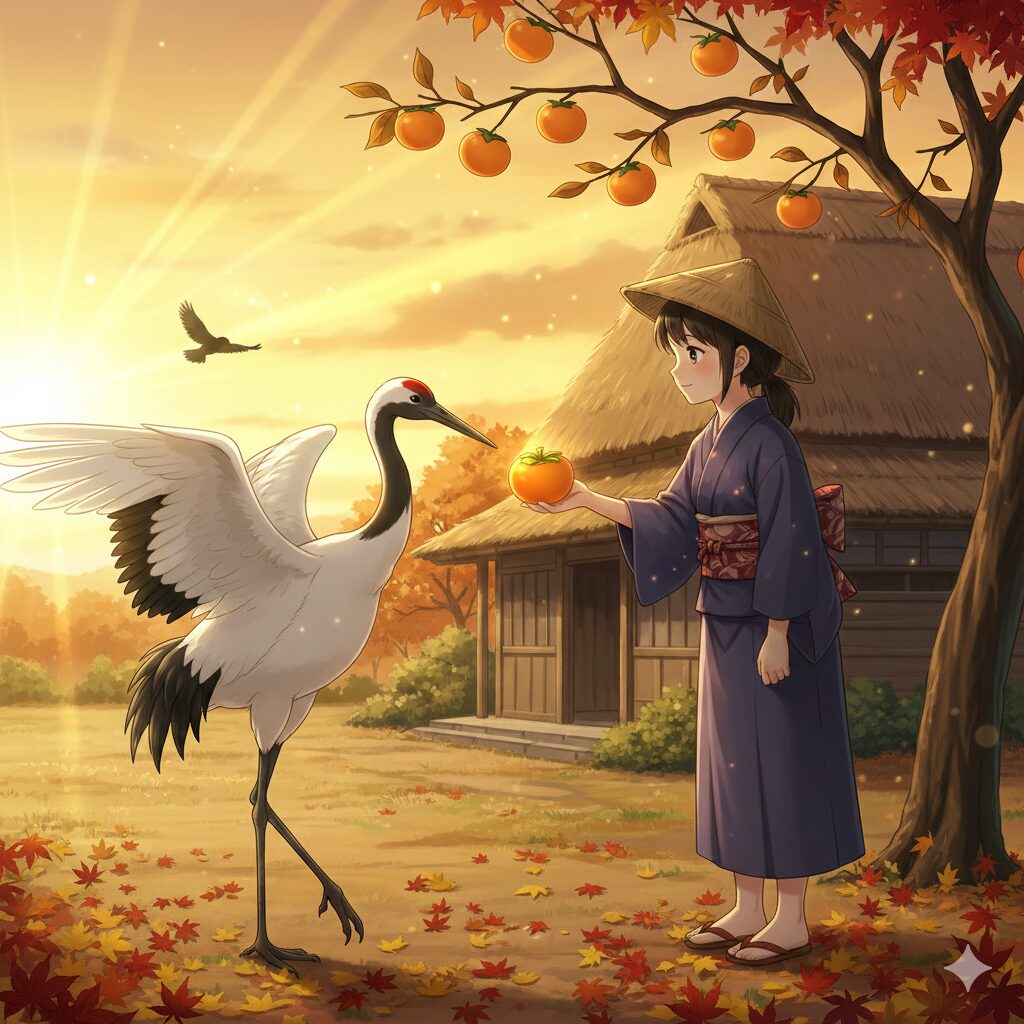
The persimmon, or “Kaki,” is a fruit that symbolizes autumn in Japan. Its sweet, vibrant orange flesh has inspired many stories throughout history. Today, I would like to introduce a heartwarming folktale called “Tsuru Gaki” (The Crane and the Persimmon), passed down in the Yashiro district of Shunan City, Yamaguchi Prefecture. Enjoy this unique story, distinct from the famous “Crane’s Return of Favor,” featuring a surprising twist and a memorable ending.

1. The Story of “Tsuru Gaki”
Arrival and Hardship
Long, long ago, on an autumn day.
A parent crane and its child flew into the village of Yashiro, surrounded by beautiful mountains on the western edge of Honshu. They had traveled a long way from the distant northern lands to survive the harsh winter.
In the village, the persimmon trees were heavy with delicious-looking fruit, ripened red like the sunset. The young crane, hungry from the journey, saw the persimmons and begged, “Mother, I want to eat that red fruit.”
However, cranes have flat feet and cannot perch on the thin branches of persimmon trees. The mother crane was at a loss, able only to look up from beneath the tree.
The Crow’s Cruelty and a Girl’s Kindness
Just then, a crow flew in. The crow deftly perched on a branch and began pecking at a ripe persimmon.
The mother crane summoned her courage and asked,
“Mr. Crow, could you please drop one persimmon for my child who is starving from our journey?”
But the crow was mean. “Hmph, it’s your own fault you can’t reach them,” he sneered, throwing hard, unripe green persimmons and seeds at the crane family. The young crane cried out in sadness.
At that moment, a farm girl working in a nearby field saw what was happening.
“How cruel!”
She shouted to chase the crow away, then brought a long bamboo pole to knock down the reddest, softest persimmon for them.
“Here, eat this. It must have been a hard journey coming from so far away.”
Touched by the girl’s kindness, the cranes were overjoyed, bowing their heads repeatedly as they ate the persimmon. Then, they flew off energetically into the sky.
A Winter Incident and the Crane’s Return
Seasons passed, and a cold winter arrived.
One day, a terrible thing happened at the kind girl’s house. While eating a dried persimmon, she accidentally choked on a large seed.
“It hurts, it hurts!”
Her face turned red with agony, but the seed was stuck deep, and no matter how hard her parents patted her back, it wouldn’t come out. In a village with no doctor, her parents could only pray to the gods.
Suddenly, there was a tapping sound at the door. When they opened it, the mother crane from that autumn day was standing there.
The crane entered the house without hesitation and approached the suffering girl’s bedside. Then, gently but swiftly, it inserted its long, sharp beak into the girl’s mouth.
A Miraculous Gift
In the next instant, the crane clamped the seed with the tip of its beak and pulled it out smoothly.
“Oh, she’s saved!”
The girl’s breathing returned to normal, and the family hugged each other in joy.
The father wept as he thanked the crane.
“Thank you so much. Yashiro’s persimmons are delicious, but the many seeds make them dangerous for children. If only they had no seeds, they would be perfect.”
Hearing this, the crane nodded quietly and flew high into the sky.
Something mysterious happened after that. From the following year on, when the persimmons harvested in this village were dried, the seeds would completely disappear.
The villagers rumored, “That crane must have cast a spell so that children would never choke again.” Since then, the seedless dried persimmons of this village have been called “Tsuru Gaki” (Crane Persimmons) and are cherished by the people.
2. Analysis: Physical Rescue and the Meaning of “Seeds”
This story of “Tsuru Gaki” has very interesting characteristics when compared to Japan’s most famous folktale, “The Crane’s Return of Favor” (Weaving).
- Realistic and Surgical Rescue: In the standard “Crane’s Return of Favor,” the crane weaves beautiful cloth to provide economic wealth. However, in “Tsuru Gaki,” the crane uses its physical characteristic—its “long beak”—to perform a very physical and surgical lifesaving measure by removing the seed. This is a rare pattern where an animal’s trait is utilized as a realistic function.
- Contrast with the Crow: In many folktales, the crow appears as a trickster or villain. Here too, the crow’s “possessiveness and coldness” is contrasted with the human’s “sharing and mercy.” This contrast validates the subsequent rescue by the crane.
- Etiology (Origin Story): This story serves not only as a moral tale but also explains “why dried persimmons in Yashiro have no seeds.” By giving a narrative reason to a real phenomenon (seedless persimmons), it deepens the attachment to the local region.
3. Cultural Insight: Symbiosis and the Cycle of “On”
The core of Japanese culture readable from “Tsuru Gaki” is the “symbiosis” with nature and the cycle of “On” (obligation/gratitude).
Immediacy and Concreteness of “On”
In Japanese culture, “On” is a moral concept of never forgetting kindness received and repaying it in some form. In this story, what the girl gave the crane was a “single persimmon,” but what the crane returned was “the girl’s life” and “permanent agricultural improvement (seedless persimmons).” We can see a structure of expanding happiness where a small kindness returns as a result far exceeding imagination.
A Society Coexisting with Migratory Birds
Yashiro in Shunan City, the setting of the story, is actually known as the only wintering ground for Hooded Cranes in Honshu. This story is evidence of how the local people have cherished cranes and welcomed them like family. The attitude of not dominating nature, but living with and helping nature (the cranes), lies at the root of Japanese rural culture.
4. Question to the Reader
How did you feel reading this story?
Did you feel angry at the mean crow, or surprised by the wise crane’s actions?
If you saw someone (or an animal) in trouble with whom you couldn’t communicate, would you be able to lend a hand like the girl? And would you be able to remember a small kindness received without forgetting it, like the crane?
Does your country have stories where animals repay humans? Please compare your culture’s stories with those of Japan.
5. External Links
- Japanese Folktale Series Category
- Shunan City Official: Folktale of the Hooded Crane “Tsuru Gaki” (Japanese)
日本昔話「鶴柿」:優しさが生んだ奇跡の果実
日本昔話「鶴柿」:優しさが生んだ奇跡の果実
日本の秋を象徴する果物、「柿(Kaki)」。その甘く鮮やかなオレンジ色の果実には、古くから多くの物語が宿っています。今回は、山口県周南市八代(やしろ)地区に伝わる、鶴と人間の心温まる交流を描いた民話「鶴柿(つるがき)」をご紹介します。有名な「鶴の恩返し」とは一味違う、独自の展開と心に残る結末をお楽しみください。
① 昔話「鶴柿」のストーリー
飛来と困難
むかしむかし、ある秋の日のことです。
本州の西の端、美しい山々に囲まれた八代(やしろ)の里に、一組の親子の鶴が飛んできました。彼らは遠い北国から、厳しい冬を越すために長い旅をしてきたのです。
里の柿の木には、夕焼けのように赤く熟した美味しそうな柿がたわわに実っていました。旅の疲れでお腹を空かせた子鶴は、その柿を見て「お母さん、あの赤い実が食べたいよ」とせがみました。
しかし、鶴の足は平らで、細い柿の木の枝に止まることができません。親鶴は困り果て、木の下からただ見上げることしかできませんでした。
カラスの冷酷さと少女の優しさ
そこへ、一羽のカラスが飛んできました。カラスは器用に枝に止まると、熟した柿をつつき始めました。
親鶴は勇気を出して頼みました。
「カラスさん、旅でお腹を空かせた子供のために、その柿を一つ落としてくれませんか?」
しかし、カラスは意地悪でした。「へん、自分で取れないのが悪いんだ」とあざ笑い、熟していない青くて硬い柿や、食べかすの種を鶴の親子めがけて投げつけました。子鶴は悲しそうに鳴き声を上げました。
その時です。近くの畑で仕事をしていた農家の少女が、その様子を見ていました。
「なんてひどいことをするの!」
少女は大きな声を上げてカラスを追い払うと、長い竹竿を持ってきて、一番赤くて柔らかそうな柿を選んで落としてくれました。
「さあ、お食べ。遠くから来て大変だったでしょう」
少女の優しさに触れ、鶴の親子は涙を流さんばかりに喜び、何度も頭を下げて柿を食べました。そして、元気に空へと飛び立っていきました。
冬の出来事と鶴の再訪
季節は巡り、寒い冬がやってきました。
ある日、あの親切な少女の家で大変なことが起こりました。少女が干し柿を食べていたところ、誤って大きな柿の種を喉に詰まらせてしまったのです。
「苦しい、苦しい!」
少女は顔を真っ赤にして苦しみますが、種は深く詰まっており、両親が背中を叩いてもどうしても取れません。医者のいない里で、両親は神棚に祈ることしかできませんでした。
その時、トントンと戸を叩く音がしました。戸を開けると、そこにはあの時の親鶴が立っていました。
鶴は迷わず家の中へ入ると、苦しむ少女の枕元へ歩み寄りました。そして、その長く鋭いクチバシを、少女の口の中へ静かに、しかし素早く差し込みました。
奇跡の贈り物
次の瞬間、鶴はクチバシの先で器用に種を挟み、すっと引き抜きました。
「あぁ、助かった!」
少女の呼吸は元通りになり、家族は抱き合って喜びました。
父親は涙を流して鶴に礼を言いました。
「本当にありがとう。八代の柿は美味しいが、種が多くて子供には危ないのが玉に瑕(たまにきず)じゃ。種さえなければもっと良いのだが」
それを聞いた鶴は、静かに頷くように首を振ると、空高く舞い上がっていきました。
不思議なことはそれから起こりました。翌年から、この里で採れる柿を干し柿にすると、なぜか種がすっかり無くなるようになったのです。
村人たちは「これはあの時の鶴が、二度と子供が喉を詰まらせないように魔法をかけてくれたのだ」と噂しました。それ以来、この里の種なしの干し柿は「鶴柿(つるがき)」と呼ばれ、人々に大切にされるようになったということです。
② 昔話の考察:物理的な救済と「種」の意味
この「鶴柿」という物語は、日本で最も有名な民話の一つ「鶴の恩返し(機織り)」と比較すると非常に興味深い特徴を持っています。
- 現実的・外科的な救済: 一般的な「鶴の恩返し」では、鶴は自分の羽を使って美しい布を織り、経済的な豊かさを提供します。しかし、「鶴柿」では、鶴が「長いクチバシ」という身体的特徴を活かして、喉に詰まった種を取り除くという、極めて物理的かつ外科的な救命措置を行います。これは、動物の特徴をより現実的な機能として捉えた珍しいパターンです。
- カラスとの対比: 多くの昔話において、カラスはトリックスターや悪役として登場します。ここでもカラスの「独占欲・冷淡さ」と、人間の「共有・慈悲」が対比されています。この対比が、後の鶴による救済の正当性を高めています。
- 起源説話(エティオロジー): この物語は、単なる道徳譚にとどまらず、「なぜ八代の干し柿には種がないのか」という地域の特産品の起源を説明する役割を果たしています。現実の現象(種なし柿)に物語的な理由付けを行うことで、地域への愛着を深めています。
③ 日本文化の読み解き:共生と「恩」の循環
「鶴柿」から読み取れる日本文化の核心は、自然界との「共生」と「恩(On)」の循環です。
「恩(On)」の即時性と具体性
日本文化における「恩」は、受けた親切を決して忘れず、必ず何らかの形で報いるという道徳観念です。この物語では、少女が鶴に与えたのは「一つの柿」でしたが、鶴が返したのは「少女の命」と「永続的な品種改良(種なし柿)」でした。小さな親切が、想像を超えた大きな結果として返ってくるという「わらしべ長者」的な幸福の拡大構造が見て取れます。
渡り鳥との共生社会
物語の舞台である山口県周南市八代は、実際にナベヅルの本州唯一の渡来地として知られています。この物語は、地域の人々がいかに鶴を大切にし、家族のように迎え入れてきたかを示す証拠でもあります。自然を支配するのではなく、自然(鶴)と共に生き、助け合う姿勢が、日本の農村文化の根底にあります。
④ 読者への問いかけ
この物語を読んで、あなたはどう感じましたか?
意地悪なカラスを見て腹が立ったでしょうか、それとも賢い鶴の行動に驚いたでしょうか。
もしあなたが、言葉の通じない誰か(あるいは動物)が困っているのを見かけたら、少女のように手を差し伸べることができるでしょうか? そして、誰かから受けた小さな親切を、鶴のように忘れずにいられるでしょうか。
あなたの国の物語にも、動物が人間に恩返しをする話はありますか? ぜひ、あなたの文化と日本の物語を比べてみてください。


コメント