
The Beginning of the Tale: The Tengu and the Village Headman
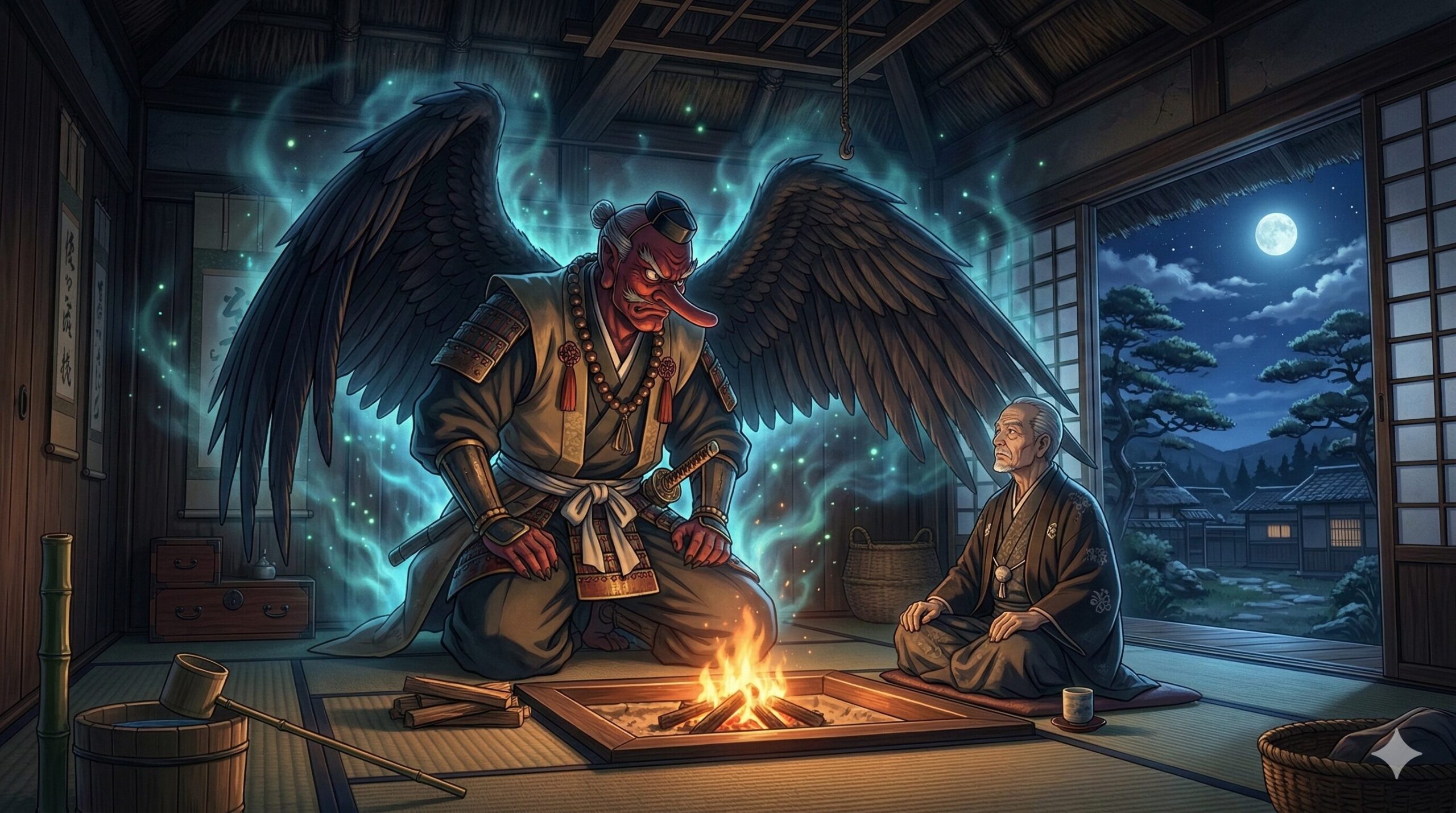
Once upon a time, in a deep mountain village in Japan, lived a quick-witted Village Headman (Shoya) who was greatly adored by the villagers. Behind the village stood a towering mountain covered in a dense, dark forest, where it was long said a “Tengu” resided. Tengu are feared as terrifying creatures with red faces, long noses, and wings on their backs, flying through the sky using divine powers.
One autumn evening, as the Headman was enjoying a solitary drink by the irori (traditional sunken hearth), something landed on the roof with a sudden, massive “thud!” The wind howled, the doors flew open, and there stood a Great Tengu, twice the size of a normal man. Glaring at the Headman with piercing eyes, the Tengu declared in a booming voice, “Listen, leader of humans. Let us test your wisdom against mine. If you lose, I will take all the crops of this village as my own!”
An ordinary human would have fled in terror, but the Headman remained calm. To protect the village’s harvest, he accepted the challenge. “Very well, Lord Tengu. However, if I win, you must promise never to lay a hand on this village again.”
The Tengu’s first challenge was a game of hide-and-seek. “Guess where I am hiding!” he shouted, disappearing in a puff of smoke. Without panicking, the Headman closed his eyes and focused on the sounds and airflow. He noticed the fire in the hearth flickering unnaturally and caught a faint scent of scorching. “Lord Tengu, you are hiding in the ashes of the hearth!” he shouted. With a pop, the Tengu appeared from the ashes. “Ho, you are quite good. But the next one won’t be so easy.”
The second challenge was a “boasting of length.” The Tengu stretched his proud long nose until it pierced the ceiling of the house and reached the clouds in the night sky. “How about that! No human possesses anything this long!” the Tengu gloated. The Headman took a breath and replied quietly, “Your nose is indeed long, Lord Tengu. But I can see things that are far longer. It is the endless darkness of the ‘long autumn night,’ and the boundless ‘human heart’ that dreams of tomorrow. They are continuous and cannot be measured by physical length.”
The Tengu was taken aback. Relying solely on divine and physical power, the Headman’s answer, which tapped into human spiritual richness and the laws of nature, was completely unexpected. The Tengu shrank his nose back to its normal size and burst into hearty laughter. “Wah-ha-ha! Brilliant, Headman. You have certainly shown me the depth of human wisdom and heart. As promised, I will never threaten this village again.”
With those words, the Tengu flew off into the darkness of the night with a loud flap of his wings. From then on, the village was blessed with bountiful harvests, and the Headman’s quick wit and courage were passed down through generations.
Analysis: A Tale Where Wisdom Meets Awe
The story of “The Tengu and the Village Headman” is not just a simple monster-slaying tale. It depicts a human confronting an overwhelmingly powerful supernatural entity (Tengu) not with force, but with “wisdom” and “composure.”
The Tengu is a highly complex character in Japanese folklore. Sometimes portrayed as a terrifying incarnation of mountain gods who abducts humans (Kamikakushi) or brings disasters, they also possess a comical side, engaging in battles of wits with humans and sometimes being tricked. In this story, the Tengu symbolizes the fury of nature and unavoidable trials. The Headman overcomes this trial not by panicking, but by using his observation skills and quick thinking.
Particularly interesting is the “boasting of length” scene. While the Tengu flaunted physical power (an extending nose), the Headman countered with a conceptual and philosophical answer (the long night and the human heart). This suggests the moral that to overcome nature’s overwhelming physical power, humans must utilize their unique weapons: spirituality and intellect.
Connection to Japanese Culture: Coexistence with Nature and the Spirit of Wit
This tale is deeply intertwined with the Japanese view of nature. Japan is a mountainous country, and since ancient times, people have relied on the mountains’ blessings while living side-by-side with the threat of natural disasters like typhoons and earthquakes. The belief in “Animism”—that gods (or Yokai like Tengu) reside in the mountains—is deeply rooted, leading to a culture of reverence and awe.
The ending, where the Headman doesn’t destroy the Tengu with force but convinces him to leave using wisdom, embodies the spirit of “coexistence with nature” in Japanese culture. It represents an attitude of not trying to completely dominate or destroy nature, but finding a compromise and using wisdom to live together. Furthermore, the popularity of stories highlighting “Tonchi” (quick wit) over military prowess in Japanese history proves how highly the value of intellect overcoming sheer force has been esteemed.
How Did You Feel?
When faced with an entity of overwhelming power, could you remain as calm and use your wits like the Village Headman? If you were in his shoes, how would you have answered the Tengu’s challenge of the “longest thing”?
Even in our modern society dominated by physical power and technology, the “richness of heart” and “wisdom to view things from different perspectives” shown by the Headman could be great hints for overcoming difficulties. Please let us know your thoughts in the comments!
References & Related Links
- Reference: Tengu (Wikipedia)
- Discover more folktales: Japanese Folktale Series
【日本昔話】「天狗と庄屋さん」:知恵と自然の超常的な化身との交差点
物語の幕開け:天狗と庄屋さん
むかしむかし、日本のとある山深い村に、頭の回転が速く、村人たちから大変慕われている庄屋(村の長)さんが住んでいました。この村の背後にはうっそうとした深い森が広がる高い山があり、そこには古くから「天狗(てんぐ)」が住むと言い伝えられていました。天狗は赤い顔に高い鼻を持ち、背中には翼が生え、神通力を使って空を飛び回る恐ろしい存在として恐れられていました。
ある秋の夜、庄屋さんが囲炉裏のそばで一人酒を飲んでいると、突然「ドスン!」という大きな音とともに、屋根の上から何かが降り立ちました。風が吹きすさび、戸が勢いよく開くと、そこには身の丈が常人の倍はあろうかという大天狗が立っていました。天狗は鋭い眼光で庄屋さんを睨みつけ、「おい、人間の長よ。お前の知恵がどれほどのものか、俺様と勝負しろ。もしお前が負けたら、この村の作物をすべて俺様のものにするぞ」と恐ろしい声で宣言しました。
普通の人間なら恐怖で逃げ出してしまうところですが、庄屋さんは冷静でした。村の作物を守るため、彼は天狗の挑戦を受けて立つことにしました。「よかろう、天狗殿。ただし、私が勝ったら二度とこの村に手を出さないと約束していただこう」
天狗が出した最初の勝負は「姿隠し」でした。「俺がどこに隠れたか当ててみろ」と言うなり、天狗は煙とともに消え去りました。庄屋さんは焦ることなく、静かに目を閉じ、周囲の音や風の動きに集中しました。すると、囲炉裏の火が不自然に揺れ、わずかに焦げ臭い匂いがすることに気づきました。「天狗殿、囲炉裏の灰の中に隠れているな!」と庄屋さんが叫ぶと、ポンと音を立てて灰の中から天狗が姿を現しました。「ほう、なかなかやるではないか。だが、次はこうはいかんぞ」
次の勝負は「長いもの自慢」でした。天狗は自分の自慢の高い鼻をグングンと伸ばし、家の天井を突き抜け、夜空の雲に届くほどにしました。「どうだ、これほど長いものは人間にはあるまい!」と勝ち誇る天狗に対し、庄屋さんは一呼吸おいてから静かに答えました。「天狗殿の鼻は確かに長い。しかし、私にはもっと長いものが見える。それは『秋の夜長』の闇と、私たち人間の『明日を思う果てしない心』だ。物理的な長さでは計れない、途切れることのないものだ」
これには天狗もハッとしました。神通力や物理的な力に頼っていた天狗にとって、人間の精神的な豊かさや自然の摂理を突いた答えは予想外でした。天狗は鼻を元の長さに戻すと、豪快に笑い出しました。「ワッハッハ!見事だ、庄屋。人間の知恵と心の深さ、確かに見せてもらった。約束通り、もうこの村を脅かすようなことはしない」
そう言い残すと、天狗は大きな羽音を立てて夜の闇へと飛び去っていきました。それ以来、村は豊作に恵まれ、庄屋さんの機転と勇気は長く語り継がれることとなりました。
考察:知恵と畏れが交差する物語
「天狗と庄屋さん」の物語は、単なる化け物退治の話ではありません。ここには、圧倒的な力を持つ超自然的な存在(天狗)に対して、人間が力ではなく「知恵」と「冷静さ」で立ち向かう姿が描かれています。
天狗は日本の民話において非常に複雑なキャラクターです。時には人間をさらい(神隠し)、災害をもたらす恐ろしい山の神の化身として描かれますが、一方で人間と知恵比べをしたり、時には人間に騙されたりする滑稽な一面も持ち合わせています。この物語における天狗は、自然の猛威や不可抗力的な試練を象徴しています。庄屋は、その試練に対してパニックになることなく、観察力と機転を駆使して乗り越えます。
特に興味深いのは、「長いもの自慢」の場面です。天狗が物理的な力(伸びる鼻)を誇示したのに対し、庄屋は概念的で哲学的な答え(夜長や人間の心)で対抗しました。これは、人間が自然の圧倒的な物理的力に勝つためには、精神性や知性という人間ならではの武器を用いるべきであるという教訓を示唆しています。
日本文化との関連:自然との共生と機転の精神
この物語は、日本人の自然観と深く結びついています。日本の国土は山が多く、古くから人々は山の恵みに頼る一方で、台風や地震などの自然災害の脅威と隣り合わせで生きてきました。山には神(または天狗のような妖怪)が宿ると信じ、彼らを畏れ敬う「アニミズム」の信仰が根付いています。
物語の中で庄屋が天狗を力で滅ぼすのではなく、知恵で納得させて退散させるという結末は、日本文化における「自然との共生」の精神を体現しています。自然を完全に支配したり破壊したりするのではなく、折り合いをつけ、知恵を絞って共に生きていくという姿勢です。また、日本の歴史の中で、武力よりも「とんち(機転)」を重んじる一休さんのような物語が人気を博すのも、知性が力に勝るという価値観が尊ばれてきた証拠です。
あなたはどう感じましたか?
圧倒的な力を持つ存在に直面したとき、庄屋さんのように冷静に知恵を絞ることができるでしょうか?もしあなたが庄屋さんの立場なら、天狗の「長いもの自慢」に対してどんな答えを返したと思いますか?
物理的な力やテクノロジーが支配する現代社会においても、この庄屋さんのような「心の豊かさ」や「物事を別の視点から見る知恵」は、私たちが困難を乗り越えるための大きなヒントになるのではないでしょうか。ぜひ、あなたの考えを聞かせてください。
参考・関連リンク
- 参考記事:天狗(Wikipedia)
- その他の日本昔話はこちら:Japanese Folktale Series

コメント