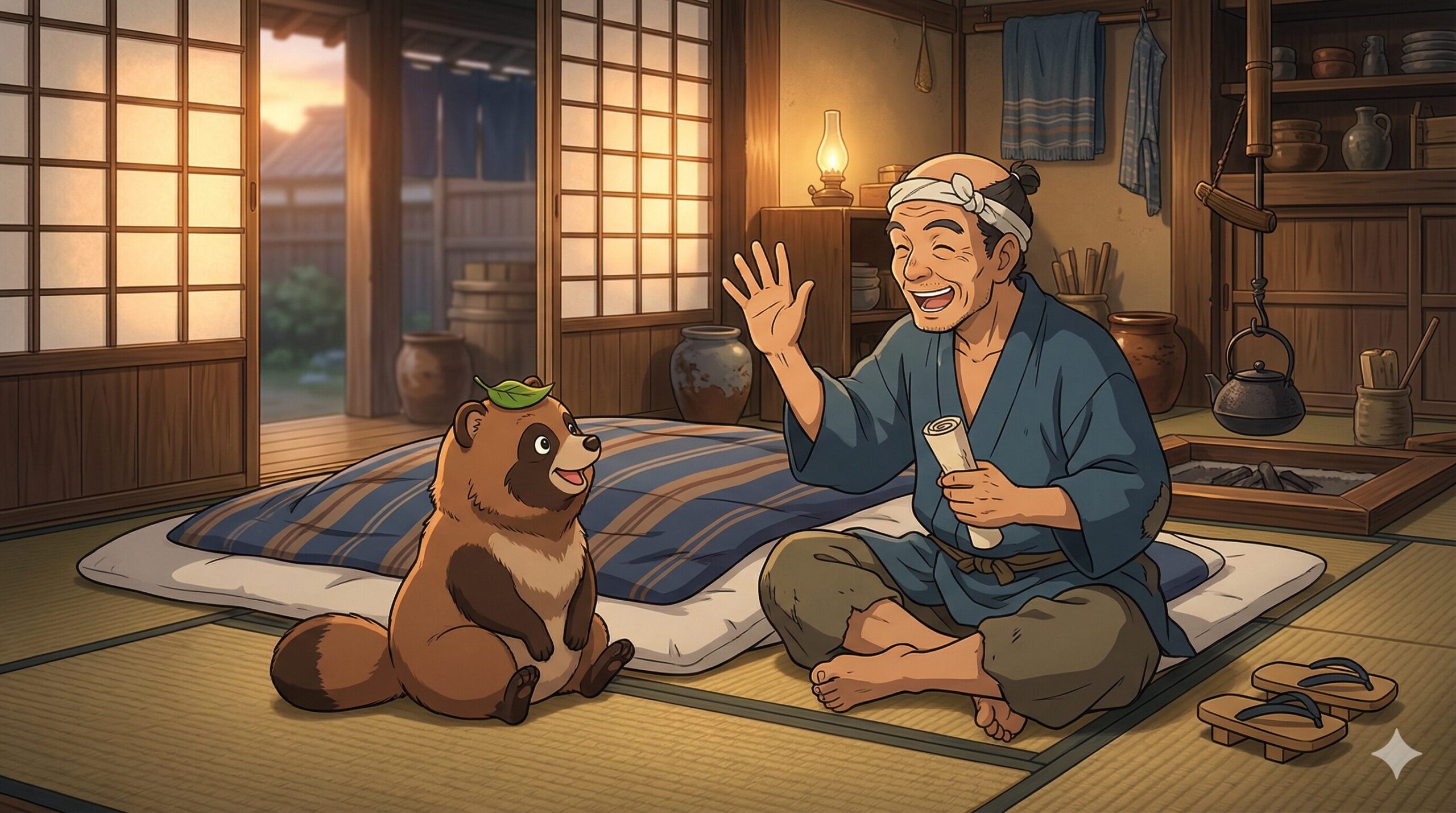
① The Story of “The Tanuki is My Friend”
Once upon a time, in a village in Tosa (present-day Kochi Prefecture) on the island of Shikoku, there lived a cheerful farmer named Kaneyan. Kaneyan was known in the village as a bit of an eccentric. Surprisingly, he was best friends with a mountain Tanuki (raccoon dog), and they could converse just like regular humans. Even in ancient Japan, a friendship between a human and a shape-shifting Yokai (supernatural creature) was incredibly rare.
One day, Kaneyan went to visit his friend Gonbei on an errand. When he entered the house, he found Gonbei lying in his futon, flushed and sick. To his shock, sitting perfectly still at the foot of Gonbei’s futon was none other than his Tanuki friend. The Tanuki had “possessed” Gonbei!
Exasperated, Kaneyan shouted,
“Hey! What are you doing at Gonbei’s place? Stop causing trouble!”
Without a hint of remorse, the Tanuki replied,
“But I have nowhere else to go!”
Hearing this, Kaneyan half-jokingly blurted out,
“You idiot! Don’t possess poor folks like us. If you have to possess someone, go to Kinbei’s place, the richest man in the village!”
The Tanuki looked thoughtful, as if saying “That makes sense,” and quietly vanished into thin air.
A few days passed. A rumor spread through the village: “The wealthy Kinbei has suddenly fallen ill and is bedridden.” Having a bad feeling about this, Kaneyan rushed to Kinbei’s mansion to check on him. Sure enough, sitting proudly at the foot of Kinbei’s futon was the very same Tanuki.
“Hey, Tanuki! Why the hell are you here?!”
When Kaneyan scolded him, the Tanuki puffed out his chest and answered confidently,
“You were the one who told me to go to Kinbei’s place the other day!”
“That was a joke! Don’t blame this on me!” Kaneyan panicked, but the Tanuki wouldn’t back down.
“A Tanuki never lies! I just did exactly what you told me to do!”
Eventually, a massive brawl broke out between the human and the Yokai. Rolling around the room and tearing through paper sliding doors (shoji), Kaneyan desperately managed to physically throw the Tanuki out of the mansion.
The moment the Tanuki was kicked out, Kinbei’s illness completely vanished. However, the fully recovered Kinbei was furious. “Did you send that Tanuki to possess me, Kaneyan?!” he raged. Kaneyan had to rub his head against the ground and apologize profusely until the uproar finally settled down. The moral of the story? Having a Yokai friend you can talk to might just bring you a lot of unexpected trouble.
② Analysis of “The Tanuki is My Friend”: The Egalitarian Human-Yokai Relationship
The greatest charm of this story is that there is no “overwhelming power gap” or “terror” between the human (Kaneyan) and the Yokai (Tanuki). They have a completely equal friendship. In Western tales of demonic possession or other terrifying ghost stories, exorcising a spirit requires an incredibly powerful priest, monk, or exorcist.
But what happens in this story? A simple farmer just yells “Hey!” and a dialogue begins, ultimately resolving the supernatural crisis with a physical fistfight. Despite being a supernatural Yokai, the Tanuki is depicted as incredibly human-like and vulnerable to physical attacks. This perfectly illustrates how Yokai in Japanese folklore are rarely absolute evil; they are more like “slightly annoying but lovable neighbors” living right next to human society.
Furthermore, the Tanuki’s line, “A Tanuki never lies!” is brilliantly ironic. Traditionally, Tanuki are the ultimate tricksters known for deceiving humans. Yet here, the Tanuki who faithfully executed a joke is actually more “honest” than the human who casually told a lie. It serves as a humorous and biting satire on the complexities and facades of human society.
③ Connection to Japanese Culture: Yokai Blending into Daily Life
Since ancient times, Japan has embraced Animism, the Shinto belief in “Yaoyorozu no Kami” (eight million gods), where spirits reside in everything—mountains, rivers, trees, and animals. Yokai were born from this perspective of nature. They are seen as lesser spirits or incarnations of nature, without the grand authority of deities.
Even in modern Japan, you will frequently see “Shigaraki-ware Tanuki statues” placed at the entrances of restaurants. With their large straw hats, round bellies, and giant testicles (a symbol of financial luck), they have an endearing appearance. Japanese people have long loved the Tanuki as a “lucky charm for business prosperity.”
This story also highlights the unique Japanese culture of “Tsukimono” (spirit possession). In the past, sudden illnesses or mental distress were often interpreted as “being possessed by a fox or Tanuki.” However, this was not a hopeless curse, but rather a “routine accident” akin to catching a cold. That is exactly why Kaneyan’s dark humor—”go to the rich guy instead of us poor folks”—works. In Japanese culture, nature and otherworldly beings are not enemies to be eradicated, but entities to coexist with, negotiate with, and sometimes even fight with.
④ What Would You Do?
Through this tale, you can see just how human-like and full of humor Japanese Yokai truly are.
If your friend suddenly fell sick, and you found a Tanuki sitting at the foot of their bed boldly claiming, “I have nowhere else to go,” what would you do? Would you lecture it and get into a fistfight like Kaneyan? Or would you invite it to your own home for a cup of green tea?
We’d love to hear your thoughts and what you would do in this situation!
Reference Links & Categories
- Source Reference: Manga Nippon Mukashibanashi Database – “The Tanuki is My Friend”
- Read more stories here: Japanese Folktale Series
日本の昔話:「狸がともだち」〜人間と妖怪の奇妙な友情〜
① 昔話「狸がともだち」のストーリー
むかしむかし、四国は土佐(現在の高知県)のある村に、「かねやん」という陽気なお百姓が住んでいました。このかねやん、村でも少し変わった男として知られていました。なんと、山の狸と大の仲良しで、普通に言葉を交わして会話ができたのです。人間と妖怪である狸が友達同士というのは、昔の日本でも大変珍しいことでした。
ある日のこと、かねやんは用事があって、友人の権兵衛(ごんべえ)の家を訪ねました。家に入ると、権兵衛は顔を真っ赤にして布団に寝込んでいます。そして驚いたことに、権兵衛の布団の足元には、かねやんの友達であるあの狸がちょこんと座り、権兵衛に「憑りついて」いたのです。
かねやんは呆れて怒鳴りました。
「こら!お前、権兵衛のところで何をしてるんだ!悪さをするな!」
すると狸は、少しも悪びれる様子もなく言い返します。
「だって、他に行く所がないんじゃ!」
これを聞いたかねやんは、つい冗談半分でこう言ってしまいました。
「ばかやろう!儂らみたいな貧乏人のところじゃなくて、どうせ憑りつくなら、村一番の金持ちの金兵衛(きんべえ)さんの所へ行け!」
それを聞いた狸は、「なるほど、それもそうだな」という顔をして、スッとどこかへ消えていきました。
それから何日か過ぎた頃。村で「あの金持ちの金兵衛さんが、急な病で寝込んでいるらしい」という噂が広まりました。嫌な予感がしたかねやんが慌てて金兵衛の屋敷へ見舞いに行くと、案の定、金兵衛の布団の足元に、あの狸が偉そうに座って憑りついていたのです。
「こら狸!お前、なんでこんな所にいるんだ!」
かねやんが叱りつけると、狸は胸を張って堂々と答えました。
「お前がおととい、『金兵衛さんのところへ行け』と言ったんじゃないか!」
「あれは冗談で言ったんだ!俺のせいにするな!」と焦るかねやんに対し、狸は一歩も引きません。
「狸は嘘はつかん!お前が言った通りにしただけだ!」
とうとう人間と妖怪の、取っ組み合いの大喧嘩が始まりました。部屋の中で転げ回り、障子を破りながら、かねやんは必死の思いで狸を屋敷から外へ叩き出しました。
狸が追い出された途端、金兵衛の病気はケロリと治りました。しかし元気になった金兵衛は、「かねやんが狸を俺に憑かせたのか!」と激怒します。かねやんが地面に頭をこすりつけて平謝りに謝り続け、やっとのことでこの大騒動は収まりました。言葉の通じる狸を友達に持つと、とんだ苦労を背負い込むというお話です。
② 「狸がともだち」の考察:妖怪と人間のフラットな関係性
この物語が持つ最大の魅力は、人間(かねやん)と妖怪(狸)の間に「圧倒的な力の差」や「恐怖」が存在せず、完全に対等な友人関係が築かれている点です。西洋の悪魔憑きや、他の恐ろしい怪談であれば、人に憑りついた悪霊を祓うためには、強力な力を持つ聖職者や陰陽師、僧侶の祈祷が必要です。
しかし、この物語ではどうでしょう。農民であるかねやんが「こら!」と怒鳴るだけで狸と対話が成立し、最後は「取っ組み合いの物理的な喧嘩」で解決しています。狸は超自然的な力を持つ妖怪でありながら、非常に人間臭く、物理的な攻撃(喧嘩)が通用する存在として描かれています。これは、日本の民話における妖怪が、決して絶対的な悪ではなく、人間社会のすぐ隣で暮らす「少し迷惑で、でもどこか憎めない隣人」であることを如実に表しています。
また、「狸は嘘はつかん!」という狸のセリフは非常にアイロニカルで秀逸です。本来、狸は人を化かし、騙すトリックスターの代表格です。しかしここでは、冗談を真に受けて忠実に実行した狸の方が、適当な嘘(冗談)をついた人間よりも「誠実(正直)」であるという逆転現象が起きています。人間社会の複雑さや建前に対する、痛烈でユーモラスな風刺が込められています。
③ 日本文化との関連:自然や精霊と共生するアニミズムの世界観
日本には古くから、山や川、木や動物など、あらゆるものに神や霊が宿るという「八百万の神(やおよろずのかみ)」のアニミズム信仰があります。この自然観から生まれたのが「妖怪」です。彼らは神様ほどの権威を持たない、少し格の低い精霊や自然の化身として捉えられています。
現代の日本でも、飲食店の入り口に「信楽焼(しがらきやき)の狸の置物」がよく置かれています。大きな笠をかぶり、丸いお腹に、大きな金玉(金運の象徴)を持ったあの愛嬌のある姿です。日本人は狸を「商売繁盛の縁起物」や「福を呼ぶ存在」として愛してきました。
また、日本特有の「憑き物(つきもの)」の文化もこの物語から読み取れます。昔の日本では、急な病気や精神の不調を「キツネやタヌキが憑いた」と解釈していました。しかしそれは絶望的な呪いではなく、風邪を引いたのと同じような「日常的なアクシデント」でした。だからこそ、かねやんのように「貧乏人じゃなく金持ちのところへ行け」というブラックジョークが成立するのです。日本文化において、自然や異界の存在は排除すべき敵ではなく、上手く付き合い、時には喧嘩しながら共に生きていく存在なのです。
④ あなたならどうする?
この物語を通して、日本の妖怪がいかに人間臭く、ユーモアに溢れた存在であるかがお分かりいただけたでしょう。
もし、あなたの友人が急に寝込み、その足元に「他に行くところがない」と開き直るタヌキが座っていたら、あなたはどうしますか? かねやんのように説教をして取っ組み合いの喧嘩をしますか? それとも、自分の家に招き入れて、一緒にお茶でも飲みますか?
ぜひ、あなたの考えや感想を教えてください。
参考リンク・カテゴリー
- 参考元:まんが日本昔ばなし〜データベース〜「狸がともだち」
- その他の日本の昔話はこちら:Japanese Folktale Series
コメント