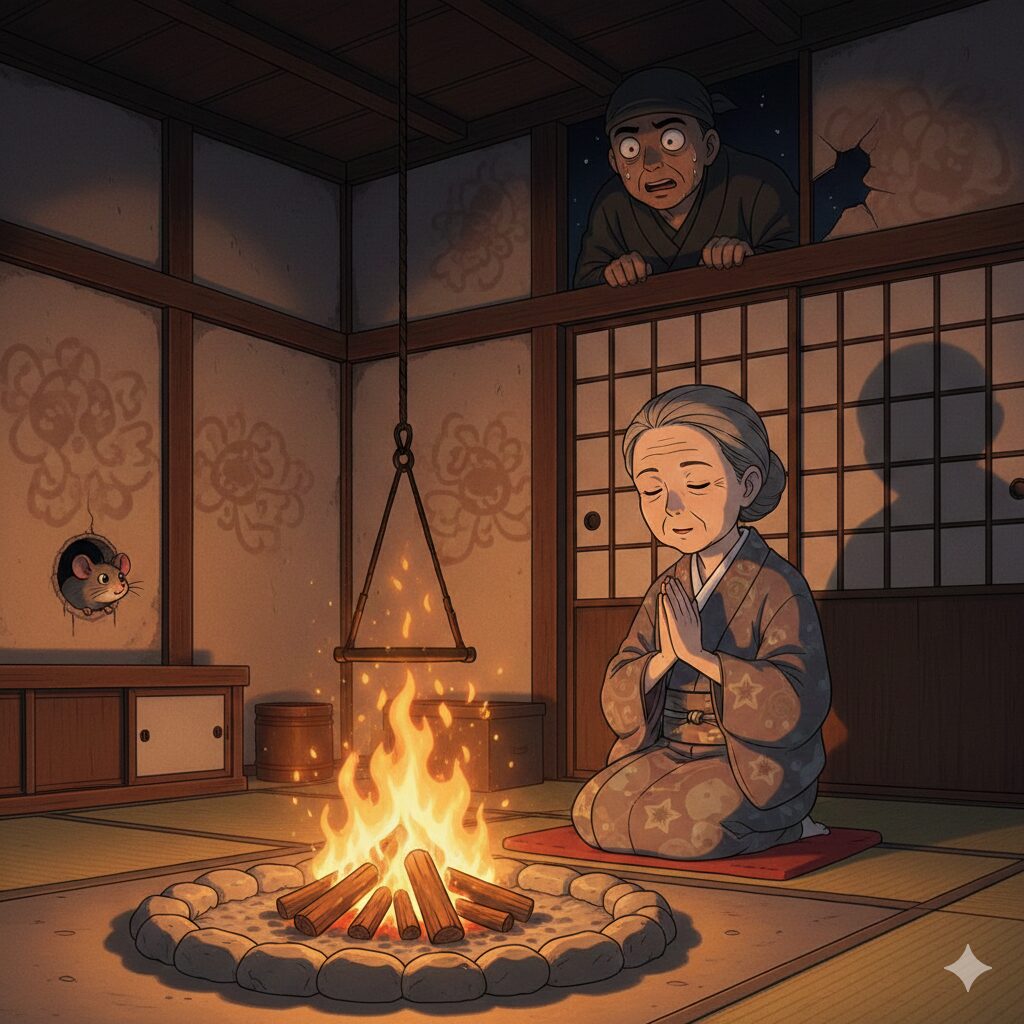
In Japanese folklore, there aren’t just stories of heroes defeating monsters, but also many humorous tales known as “Warai-banashi” (funny stories) that are rooted in the daily lives of common people. The story I will introduce today, “The Mouse Sutra” (Nezumi Kyo), is a masterpiece of this genre. It is a story mixed with irony and truth, where a fake Buddhist sutra exhibits more power than a real one. Please enjoy this intriguing tale that makes us think about the “power of words” and the “mind that believes.”

The Story: The Mouse Sutra
Once upon a time, in a rural village in Japan, there lived an old woman. She was very devout, but she was always ashamed that she could not read and did not know a single sutra. “Before I die, I want to be able to chant at least one holy sutra,” was her constant wish.
One stormy night, a traveling monk visited the old woman’s house asking for lodging. The old woman rejoiced, thinking, “This is guidance from the Buddha,” and treated the monk with great hospitality. After dinner, she bowed down and begged him.
“Reverend monk, I have a request. Could you please teach me one holy sutra?”
However, this man was actually just a vagabond dressed as a monk and knew absolutely nothing about sutras. Having eaten her food, he couldn’t refuse and was at a loss. Just then, he saw a mouse peeking out from a hole in the corner of the room.
Thinking quickly, the man started singing a made-up tune matching the mouse’s movements.
“On-choro-choro, dete gozaru.”
(Meaning: “Om, smooth and quick, coming out.”)
The old woman’s eyes sparkled as she repeated it. “On-choro-choro, dete gozaru… What a holy sound.”
Next, as the mouse crawled out of the hole, the man continued:
“Churo-churo to, hai gozaru.”
(Meaning: “Squeak-squeak, crawling along.”)
The mouse looked around the room restlessly.
“Acchi mitari, kocchi mitari.”
(Meaning: “Looking that way, looking this way.”)
When the old woman’s cat meowed, the mouse hurriedly fled back into the hole.
“Sore, ana e nigekonda.”
(Meaning: “There, ran away into the hole.”)
Wiping his sweat, the man lied, “This is the most precious sutra in the capital.” The old woman shed tears of gratitude, and even after the man left, she continued to chant this “Mouse Sutra” enthusiastically day after day.
A few days later, on a moonlit night, a notorious thief broke into the old woman’s house. The thief waited for everyone to fall asleep and quietly peeked into the room from the attic.
At that very moment, the old woman, who was still awake, began to chant her daily sutra.
“On-choro-choro, dete gozaru.”
The thief was startled. “What? Did she see me stick my head out?”
When the thief fearfully climbed down to the floor and tried to crawl forward, the voice resonated again.
“Churo-churo to, hai gozaru.”
“Yikes! It’s like she can see everything!” The thief panicked and looked left and right for an escape route.
“Acchi mitari, kocchi mitari.”
“Waaah! Forgive me! This old woman must be clairvoyant!”
Terrified, the thief jumped toward the window to escape.
“Sore, ana e nigekonda.”
The thief ran away, tumbling down, and spread the rumor that “There is a terrifying user of supernatural powers in that house.” Meanwhile, the old woman, knowing nothing of this, deepened her faith even more, thinking, “Thanks to the holy sutra, my heart is at peace today as well.”
Analysis: The Strongest Defense Born of Ignorance
At first glance, this story seems like a funny tale about an ignorant old woman being tricked, but it contains very sharp insights from the perspectives of deep psychology and religious views.
1. The Absolute Nature of “The Power of Belief”
The words the old woman was chanting had no meaning in themselves. However, because the old woman believed 100% that they were “holy words,” her voice had no hesitation and harbored intense energy (Kotodama). What repelled the thief was not the meaning of the words, but the old woman’s “attitude full of conviction.”
2. Synchronicity
Like the concept of synchronicity proposed by the psychologist Jung, the old woman’s unconscious actions and the thief’s reality coincided miraculously. This story symbolizes the Japanese optimism that “if you act with a pure heart, the universe (or gods and Buddhas) will take your side and keep bad things away.”
Relevance to Japanese Culture: Kotodama and Formal Beauty
Since ancient times, Japan has had a belief called “Kotodama” (Spirit of Words). It is the idea that spiritual power dwells in words, and what is spoken becomes reality. “The Mouse Sutra” depicts this Kotodama belief paradoxically.
- Essence over Form: Originally, sutras are noble teachings, but in Japan, there was a tendency to believe that the “sound” itself had the effect of warding off evil. This story suggests a reverse idea, common in Zen, that “even if it is a fake, if the heart of the person chanting is pure, it brings merit greater than the real thing.”
- Acceptance of “Mere Coincidence” as “Grace”: The old woman does not know the fact that the thief ran away. However, peace was protected as a result. Japanese people have a culture of appreciating such inexplicable good fortune as “Okage-sama” (grace of gods, Buddhas, or ancestors).
To Our Readers
What did you think after reading this story? Did you think “the deceived old woman is pitiful”? Or did you feel “all’s well that ends well”?
If someone pointed out that what you believe in is “fake,” but it saves you and makes you happy, would you stick to that faith? Or would you seek the truth?
Please let us know your thoughts.
External Link (Reference):
National Diet Library Digital Collections
Read More:
Japanese Folktale Series Category
【日本昔話】ねずみ経(The Mouse Sutra):信じる心が起こした滑稽な奇跡
日本の民間伝承には、英雄が怪物を倒す物語だけでなく、庶民の生活に根差したユーモアあふれる「笑い話」が数多く存在します。今回ご紹介する『ねずみ経(ねずみきょう)』は、その代表作です。これは、偽物のお経が本物以上の力を発揮してしまうという、皮肉と真理が入り混じった物語です。「言葉の力」と「信じる心」について考えさせられる、興味深いストーリーをお楽しみください。
物語:ねずみ経
むかしむかし、ある田舎の村に、一人のお婆さんが住んでいました。お婆さんはとても信心深い性格でしたが、字が読めず、お経を一つも知らなかったことを常に恥じていました。「死ぬまでに、せめて一つでもありがたいお経を唱えられるようになりたい」それが彼女の口癖でした。
ある嵐の夜、一人の旅の僧侶が「一晩泊めてくだされ」とお婆さんの家を訪ねてきました。お婆さんは「これは仏様のお導きだ」と喜び、僧侶を手厚くもてなしました。そして夕食の後、手をついて頼み込みました。
「お坊様、お願いがございます。私にありがたいお経を一つ教えていただけないでしょうか」
しかし、実はこの男、僧侶の格好をしたただの風来坊で、お経のことなど何一つ知りませんでした。ご馳走になった手前、断ることもできず困り果てていると、ふと部屋の隅の壁穴から、一匹のネズミが顔を出しているのが見えました。
男はとっさに、そのネズミの動きに合わせて、もっともらしい節をつけて歌い出しました。
「おんちょろちょろ、出てござる」
(ネズミが顔を出したのを見て)
お婆さんは目を輝かせて復唱します。「おんちょろちょろ、出てござる…なんとありがたい響きでしょう」
次にネズミが穴から這い出してくると、男は続けました。
「ちゅうろちゅうろと、這いござる」
ネズミが部屋の中をキョロキョロと見回します。
「あっち見たり、こっち見たり」
お婆さんの飼っている猫がニャーと鳴くと、ネズミは慌てて穴へ逃げ込みました。
「それ、あなへ逃げ込んだ」
男は汗を拭いながら、「これが都で一番尊いお経です」と嘘をつきました。お婆さんは涙を流して感謝し、男が去った後も、来る日も来る日も、この「ねずみ経」を熱心に唱え続けました。
それから数日後の月夜の晩のことです。お婆さんの家に、悪名高い泥棒が忍び込みました。泥棒は皆が寝静まるのを待ち、そっと天井裏から部屋を覗き込みました。
その時です。まだ起きていたお婆さんが、日課のお経を唱え始めました。
「おんちょろちょろ、出てござる」
泥棒はギクリとしました。「えっ? 俺が顔を出したのが見えたのか?」
泥棒が恐る恐る床に降り、這って進もうとすると、また声が響きます。
「ちゅうろちゅうろと、這いござる」
「ひえっ! まるで見えているようだ!」泥棒はパニックになり、逃げ道を探して右往左往しました。
「あっち見たり、こっち見たり」
「わあっ! 許してくれ! この婆さんは千里眼の持ち主に違いない!」
泥棒は恐怖のあまり、慌てて逃げ出そうと窓へ飛び込みました。
「それ、あなへ逃げ込んだ」
泥棒は転げるように逃げ帰り、「あの家には恐ろしい神通力の使い手がいる」と噂しました。一方、何も知らないお婆さんは、「ありがたいお経のおかげで、今日も心が安らぐ」と、ますます信仰を深めたのでした。
考察:無知が生んだ最強の防衛システム
この物語は、一見すると「無知なお婆さんが騙される滑稽話」に見えますが、深層心理や宗教観の観点から非常に鋭い洞察を含んでいます。
1. 「信じる力」の絶対性
お婆さんが唱えていた言葉自体には何の意味もありませんでした。しかし、お婆さんがそれを「聖なる言葉」だと100%信じ込んでいたために、その声には迷いがなく、強烈なエネルギー(言霊)が宿りました。泥棒を撃退したのは、言葉の意味ではなく、お婆さんの「確信に満ちた態度」だったのです。
2. 偶然の必然化(シンクロニシティ)
心理学者のユングが提唱したシンクロニシティのように、お婆さんの無意識の行動と、泥棒の現実の行動が奇跡的に一致しました。この物語は、「純粋な心で行動していれば、宇宙(あるいは神仏)が味方をして、悪いものを遠ざけてくれる」という日本的な楽観主義を象徴しています。
日本文化との関連:言霊(Kotodama)と形式美
日本には古来より「言霊(ことだま)」という信仰があります。言葉には霊的な力が宿り、口に出したことが現実になるという考え方です。『ねずみ経』は、この言霊信仰を逆説的に描いています。
- 形式よりも本質: 本来、お経はサンスクリット語などを翻訳した高尚な教えですが、日本では「音の響き」そのものに魔除けの効果があると信じられる傾向がありました。この物語は、「たとえ偽物であっても、唱える者の心が清らかであれば、それは本物以上の功徳をもたらす」という、禅にも通じる逆転の発想を示唆しています。
- 「ただの偶然」を「ご利益」とする受容性: お婆さんは泥棒が逃げた事実を知りません。しかし、結果的に平和が守られました。日本人はこのように、理屈で説明できない幸運を「おかげさま(神仏や先祖の恩恵)」として感謝する文化を持っています。
読者の皆様へ
あなたはこの物語を読んでどう思いましたか?「騙されたお婆さんが可哀想」だと思いましたか?それとも「結果良ければ全て良し」と感じましたか?
もし、あなたの信じているものが「偽物」だと誰かに指摘されたとしても、それがあなた自身を救い、幸せにしているのであれば、その信仰を貫きますか?それとも真実を求めますか?
ぜひ、あなたの考えを聞かせてください。
この物語が気に入ったら、ぜひシェアして日本のユニークな文化を広めてください。
外部リンク(参考):
国立国会図書館デジタルコレクション(日本の古い文献が検索できます)


コメント