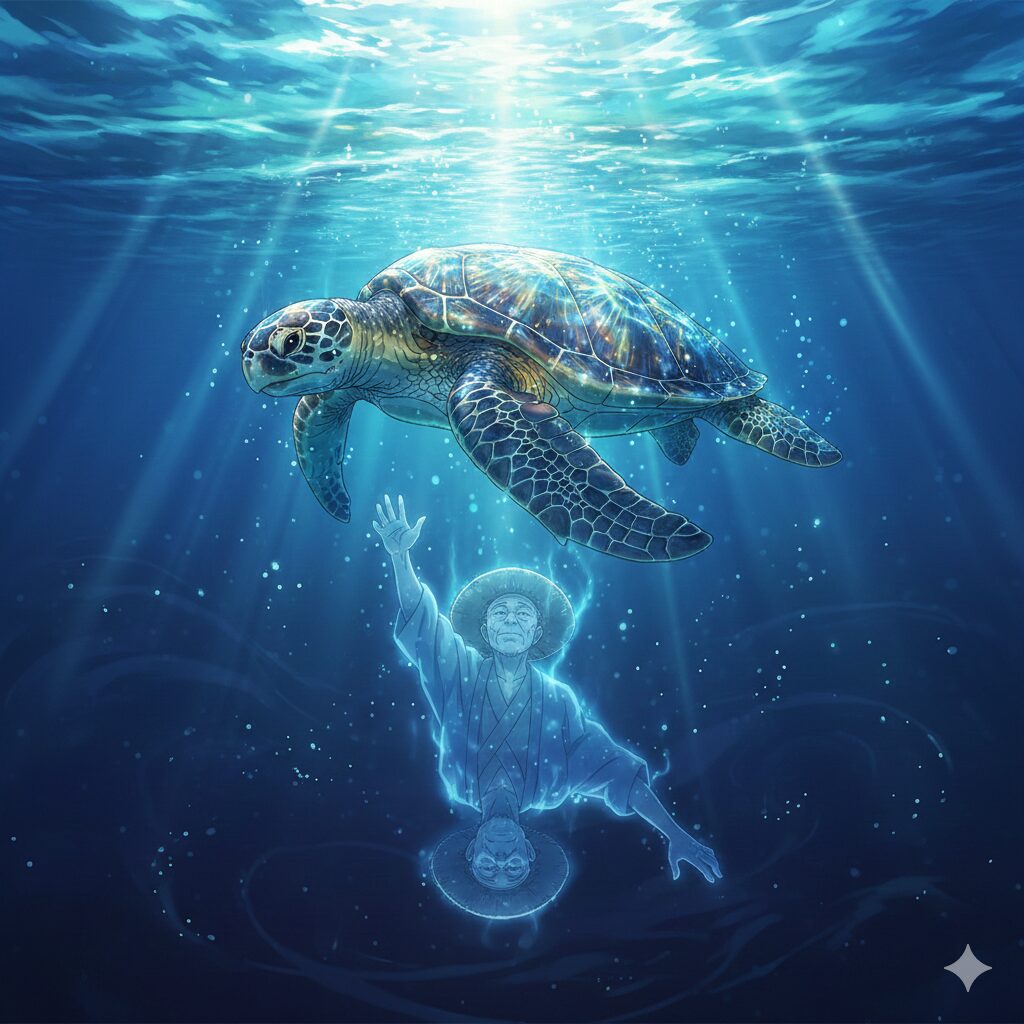
Japanese folklore is filled with stories involving turtles, the most famous being “Urashima Taro.” However, the story I am sharing today is different. It is not about a man who saved a turtle, but a story about a man who desired to become a turtle himself. This mysterious and somewhat melancholic tale poses profound questions about “time” and “humanity.”

The Story: The Man Who Became a Turtle
Long ago, in a coastal village in Japan, lived a man named Gonzo.
Although Gonzo was a skilled fisherman, he was incredibly lazy. He would often stare at the ocean and complain, “Why must humans work endlessly, worry constantly, only to grow old and die?”
One hot summer day, Gonzo lay on the rocky shore and spotted a giant sea turtle drifting among the waves. The turtle had an aura of ancient wisdom, having lived for centuries. It simply floated quietly in the blue sea, doing absolutely nothing.
“How lucky the turtle is,” Gonzo muttered. “No work, no need for money, and a hard shell to protect it from any harm. If I could drift in the sea forever like that turtle, how happy I would be.”
That night, a sea spirit with a pale blue face appeared in Gonzo’s dream.
“Gonzo, do you wish to cast aside your humanity and live as a turtle? If you desire it, I shall grant you an ageless body and ten thousand years of life.”
Gonzo answered without hesitation. “Yes, I desire it! I am sick of the burdens of being human.”
When Gonzo woke the next morning, his body felt terribly heavy. A giant, hard shell had formed on his back, and his limbs had transformed into flippers. He tried to speak, but only a sound like the whistling wind came out: “Hyuuu.”
Gonzo had become a turtle.
Overjoyed that his wish had come true, Gonzo dived into the sea. The water felt comforting, and he no longer struggled for breath. He swam deep, admiring beautiful coral reefs and fish, beginning a life of simply surrendering to the waves.
One year passed. Then ten years. For Gonzo, it felt like a brief afternoon nap.
However, when one hundred years had passed, Gonzo decided to approach the shore of his hometown. The house he once knew, his friends, everyone was gone. The scenery of the village had changed, and strangers were laughing on the beach.
Gonzo wanted to speak to someone. He tried to shout, “I am here! It’s me, Gonzo!”
But only bubbles came from his mouth. The village children spotted him and shouted, “Look, a giant turtle!” and began throwing stones. Gonzo panickingly retracted his head into his shell.
Inside the dark shell, Gonzo realized for the first time.
“This hard shell that hurts no one is also a wall that lets in no warmth.”
Gonzo tried to cry, but in the ocean, tears simply dissolve into the saltwater and disappear. It is said that he still drifts somewhere in the seas of Japan today, accompanied only by eternal loneliness.
Analysis: Escapism and the Loss of Identity
The story of “The Man Who Became a Turtle” is not merely a transformation myth. It conceals a powerful message relevant to modern society.
1. The “Shell” as an Absolute Safe Zone
The “shell” Gonzo admired symbolizes what we might call emotional walls or social withdrawal in the modern world. If one shuts themselves away to avoid getting hurt, they are indeed free from pain. However, this is synonymous with cutting off contact, love, and warmth from others. The story sharply illustrates the paradox that absolute safety is absolute loneliness.
2. The Curse Named Eternity
In Japan, there is a saying: “Cranes live for a thousand years, turtles for ten thousand years.” Turtles are celebrated as symbols of longevity. Yet, in this story, longevity is depicted not as a blessing but as a “punishment.” Eternity without change is a stagnation more frightening than death. This contains a paradoxical lesson: humans shine precisely because life is finite, and we live desperately in each moment.
Cultural Perspective: “Mujō” (Impermanence) and Return to Nature
Here is how this story connects to unique Japanese cultural backgrounds.
Animism and Blurry Boundaries
In Japanese Shinto and Animism, the boundary between humans and nature (animals and plants) is very ambiguous. Tales of humans becoming animals or animals transforming into humans are common because of the belief that “spirits dwell in all things.” Gonzo becoming a turtle might look like a punishment from a Western perspective, but from a Japanese perspective, it can also be seen as “assimilation into nature.” He discarded the individual “human” self to become part of the great “ocean.”
Contrast with “Mono no Aware”
Japanese aesthetics include the concept of “Mono no Aware”—finding beauty in things that pass, like cherry blossoms. Gonzo chose the opposite: an unchanging, rock-like existence. Perhaps the reason Japanese people love cherry blossoms and cherish transience is due to an instinctive avoidance of the “eternal loneliness” that Gonzo chose, and a celebration of finite life.
To My Readers
If a sea spirit appeared before you and said, “I will turn you into a turtle, free from all worries to live forever,” what would you do?
Would you abandon your current relationships and work stress to dive into the silent ocean? Or would you choose to live as a human, even if it means getting hurt and worrying?
Those who can laugh at Gonzo’s choice as foolish are surely happy people. But in today’s overly busy society, is there not a moment where anyone might secretly wish, “I want to become a turtle”?
For more interesting Japanese folktales, please check the category below:
Japanese Folktale Series – Kiri53.com
Also, if you wish to learn deeper about Japanese Yokai and folklore, the database by the International Research Center for Japanese Studies is a valuable resource.
International Research Center for Japanese Studies
【日本昔話】亀になった男:永遠の命と引き換えにした孤独
【日本昔話】亀になった男:永遠の命と引き換えにした孤独
日本の伝説には、有名な「浦島太郎」のように亀が登場する物語が多く存在します。しかし、今回ご紹介するのは、亀を助けたのではなく、自ら亀になることを望んだ男の物語です。この不思議で少し切ない物語は、私たちに「時間」と「人間性」について深く問いかけてきます。
昔話:亀になった男
むかしむかし、ある海岸の村に、権三(ごんぞう)という男が住んでいました。
権三は、漁師としては腕が立ちましたが、大変な怠け者でした。「なぜ人間は、毎日あくせくと働き、悩み、やがて老いて死んでいくのか」と、いつも海に向かってぼやいていました。
ある夏の暑い日、権三は岩場に寝そべり、一匹の巨大な海亀が波間に漂っているのを見つけました。その亀は、何百年も生きている主(ぬし)のような風格があり、ただ静かに、何もせず、青い海に揺られていました。
「いいなぁ、亀は」と権三は呟きました。「働くこともなく、銭の心配もなく、硬い甲羅があれば誰にも傷つけられない。俺もあの亀のように、永遠に海を漂って暮らせたらどんなに幸せか」
その夜、権三の夢枕に、青白い顔をした海の精霊が現れました。
「権三よ、お前は人間であることを捨て、亀として生きることを望むか? 望めば、老いることのない体と、万年の時を与えよう」
権三は迷わず答えました。「ああ、望むとも! 人間のしがらみなど真っ平ごめんだ」
翌朝、権三が目を覚ますと、体がひどく重く感じられました。背中には巨大な硬い甲羅が生じ、手足は短く、ひれのように変化していました。声を出そうとしましたが、「ヒュウ」という風のような音しか出ません。
権三は亀になっていたのです。
念願が叶った権三は、喜び勇んで海へ飛び込みました。水の中は心地よく、息継ぎの苦しさもありません。彼は深く深く潜り、美しい珊瑚礁や魚たちを眺めながら、ただ波に身を任せるだけの日々を送り始めました。
1年が経ち、10年が経ちました。権三にとってそれは、ほんの一瞬の昼寝のようでした。
しかし、100年が経った頃、権三はふと故郷の浜辺に近づいてみました。そこには、かつて自分が知っていた家も、友人たちも、もう誰一人としていませんでした。村の景色は変わり、知らない人々が笑い合っていました。
権三は、誰かと話がしたいと思いました。「俺はここにいるぞ、権三だ」と叫ぼうとしました。
しかし、口から出るのは泡だけ。村の子供たちが彼を見つけ、「大きな亀がいるぞ!」と石を投げてきました。権三は慌てて甲羅に首を引っ込めました。
その暗い甲羅の中で、権三は初めて気づいたのです。
「誰も傷つけない硬い甲羅は、誰の温もりも感じられない壁だったのだ」と。
権三は涙を流そうとしましたが、海の中では涙もまた、ただの海水に溶けて消えていくだけでした。彼は今も日本のどこかの海で、永遠の孤独と共に漂っていると言われています。
考察:逃避願望とアイデンティティの喪失
この「亀になった男」の物語は、単なる変身譚ではありません。現代社会にも通じる、強烈なメッセージが隠されています。
1. 「甲羅」という絶対的な安全地帯
権三が憧れた「甲羅」は、現代で言うところの「心の壁」や「社会的な引きこもり」を象徴しています。傷つくことを恐れるあまり、自分の殻に閉じこもれば、確かに痛みからは解放されます。しかし、それは同時に、他者との接触、愛、そして温もりを遮断することと同義です。物語は、絶対的な安全は、絶対的な孤独であるというパラドックスを鋭く描いています。
2. 永遠という名の呪い
日本では「鶴は千年、亀は万年」と言われ、亀は長寿の象徴として祝われます。しかし、この物語において、長寿は祝福ではなく「刑罰」のように描かれています。変化のない永遠は、死よりも恐ろしい停滞です。人間が輝くのは、命に限りがあり、その一瞬一瞬を懸命に生きるからこそだという逆説的な教訓が含まれています。
日本文化の視点:「無常」と自然への回帰
この物語から読み解ける日本独自の文化的背景について解説します。
アニミズムと境界線の曖昧さ
日本の神道やアニミズムの考え方では、人間と自然(動物や植物)の境界線は非常に曖昧です。人間が動物になったり、動物が人間に化けたりする話が多いのは、「万物に魂が宿る」という信仰があるためです。権三が亀になったことは、西洋的な視点では「罰」に見えるかもしれませんが、日本的な視点では「自然への同化」とも捉えられます。彼は個としての「人間」を捨て、大いなる「海」の一部となったのです。
「もののあわれ」との対比
日本文化の美学には、桜のように散りゆくものに美を見出す「もののあわれ」という概念があります。権三が選んだのは、その対極にある「変わらない岩のような存在」です。日本人がなぜ桜を愛し、儚さを愛でるのか。それは、権三のような「永遠の孤独」に対する本能的な忌避感と、限りある生への賛歌があるからかもしれません。
読者の皆様へ
もし、あなたの目の前に海の精霊が現れ、「すべての悩みから解放され、永遠に生きられる亀にしてやろう」と言われたら、あなたはどうしますか?
今の人間関係や仕事のストレスを捨てて、静寂な海へ飛び込みますか? それとも、傷つき悩みながらも、人間として生きることを選びますか?
権三の選択を愚かだと笑える人は、きっと幸せな人です。しかし、現代の忙しすぎる社会において、ふと「亀になりたい」と願ってしまう瞬間が、誰にでもあるのではないでしょうか。
その他の興味深い日本の昔話については、以下のカテゴリーをご覧ください。
Japanese Folktale Series – Kiri53.com
また、日本の妖怪や伝承についてさらに深く知りたい方は、以下の国際日本文化研究センターのデータベースも参考になります。
International Research Center for Japanese Studies


コメント