Among Japan’s rich oral traditions and folktales, there are stories that surpass even modern mystery novels and psychological thrillers in their surprising plot twists. The story of “Shibarare Jizo” (The Tied-up Jizo) is arguably the best example. Starting with the unprecedented premise of a stone Buddha statue being arrested as a criminal, the narrative follows a brilliant psychological battle to corner the true culprit. It is a masterpiece that sharply highlights the history of the Japanese justice system, the religious devotion of the people, and the depths of human psychology.

1. The Story: The Incident of the Tied-up Jizo
Once upon a time, on the outskirts of a certain village, there stood a Jizo statue beloved by the locals. One sunny day, a young peddler boy carrying a large furoshiki (wrapping cloth) stuffed with expensive kimono fabrics passed by. Exhausted from his long journey, the boy stopped in front of the Jizo statue and accidentally fell asleep in the pleasant shade of a tree.
When the boy woke up a little while later, his precious bundle of fabrics had vanished without a trace. Devastated by the theft of his valuable merchandise, the boy cried out loudly. Hearing his wails, the villagers gathered one after another, and eventually, a samurai official (the local magistrate) rushed to the scene.
The official asked the boy, “When the fabrics disappeared, was there anyone suspicious around?” Weeping, the boy replied, “I saw absolutely no one. Only this Jizo statue was beside me the entire time.”
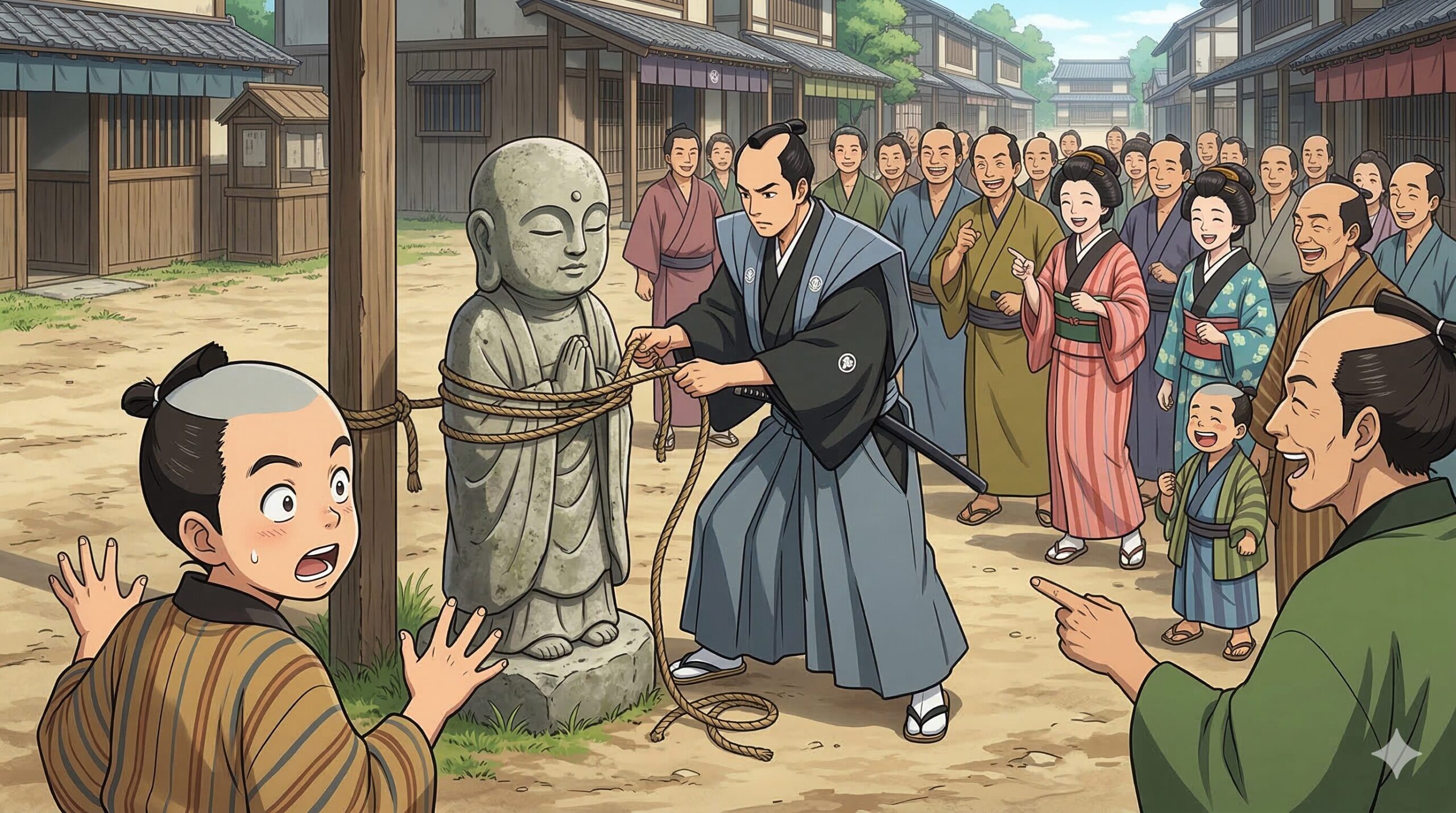
Upon hearing this, the official declared something unbelievable: “In that case, the Jizo statue who silently allowed the theft to happen is the culprit! Arrest it immediately!” Following the magistrate’s strict orders, his subordinates wrapped thick ropes around the stone Jizo and tied it up without mercy.
The bound Jizo was then dragged to the Oshirasu (the magistrate’s court). The villagers found this unprecedented arrest of a sacred stone statue absolutely hilarious. Thinking, “It’s ridiculous for a Jizo to be put on trial,” a massive crowd of curious onlookers followed the statue all the way to the court.
Brought before the magistrate, the Jizo faced severe interrogation. But of course, the suspect was made of stone. Naturally, it said absolutely nothing. The official pretended to be furious, shouting, “Maintaining your silence is an outrageous act of defiance!” and threw the stone Jizo straight into the jail cell. Watching this absurd spectacle, the crowd of villagers burst into roaring laughter.
In that instant, the official’s expression hardened. “Laughing and jeering in a sacred courtroom is utterly unacceptable! It is a grave contempt of court! As punishment, every single person here must bring one roll of fabric from your home immediately!”
The villagers turned pale at this unexpected fine, but no one could defy a samurai magistrate’s order. Reluctantly, they all returned home and brought back one roll of fabric each, building a mountain of cloth in the courtroom. The official then called the crying boy forward and ordered him to search for his stolen goods among the pile.
Suddenly, the boy pointed at one specific fabric. “Ah! This is it! This is my stolen fabric!” When the official fiercely interrogated the villager who had submitted that exact roll, the man immediately confessed to the theft. The true culprit was successfully apprehended.
The official declared, “As a penalty for silently watching the theft, leave the Jizo tied up for a while.” Thus, the statue remained bound in ropes. From that day on, this specific statue became known as the “Shibarare Jizo” (The Tied-up Jizo).
2. Folktale Analysis: A Perfect Trap Using Mob Psychology
The greatest appeal of this story lies in the genius psychological warfare deployed by the magistrate (often attributed in legends to the famous historical judge, Ooka Echizen). He never actually thought the Jizo was the criminal. The official instantly deduced: “The thief hasn’t fled far; he is hiding among the villagers.”
However, interrogating everyone individually would take too much time, allowing the thief to hide the evidence. Therefore, he staged the bizarre performance of “arresting a stone Jizo.” This was a flawless trap designed to stimulate human curiosity and the mob mentality, gathering all the villagers in one place. The thief, anxious to see how his crime would be handled and fueled by the same curiosity, naturally followed along and hid within the crowd.
Then, under the pretext of punishing them for “laughing in court,” the magistrate forced everyone to submit a roll of fabric. Even without a search warrant, making the criminal voluntarily hand over the evidence is a highly logical tactic, even from the perspective of modern criminal psychology. It is the brilliant result of sharp human observation hidden behind humor.
3. Connection to Japanese Culture: Jizo Statues and the “Ooka Judgment”
Through this folktale, we can deeply understand the unique culture and spirituality of Japan.
First is the intimate presence of the “Jizo” (Bodhisattva Ksitigarbha). You can find Jizo statues sitting at almost every village boundary and roadside in Japan. They are friendly guardian deities who protect children and ensure the safety of travelers. It was precisely because the Jizo is such a familiar, everyday presence that the “arrest of a Jizo” strongly captured the people’s attention.
Second is the Japanese virtue represented by the “Ooka Sabaki” (the brilliant judgments of Ooka Echizen). The ideal leader in traditional Japanese society is not a judge who mechanically applies the law, but one who masterfully manipulates human emotion and psychology to reach a brilliant conclusion that satisfies everyone.
Even more fascinating is that “Shibarare Jizo” is not just a fairy tale; it lives on as an active religious practice today. You can visit the actual Nanzo-in Temple in Katsushika, Tokyo, where the real “Shibarare Jizo” is enshrined. Today, worshippers carry on the tradition by personally tying ropes around the Jizo to “bind their wishes,” ward off thieves, and protect against evil. Once their wish comes true, they untie the ropes. This is a magnificent example of a folktale blending into reality and taking root in people’s daily lives.
If you want to dive deeper into Japanese culture, please check out our Japanese Folktale Series here.
4. How Would You Pass Judgment?
Arresting a stone Buddha statue just to gather a crowd. The official’s out-of-the-box thinking is nothing short of astonishing.
Now, I pose a question to you, the readers. If you were a magistrate in that era, tasked with solving a theft that occurred in front of a silent stone Buddha, what method would you use to catch the culprit? Also, does your country have similar folktales featuring “clever judges”?
Please think about how this story made you feel and what your own brilliant solution would be. And when you visit Japan, pay close attention to the stone Jizo statues quietly standing by the roadside. They just might be hiding a fascinating story of their own.
【日本の昔話】お地蔵様が逮捕された!?名奉行の心理戦が光る「しばられ地蔵」の謎と文化
日本の豊かな口承文学である「昔話」には、時に現代のミステリー小説や心理サスペンスを凌駕するような驚きの展開を持つ物語が存在します。今回紹介する「しばられ地蔵」は、まさにその筆頭です。「石でできたお地蔵様が罪人として逮捕される」という前代未聞の滑り出しから、見事な心理戦を経て真犯人を追い詰めるこの物語は、日本の司法の歴史や人々の信仰心、そして人間の心理を鋭く突いた傑作です。
1. 昔話「しばられ地蔵」のストーリー
むかしむかし、ある村の外れに、村人たちから親しまれているお地蔵様が立っていました。ある晴れた日のこと、反物(着物の生地)がぎっしり詰まった大きな風呂敷包みを背負った小僧が通りかかりました。長旅に疲れた小僧は、お地蔵様の前で足を止め、心地よい木陰でつい昼寝をしてしまいました。
しばらくして小僧が目を覚ますと、大切な風呂敷包みが跡形もなく消え去っています。大事な商品を盗まれた小僧が大声で泣き叫ぶと、その声を聞きつけた村人たちが次々と集まり、ついにはお役人(奉行)まで駆けつける事態となりました。
お役人は小僧に尋ねました。「反物が無くなった時、周りに誰か怪しい者はいなかったか?」小僧は泣きじゃくりながら答えます。「誰にも会いませんでした。ただ、あのお地蔵様だけはずっと傍にいました」
すると、お役人は驚くべき言葉を口にしました。「それならば、盗みを見過ごしたお地蔵様が犯人(共犯)である!直ちに捕縛せよ!」お役人の命令により、役人たちはお地蔵様にぐるぐると太い縄をかけ、容赦なく縛り上げました。
そして、縛り上げられたお地蔵様は、そのまま裁判を行う「お白州(おしらす)」へと引き立てられました。前代未聞のお地蔵様の逮捕劇に、村人たちは「お地蔵様が裁判にかけられるなんておかしい」とおもしろがり、黒山の人だかりとなってお白州についていきました。
お白州に引き出されたお地蔵様に対し、お役人は厳しく尋問を行います。しかし、相手は石です。当然、一言も喋りません。お役人は「黙秘を貫くとは不届き千万!」と激怒し、お地蔵様をそのまま牢屋へ放り込んでしまいました。これを見た野次馬の村人たちは、あまりの滑稽さにドッと大声で笑い出しました。
その瞬間、お役人の表情が険しくなりました。「神聖な裁判の場で笑い声を上げ、野次を飛ばすとは言語道断!不届き千万である!罰として、ここにいる者全員、一人一反ずつ反物を持参せよ!」
まさかの罰金刑に村人たちは青ざめました。しかしお役人の命令には逆らえません。仕方なく、村人たちは家から一反ずつ反物を持ち寄り、お白州には反物の山が築かれました。お役人は泣いていた小僧を呼び寄せ、その山の中から自分の反物を探させました。
すると小僧は、「あ!これです!これが私の反物です!」と一つの反物を指差しました。それを持ってきた村人を問いただしたところ、見事に盗みを自白。見事、真犯人を捕まえることに成功したのです。
お役人は「盗みを見過ごした罰として、しばらくそのままにしておけ」と命じ、お地蔵様はしばらくの間、縄で縛られたままになりました。それ以来、このお地蔵様は「しばられ地蔵」と呼ばれるようになりました。
2. 昔話の考察:野次馬心理を利用した完璧な罠
この物語の最大の魅力は、お役人(伝説では大岡越前守忠相とされています)の天才的な心理戦にあります。最初からお地蔵様を犯人だと思っていたわけではありません。お役人は「犯人は遠くに逃げず、村人の中に紛れ込んでいる」と即座に推理したのです。
しかし、一人一人を取り調べては時間がかかり、証拠を隠滅されてしまいます。そこで、「お地蔵様を逮捕する」という突拍子もないパフォーマンスを行いました。人間の「好奇心」と「野次馬根性」を最大限に刺激し、村人全員を一箇所に集めるための完璧な罠だったのです。犯人もまた「自分の盗みがどう裁かれるのか」という不安と好奇心から、群衆の中に身を潜めてついてきました。
そして、「裁判所で笑った罪」という名目で、無理やり全員から反物を提出させました。家宅捜索令状がなくても、犯人に自ら証拠品を提出させるこの手法は、現代の捜査心理学の観点から見ても非常に理にかなっています。ユーモアの中に隠された鋭い人間観察の賜物です。
3. 日本文化との関連:お地蔵様と大岡裁き
この昔話からは、日本独特の文化や精神性を深く読み解くことができます。
第一に、「お地蔵様(地蔵菩薩)」という存在の近さです。日本の村境や道端には必ずと言っていいほどお地蔵様が鎮座しています。彼らは子供の守り神であり、旅人の安全を見守る親しみやすい存在です。だからこそ「お地蔵様が逮捕された」という異常事態が、人々の関心を強烈に引きつけたのです。
第二に、「大岡裁き(おおおかさばき)」に代表される日本の美徳です。単に法律を機械的に適用するのではなく、人情や心理を巧みに操り、最終的に誰もが納得する鮮やかな結末を導き出す裁判官の姿は、日本人が古来より理想としてきたリーダー像です。
さらに興味深いことに、この「しばられ地蔵」は単なる作り話ではなく、現実の信仰として現代に受け継がれています。東京都葛飾区にある南蔵院には、実際に「しばられ地蔵」が安置されています。現在では、盗難除けや厄除け、さらには「願い事を縛り付ける」という意味で、参拝者が自らお地蔵様に縄を縛り、願いが叶ったら縄を解くという信仰が続いています。昔話が現実に結びつき、人々の生活に根付いている素晴らしい例です。
日本文化についてさらに深く知りたい方は、ぜひこちらの日本の昔話シリーズもご覧ください。
4. あなたならどう裁きますか?
石でできた仏像を逮捕して群衆を集める。このお役人の奇想天外なアイデアには驚かされるばかりです。
さて、読者の皆さんに問いかけます。もしあなたがこの時代のお役人だとして、物言わぬ石仏の前で発生した盗難事件を任されたら、一体どのような方法で犯人を捕まえますか?また、あなたの国にも、このように「賢い裁判官」が活躍する昔話はありますか?
ぜひ、この物語を読んで感じたことや、あなたなりの名案を考えてみてください。そして、日本を訪れた際は、道端にひっそりと佇むお地蔵様に目を向けてみてください。もしかすると、彼らもまた、何か不思議な物語を隠し持っているかもしれません。


コメント