
[Japanese Folktale] The God’s Demon Extermination
Once upon a time, deep in the mountains, there was a small village called “Otonashi Mura” (Soundless Village). As the name suggests, the villagers loved tranquility, listening to the sounds of nature and living modestly.
However, one summer, a terrifying Oni named “Todoroki” (Thunderous Roar) came from the neighboring Black Cloud Mountain. Todoroki was three meters tall, with red skin, two horns, and most terrifying of all, an incredibly loud voice.
“I’m hungry! Bring me sake!”
Just by Todoroki shouting, the paper sliding doors (shoji) in the village houses would tear, children would burst into tears, and birds would fly away in terror. Todoroki came every night, beating his drum-like belly and singing loudly, destroying the village’s peace. The villagers grew thin from fear and lack of sleep.
The village elder, at his wit’s end, went to an old, dilapidated shrine on the outskirts of the village. It was a place where a small god, whose name everyone had forgotten, was enshrined.
“Oh God, please drive away that loud demon. We just want to live quietly.”
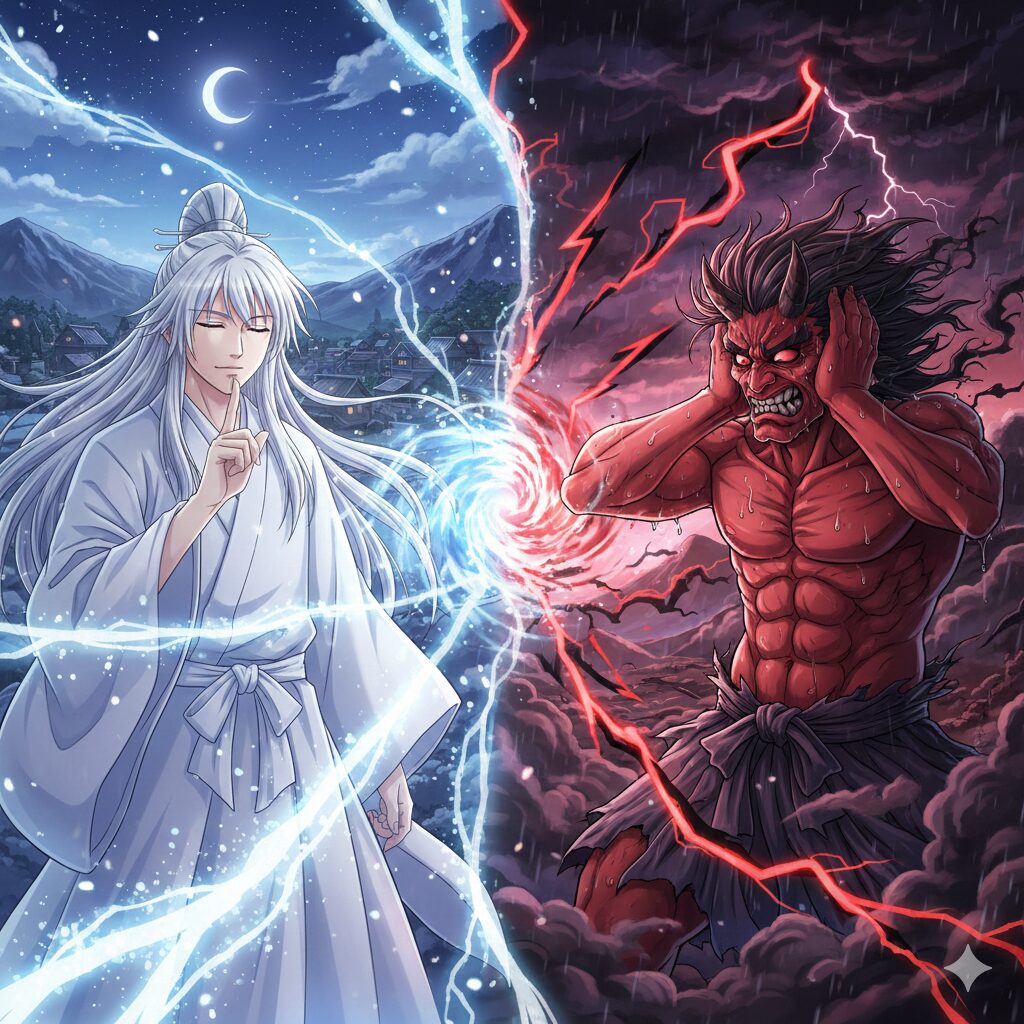
As the elder prayed with tears in his eyes, a faint light leaked from the shrine. Appearing from the light was not a warrior or a giant man, but a beautiful, boy-like god wearing white robes. The god introduced himself as “Shizuka” (Silence).
“I have heard your wish. However, if I suppress him with force, the demon’s grudge will remain as noise. I will solve this with a battle of wits.”
That night, Todoroki the Oni came to the village again, shouting loudly. There, in the village square, stood Shizuka the God.
“Hey, little one! Are you trying to get in my way? I’ll crush you!” Todoroki yelled.
Shizuka smiled and put a single finger to his lips. “Todoroki. I hear you are good at making loud noises. But a truly strong being should also be able to ‘erase sound.’ Will you compete with me?”
“What? There is nothing I cannot do!”
“Then, if you can stay without speaking a word or making a sound until dawn, I will give you all the sake in this village. But if you make even the slightest sound, promise me you will never come down to this mountain again.”
The sake-loving Todoroki agreed immediately. “Gahaha! That’s easy!” The moment he said that, Shizuka waved his hand. Immediately, the area was wrapped in absolute silence.
The contest began. Todoroki kept his mouth shut tight and sat still. At first, he was confident, but as time passed, something strange happened.
It was too quiet. He couldn’t hear the wind or the insects. All he could hear was the sound of his own heart beating—”thump, thump”—and the flow of his blood. For Todoroki, who always asserted his existence with loud voices, this “silence” was unbearable pain. The sounds inside him were deafening.
(It’s painful… I want to scream… I want to make a sound…!)
Cold sweat poured down like a waterfall. On the other hand, Shizuka the God sat with a cool face, as if he had become part of the air. His figure was beautiful, the embodiment of silence itself.
When the sky began to turn white, Todoroki finally reached his limit.
“Uwaaaaaah! It’s so quiet I’m going crazy!!”
The voice Todoroki shouted was so powerful that it blew him away. Todoroki flew far into the distant sky on the wind and eventually became a black cloud and disappeared.
The murmuring of the brook and the singing of small birds returned to the village. The god was no longer there, but the villagers still offer prayers of gratitude to the shrine on quiet nights.
Analysis: Why “Silence” is the Strongest Weapon
This story is not just about monster hunting. It hides unique Japanese aesthetics and philosophy.
1. Contrast between “Stillness” and “Motion”
The Oni, Todoroki, is a symbol of uncontrollable energy, noise, and the desire for self-display. It can be likened to the stress of modern society or the ceaseless torrent of information. In contrast, Shizuka represents harmony, introspection, and “Mu” (nothingness/void). In Japanese culture, silence is not merely the absence of sound, but a space rich with meaning (called “Ma”).
2. The Battle with Oneself
Todoroki lost not because he yielded to the god’s power, but because he could not endure the “sound within himself.” This implies the difficulty of facing oneself in solitude and silence. While shouting outward, one does not notice one’s own weakness, but in silence, one cannot lie.
Decoding Japanese Culture: Shinto and “Purity”
From this folktale, we can learn about the concept of “Seijo” (purity) at the root of Japanese culture.
- Purification by Sound and Silence: At Japanese shrines, we clap our hands (Kashiwade) to make a sound, but the subsequent prayer is done in silence. We drive away evil spirits with sound and connect with the gods in silence.
- Kotodama (Spirit of Words): It is believed that words have souls, but power also dwells in “silence.” Not speaking unnecessary words has been considered a virtue.
The ending, where the Oni is driven away not by killing but by using his own nature against him, connects to the Shinto idea of living in harmony with nature and soothing turbulent spirits (Ara-mitama) into peaceful ones (Nigi-mitama).
What Would You Do?
Living in modern times, we are constantly surrounded by sounds and information, like Todoroki the Oni, and we may feel anxious if we are not transmitting something. If you were placed in complete silence for one night, would you be fine? Or would you be unable to bear your own inner sounds?
Once in a while, put down your smartphone, turn off the TV, and try to create a silence like “Otonashi Village.” The voice of the god that appears there might heal you.
After reading this story, what kind of “silence” has visited your heart?
References & Related Info
Read more Japanese Folktales here:
Japanese Folktale Series
日本には八百万(やおよろず)の神が存在すると言われています。山に、川に、そして私たちの日常のふとした瞬間に、神さまは宿っています。今回ご紹介するのは、力ではなく「ある意外な方法」で鬼を退治した神さまの物語です。日本の精神性が色濃く反映されたこの物語を、じっくりとお楽しみください。
【日本昔話】神さまの鬼退治
むかしむかし、ある深い山奥に「音無村(おとなしむら)」という小さな村がありました。その名の通り、村人たちは静けさを愛し、自然の音に耳を傾けて慎ましく暮らしていました。
しかし、ある年の夏のことです。隣の黒雲山から、恐ろしい鬼「轟(とどろき)」がやってきました。轟は身長が三メートルもあり、真っ赤な肌に二本の角、そして何より恐ろしいのは、その大声でした。
「腹が減ったぞー! 酒を出せー!」
轟が叫ぶだけで、村の家の障子はビリビリと破れ、子供たちは泣き出し、鳥たちは驚いて空へ逃げ去りました。轟は毎晩やってきては、太鼓のような腹を叩き、大声で歌い散らし、村の静寂を破壊し続けました。村人たちは恐怖と寝不足で痩せ細ってしまいました。
村の長老は困り果て、村外れにある古びたお社(やしろ)へ行きました。そこは、もう誰も名前すら覚えていない小さな神さまが祀られている場所でした。
「神さま、どうかあの大声の鬼を追い払ってください。私たちはただ、静かに暮らしたいのです」
長老が涙ながらに祈ると、お社の中からぽぅっと淡い光が漏れ出しました。現れたのは、武者でも大男でもなく、白い着物を着た、透き通るように美しい少年のような神さまでした。その神さまは「静(しずか)」と名乗りました。
「お前たちの願い、聞き届けた。しかし、力でねじ伏せれば、鬼の恨みは騒音となって残り続けるだろう。私が知恵比べで解決しよう」
その夜、鬼の轟がまた大声を上げて村へやってきました。すると、村の広場に神さまの静が立っていました。
「おい、ちびっ子! 俺様の邪魔をする気か? 踏み潰してやるぞ!」と轟が怒鳴りました。
静は微笑んで、指を一本口元に当てました。「轟よ。お前は大きな音を出すのが得意だそうだな。だが、本当に強い者は『音を消す』こともできるはずだ。私と勝負をしないか?」
「なんだと? 俺様にできないことなどないわ!」
「では、夜明けまで一言も発さず、音も立てずにいられたら、この村の酒を全てお前にやろう。しかし、もし少しでも音を立てたら、二度とこの山へは降りてこないと約束しろ」
酒好きの轟は、二つ返事で承諾しました。「ガハハ! たやすいことだ!」そう言った瞬間、静がすっと手を振りました。すると、辺り一面が完全な静寂に包まれました。
勝負が始まりました。轟は口を堅く結び、じっと座り込みました。最初は余裕でしたが、時間が経つにつれ、異変が起きました。
あまりにも静かなのです。風の音も、虫の声も聞こえません。聞こえるのは、自分自身の心臓の音「ドクン、ドクン」と、血が流れる音だけ。普段、大声で自分の存在を誇示していた轟にとって、この「沈黙」は耐え難い苦痛でした。自分の内側の音がうるさくてたまらないのです。
(苦しい……何か叫びたい……音を出したい……!)
冷や汗が滝のように流れ落ちます。一方、神さまの静は、まるで空気の一部になったかのように、涼しい顔で座っています。その姿は美しく、静寂そのものでした。
空が白み始めた頃、ついに轟は我慢の限界を迎えました。
「うわあああああ! 静かすぎて気が狂いそうだあああ!!」
轟が叫んだその声は、あまりの圧力で自分自身を吹き飛ばしてしまいました。轟は風に乗って遠い空の彼方へ飛んでいき、やがて黒い雲となって消えていきました。
村には再び、小川のせせらぎと小鳥のさえずりが戻ってきました。神さまの姿はもうありませんでしたが、村人たちは今でも、静かな夜にはお社に感謝の祈りを捧げています。
物語の考察:なぜ「静寂」が最強の武器なのか
この物語は、単なる「化け物退治」の話ではありません。ここには日本独自の美学と哲学が隠されています。
1. 「静」対「動」の対比
鬼である轟は、制御できないエネルギー、騒音、自己顕示欲の象徴です。現代社会におけるストレスや、止まらない情報の奔流とも言えるでしょう。対する神さまの静は、調和、内省、そして「無」の象徴です。日本文化において、沈黙は単なる音の欠如ではなく、豊かな意味を持つ空間(「間」)として捉えられます。
2. 己との戦い
轟が負けたのは、神さまの力に屈したからではありません。「自分自身の内なる音」に耐えられなかったからです。これは、私たちが孤独や静寂の中で自分自身と向き合うことの難しさを暗示しています。外に向かって叫んでいる間は自分の弱さに気づきませんが、静寂の中では嘘がつけないのです。
日本文化を読み解く:神道と「清浄」
この昔話から、私たちは日本文化の根底にある「清浄(せいじょう)」の概念を学ぶことができます。
- 音によるお祓いと静寂: 日本の神社では、柏手(かしわで)を打って音を出しますが、その後の祈りは静寂の中で行われます。音で邪気を払い、静寂で神と繋がるのです。
- 言霊(ことだま): 言葉には魂が宿るとされますが、同時に「沈黙」にも力が宿ります。無駄な言葉を発しないことは、美徳とされてきました。
鬼を力で殺すのではなく、鬼自身の性質を利用して退散させる結末は、自然と共生し、荒ぶる魂(荒御魂)を鎮める(和御魂)という神道の考え方に通じています。
あなたならどうしますか?
現代を生きる私たちは、鬼の「轟」のように、常に音や情報に囲まれ、何かを発信していないと不安になることがあります。もし、あなたが完全な静寂の中に一晩置かれたら、平気でいられるでしょうか? それとも、自分自身の内なる音に耐えられなくなるでしょうか?
たまにはスマートフォンを置き、テレビを消して、「音無村」のような静寂を作ってみてください。そこに現れる神さまの声が、あなたを癒やしてくれるかもしれません。
この物語を読んで、あなたの心にどのような「静けさ」が訪れましたか?
参考リンク・関連情報
もっと日本の昔話を知りたい方はこちら:
Japanese Folktale Series


コメント