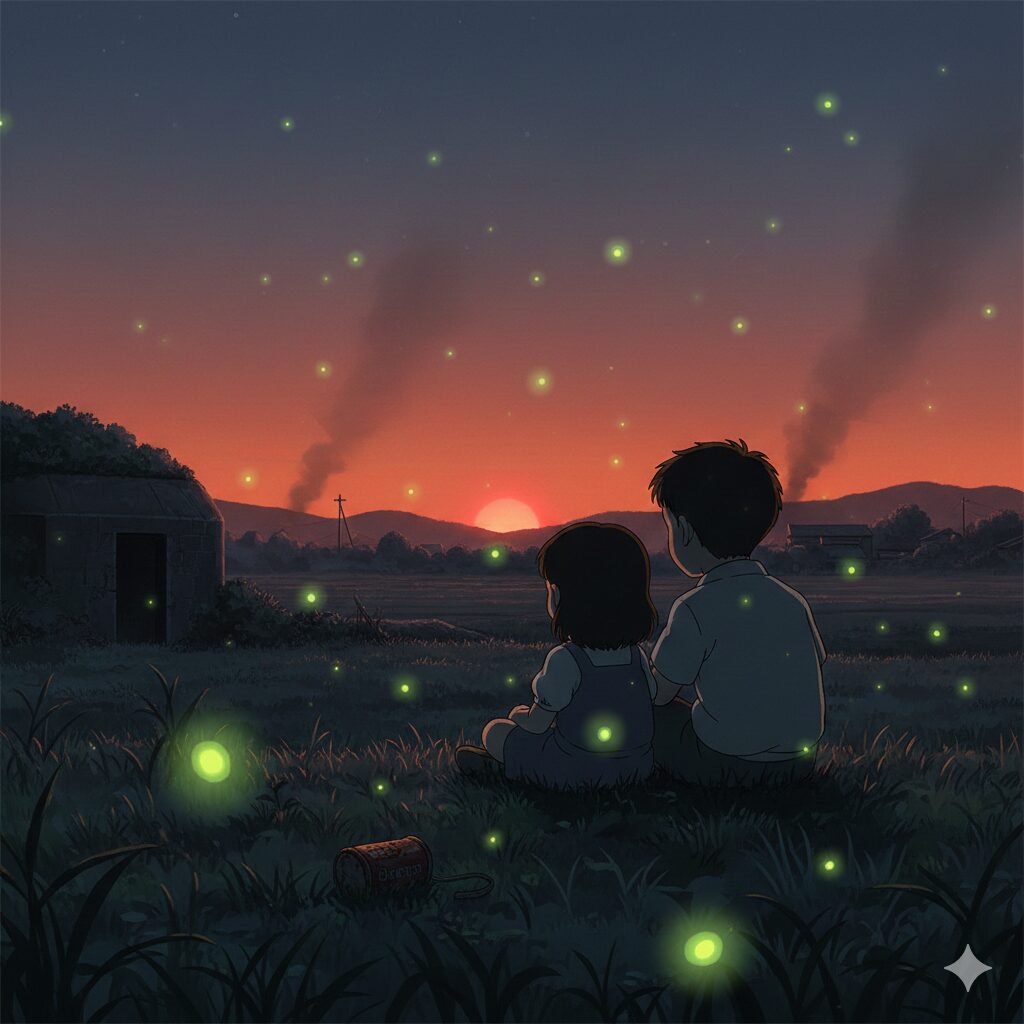
When people think of Studio Ghibli, they often imagine fantastic, heartwarming tales like “My Neighbor Totoro” or “Spirited Away.” However, within the Ghibli canon exists a masterpiece that confronts one of humanity’s darkest realities—war—with unflinching honesty. That film is Isao Takahata’s 1988 animated feature, “Grave of the Fireflies.”
This film is not mere entertainment. It possesses the power to shake the very souls of its viewers, forcing a deep contemplation on the cruelty of war and human dignity under extreme conditions. More than 30 years after its release, it continues to shock audiences worldwide. In this article, we will delve deep into this work, exploring its plot, its significance in Japanese society, and its cultural background.

1. Synopsis: Two Lives Fragilely Burned Out Amidst the Flames of War
The story is set in Kobe, Japan, in 1945, during the final months of World War II. 14-year-old Seita and his 4-year-old sister, Setsuko, are caught in a fierce air raid while their father, a naval captain, is away at war. Their sickly mother evacuates to a bomb shelter ahead of them, but she succumbs to severe burns sustained during the bombing.
Having lost both their home and their mother, the young siblings turn to a distant aunt living in Nishinomiya. Initially, she takes them in, but as food shortages worsen and the war intensifies, her attitude toward them turns cold. Resentful that they do not work yet share the food, and feeling a sense of obligation to those fighting for the country, her words become increasingly harsh, mentally cornering Seita and Setsuko.
Unable to bear the discomfort any longer, Seita decides to leave the house with Setsuko. The new “home” they choose is an abandoned hillside bomb shelter in the suburbs. At first, they find a modest sense of freedom and joy in living alone, without worrying about anyone else. At night, they gaze at the fantastical light of fireflies released inside their mosquito net, immersing themselves in fleeting happiness.
However, reality is cruel. Rations cease, the money they have becomes useless, and even when Seita steals vegetables from fields or loots during the chaos of air raids, he cannot satisfy young Setsuko’s hunger. Setsuko weakens from malnutrition and heat rash. Despite Seita’s desperate nursing, Setsuko’s short life comes to an end one day shortly after the war ends.
Seita, having cremated his beloved sister with his own hands, also runs out of strength soon after and dies a lonely death inside a train station. The figures of the two as ghosts, appearing at the beginning and end of the film, overlook the modern city of Kobe, quietly conveying the wandering of souls with nowhere to go.
2. Evaluation and Commentary: Why “Grave of the Fireflies” is Special
The “Saddest Animated Film” That Shook the World
“Grave of the Fireflies” is highly acclaimed by film critics and audiences abroad as “one of the saddest films ever made” and “a true work of art that transcends the boundaries of animation.” It completely eliminates heroic aspects of war or political messages, focusing solely on the collapse of everyday life from the perspective of “helpless children placed in the context of war,” evoking universal empathy.
In particular, Studio Ghibli’s delicate and beautiful animation style further emphasizes the tragedy. The beautiful Japanese rural landscape, the light of fireflies coloring summer nights, and Setsuko’s innocent smile. All of these, contrasted with the violence of war, make the magnitude of what was lost painfully clear.
“Grave of the Fireflies” in Japan: A Summer Tradition and Peace Education
In Japan, “Grave of the Fireflies” holds a special significance. For many years, it was customary for this film to be broadcast on television around the anniversary of the end of the war in August (though the frequency has decreased in recent years). For many Japanese people, watching this film was like a “summer ritual” to remember the misery of past wars and reaffirm the importance of peace.
It is often used as teaching material for peace education in schools, and many Japanese people were shocked by watching this film as children and developed a strong aversion to war. While it is a work that inflicts trauma-level sadness, it has therefore fulfilled the role of strongly engraving the message “war must never happen again” into people’s hearts.
Consideration from Historical and Cultural Backgrounds: A Society of “Endurance” and Isolation
To more deeply understand this film, it is necessary to know the cultural background of Japanese society at that time.
- The Spirit of “We Want Nothing Until Victory”: During the war, all Japanese citizens were forced to live lives of austerity. Under the slogan “Luxury is the enemy,” there was a “Tonarigumi” (neighborhood association) system where people monitored each other, and there was an atmosphere where deviating from the norms set by the state was not allowed. Although the aunt’s attitude seems cruel, she too can be said to have been a typical adult of that time who was desperate to survive and had lost her composure.
- Seita’s Choices and the “Theory of Self-Responsibility”: In modern Japan, this film is often a subject of debate. It is a critical perspective on Seita’s actions, asking, “Why couldn’t Seita have managed things better?” or ” Shouldn’t he have humbled himself and stayed at his aunt’s house?” This is linked to the pressure to conform in Japanese society, which does not look kindly on disrupting group harmony, and the “theory of self-responsibility” that has strengthened in recent years. However, can we really expect wise, adult-like judgments from a 14-year-old boy with high pride? His immaturity and stubbornness are also part of a youth distorted by war.
- The Symbolism of “Fireflies” (Hotaru): In Japanese culture, fireflies have been considered symbols of short, fleeting lives and the souls of the deceased. The sight of fireflies shining beautifully in the dark night and quickly vanishing is the very image of the all-too-short lives of Seita and Setsuko. The fact that the Japanese title uses ateji (phonetic kanji) for “hotaru” that can be read as “fire dropping” is also said to imply an overlapping of the falling firebombs during air raids with the light of the fireflies.
3. Recommended Points: Why You Should Watch This Work
- Unparalleled Realistic Animation: The depiction of the landscape, daily necessities, and people’s clothing in Japan around 1945, based on thorough historical research, is overwhelmingly impressive. The reality, as if watching a documentary film, enhances the tragedy of the story.
- Expression of Unspoken Emotions: The subtleties of emotion told outside of dialogue, such as Setsuko’s adorable gestures and words, and Seita’s sorrowful expressions thinking of his sister, are wonderful. In particular, scenes like Setsuko putting water in a fruit drop tin to drink, or pretending mud dumplings are rice balls, cannot be watched without tears.
- Questions for Modern Society: Although this film depicts events from the past more than 70 years ago, the themes of “poverty,” “isolation,” and “societal indifference” portrayed there are universal problems that also apply to modern society. Even in the affluent modern era, aren’t there unseen “Seitas and Setsukos” seeking help? This film is also a mirror for us to re-examine our own society.
Conclusion
“Grave of the Fireflies” is by no means a comfortable film to watch. After finishing it, you may be overcome by deep sadness and a sense of powerlessness. However, that is precisely why this film is worth watching. How unreasonably war steals the daily lives and futures of innocent people. This masterpiece, which depicts that truth without averting its eyes, is an eternal monument that continues to question the meaning of peace across times and borders.
If you wish to know the true power that animation possesses, and if you want to touch deeply upon the history and spirituality of Japan, please prepare yourself and face this film.
References and Related Links
- Nausicaa.net – Grave of the Fireflies Information (English Fan Site)
- Rotten Tomatoes – Grave of the Fireflies Reviews
If you would like to know more about Japanese culture, please also read these articles.
Category: Japanese Culture
はじめに:忘れ去られた子供たちの魂への鎮魂歌「火垂るの墓」
スタジオジブリといえば、「となりのトトロ」や「千と千尋の神隠し」のような、ファンタジックで心温まる物語を想像する人が多いかもしれません。しかし、ジブリ作品の中には、戦争という人類史上最も暗い現実に真正面から向き合った、あまりにも痛切な傑作が存在します。それが、1988年に公開された高畑勲監督によるアニメーション映画「火垂るの墓」(Grave of the Fireflies)です。
この映画は、単なるエンターテインメントではありません。観る者の魂を揺さぶり、戦争の残酷さ、そして極限状態における人間の尊厳について、深く考えさせずにはおかない力を持っています。公開から30年以上が経過した今もなお、世界中の人々に衝撃を与え続けているこの作品について、そのあらすじ、日本社会における位置づけ、そして文化的な背景を交えて深く掘り下げていきます。
1. あらすじ:戦火の下、儚く燃え尽きた二つの命
物語の舞台は、第二次世界大戦末期、1945年の日本・神戸です。14歳の少年・清太(せいた)と、4歳の妹・節子(せつこ)は、海軍大尉の父の留守中、激しい空襲に見舞われます。病身の母は先に防空壕へ避難していましたが、空襲による火傷で帰らぬ人となってしまいます。
家も家族も失った幼い兄妹は、西宮に住む遠い親戚の叔母の家を頼ります。当初は二人を受け入れた叔母でしたが、食糧難が深刻化し、戦争が激しさを増すにつれて、二人に冷たく当たるようになります。働かずに食事を分け与えられることへの不満や、国のために戦う人々への引け目から、叔母の言葉は次第に棘を帯び、清太と節子を精神的に追い詰めていきます。
居心地の悪さに耐えかねた清太は、節子を連れて家を出ることを決意します。二人が選んだ新しい「家」は、誰も使わなくなった郊外の横穴式防空壕でした。最初のうちは、誰にも気兼ねなく過ごせる二人きりの生活に、ささやかな自由と喜びを感じていました。夜には蚊帳の中に放ったホタルの幻想的な光を眺め、つかの間の幸せに浸ります。
しかし、現実は残酷でした。配給は途絶え、持っていたお金も役に立たず、清太が畑から野菜を盗んだり、空襲の混乱に乗じて火事場泥棒をしたりしても、幼い節子の飢えを満たすことはできません。栄養失調とあせもで衰弱していく節子。清太の必死の看病も虚しく、終戦から間もないある日、節子は短い生涯を閉じます。
最愛の妹を自らの手で荼毘に付した清太もまた、ほどなくして駅の構内で力尽き、孤独な死を迎えます。映画の冒頭と結末に登場する幽霊となった二人の姿は、現代の神戸の街を見下ろし、行き場のない魂の彷徨を静かに伝えています。
2. 作品評価と論評:なぜ「火垂るの墓」は特別なのか
世界が震えた「最も悲しいアニメーション映画」
「火垂るの墓」は、海外の映画評論家や観客から「これまでに作られた最も悲しい映画の一つ」「アニメーションの枠を超えた真の芸術作品」として極めて高く評価されています。戦争の英雄的な側面や政治的なメッセージを一切排し、ただひたすらに「戦争という状況下に置かれた無力な子供たち」の視点から日常が崩壊していく様を描いた点が、普遍的な共感を呼んでいます。
特に、スタジオジブリならではの繊細で美しいアニメーション表現が、悲劇性をより際立たせています。美しい日本の田園風景、夏の夜を彩るホタルの光、節子の無邪気な笑顔。それらすべてが、戦争の暴力性と対比されることで、失われたものの大きさを痛感させるのです。
日本における「火垂るの墓」:夏の風物詩と平和教育
日本において、「火垂るの墓」は特別な意味を持つ作品です。毎年8月の終戦記念日前後になると、テレビでこの映画が放送されることが長年の慣習となっていました(近年はその頻度は減っていますが)。多くの日本人にとって、この映画を観ることは、過去の戦争の悲惨さを思い出し、平和の尊さを再確認するための「夏の儀式」のようなものでした。
学校の平和学習の教材として用いられることも多く、子供の頃にこの映画を観て衝撃を受け、戦争に対する強烈な嫌悪感を抱いたという日本人は少なくありません。トラウマ級の悲しみを与える作品でありながら、それゆえに「二度と戦争を起こしてはならない」というメッセージを強烈に心に刻み込む役割を果たしてきたのです。
歴史・文化的背景からの考察:「耐え忍ぶ」社会と孤立
この映画をより深く理解するためには、当時の日本社会の文化的背景を知る必要があります。
- 「欲しがりません勝つまでは」の精神: 戦時中の日本は、国民全員が耐乏生活を強いられていました。「贅沢は敵だ」というスローガンのもと、互いに監視し合う「隣組」制度があり、国の定めた規範から外れることは許されない空気がありました。叔母の態度は冷酷に見えますが、彼女もまた、生きるために必死で、余裕を失っていた当時の一般的な大人の一人だったと言えます。
- 清太の選択と「自己責任論」: 現代の日本において、この映画はしばしば議論の的になります。それは「清太はなぜもっと上手く立ち回れなかったのか」「叔母の家に頭を下げて留まるべきだったのではないか」という、清太の行動に対する批判的な視点です。これは、集団の和を乱すことをよしとしない日本社会の同調圧力や、近年強まっている「自己責任論」とも結びついています。しかし、まだ14歳の、プライドの高い少年に、大人のような賢明な判断を求めることが果たしてできるでしょうか。彼の未熟さや意地もまた、戦争によって歪められた青春の一部なのです。
- 「火垂る(ホタル)」の象徴性: 日本の文化において、ホタルは短く儚い命、そして死者の魂の象徴とされてきました。闇夜に美しく輝き、すぐに消えてしまうホタルの姿は、清太と節子のあまりにも短い生涯そのものです。タイトルが「火垂る」と当て字になっていることにも、空襲の焼夷弾の火の粉が降り注ぐ様子と、ホタルの光を重ね合わせる意図が込められていると言われています。
3. おすすめポイント:この作品を観るべき理由
- 比類なきリアリズムのアニメーション: 徹底的な時代考証に基づいた、1945年当時の日本の風景、生活用品、人々の服装などの描写は圧巻です。まるでドキュメンタリー映像を見ているかのようなリアリティが、物語の悲劇性を高めます。
- 言葉にならない感情の表現: 節子の愛らしい仕草や言葉、清太の妹を想う切ない表情など、セリフ以外の部分で語られる感情の機微が素晴らしいです。特に、節子がドロップスの缶に水を入れて飲むシーンや、泥団子をおにぎりに見立てるシーンは、涙なしには見られません。
- 現代社会への問いかけ: この映画が描くのは、70年以上前の過去の出来事ですが、そこで描かれる「貧困」「孤立」「社会の無関心」といったテーマは、現代社会にも通じる普遍的な問題です。豊かになった現代でも、見えないところで助けを求めている「清太と節子」がいるのではないか。この映画は、私たち自身の社会を見つめ直す鏡でもあります。
まとめ
「火垂るの墓」は、決して心地よい映画ではありません。観終わった後、深い悲しみと無力感に襲われるかもしれません。しかし、だからこそ、この映画は観る価値があります。戦争がいかに理不尽に、何の罪もない人々の日常と未来を奪い去るのか。その真実から目を背けずに描いたこの傑作は、時代や国境を越えて、平和の意味を問い続ける永遠の記念碑なのです。
もしあなたが、アニメーションが持つ真の力を知りたいと願うなら、そして日本の歴史と精神性に深く触れたいと思うなら、覚悟を持ってこの映画と向き合ってみてください。
参考文献・関連リンク
日本の文化についてもっと知りたい方は、こちらの記事もあわせてお読みください。
カテゴリー:日本文化

コメント