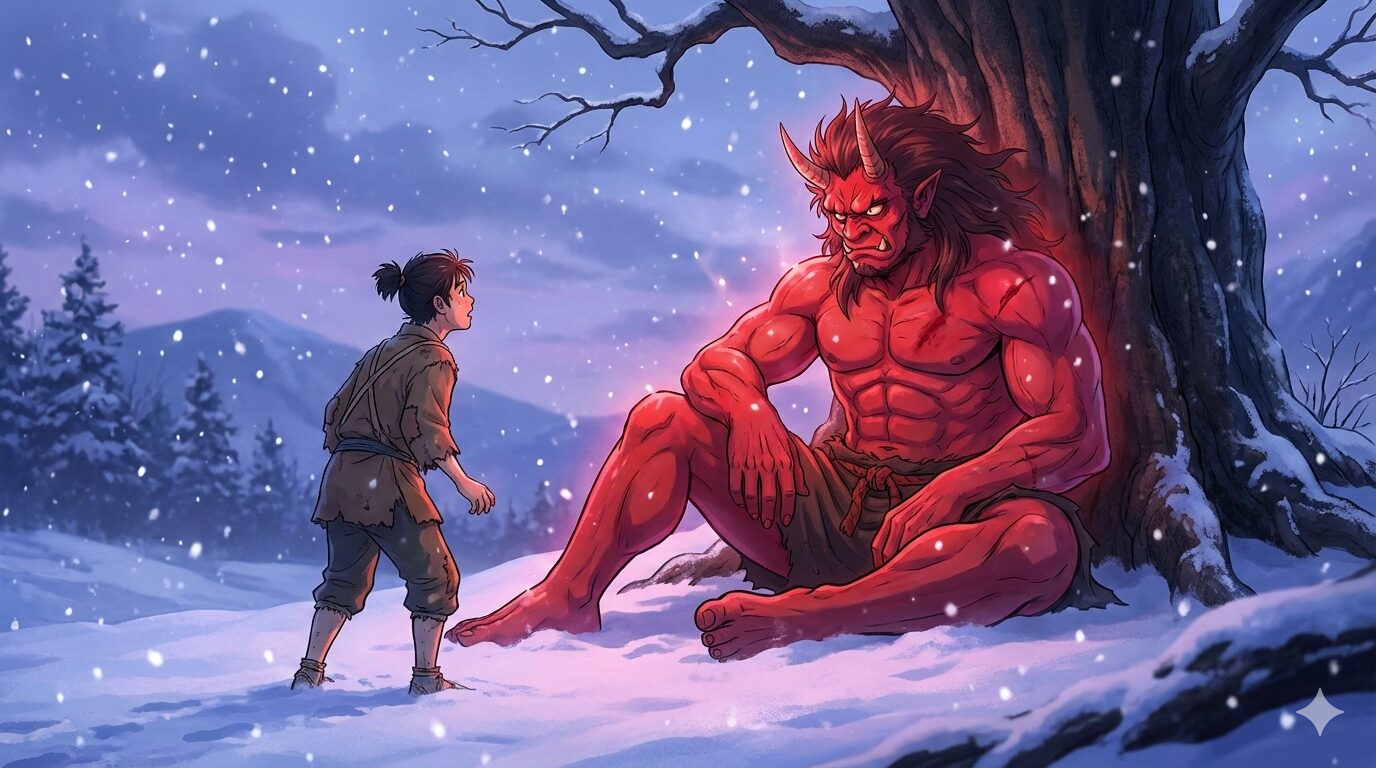
In Japanese folklore, the “Oni” is not merely a villain. While they are terrifying beings that can devour humans, they are also “Marebito” (visitors from the other world) who can bestow overwhelming wealth or power upon humans. The story I am introducing today, “The Power Received from the Oni,” is a hidden masterpiece that deeply questions human desire, kindness, and the cost of power.
If you gained a “power” that surpassed everyone else’s, how would you use it? This story serves as a warning to us living in the modern world.

Folktale: The Power Received from the Oni
An Encounter Deep in the Mountains
Once upon a time, in a deep, snowy mountain, lived a young woodcutter named Sokichi. Sokichi was an honest man, but he was small in stature. It took him twice as long as other men to cut down a large tree. “Ah, if only I had more strength, I could make life easier for my sick mother,” was his constant lament.
One stormy night, as Sokichi was warming himself in his mountain hut, a thundering sound—Doshin, Doshin—approached. The door flew open with force, and there stood a Red Oni, so huge his head touched the ceiling. Several arrows were stuck in the Oni’s body, and blood was flowing. He had likely been chased by warriors from the village.
An ordinary person would have fainted from fear, but Sokichi, seeing the pain on the Oni’s face, instinctively beckoned him in. “Come inside. The humans won’t find you here.”
The Pact of Red Blood
Sokichi treated the Oni’s wounds with secret medicinal herbs and shared his meager porridge. The Oni slept for three days and three nights, and by the morning of the fourth day, he had completely recovered.
“Human, why did you save me?” The Oni’s voice resonated like thunder.
“Whether it’s an Oni or a Buddha, if someone is suffering right in front of me, it’s my nature to help,” Sokichi answered, trembling.
The Oni grinned, shaved a bit of his horn into a powder, and offered it to Sokichi. “Drink this. I will give you the strength of ‘100 men.’ You will be able to lift boulders lightly and snap great trees with your bare hands. But promise me one thing.”
The Oni’s red eyes glowed as he spoke.
“Use this power for others. If you use this power for your own selfishness and greed, at that moment, you will lose everything.”
When Sokichi drank the powder, a burning power surged through his body. The Oni then left like the wind.
The Hero’s Glory and Downfall
Returning to the village, Sokichi became an instant star with his superhuman strength. When the river threatened to flood, he moved massive boulders to build a levee. When a bridge collapsed, he rebuilt it alone. The villagers worshipped Sokichi and gave him gifts of gratitude.
However, fame can be a poison. A wealthy merchant in the neighboring town heard rumors of Sokichi and said, “If you show off your strength at my mansion, I will give you a fortune. Throw all my sumo wrestlers to the ground.”
At first, Sokichi refused. But he was blinded by the pile of gold coins before his eyes. “With this, I won’t have to work anymore. I can build a great palace.” He forgot his promise. “Fine, I will show you my power!”
At the merchant’s mansion, just as Sokichi lifted a giant stone lantern to show off to the crowd, the power suddenly drained from his body. The stone lantern regained its crushing weight and fell straight onto Sokichi.
The Lesson Left Behind
Sokichi survived, but his leg was broken, and he could never walk the mountains again. Of course, his superhuman strength had vanished. Lying in his futon, he would remember the Oni’s words from that stormy night and shed tears.
“Power is something borrowed. If the heart changes, it flees immediately.”
It is said that although Sokichi could no longer do physical labor, he spent the rest of his quiet life helping many people with the knowledge of medicinal herbs he had learned from the Oni.
Analysis: The True Nature of the Power Gifted by the Oni
This story is highly suggestive. The “Oni” here symbolizes not just a monster, but the “energy of nature itself.”
- The Duality of Power: The power given by the Oni could be used to build levees (construction) or to perform for money (greed). Technology and authority are the same. The “ethics” of the user are being tested.
- Contracts and Taboos: Japanese folktales often feature constraints, such as the “taboo of looking” (The Crane of Gratitude). This represents the ancient Japanese wisdom that “one must not over-exploit the blessings of nature.”
- Karma (Cause and Effect): Sokichi was not a villain, but he was punished for his “hubris.” The fact that he is depicted not as a perfect saint but as a human with weaknesses enhances the reality of this story.
Decoding Japanese Culture: The Spirit of Coexisting with “Oni”
For international readers, “Oni” is often translated as “Demon” or “Ogre,” but the nuance is slightly different.
1. Oni as a Type of Deity
In Japan, Oni are feared but also worshipped. For example, they are treated as guardians of the “Kimomon” (Demon Gate, North-East direction) or as powerful protectors who drive away evil. The Red Oni in this story is depicted not as an evil being who returns evil for good, but as a creature of integrity.
2. The Culture of “On” (Debt of Gratitude)
Sokichi helps the Oni, and the Oni returns the power. This is the spirit of “On-gaeshi” (Repayment of kindness) that lies at the root of Japanese culture. However, when that favor is tainted by selfishness, “Bachi” (Divine punishment) strikes. Here lies a heavy warning against betraying trust and obligation in Japanese society.
To Our Readers
What did you think of “The Power Received from the Oni”?
In modern society, we also possess a kind of magic power called “technology” and “money.” But are we using it solely for our own egos? If you, like Sokichi, were to gain the power to change the world in an instant, are you confident you could keep that “condition”?
Please let us know your thoughts.
References & Related Information
If you want to learn more about Japanese legends and Yokai, please check the following pages:
- Our Folktale Series: Japanese Folktale Series Category
- External Resource (Wikipedia): History and Cultural Background of Oni
はじめに:日本の闇に潜む異形の神、鬼との契約
日本の民話において、「鬼(Oni)」は単なる悪役ではありません。彼らは時に人を喰らう恐ろしい存在でありながら、時に圧倒的な富や力を人間に授ける「まれびと(異界からの来訪者)」でもあります。今回ご紹介する物語『鬼からもらった力』は、人間の欲望、優しさ、そして力の代償について深く問いかける、隠れた名作です。
もし、あなたが誰にも負けない「力」を手に入れたら、その力を何に使いますか?この物語は、現代を生きる私たちへの警告でもあります。
昔話『鬼からもらった力』
山奥での遭遇
むかしむかし、ある深い雪山に、惣吉(そうきち)という木こりの若者が住んでいました。惣吉は正直者でしたが、体は小さく、大きな木を切り倒すのに人の倍の時間がかかりました。「ああ、もっと力があれば、病気の母ちゃんに楽をさせてやれるのに」それが惣吉の口癖でした。
ある吹雪の晩、惣吉が山小屋で暖をとっていると、ドシン、ドシンと地響きが近づいてきました。戸が破れんばかりの勢いで開くと、そこに立っていたのは、天井に頭がつくほど巨大な赤鬼でした。鬼の体には数本の矢が刺さり、血が流れていました。里の武士たちに追われたのでしょう。
普通の人間なら腰を抜かすところですが、惣吉は鬼の苦痛に歪んだ顔を見て、とっさに手招きしました。「ここへ入れ。人間には見つからねえ」
赤き血の契約
惣吉は秘伝の薬草で鬼の傷を手当てし、なけなしの粥を分け与えました。鬼は三日三晩眠り続け、四日目の朝、すっかり回復していました。
「人間よ、なぜ俺を助けた」鬼の声は雷のように響きました。
「目の前で苦しんでいる奴がいれば、鬼でも仏でも助けるのが俺の性分だ」惣吉は震えながらも答えました。
鬼はニヤリと笑い、自分の角を少し削り、粉にして惣吉に差し出しました。「これを飲め。お前に『百人力』をやる。大岩も軽々と持ち上がり、大木も素手でへし折れるだろう。だが、一つだけ約束しろ」
鬼は赤い目を光らせて言いました。
「この力は、他人のために使え。自分の私利私欲のために力を使えば、その時、お前は全てを失うだろう」
惣吉が粉を飲むと、体中に灼熱のような力がみなぎりました。鬼は風のように去っていきました。
英雄の栄光と没落
里へ戻った惣吉は、その怪力で一躍人気者になりました。川が氾濫しそうになれば大岩を動かして堤防を作り、崩れた橋を一人でかけ直しました。村人は惣吉を拝み、感謝の品を贈りました。
しかし、名声は毒にもなります。隣町の長者が惣吉の噂を聞きつけ、こう言いました。「わしの屋敷で力自慢を見せれば、大金をやろう。相撲取りを全員投げ飛ばしてみせろ」
最初は断っていた惣吉でしたが、目の前に積まれた小判の山に目がくらみました。「これがあれば、もう働かなくてもいい。大御殿が建つぞ」。彼は約束を忘れました。「いいだろう、俺の力を見せてやる!」
惣吉が長者の屋敷で、巨大な石灯籠を持ち上げ、観衆に見せびらかそうとしたその瞬間です。体からスッと力が抜け落ちました。持ち上げた石灯籠はズシリと重さを増し、そのまま惣吉の上に落下しました。
残された教訓
惣吉は命こそ助かりましたが、足の骨を折り、二度と山を歩けない体になりました。もちろん、怪力も消え失せていました。彼は布団の中で、あの吹雪の夜の鬼の言葉を思い出しては、涙を流しました。
「力は借り物。心が変われば、すぐに逃げていくものだ」
惣吉はその後、力仕事はできませんでしたが、鬼から教わった薬草の知識で多くの人を助け、静かに暮らしたといいます。
考察:鬼が授けた「力」の正体とは
この物語は非常に示唆に富んでいます。ここで登場する「鬼」は、単なる怪物ではなく「自然界のエネルギーそのもの」を象徴しています。
- 力の二面性: 鬼から与えられた力は、堤防を作る(建設)ためにも、見世物として稼ぐ(欲望)ためにも使えました。テクノロジーや権力も同様です。使う側の「倫理観」が試されています。
- 契約とタブー: 日本の昔話には「見るなのタブー(鶴の恩返し)」など、異界との契約には必ず制約が伴います。これは「自然の恵みを搾取しすぎてはいけない」という古代日本人の知恵です。
- 因果応報: 惣吉は悪人ではありませんでしたが、「慢心」によって罰を受けました。完璧な善人ではなく、弱さを持った人間として描かれている点が、この物語のリアリティを高めています。
日本文化を読み解く:Oni(鬼)と共生する精神
海外の読者にとって、鬼(Oni)は「Demon」や「Ogre」と翻訳されることが多いですが、ニュアンスは少し異なります。
1. 鬼は神の一種である
日本では「鬼」は恐れられると同時に、祀られる対象でもあります。例えば、鬼門(北東の方角)を守る神として扱われたり、悪いものを追い払う強力な守護者として描かれたりします。この物語の赤鬼も、恩を仇で返すような邪悪な存在ではなく、義理堅い性格として描かれています。
2. 「恩(On)」の文化
惣吉が鬼を助け、鬼が力を返す。これは日本文化の根底にある「恩返し(Repayment of kindness)」の精神です。しかし、その恩を私利私欲で汚した時、バチ(Divine punishment)が当たります。日本社会において、信頼や恩義を裏切ることへの重い戒めがここにはあります。
読者の皆様へ
『鬼からもらった力』、いかがでしたでしょうか。
現代社会において、私たちも「科学技術」や「お金」という、ある種の魔法の力を持っています。しかし、それを自分のエゴのためだけに使ってはいないでしょうか?もしあなたが惣吉のように、一瞬にして世界を変える力を手に入れたとしたら、あなたはその「制約」を守り通す自信がありますか?
ぜひ、あなたの考えを教えてください。
参考リンク・関連情報
日本の伝説や妖怪についてさらに詳しく知りたい方は、以下のページもご覧ください。
- 当ブログの昔話シリーズ: Japanese Folktale Series Category
- 外部リソース(Wikipedia): 鬼(Oni)の歴史と文化的背景について


コメント