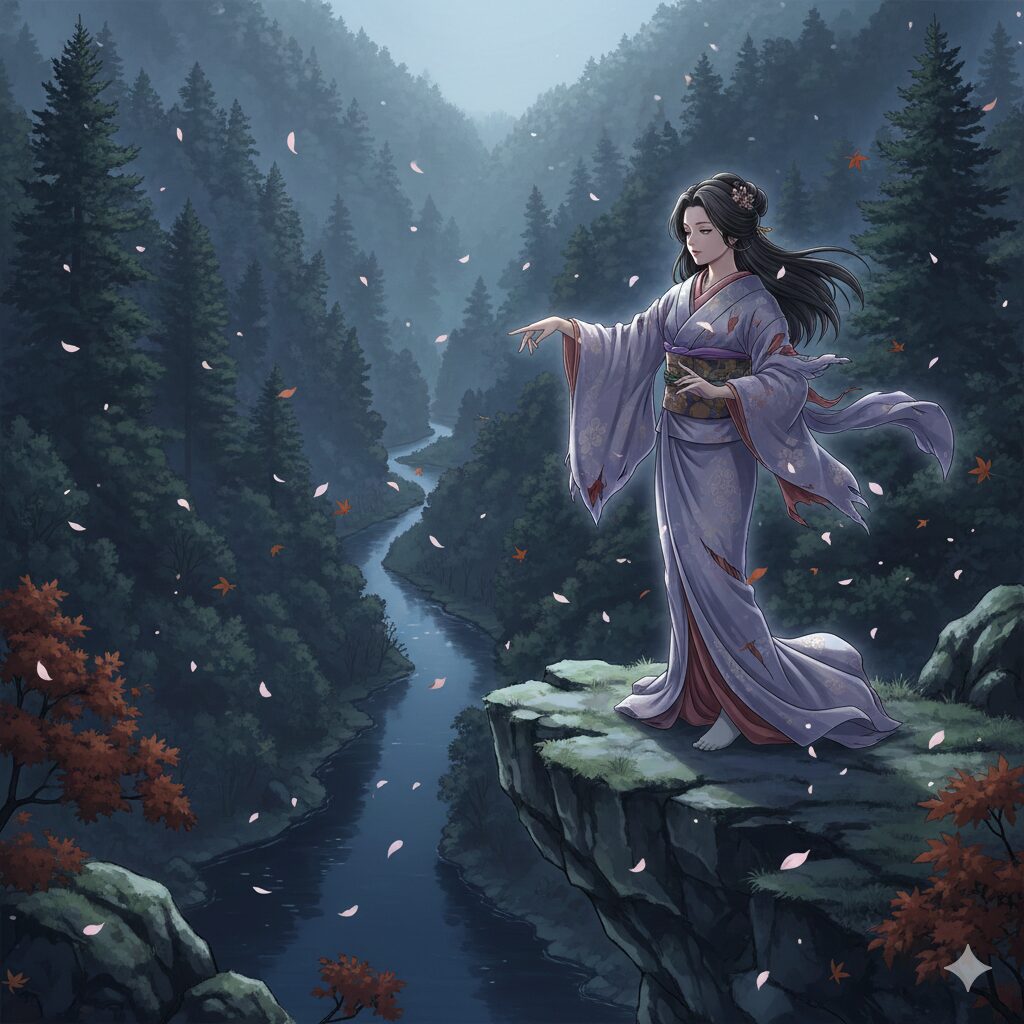
Deep in the mountains of Japan, along the Kiso River, lies a legend that is both heartbreaking and beautiful. This story, known as “Himebuchi no Uta” (The Song of the Princess Pool), conveys the cruelty of a war-torn era and the noble soul that perished within it. Why did the princess have to sing? And why is that place now called “Himebuchi”? Prepare your handkerchiefs, and read on.

The Story: The Song of Himebuchi
Long ago, along the Kiso River, which flows between what is now Nagano and Gifu prefectures, a tragic event took place.
It was the Sengoku period (Warring States period), a time when all of Japan was engulfed in the flames of war. A prestigious noble house was destroyed by enemy forces, and their mansion burned to the ground. From amidst the fire, a single beautiful princess managed to escape with only a few attendants, barely clinging to life.
Fleeing the enemy’s gaze, the princess walked for days along steep mountain paths. Her kimono was torn, her feet were bloodied, and her once-glittering appearance was nowhere to be seen. Yet, driven by the sheer will to survive, she continued walking upstream.
When she reached a certain village, she begged the villagers for help. “Please, share a little water and food. And let me rest for just one night.”
However, the villagers turned their backs on her coldly.
“We don’t want to get involved.”
“If we harbor a fugitive, the enemy will kill us too.”
They locked their doors and drove the princess away. One can only imagine the depth of her despair.
Exhausted and on the verge of losing consciousness, a poor old man known as “Takakura no Jiisama,” who lived on the outskirts of the mountain, found her.
“How pitiful… Come, into my home.”
Though he had little food himself, the old man made warm rice porridge, dressed her in his daughter’s old clothes, and nursed her kindly. To the princess, this was a warmth like a spider’s thread lowered into hell.
But fate is cruel. The enemy pursuers finally closed in on the village.
“Has a strange woman come here?!”
Angry shouts echoed. Not wanting to bring trouble to the old man, the princess ran out of the house on her own and headed toward the river.
She reached a “Buchi” (a deep pool in the river) filled with deep blue water of the Kiso River. Behind her were the enemy troops; in front of her, a precipice and deep water. There was no escape.
The princess made up her mind. Rather than suffer humiliation at the hands of the enemy, she would die with her pride intact.
At that moment, she smoothed her disheveled hair and, to everyone’s surprise, began to sing. It was a “Rice Planting Song” (Taue-uta) that the people of her domain used to sing in peaceful times.
Her clear, beautiful voice reached the ears of the murderous soldiers. As she sang, she gracefully danced, mimicking the gestures of planting rice. Her figure was so divine that it seemed unearthly, and the soldiers watched in breathless awe.
As the song ended, the princess smiled faintly and threw herself into the clear blue abyss.
The sound of water echoed, beautiful ripples spread, and then silence returned.
Since then, the place has been called “Himebuchi” (Princess Pool). It is said that even now, on quiet rainy nights, a sad yet beautiful rice-planting song can be heard from the bottom of the river.
Analysis: Resistance Through Beauty
This story holds meaning beyond simple tragedy. What is remarkable is that the princess’s final act was a “Song.”
Usually, a cornered samurai would fight with a sword or commit seppuku. However, the princess had no weapon and did not resort to violence; she adorned her final moments with “Art” (song and dance). This can be interpreted as a spiritual resistance—culture and pride standing against barbaric violence (war).
Furthermore, the fact that she sang a “Rice Planting Song” is significant. Rice planting is a symbol of “Life” and “Abundance.” By singing a symbol of life on the verge of death, she perhaps transcended death and transformed into a “Spirit protecting the abundance” of the land. Instead of cursing the villagers who rejected her, she left behind a song of harvest, demonstrating her noble spirit.
Cultural Perspective: Water, Women, and Boundaries
In Japanese culture, the “waterside” (rivers and pools) is often seen as a boundary between this world and the next. In many legends, it is believed that dragon gods or spirits reside in the depths.
The legend of “Himebuchi” follows the typical pattern of “suicide by drowning” legends found across Japan. However, it embodies the Japanese aesthetic of “Kishu Ryuritan” (tales of the wandering nobility). Since ancient times, Japanese people have tended to feel deep sympathy and respect for noble figures who lose power struggles and meet tragic ends (a sentiment known as *Hogan-biiki*).
This pool is the place that took her life, but it also functioned as a “sanctuary” that protected her from the impurities of the mundane world (war and enemy soldiers), preserving her beauty eternally. The water washed everything away, sublimating her into a sacred existence.
A Question for You
If you were a villager at that time, what would you have done?
Could you have helped a stranger, knowing it risked the massacre of your family and village? Or would you have locked your door?
Even in modern society, we sometimes close our ears to “calls for help” out of fear of risk. The legend of Himebuchi quietly questions our conscience across hundreds of years.
References
【日本昔話】姫淵のうた:水底に沈んだ悲劇の歌姫と、美しくも残酷な伝説
日本の深い山奥、木曽川のほとりには、悲しくも美しい伝説が残されています。「姫淵(ひめぶち)のうた」と呼ばれるこの物語は、戦乱の世の残酷さと、その中で散った高貴な魂を今に伝えています。なぜ、姫は歌を歌わなければならなかったのか。そして、なぜその場所は「姫淵」と呼ばれるようになったのか。ハンカチを用意して、この物語を読んでください。
昔話のストーリー:姫淵のうた
むかしむかし、今の長野県と岐阜県の境を流れる木曽川沿いに、ひとつの悲しい出来事がありました。
時は戦国時代。日本中が戦(いくさ)の炎に包まれていた頃のことです。ある名門の家が敵に攻め滅ぼされ、屋敷は焼け落ちました。その炎の中から、ひとりの美しい姫君が、わずかな家来と共に命からがら逃げ出しました。
姫は、敵の目を逃れ、険しい山道を何日も何日も歩き続けました。着物は破れ、足は血にまみれ、かつての煌びやかな姿は見る影もありません。それでも姫は、「生き延びなければならない」という一心で、上流へと歩を進めました。
ある村にたどり着いた時、姫は村人たちに助けを求めました。「どうか、水と食べ物を少し分けてください。そして、一晩だけでいい、休ませてください」
しかし、村人たちは冷たく背を向けました。
「関わり合いになりたくない」
「落ち武者をかくまえば、俺たちまで敵に殺される」
彼らは扉を閉ざし、姫を追い払ったのです。姫の絶望はどれほど深かったことでしょう。
疲れ果て、意識が遠のきかけたその時、山の外れに住む「高倉の爺(じい)さま」という貧しい老人が、姫を見つけました。
「なんと痛ましい…。さあ、私の家へ」
爺さまは、自分も食べるものがない中で、温かいお粥を作り、娘の古着を着せ、姫を優しく介抱しました。姫にとって、それは地獄に垂らされた蜘蛛の糸のような温もりでした。
しかし、運命は残酷です。敵の追手が、ついにその村まで迫ってきたのです。
「ここに見慣れぬ女が来ていないか!」
怒号が響き渡ります。姫は、爺さまに迷惑をかけてはいけないと、自ら家を飛び出し、川へと走りました。
行き着いた先は、木曽川の深く青い水をたたえる「淵(ふち)」でした。背後には敵の軍勢、前には断崖絶壁と深い水。もう、逃げ場はありません。
姫は覚悟を決めました。敵の手にかかって辱めを受けるくらいなら、誇り高く散ろうと。
その時です。姫は乱れた髪を整えると、なんと歌を歌い始めたのです。それは、領地の民が平和に暮らしていた頃に歌っていた「田植え歌」でした。
透き通るような美しい声が、殺気立った兵士たちの耳に届きます。姫は歌いながら、手つきで田植えの仕草を真似て、優雅に舞いました。その姿は、この世のものとは思えないほど神々しく、兵士たちも息を呑んで見惚れてしまいました。
歌が終わると同時に、姫はふっと微笑み、そのまま青く澄んだ淵へと身を投げました。
水音が響き、美しい波紋が広がり、やがて静寂が戻りました。
それ以来、その場所は「姫淵(ひめぶち)」と呼ばれるようになりました。今でも雨の降る静かな夜には、川底から悲しくも美しい田植え歌が聞こえてくると伝えられています。
考察:美による抵抗と鎮魂
この物語は、単なる「悲劇」以上の意味を持っています。ここで注目すべきは、姫が最後に選んだ行動が「歌」であったという点です。
通常、追い詰められた武士は刀で戦うか、切腹を選びます。しかし、姫は武器を持たず、暴力に訴えることもなく、「芸術(歌と舞)」で最期の瞬間を飾りました。これは、野蛮な暴力(戦争)に対する、文化と誇りによる精神的な抵抗と解釈できます。
また、彼女が歌ったのが「田植え歌」であったことにも深い意味があります。田植えは「生」と「豊穣」の象徴です。死の間際に、生の象徴である歌を歌うことで、彼女は死を超越し、その土地の「豊かさを守る精霊」へと転化したのではないでしょうか。彼女を受け入れなかった村人たちへの呪いではなく、五穀豊穣の歌を残した点に、姫の高潔な精神性が表れています。
日本文化の視点:水と女性と境界線
日本文化において、「水辺(川や淵)」は、この世とあの世の境界線とされています。そして、多くの伝説において、水底には龍神や神が住むと信じられてきました。
「姫淵」の伝説は、日本各地に見られる「入水伝説」の典型的なパターンです。しかし、そこには日本独自の「貴種流離譚(きしゅりゅうりたん:高貴な人が苦難の旅をする物語)」の美学が込められています。日本人は古来より、権力争いに敗れ、悲劇的な最期を遂げた人物に深い同情と敬意を寄せる傾向があります(判官贔屓)。
この淵は、姫の命を奪った場所であると同時に、彼女を俗世の汚れ(戦争や敵兵)から守り、永遠に美しいまま保存した「聖域」としても機能しています。水は全てを洗い流し、彼女を神聖な存在へと昇華させたのです。
読者への問いかけ
もしあなたが、当時の村人だったとしたらどうしたでしょうか?
自分の家族や村が皆殺しにされるリスクを背負ってでも、見知らぬ姫を助けることができたでしょうか? それとも、扉を閉ざしてしまったでしょうか。
現代社会においても、私たちは「助けを求める声」に対して、リスクを恐れて耳を塞いでしまうことがあるかもしれません。姫淵の伝説は、数百年という時を超えて、私たちの良心に静かに問いかけています。


コメント