If you live in Japan, or even if you just watch Japanese anime or movies, you might have noticed something unique: Japanese people are obsessed with the weather. On morning news programs, detailed precipitation probabilities and “laundry indices” are discussed with the same passion as horoscopes or breaking news.
Why is this island nation so sensitive to the patterns of the sky? One of the roots lies on February 16, 1883. Today, let’s explore “Weather Map Day” (Tenkizu Kinenbi) and uncover the history and cultural depth behind Japan’s relationship with the atmosphere.

February 16, 1883: A German Scholar and the Japanese Sky
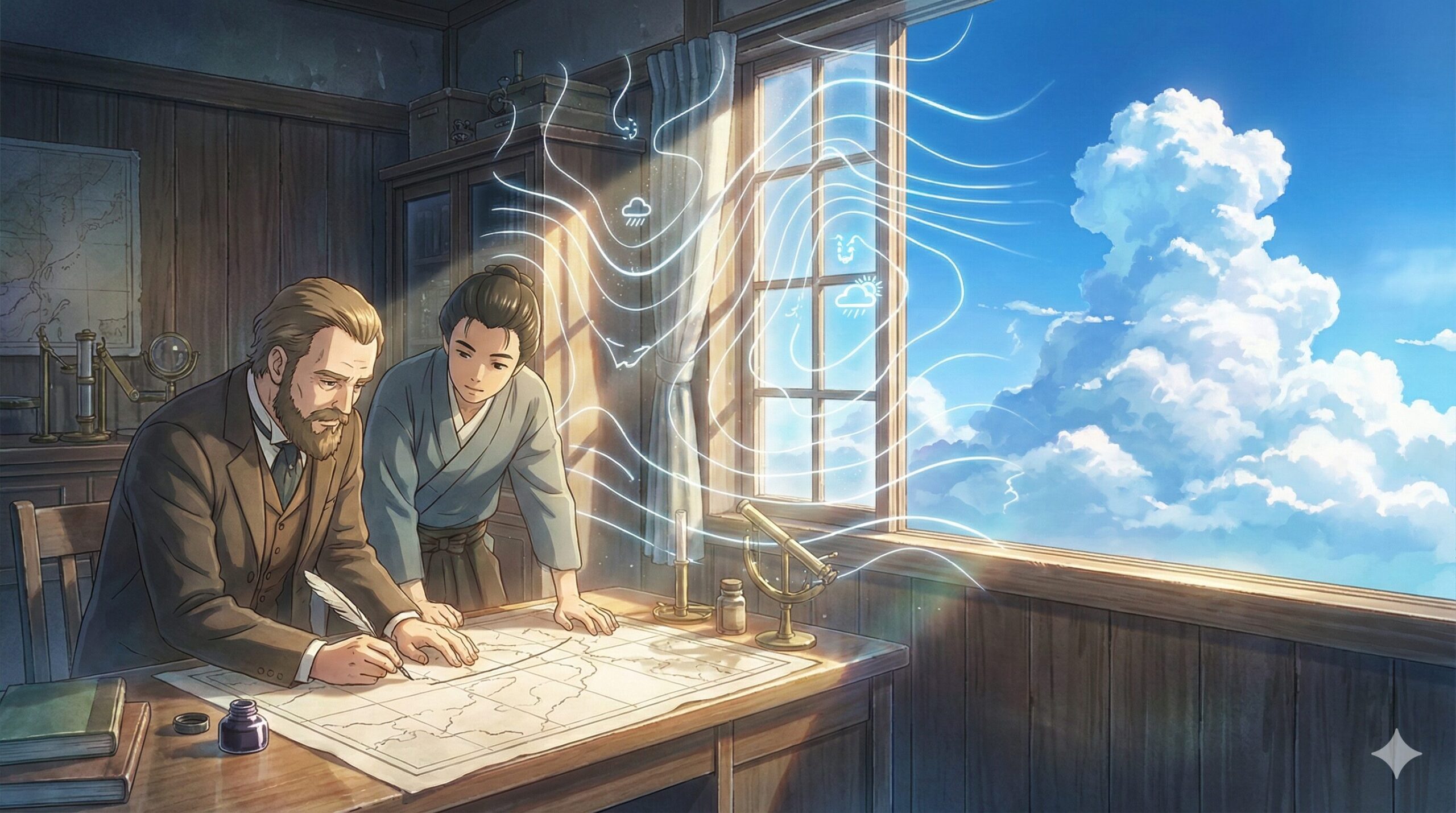
It was the Meiji era, a time when Japan was rapidly modernizing. Under the guidance of Erwin Knipping, a German meteorologist working at the Tokyo Meteorological Observatory (now the Japan Meteorological Agency), the very first weather map in Japan was created.
There were no satellite images or supercomputers. Data on air pressure and wind direction, sent via telegraph from weather stations across the country, was manually plotted onto maps. Isobars were drawn by hand. It was a painstakingly analog process involving lithography.
This inaugural weather map was printed and posted at train stations in Shimbashi and Yokohama, and even at police boxes (Koban). In an era before radio or television, people stopped in their tracks to stare at this scientific prediction of “tomorrow’s sky.” This marked the first step for Japanese people moving from “folklore-based weather reading” to “data-driven forecasting.”
Decoding Culture Through the Weather Map
This day isn’t just about the utility of knowing if it will rain. Weather Map Day reveals the spiritual makeup of the Japanese people.
1. Preparedness Born from Coexisting with Disaster
Japan is prone to typhoons, torrential rains, and heavy snow. In the Meiji era, the urgent push for weather maps was primarily to ensure safety for shipping lines against typhoons. The Japanese cultural concept of Mujō (impermanence) stems from living side-by-side with nature’s fury. The weather map represents humanity’s wisdom and prayer for order amidst chaotic nature.
2. The Aesthetic of the “Four Seasons”
Japan is famous for its four seasons, but traditionally, the calendar is divided even further into 72 micro-seasons (Kō). There is a culture of naming specific winds and pressure patterns, such as “Haru Ichiban” (the first strong south wind announcing spring) or “Kogarashi” (the cold wind announcing winter). Just hearing the phrase “West High, East Low” (a typical winter pressure pattern) makes a Japanese person feel the chill, but also evoke the comfort of hot pot dishes and hot springs. Weather maps are not just data; they are emotional landscapes.
A Question for You
Today, we can check the weather for the next hour just by opening a smartphone app. But why not take a moment to look up at the sky and feel the scent of the wind?
On this day in 1883, the first isobars drawn in ink contained the earnest wish of people wanting to “know the future.” What do you feel when you look at the sky today? If you plan to visit Japan, try to enjoy not just the sunny days, but the specific “atmosphere” of that season.
How important is the weather forecast in your country? Do you have beautiful words to describe the seasons? Please share your thoughts in the comments.
Useful Links
- Japan Meteorological Agency (Official English Site)
- Read more from “What’s Today’s Special Day Series”
2月16日は「天気図記念日」:日本人が空を読む理由
日本に住んでいると、あるいは日本のアニメや映画を見ていると、気付くことはありませんか?日本人は異常なほど「天気」を気にしています。朝のニュース番組では、占いのコーナーと同じくらいの熱量で、詳細な降水確率や洗濯指数が語られます。
なぜ日本人はこれほどまでに空模様に敏感なのでしょうか?そのルーツの一つが、1883年(明治16年)2月16日にあります。今日は、日本で初めて天気図が作成された日、「天気図記念日」について、その歴史と日本文化の深層を紐解いていきましょう。
1883年2月16日:ドイツ人が描いた日本の空
時は明治時代。日本が急速な近代化を推し進めていた頃のことです。当時、東京気象台(現在の気象庁)にいたドイツ人の気象学者、エリヴィン・クニッピング(Erwin Knipping)の指導のもと、日本初の天気図が作成されました。
現代のように衛星画像も、スーパーコンピューターもありません。全国の測候所から電信で送られてくる気圧や風向きのデータを、人間の手で地図上に書き込み、等圧線を引く。それは気の遠くなるようなアナログ作業でした。
記念すべき第1号の天気図は、印刷して新橋や横浜の停車場、そして交番などに掲示されました。まだラジオもテレビもない時代、人々は足を止めて、「明日の空はどうなるのか」という科学的な予測に見入ったのです。これが、日本人が「経験則」から「科学的データ」で天気を知るようになった最初の一歩でした。
なぜ天気図が日本文化の鍵なのか?
単に「雨が降るか知りたい」という実用性だけではありません。天気図記念日から、日本人の精神性が見えてきます。
1. 災害との共生が生んだ「備え」の精神
日本は台風、豪雨、雪害など、気象災害が多い国です。明治時代、天気図の導入を急いだ最大の理由は、海運の安全確保、つまり台風からの避難でした。日本文化における「無常観(すべてのものは移ろいゆく)」は、こうした自然の猛威と隣り合わせの生活から生まれています。天気図は、予測不能な自然に対する、人間の知恵と祈りの結晶なのです。
2. 「四季」という美意識
日本には「四季」がありますが、実はもっと細かく、5日ごとに季節が変わる「七十二候(しちじゅうにこう)」という概念があります。「春一番(春を告げる強い南風)」や「木枯らし(冬の訪れを告げる風)」など、風や気圧配置に名前をつける文化があります。天気図上の「西高東低(冬の典型的な気圧配置)」という言葉を聞くだけで、日本人は寒さと共に、鍋料理や温泉の温かさを連想し、情緒を感じるのです。
あなたへの問いかけ
現代では、スマホアプリを開けば1時間後の天気が分かります。しかし、たまには空を見上げ、風の匂いを感じてみませんか?
1883年の今日、初めてインクで描かれた等圧線には、「未来を知りたい」という人々の切実な願いが込められていました。あなたは今日、空を見て何を想いますか?もし日本へ旅行に来るなら、単に晴れか雨かだけでなく、その季節特有の「空気」を楽しんでみてください。
あなたの国では、天気予報はどのくらい重要視されていますか?また、季節を表す美しい言葉はありますか?ぜひコメントで教えてください。

コメント